
Academy for American Democracy
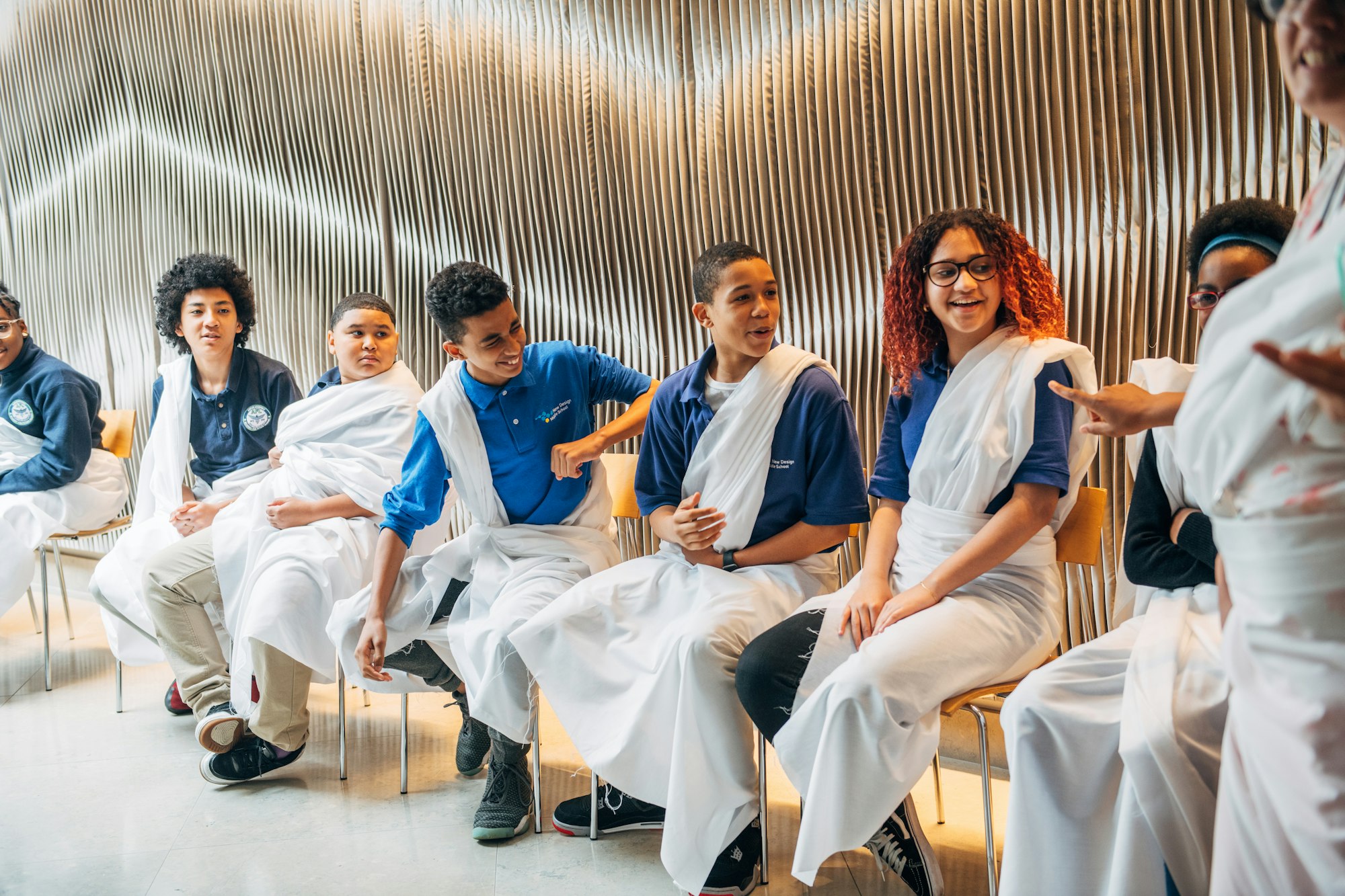
The Academy for American Democracy (AAD) is The New York Historical's educational initiative focusing on history and civics education for 6th graders. Students learn how the concept of democracy—crafted by ancient Athenians—inspired the American founders and then trace the evolution of American democracy from the drafting of the Constitution to the present day. The Dorothy Tapper Goldman Center for Teaching Democracy provides teacher training and curricula so that the program can continue in classrooms.
Applications for the 2025–2026 school year are closed! Applications for the 2026–2027 school year will open in May 2026. If you have any questions, feel free to email us at aad@nyhistory.org.
Residencies
- Museum Residencies—lessons in our museum galleries and classrooms over 4 consecutive days, from 9:30am-1:45pm.
- Outreach Residencies—our Educators come to your classroom to teach our lessons.
- Virtual Residencies— 8 or 11 synchronous lessons taught on Zoom.
What do students learn and how do they benefit from the AAD?
Through experiential learning, art-making, writing, and theater activities, your students are immersed in a process of creative discovery to consider how and why democracy has changed over time and the value of active civic participation. Students explore our galleries, in person or virtually, and engage in close examination of artifacts, art, and documents to critically examine democracy as it was practiced in ancient Athens, adapted at the United States’ founding, and as generations of people have reshaped it in the centuries since.
Students participating in the Academy for American Democracy seek the answers to three Essential Questions:
- What is a democracy?
- How does a democracy work?
- How do disenfranchised people make change in a democracy?
Students are empowered to ask big questions, think critically, and explore their own roles as civic actors. At the end of the residency, participating students create a final project—either a museum exhibition, zine, poem, song or podcast—that creatively synthesizes what they have learned.
All participating students will receive a DTG Freedom Pass, which provides one-year of Family Membership access to The New York Historical.
How do teachers benefit from the Dorothy Tapper Goldman Center for Teaching Democracy?
Teachers participate in the AAD’s free Dorothy Tapper Goldman Center for Teaching Democracy, where they come together with scholars and museum professionals to dive deeply into history, political theory, and engaging pedagogy. They study how the ideals and realities of democracy played out in ancient Athens, at the founding of the United States, and in American political and social movements across time. They are challenged to craft effective lessons that bolster their social studies curricula. CTLE hours are provided. Learn more and apply here!
What do participants need to contribute?
Thanks to generous support, we are able to provide this $5,500 program free of charge. Participants are responsible for the following:
Museum Residencies:
- Schools must arrive promptly at 9:30am each day. We subsidize the cost of charter buses (up to $3,200 per class) to ensure that the program starts each day at 9:30am. We can also subsidize subway fare. We must receive invoices and proof of payment before the start of the program in order to reimburse the school.
- Each class must have at least one teacher present at all times. The DOE requires one chaperone for every 10 students.
Outreach Residencies:
Schools must have a minimum of 2 classes which can meet back to back (or with a small break in between). If there is only one class, or two classes where one meets early in the morning and the other late in the afternoon, please apply for our Museum or Virtual Academy program.
Virtual Residencies:
- At least one certified teacher must be available to help manage the online experience and digital resources.
- Students need access to Zoom.
For All Three Versions of the Program:
- Planning sessions are virtual meetings between participating teachers and AAD Educators to discuss program content and logistics. Upon acceptance, each participating classroom teacher must attend a planning session at least two weeks in advance of the first AAD lesson.
- Upon acceptance, each participating classroom teacher is required to review our Welcome Guide before attending the planning session.
- We can accommodate a maximum of 32 students per class. If your class exceeds this maximum, teachers must discuss whether or not The New York Historical can accommodate additional students as soon as possible. The New York Historical has the right to decline additional students.
- The school must submit accurate class lists with all students’ names at least two weeks before the start of the residency.
- Participating teachers agree to complete the program evaluation, as well as any additionally requested paperwork, within two weeks of the completion of the AAD Residency.
- At least one teacher (or comparable adult approved by the school) must be in the classroom at all times.
- AAD is a free program, but cancellation of the residency must be received in writing at least one month prior to the start of your Academy program. A $2,000 cancellation fee will be issued for full residency cancellations with less than one month’s notice. Upon acceptance into the program, schools will be sent a Student Residency Agreement which will outline the cancellation policy depending on the version of the program the school is participating in
- Teachers and administrators must play an active role in supporting New York Historical AAD administrators and Educators in classroom management.
- The school community must be committed to full participation in the AAD program and will do what is expected and all within their power to ensure program success.
How can my school participate?
AAD applications for this school year are closed and will reopen for the 2025-26 school year in March 2025. Please check back then!
The Academy for American Democracy supports the New York City Curriculum Standards and Initiatives.
Sixth Grade Social Studies Scope and Sequence:
- Comparing and contrasting civilizations and political systems
- Characteristics and merits of a golden age
- Cultural achievements’ influence on contemporary societies
Civics for All:
- Foundations of American government
- Rights and responsibilities
- Role of the individual
- Power and politics
- Active engagement
Testimonials
“I learned how important voting is. We have to speak up for ourselves and have our own opinions. We have to think long and hard about them.” — Student, New Design Middle School
“In a democracy, the choice you make can affect how you and others live. When you have the option to make a choice, you can’t take it for granted.” — Student, Wagner Middle School
“When we got to debate it made the topics feel important, and we learned how to persuade.” — Student, Urban Assembly Academy for Future Leaders
“It was the best week, the best time we spent all school year. I left the experience feeling like I was a part of something big. The students did something really significant for the four days. They are dying to do it again.” — Teacher, Wagner Middle School
Lead support for the Academy for American Democracy is provided by:
The Achelis and Bodman Foundation
Carnegie Corporation of New York
Dorothy Tapper Goldman Foundation
Hertog Foundation
Institute of Museum and Library Services
Bernard L. Schwartz
Leslie and Alan Shuch
Stavros Niarchos Foundation (SNF)
Dr. Agnes Hsu-Tang and Oscar Tang
The Thompson Family Foundation


Major support is provided by:
Acorn Hill Foundation
Veronica Atkins
Irma L. and Abram S. Croll Charitable Trust
Barbara and Stephen Friedman
John & Patricia Klingenstein Fund
The Scripps Family Fund for Education and the Arts
Marilyn Skony Stamm
Additional support is provided by:
Jane and Bill Donaldson
Jane and William Friedman
Michael and Dafna Schmerin
Lead support for the Dorothy Tapper Goldman Center for Teaching Democracy is provided by the Dorothy Tapper Goldman Foundation.
Stay in touch! Subscribe now for Education updates:
Donate to Our Educational Programs
Education programs are made possible through endowments established by:
National Endowment for the Humanities
The Hearst Foundations
Charina Endowment Fund Endowed Fund for American History at The New York Historical
The Peter Jay Sharp Foundation
Public funds are provided by:
Institute of Museum and Library Services
New York City Department of Cultural Affairs in partnership with the City Council
New York State Council on the Arts with the support of the Office of the Governor and the New York State Legislature




Lead support for Education programs at The New York Historical is provided by:
The Achelis and Bodman Foundation
Edith and Frances Mulhall Achilles Memorial Fund
Carnegie Corporation of New York
Dorothy Tapper Goldman Foundation
Roger and Susan Hertog
Anna-Maria and Stephen Kellen Foundation
KHR Family Fund
Dr. Agnes Hsu-Tang and Oscar Tang
Mellon Foundation
Jean Margo Reid
Sandy and Dick Rippe
Gillian V. Steel and Robert Steel
David M. Rubenstein
Dr. Agnes Hsu-Tang and Oscar Tang
The Thompson Family Foundation
Major support is provided by:
Veronica Atkins
Irma L. and Abram S. Croll Charitable Trust
Deutsche Bank
John & Patricia Klingenstein Fund
Edward Ludwig, in honor of Sister Ann Jordan, CSJP
Stavros Niarchos Foundation
The Scripps Family Fund for Education and the Arts
The Waterfall Foundation
Whiting Foundation
Marie and John Zimmermann Fund
Anonymous
Additional support is provided by:
The Acorn Hill Foundation Inc.
Alice Lawrence Foundation
George Asch
The Barker Welfare Foundation
Herb Block Foundation
Cynthia and J. Hyatt Brown
Con Edison
Consulate General of the Netherlands
Erika Davis
Jane and Bill Donaldson
Mary Ann Fribourg
Seth Meisel
Lori and Mark Fife
Barbara and Stephen Friedman
Lucy and William Friedman
Herb Block Foundation
Alice Lawrence Foundation
Sandra and Lowell Mintz
Shelley Mulitz
Henry Nias Foundation
Steven L. Rattner
Michael and Dafna Schmerin
Richard E. Sylla
Szilvia Tanenbaum
Tiger Baron Foundation
The Michael Tuch Foundation
The Winston Foundation
Marie and John Zimmermann Fund