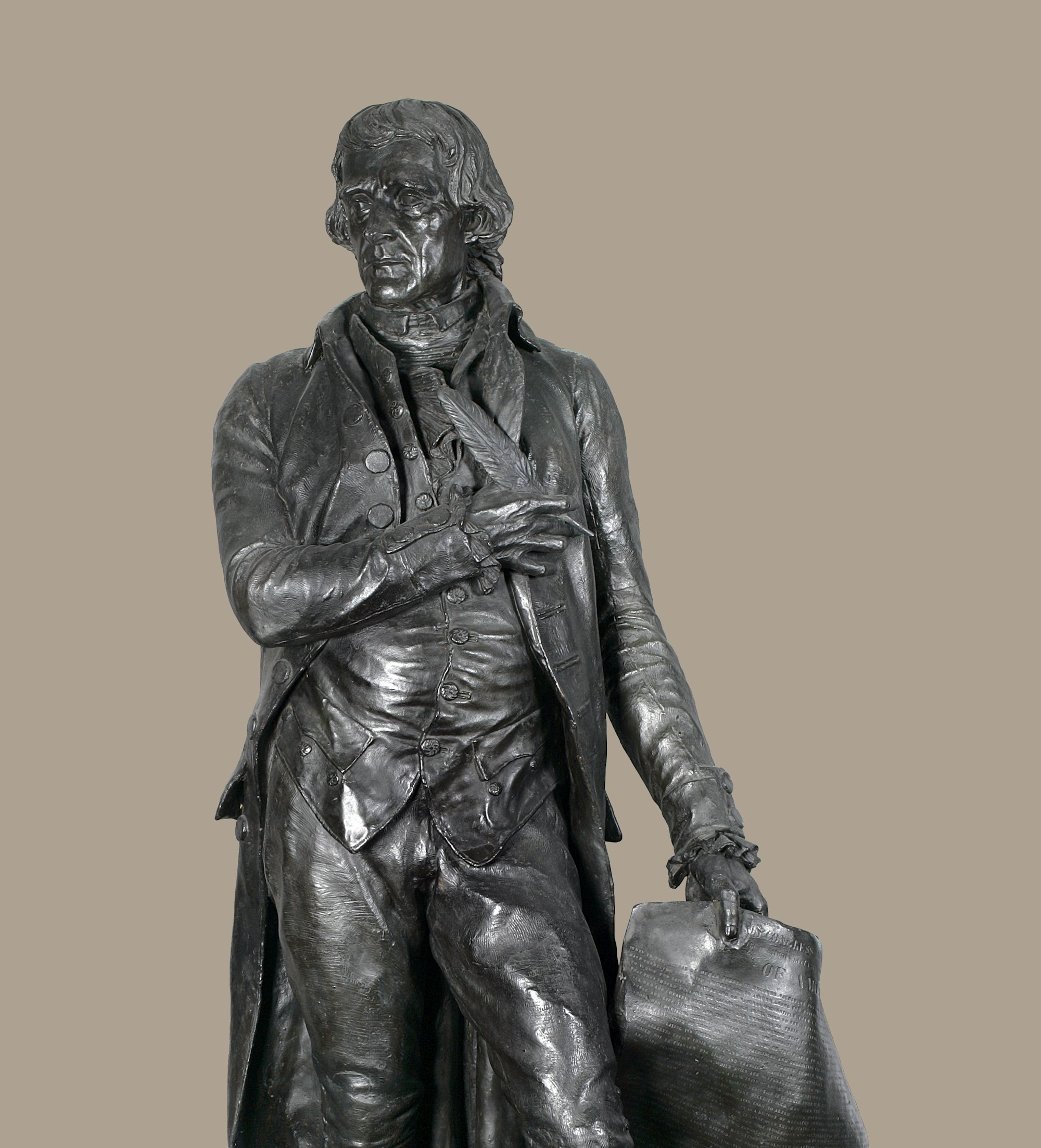
This depiction of the third U.S. president is the original plaster sculpture used to make the bronze version on display in the Capitol rotunda in Washington, D.C.
This depiction of the third U.S. president is the original plaster sculpture used to make the bronze version on display in the Capitol rotunda in Washington, D.C.
2nd floor, Patricia D. Klingenstein Library Reading Room
Please note: the Reading Room is open Fridays, 11-8 pm, and Saturdays–Sundays, 11-5 pm.
This depiction of the third U.S. president, Thomas Jefferson, is the original plaster sculpture used to make the bronze version on display in the Capitol rotunda in Washington, D.C. The seven-foot-tall sculpture, which references Jefferson’s authorship of the Declaration of Independence, arrived at City Hall in 1834, when New York real estate investor Uriah P. Levy (1792–1862) donated it to the City of New York. In 1919, it was installed in the Aldermanic (now City Council) Chamber, where it remained until its transfer to New-York Historical in 2021.
Levy, the first Jewish commodore in the U.S. Navy, had privately commissioned the statue as a gift to the nation to commemorate Jefferson’s advocacy of religious freedom. Because of Jefferson's complex legacy as both author of the Declaration of Independence's principles of liberty and equality, and owner of a plantation, Monticello, at which 600 enslaved people worked, City Council members requested that the statue be moved to a location where it could be interpreted within a historical context.
This display was made possible with the generous support of Helen and Robert Appel.


Bloomberg Connects
Download the free arts and culture app and explore New-York Historical's digital guide, including new audio clips related to this installation. Enter lookup number 5 to hear scholarly experts discuss their various perspectives on Thomas Jefferson and the statue.
Exhibitions at The New York Historical are made possible by the Saunders Trust for American History, the Evelyn & Seymour Neuman Fund, the New York City Department of Cultural Affairs in partnership with the City Council, and the New York State Council on the Arts with the support of the Office of the Governor and the New York State Legislature. WNET is the media sponsor.



Media sponsor: