When “Patriotick Barber” Jacob Vredenburgh ejected the half-shaven British Captain John Crozier from his New York barbershop in the fall of 1774, it was a small victory for one American, angry with the Motherland over unfair taxation. By spring of 1775 that fight had escalated into a full-blown War for Independence. After the battles of Bunker Hill, Lexington and Concord, all eyes turned to New York.
Whoever commanded the city controlled the Hudson River corridor, the vital artery running from the Atlantic into the vast Canadian province. If the British secured New York, they would slice the colonies in two, preventing messages, men, and materials from moving freely from New England to Georgia. In a letter to George Washington written January 6th, 1776, John Adams called New York “the key to the whole continent,” predicting that the city’s capture would most likely decide the outcome of the war.
In the summer of 1776, The British professional army and navy arrived in New York Harbor with an armada of 427 vessels carrying 32,000 British and Hessian troops supported by some 1200 cannons, all under the direction of General William Howe and his brother, Admiral Richard Howe. It was clear that the ragtag Continental Army under General George Washington was no match for their scale, discipline, or professionalism.
On August 27, British troops attacked at Gravesend Bay, Brooklyn, and outmaneuvered the unprepared American troops in several skirmishes. In what became known as the Battle of Long Island or the Battle of Brooklyn, as many as 1,000 Americans were killed, wounded, captured, or listed as missing. By nightfall, 9,000 troops were pinned against Brooklyn Heights and the East River with nowhere to turn.
The Prime Minister, Lord North, received General William Howe’s account of the victory on October 10. It is this signed document that Lord North holds up proudly in the cartoon "News From America, or the Patriots in the Dumps," published the following month in The London Magazine, or, Gentleman’s Monthly Intelligencer.
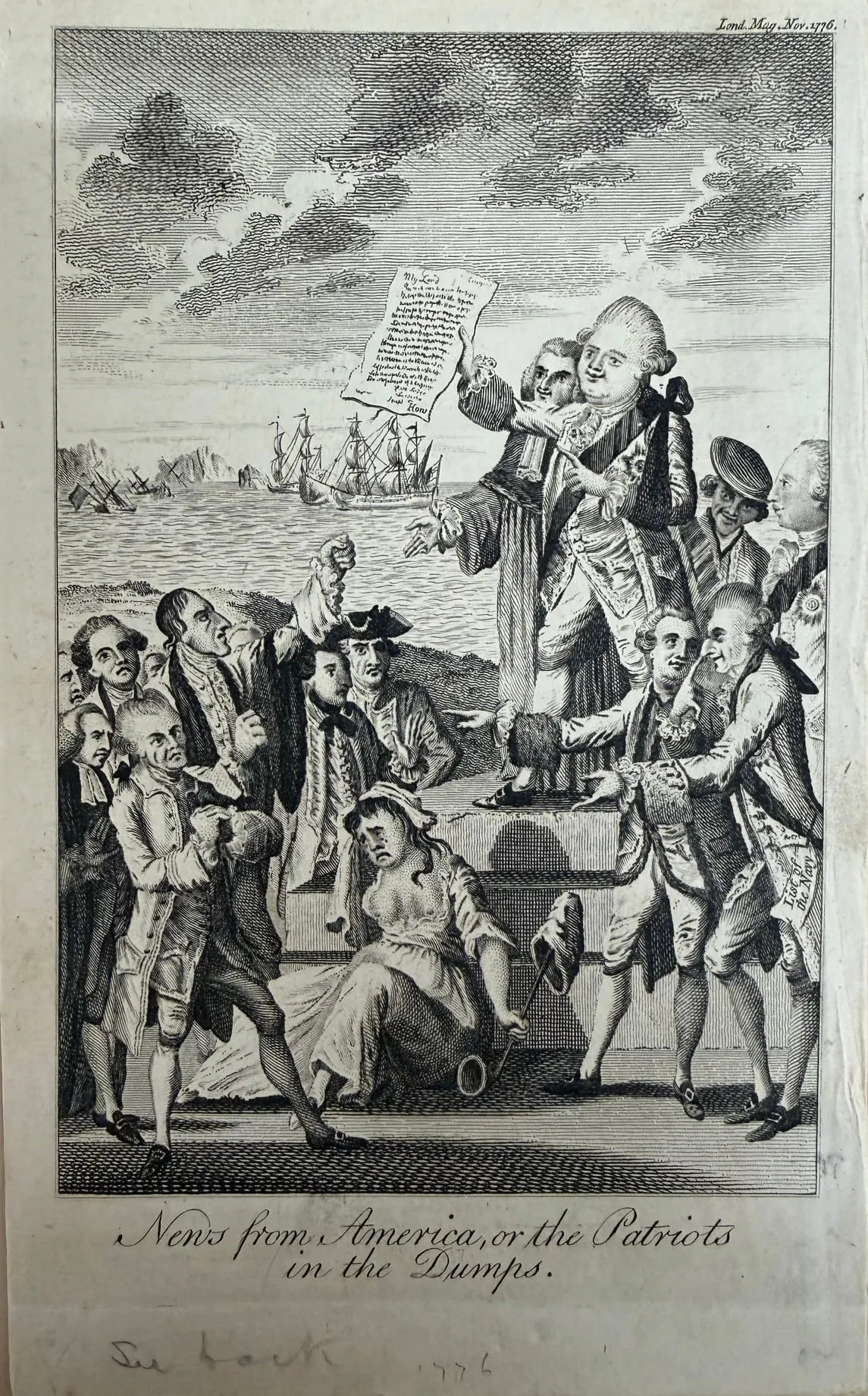
Cartoon, "News from America, or, The Patriots in the Dumps." Printed in London Magazine, or Gentlemen’s Monthly Intelligencer, Vol. 45, November 1776, opposite 599. Patricia D. Klingenstein Library, The New York Historical.
In the cartoon, the gleeful Prime Minister is surrounded by two ardent supporters of colonial oppression. These are former minster Lord Bute and the robed Lord Chief Justice, widely regarded as the principal legal architect of British policy. Standing behind him, we see King George III—arguably the principal instigator of the punitive policies. He is passive and expressionless and has been relegated to the cartoon’s margin. To the right of the Prime Minister are George Sackville Lord Germain, Secretary of State for the Colonies, and John Montagu, Earl of Sandwich and First Lord of the Admiralty, recognizable by the “List of the Navy” protruding from his pocket.
The figures interact through a complex choreography of facial expressions and gestures. Germain points towards Howe as he looks knowingly at the admiral’s superior, Lord Sandwich. Howe’s relationship with Sandwich was fraught with mistrust and strategic disagreement. The index finger of Germain’s left hand touches the side of Sandwich’s nose—a visual convention implying collusion or the sharing of a secret. Whether this gesture refers to their mutual feelings towards the admiral or to more personal issues remains deliberately ambiguous.
Both Germain and Sandwich were widely regarded as libertines and compulsive gamblers. (Sandwich’s name entered common language from the convenient eating of meat between slices of bread in order to prolong his time at the gaming table.) In this cartoon, Sandwich, a notorious womanizer, gestures toward the only woman present: a distraught and sobbing bare-breasted America, holding the Liberty cap and pole.
The largest and most enigmatic caricatures in the cartoon are the group of politicians and intellectuals on the left, the so-called “patriots in the dumps” referred to in the cartoon’s title. The artist places John Wilkes, the celebrated British radical, at the center. Wilkes would have been recognized by his distinctive wig, sharp features, and crossed eyes. Several of the surrounding figures have not been identified until now. Four of them—Dr. Richard Price, Sir Edmund Burke, Charles James Fox MP, and Admiral Lord Richard Howe—bear striking resemblance to their painted portraits or other satirical prints.
Dr. Richard Price, the dissenting minister and political radical, wears ministerial robes and stands to the right of Wilkes. Edmund Burke, sporting a side-curled wig, stands behind Wilkes. Burke was a leading statesman, political thinker, and Parliamentarian who wrote in his 1775 Speech on Conciliation with America that the American “spirit of liberty” was “stronger…than in any other people of the earth.”
The prominent figure with an outstretched arm remains unidentified, but his gesture is one of outrage. The smaller figure to his left is likely Charles James Fox, among the most radical members of Parliament and Burke’s protégé.
The figure with deep-set eyes and a dour expression wearing the official naval tricorn hat and uniform is unmistakably Admiral Lord Richard Howe, commander-in-chief of the British navy. Howe was known colloquially as “Black Dick” for his dark complexion. The artist has placed him just below the ships under his command. His inclusion among critics of ministerial policy seems to belie his important military position. He and his brother were the victors of the Battle of Long Island, and as such, Howe should be standing with Lord North and the other celebrants. The artist is aware of this irony, deliberately placing him at the end of Lord Germain’s outstretched finger. Howe’s placement with the Patriots instead of the King and his ministers is one of the most important elements of the cartoon. The Admiral is officially an enemy of the Americans, but in his heart his sentiments lay with the Patriots on both continents.
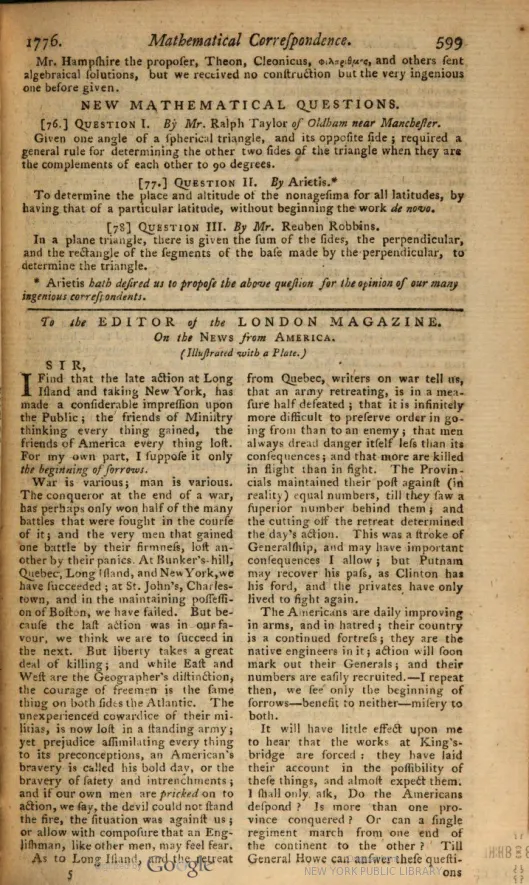
Opposite the cartoon, readers found this opinion piece, "To the editor of the London Magazine, on the news from America." Published in London Magazine, v. 45, November 1776. Credit: Hathi Trust
A letter to the editor of The London Magazine printed on the opposite page of the cartoon—and clearly intended to be its verbal counterpart—reinforces the cartoon’s underlying ambivalence. Signed only “A Bye-Stander,” the author refuses to celebrate the victory at Long Island, calling it “only the beginning of sorrows.” He warns his readers that the Americans are “daily improving in arms, and in hatred,” that their country is “a continued fortress,” and that while America remains united, “half Europe cannot conquer her lastingly, generally, or profitably.” He reminds readers that retreat—like the one on Long Island—does not equal defeat.
Taken together, these visual and textual elements resist a single triumphant reading. The image and the accompanying text expose the ministers’ celebration as premature and mock them as ridiculous. The ambivalence inscribed in the opposing group—especially in the figure of Admiral Howe and the ships above him—mirror the uncertain fate of Britain’s war: neither completely sinking nor sailing on to victory.
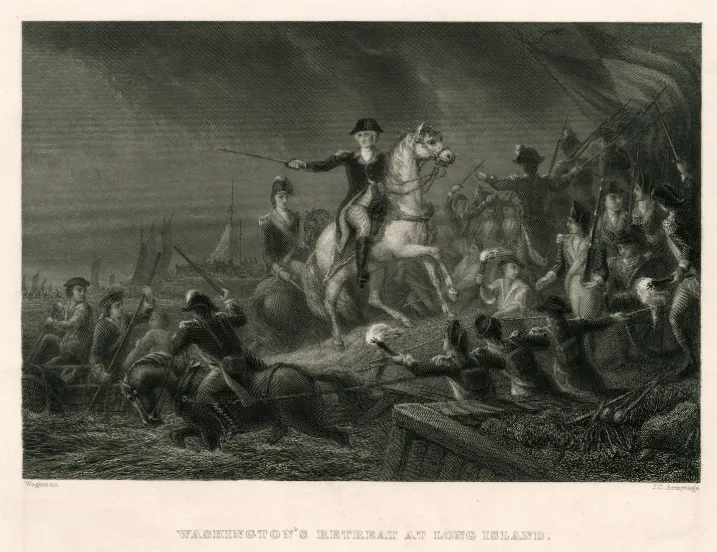
J.C. Armitage, "Washington's Retreat at Long Island," 1860. The Patricia D. Klingenstein Library, New York Historical.
On the night of August 27, with their backs against the sea, Washington and his troops silently retreated across the harbor to Manhattan Island, to the shock of the enemy the following morning. On September 15, British forces attacked Washington’s troops at Kip’s Bay and after a series of local losses, New York City fell into British hands for the next seven years. While News From America proclaims an early victory for the British in New York, ultimately America won its independence. Yet New Yorkers, exiled from their home, developed wit, grit, and resilience, the characteristics that we have proudly celebrated for the past 250 years.
This is the second of two posts by Sara Cedar Miller exploring political cartoons about Revolutionary-Era New York.
Keep Reading
- From the StacksAugust 13, 2026
"Oh Eliza, I'm undone": Part II, Conservation
The second installation of this blog series, following a manuscript from storage to exhibition, highlights treatment in the conservation lab. - From the StacksAugust 5, 2026
A Revolutionary Tunebook
An American tunebook kept in 1776 captures the soundtrack of revolution. - From the StacksJuly 20, 2026
"Oh Eliza, I'm Undone": A Journey from Storage to Display
Explore the conservator's role in this three-part blog series through the lens of a Revolutionary War-era love poem as it moves from storage to the conservation studio and finally to an exhibition. - From the StacksJune 29, 2026
The Patriotick Barber Gets a New Look
An 18th-century satirical print depicting the interior of a barber shop speaks volumes about style and politics in New York City.