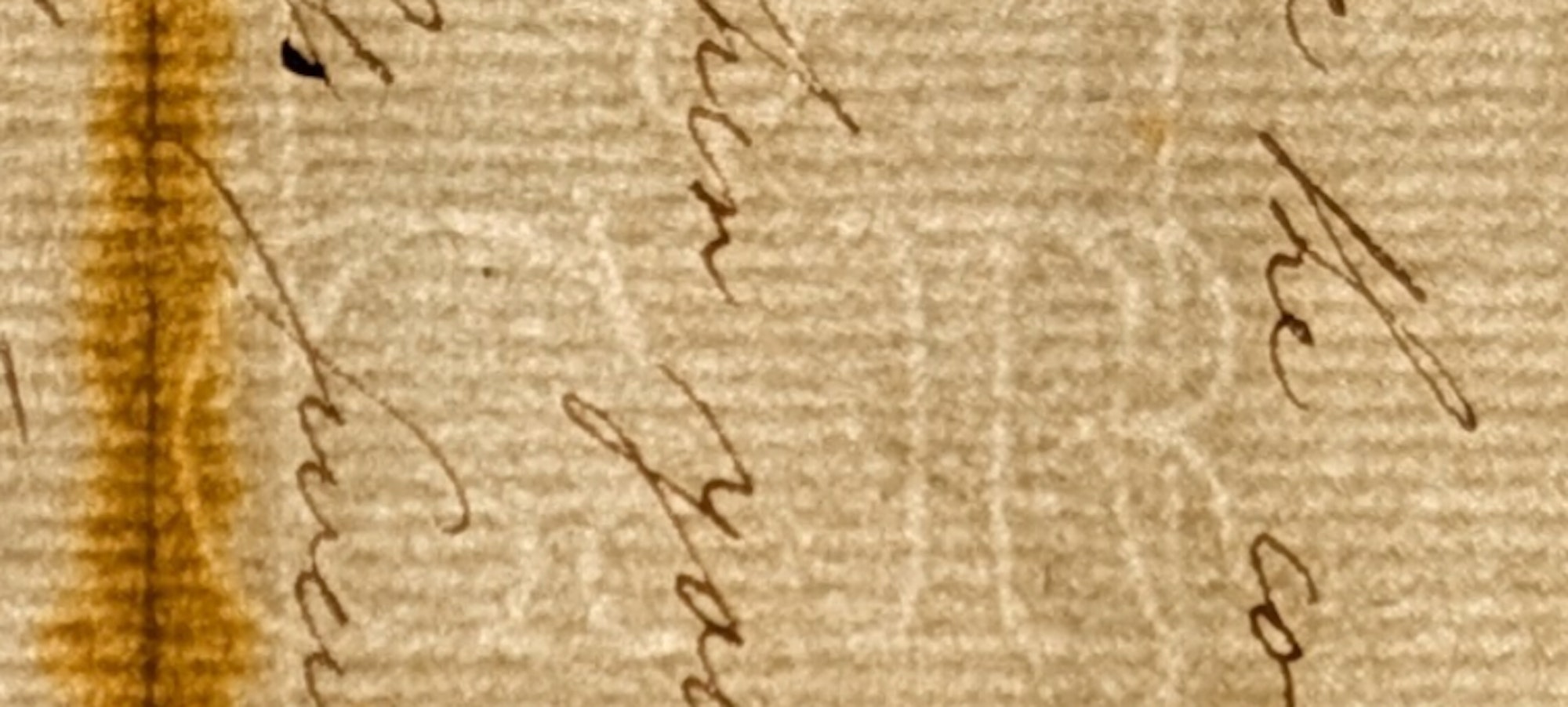
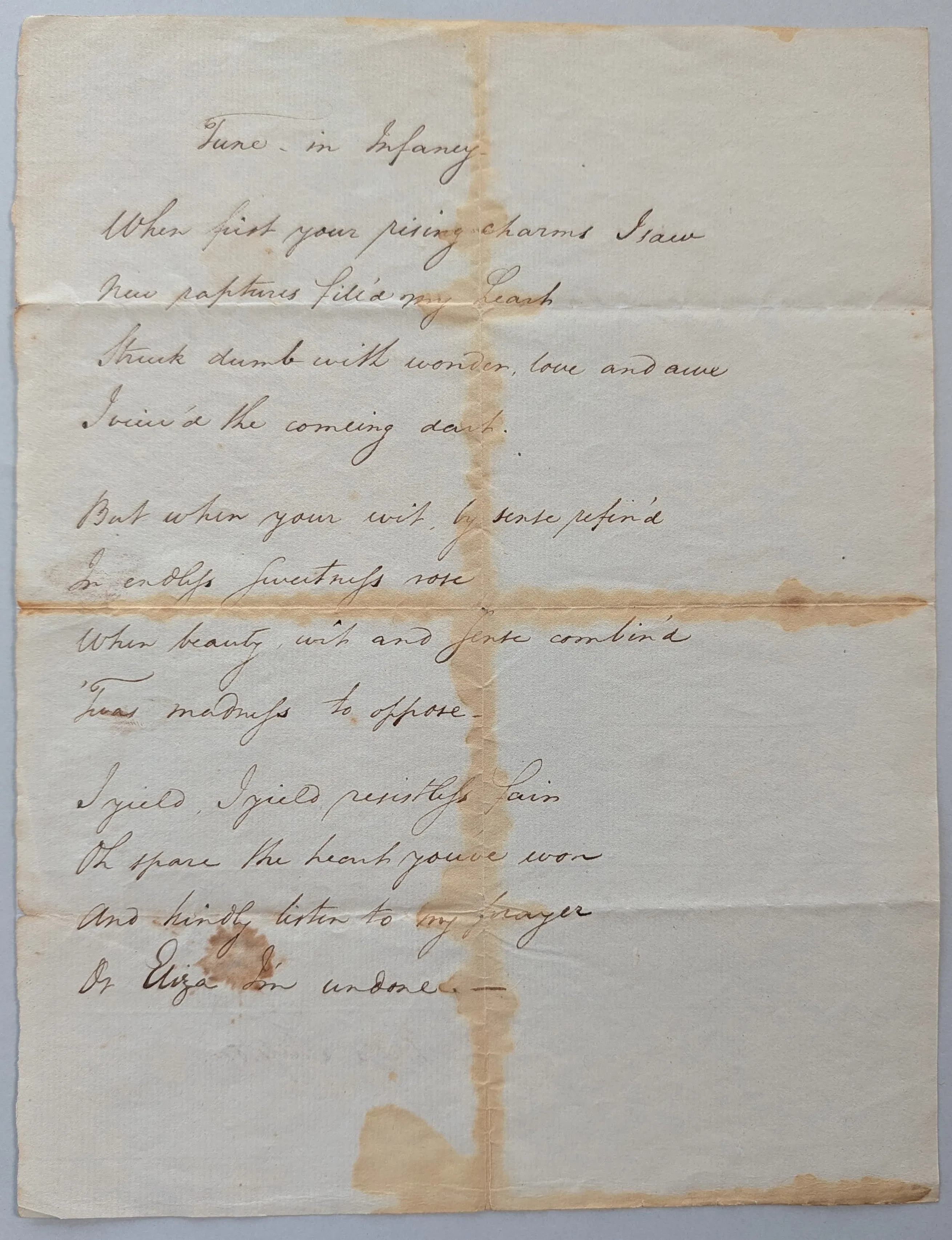
Aquila Giles writes a poem to his forbidden love, Eliza Shipton. He dips his quill pen into an iron gall ink well and etches his words onto the paper. The sheet, made of cotton rag waste, is sturdy and of high quality. Made by hand, likely in the Netherlands and imported to the new country of the United States of America, the watermark resembles those found on some of the earliest broadsides of the Declaration of Independence.
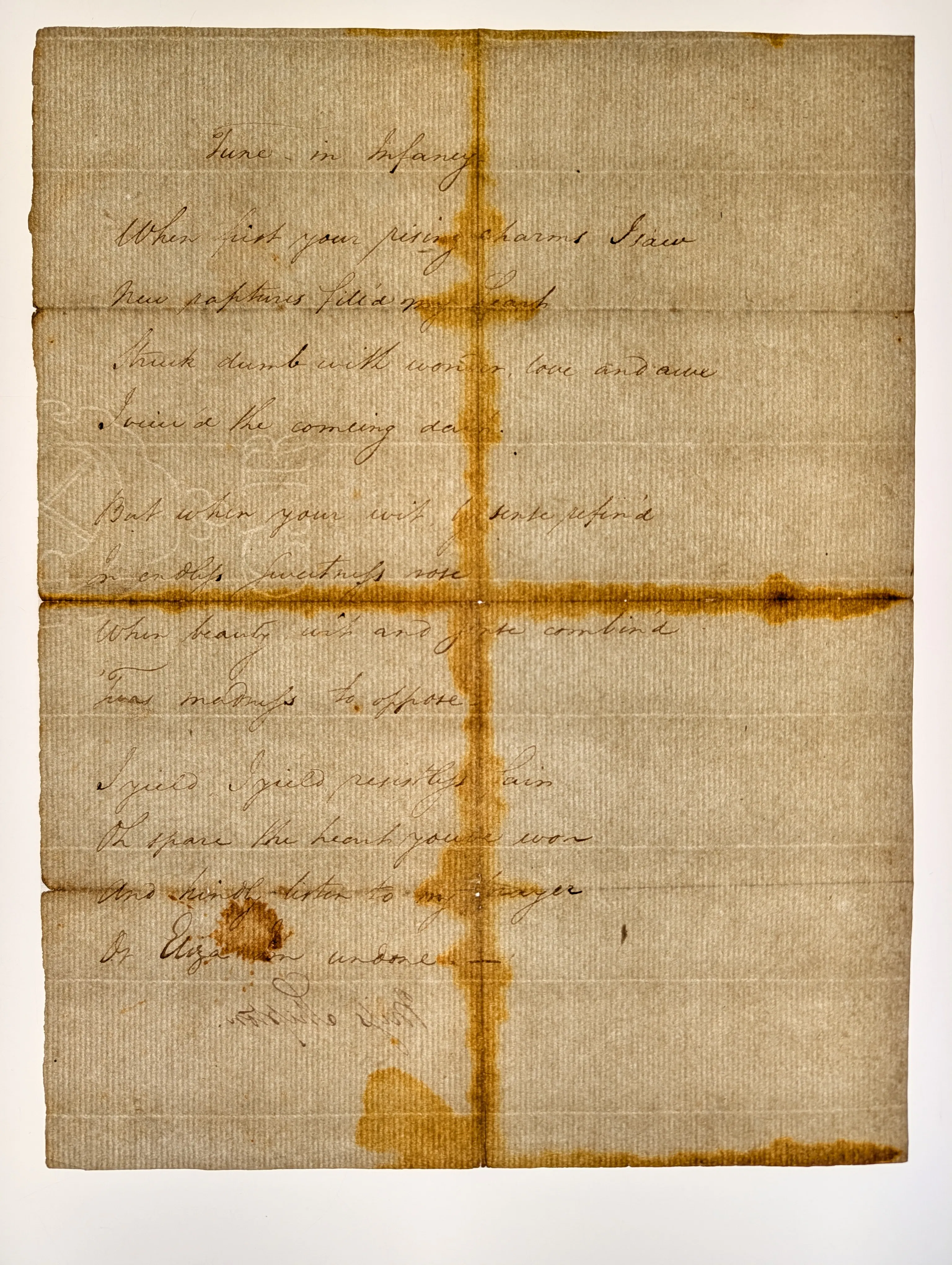
Transparent light image of a manuscript draft of a poem by Aquila Giles (1757–1822) written for Elizabeth Shipton, 1778–80. Giles Family Papers, MS 248. Patricia D. Klingenstein Library, The New York Historical. Note the visible laid and chain lines indicative of a hand-made paper mold.
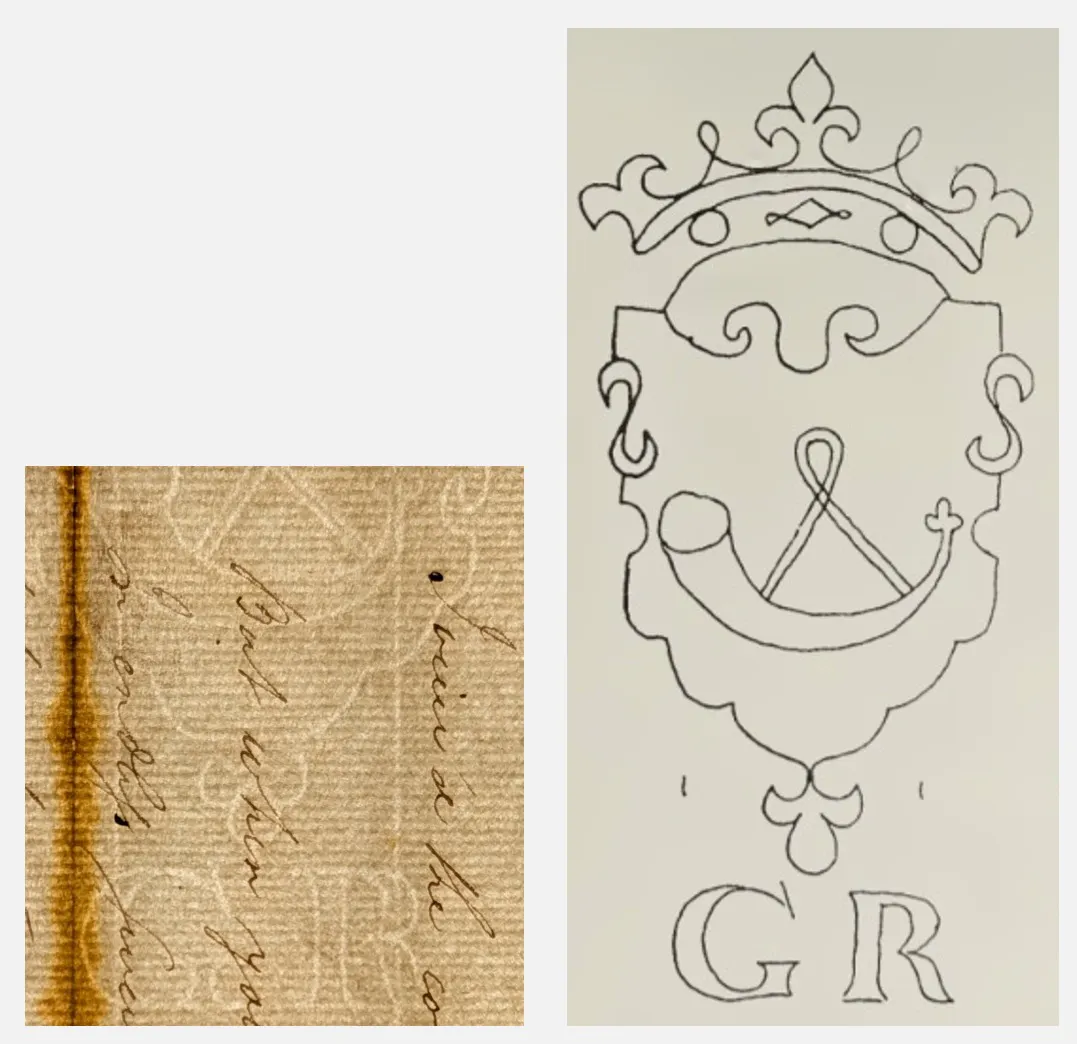
Watermark comparison between Aquila Giles’s paper and a watermark, as shown in W.A. Churchill's Watermarks in paper in Holland, England, and France, 323. The Patricia D. Klingenstein Library, The New York Historical.
Before the ink is dry, Aquila picks up the paper by the edges to examine his work. His finger disturbs the still-wet writing fluid, leaving an impression of his fingerprint. The love poem will be passed on to Eliza with the aid of friends – since the lovers are on opposite sides of the Revolutionary War. Nevertheless, their love story has a happy ending, drawing parallels between love enduring the stresses of war and an old piece of paper enduring the test of time.
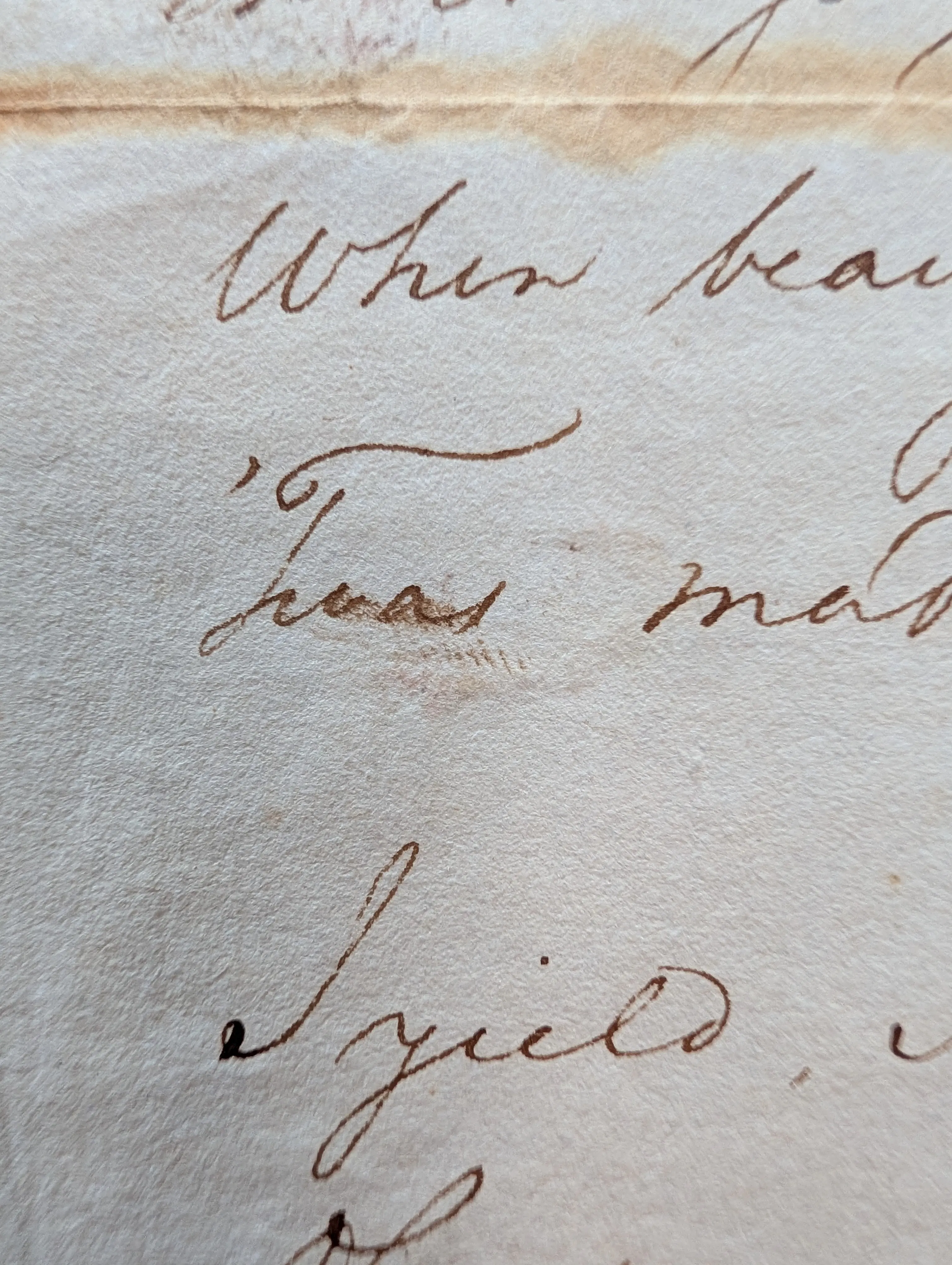
Close up of smeared ink and fingerprint.
About 250 years after the ink dries on Aquila’s poem, curators pull it from a stack of letters and documents from the Giles Family Papers at The New York Historical for potential exhibition. Not only was Eliza taken with the poem when she received it, but the research team working on our Revolutionary Women exhibit is smitten as well.
Then, the poem reaches the conservation lab. The first step in a conservation treatment of paper artifacts is surface cleaning. This is done with either vulcanized rubber sponges (soot sponges), white cosmetic sponges, or graded white erasers. The goal is to delicately remove surface soil, often soot from candles and coal burning in the past centuries that has deposited onto the surface. This dirt is acidic and will speed up the degradation and embrittlement of paper. The surface cleaning also ensures any further treatments, especially those including water, will not cause the surface soil to become embedded and stain the paper.
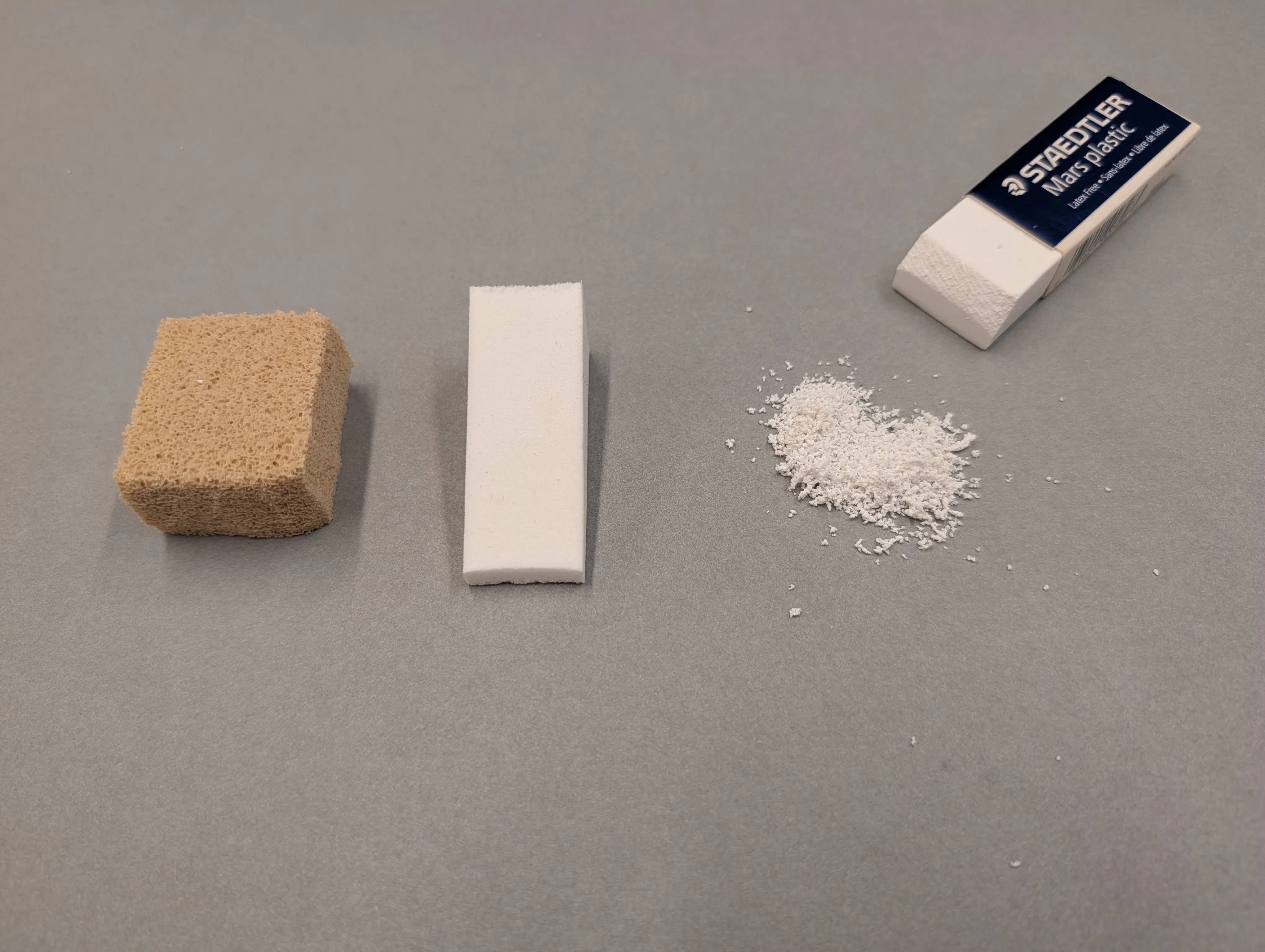
Surface cleaning materials. From left to right: vulcanized rubber sponges (soot sponges), white cosmetic sponges, graded white eraser.
Next, tears are evaluated and mended as needed. They usually form along fold lines – areas of repeated stress. We use archival adhesive, which we cook ourselves from purified and precipitated wheat starch flour. Fine Japanese paper is used as the “tape” to repair the tears. This specialty paper is purpose-made for the repair of documents. Its paradoxical qualities–strength, thinness, and transparency–are achieved through the ancient process of Japanese paper making from long mulberry tree bark fibers.
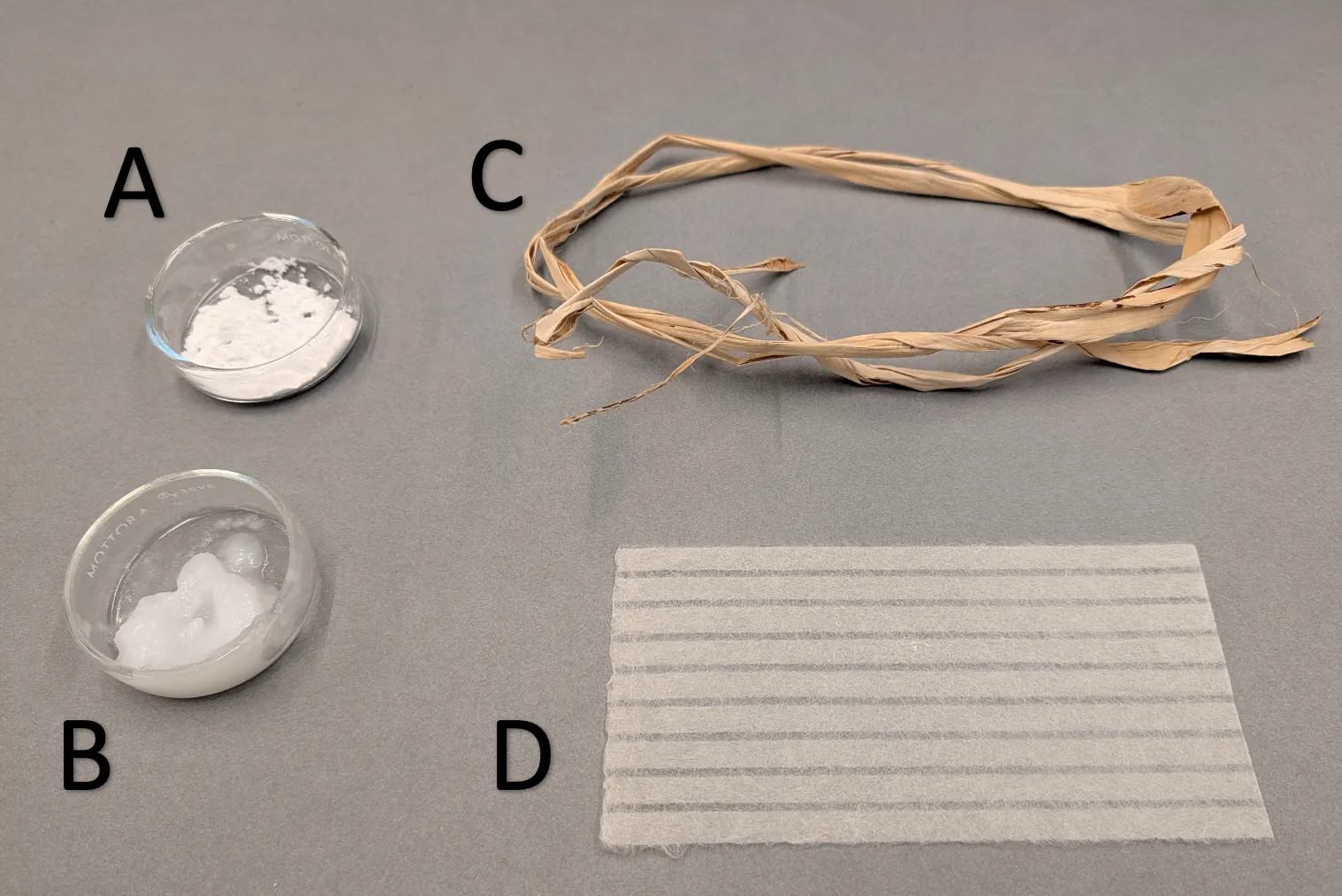
Tear repair materials. A. Purified wheat starch flour. B. Cooked adhesive paste. C. Dried Mulberry tree bark. D. Mending paper strips.
In some instances, before the mending stage, the paper can be washed to further remove acidic decomposition products and dirt, as well as minimizing stains. However, such treatment is not always appropriate. In this case, Aguila’s poem is written with a corrosive iron gal ink. With this kind of writing fluid, even high concentrations of water in the air (humidity) speed up the chemical reactions between the ink and the paper. Intentionally introducing water without much benefit overall, as is in this case, is not recommended. Over time, and in worst cases, the ink breaks down the paper on which it sits to such a degree that the written text falls out- paper and ink- leaving behind a document resembling a delicate lace. Treatment to minimize stains may also not be appropriate because these marks can tell a story, contributing to our understanding of the object’s history.
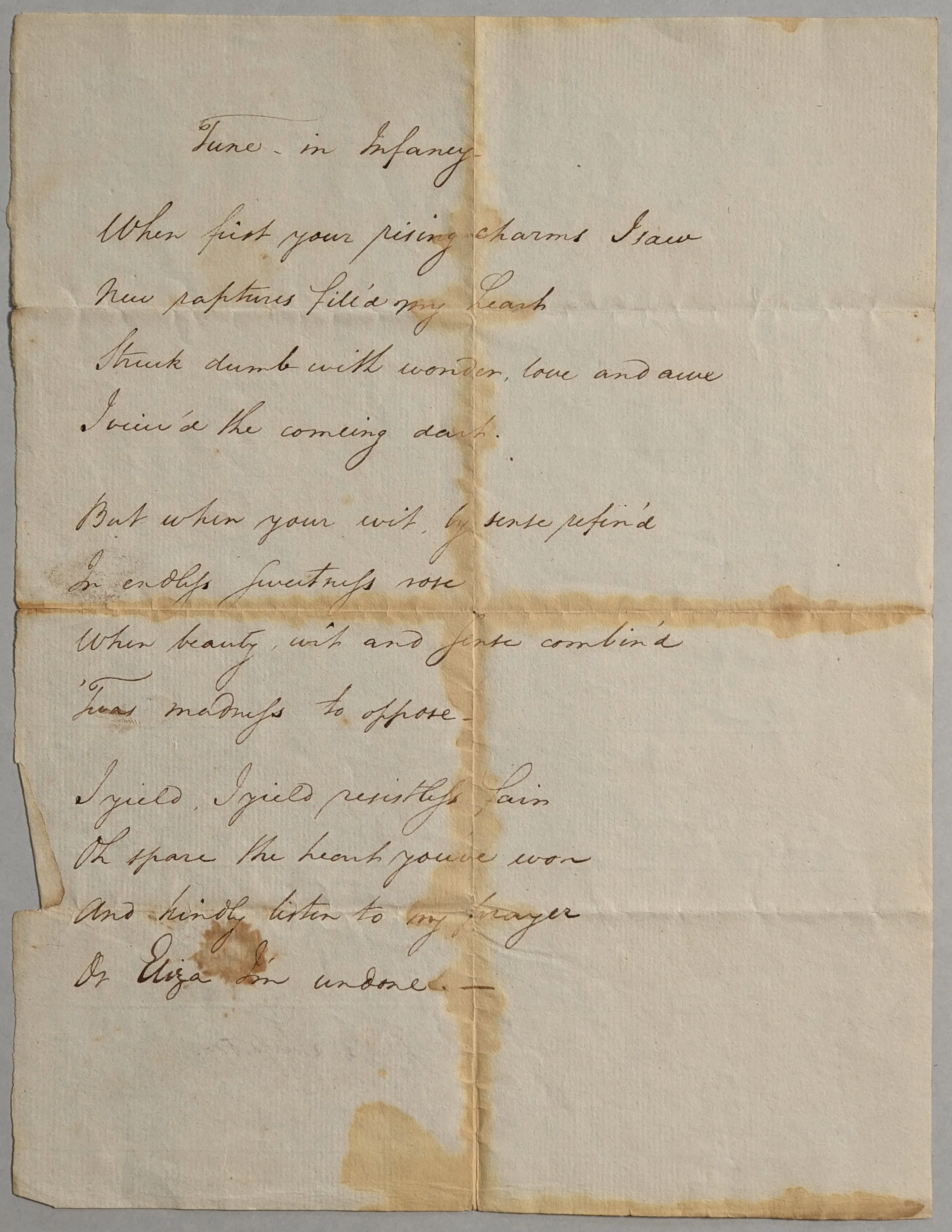
Before treatment on left, after treatment on right.
The pronounced yellow stains running along the fold lines occurred while the poem was still folded. Did Eliza spill tea while the folded poem sat on her desk? Did she get caught walking in the rain one day, with the poem tucked in her pockets? We will never know, but the significance of the stain is that this piece of paper lived a life at a time of revolution, war, and uncertainty. And as fragile as a piece of paper is, it endured.
Revolutionary Women is currently on view through October 25, 2026. For more on Aquila and Eliza's love story, you can read about them on The New York Historical's Women at the Center blog here.
Keep Reading
- From the StacksAugust 28, 2026
"The Patriots in the Dumps": A British Cartoon Takes on the Battle of Long Island
250 years ago this month, Americans were embroiled in a crucial end-of-summer Revolutionary War clash: the Battle of Long Island. - From the StacksAugust 5, 2026
A Revolutionary Tunebook
An American tunebook kept in 1776 captures the soundtrack of revolution. - From the StacksJuly 20, 2026
"Oh Eliza, I'm Undone": A Journey from Storage to Display
Explore the conservator's role in this three-part blog series through the lens of a Revolutionary War-era love poem as it moves from storage to the conservation studio and finally to an exhibition. - From the StacksJune 29, 2026
The Patriotick Barber Gets a New Look
An 18th-century satirical print depicting the interior of a barber shop speaks volumes about style and politics in New York City.