In Revolutionary-Era America, protests against the British monarch and Parliament’s prohibitive taxes occurred daily in New York, on city streets and squares, in the taverns, and even in more intimate spaces like barbershops. Published in London by the printers Sayers & Bennett in February 1775 and attributed to artist Patrick Dawe, The Patriotick Barber of New York, or the Captain in Suds, reflects the growing sentiment of many British citizens and politicians sympathetic to the rights of the American colonists. The cartoon was inspired by an incident described on a card that New York's Sons of Liberty, a radical group, distributed to the public. The card proudly congratulated
Mr. Jacob Vredenburgh, Barber, for his firm, spirited, and patriotic conduct, in refusing to complete an operation, vulgarly called Shaving, which he had begun on the face of Captain John Crozer, Commander of the Empress of Russia, one of his Majesty’s transports…[He] was informed of the identity of the gentleman’s person, when he had about half finished the job. It is most devoutly to be wished that all Gentlemen of the Razor will follow this wise, prudent, interesting, and praiseworthy example…
The information was copied verbatim and appeared in several British newspapers weeks later.
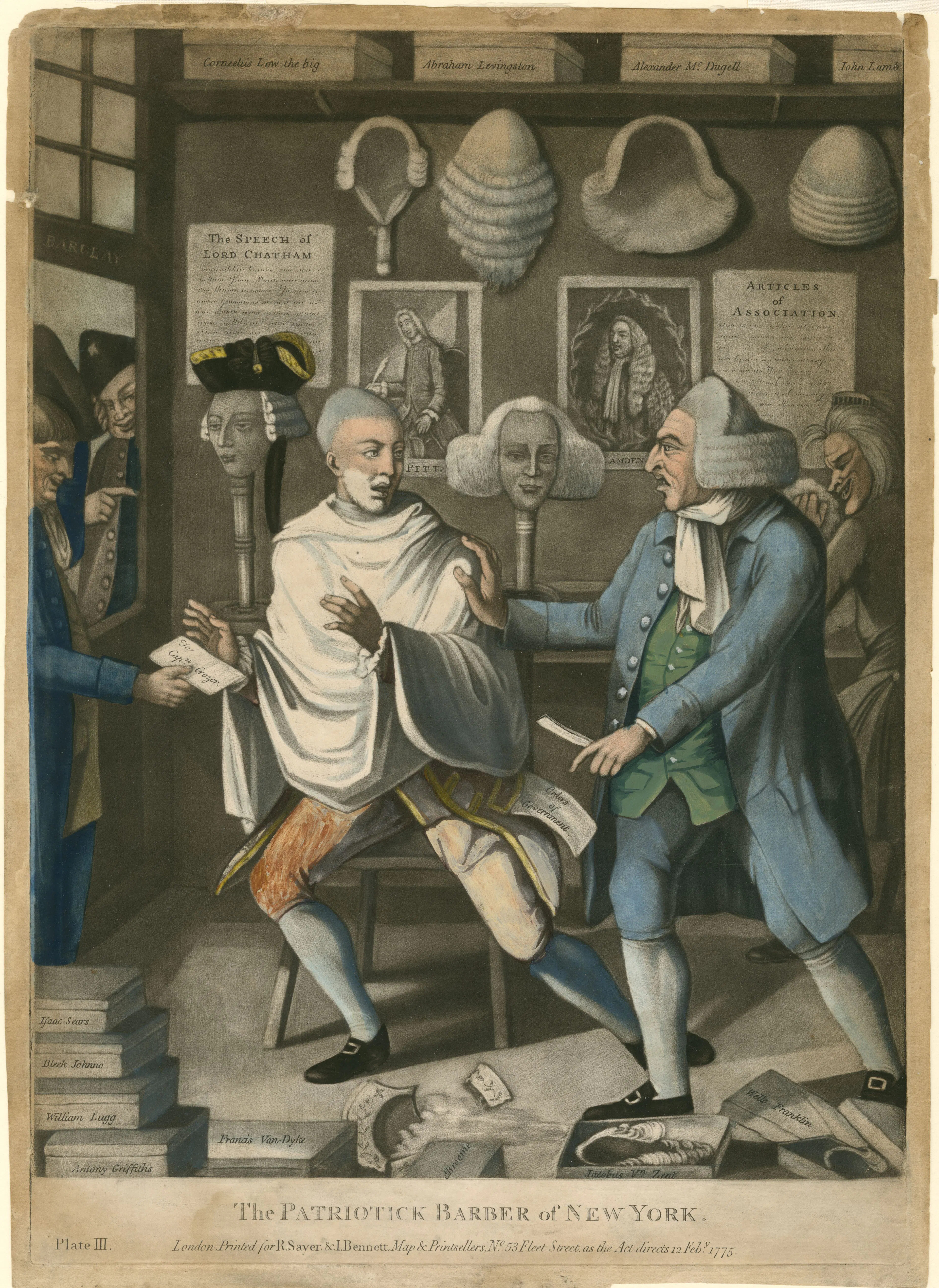
The Patriotick Barber of New York, or the Captain in Suds, attributed to Philip Dawe, 1775. The Patricia D. Klingenstein Library, The New York Historical.
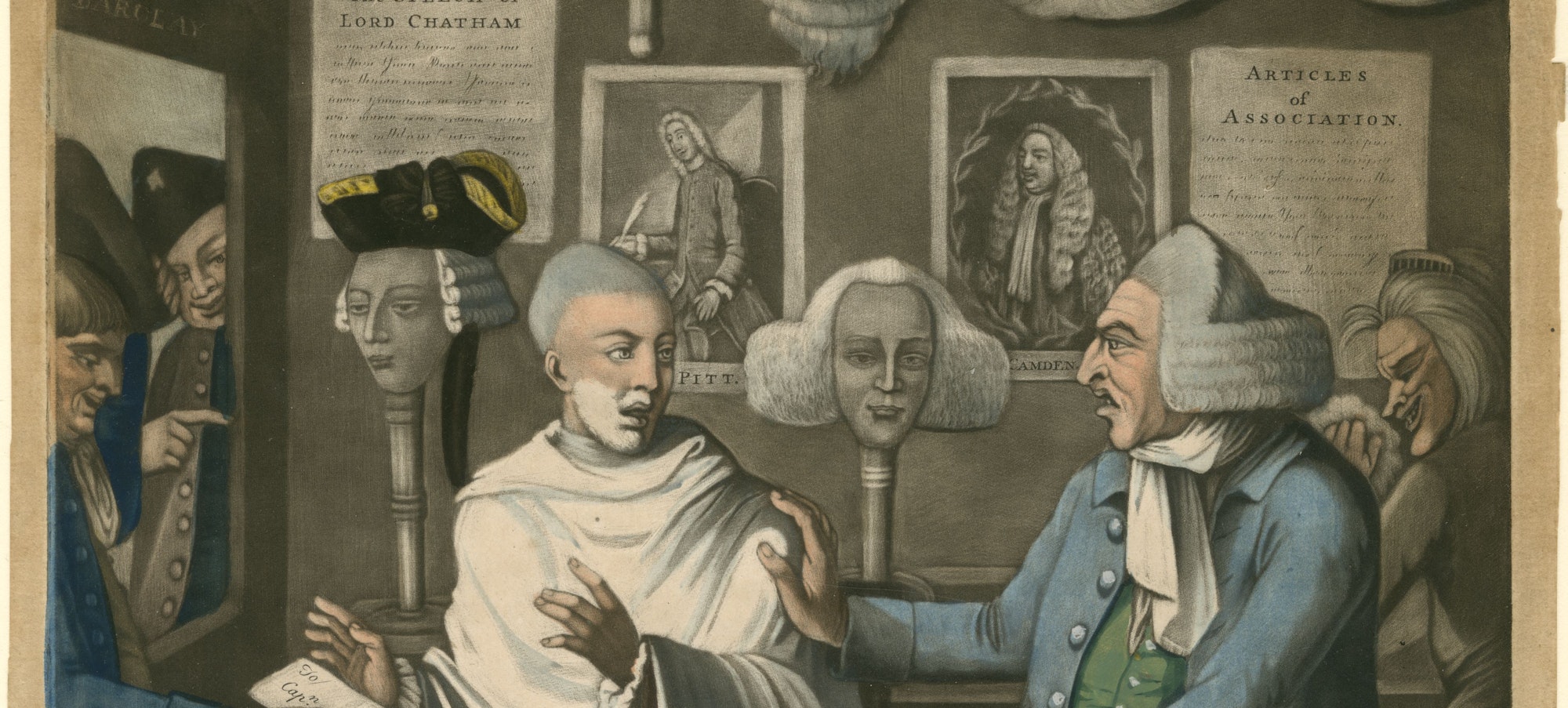
Dawe’s cartoon illustrates the incident. We see a young, bald customer, draped in a sheet. A paper inscribed, “Orders of Government,” falls from his pocket, a clue that he is a British official. The left half of his face is covered in soap (the “suds” in the cartoon title). The outraged barber, wearing an elaborate wig and holding a razor, pushes his client from the chair, realizing his military identity (revealed by a letter "To Cap'n Crozer," handed to him by one of the two men in the doorway). Above the door, the artist has written "Barclay," the New York street where Vredenburgh’s shop is located.
In the world of British satire in 18th-century prints and on stage, a barber was always portrayed as an object of ridicule. Cartoons both before and after The Patriotick Barber depict barbers gossiping and talking politics. Frequently, the barber's poor client was either ignored or, in some cases, cut by the inattentive barber's razor.
In the fall of 1774, New Yorkers routinely harassed British military regulars and officers who were viewed as the enforcers of oppressive parliamentary policies. New York business owners refused to serve them. In turn, the British attempted to pass as civilians to obtain food, drink, and occasionally, a shave. The comedy of the image relies on the revelation coming during such an ordinary yet intimate moment.
Vredenburgh, like most 18th-century barbers, is also a wigmaker and a wig maintainer. While being shaved, Crozier’s tricorn and wig were placed on the wig stand behind him. These hat and wig styles were worn by members of the American elite class as well as by British officers, so we can assume that Vredenburgh first considered his customer to be a gentleman.
Several items suggesting the proprietor's Patriot leanings appear on the walls of the shop. There is a copy of "The Speech of Lord Chatham”; a portrait labelled "Pitt,” Lord Chatham’s surname; and a portrait of Charles Pratt, Chief Justice Camden, wearing a judge's wig and gown. Lord Chatham and Charles Pratt were two of the most vocal defenders of the colonists’ rights. To Camden’s right, we see a fourth item, the Articles of Association. The document, signed by all members of Congress on October 20, 1774, agreed to stop trade with Great Britain until the punitive Boston Port Bill was repealed by Parliament.
To complement the radical wall hangings, the artist includes twelve wig boxes inscribed with the names of individual Sons of Liberty or their supporters. Our copy (pictured above) lacks the poem Dawe includes beneath the title of the cartoon, a tribute to the Sons of Liberty member, Jacob Vredenburgh:
Then Patriot grand, maintain thy Stand
And whilst thou sav'st Americ's Land
Preserve the Golden Rule;
Forbid the Captains there to roam,
Half shave them first, then send 'em home,
Objects of ridicule.
The eminent antiquarian T.R.H. Halsey remarked that Dawe had “an extraordinary knowledge of the life, customs, and political conditions in the Colonies,” which may not be entirely accurate. Dawe did have the names of many important members of the Sons and their supporters, as indicated on the twelve wig boxes. But did the radical Sons of Liberty actually wear wigs, a symbol of the British elite they were working so hard to defeat?
Wigs were originally worn in the 17th century, first by France’s King Louis XIV, and copied by the British monarch Charles II. Most men of means employed wigs to cover their receding hairlines and bald heads. Sometimes they also concealed scabs, sores, and hair loss caused by the ravages of syphilis or head lice. Once the upper class began to wear wigs, the custom was adopted by most working-class men
George Washington never wore a wig, although he did powder his hair for official portraits and formal occasions. When living in London, Benjamin Franklin would spend huge sums of money on his clothing, but he rarely if ever wore a wig or powdered his hair. Portraitists depicted Thomas Paine, radical thinker and writer of Common Sense, with his natural curly brown hair. Freedom from wigs may have echoed freedom from tyranny.
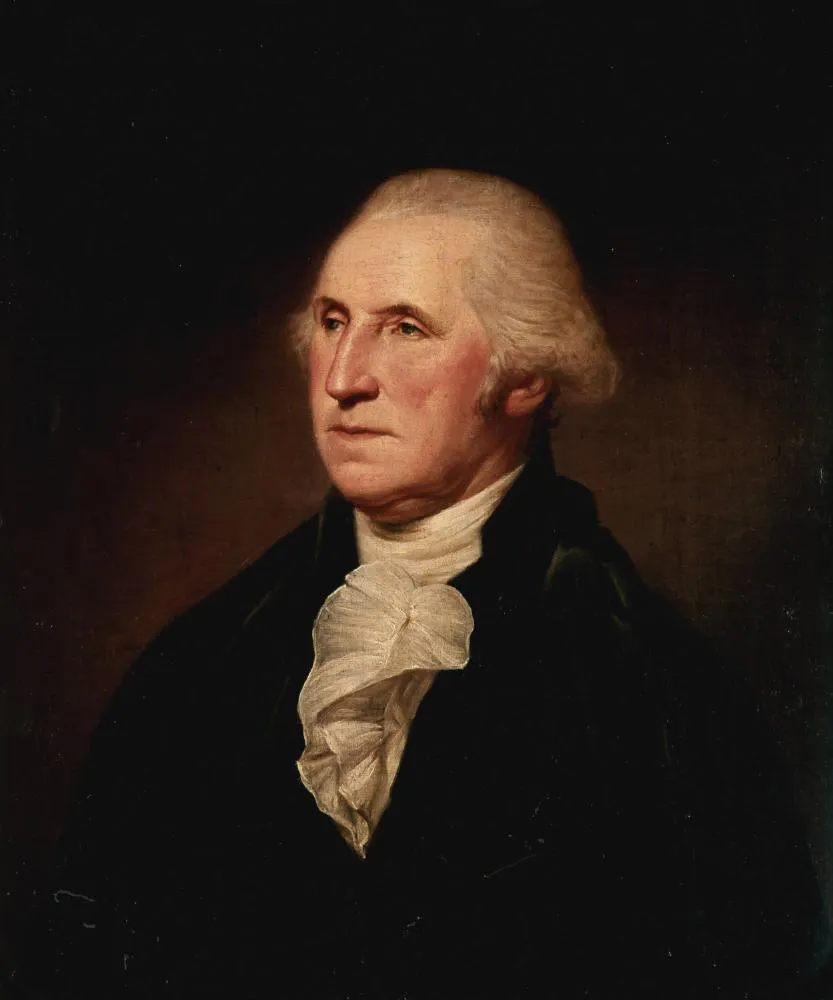
George Washington (1732-1799), painted by Charles Wilson Peale, American, 1741-1827. Oil on canvas, 1795, The New York Historical.
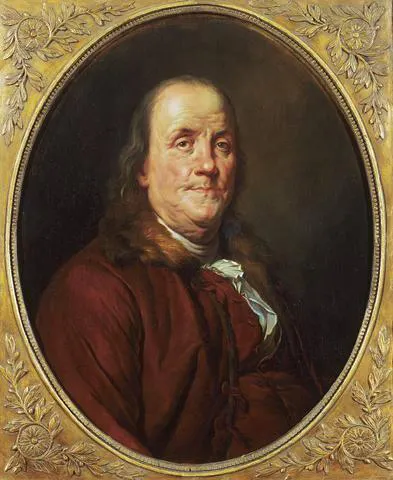
Benjamin Franklin (1706-1790), painted by Alexander Roslin (1718-1793) after Joseph Siffred Duplessis (1725-1802). Oil on canvas, ca. 1780-90, The New York Historical.
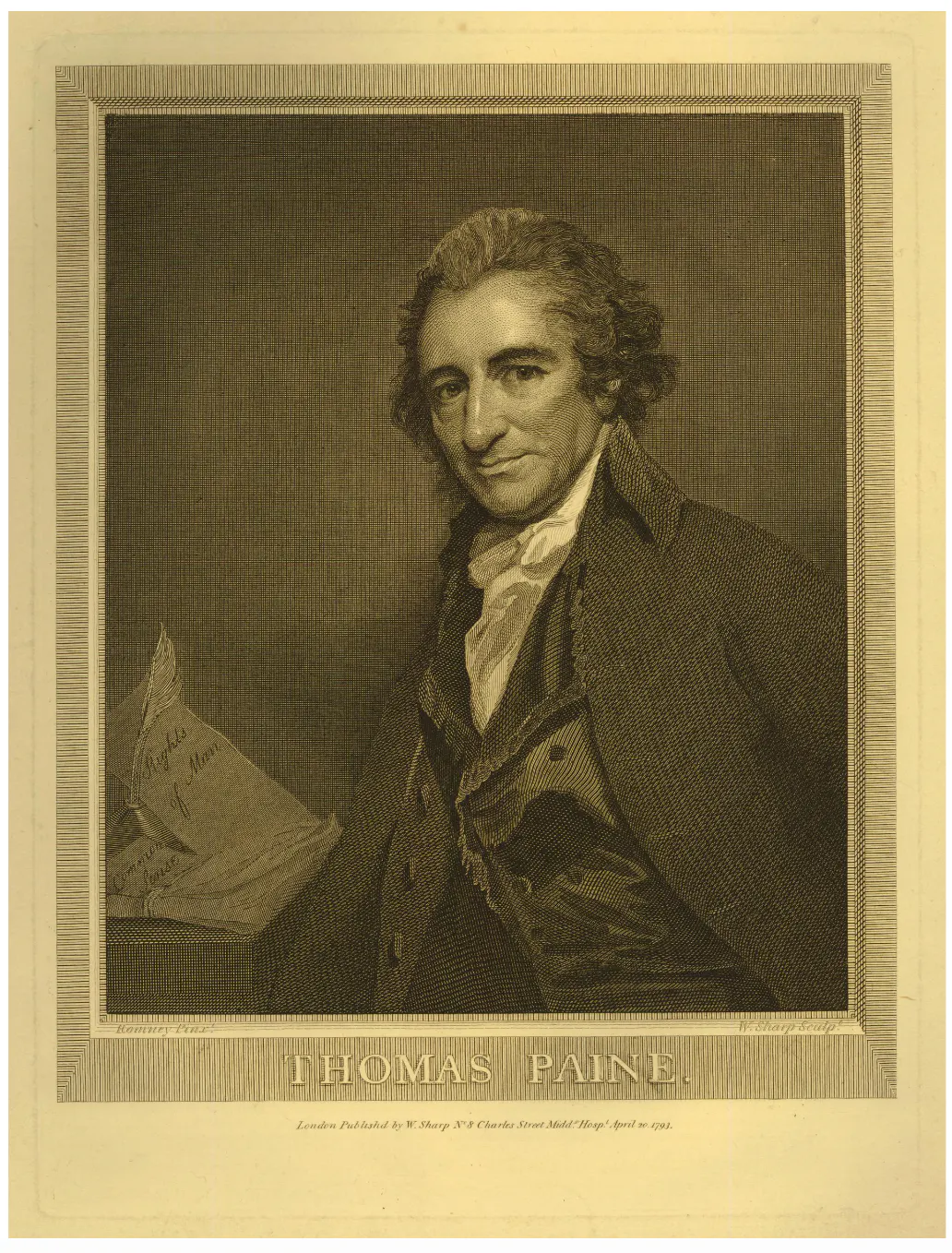
With hair like this, why would Thomas Paine wear a wig? Portrait of Thomas Paine (1737-1809), 1793, engraved by William Sharp (1749-1824), after a painting by George Romney (1734-1802). Patricia D. Klingenstein Library, The New York Historical.
This is the first of two posts by Sara Cedar Miller exploring political cartoons dating to Revolutionary-Era New York. Next, Miller will bring us to the Battle of Long Island, fought 250 years ago this August.
Keep Reading
- From the StacksAugust 28, 2026
"The Patriots in the Dumps": A British Cartoon Takes on the Battle of Long Island
250 years ago this month, Americans were embroiled in a crucial end-of-summer Revolutionary War clash: the Battle of Long Island. - From the StacksAugust 13, 2026
"Oh Eliza, I'm undone": Part II, Conservation
The second installation of this blog series, following a manuscript from storage to exhibition, highlights treatment in the conservation lab. - From the StacksAugust 5, 2026
A Revolutionary Tunebook
An American tunebook kept in 1776 captures the soundtrack of revolution. - From the StacksJuly 20, 2026
"Oh Eliza, I'm Undone": A Journey from Storage to Display
Explore the conservator's role in this three-part blog series through the lens of a Revolutionary War-era love poem as it moves from storage to the conservation studio and finally to an exhibition.