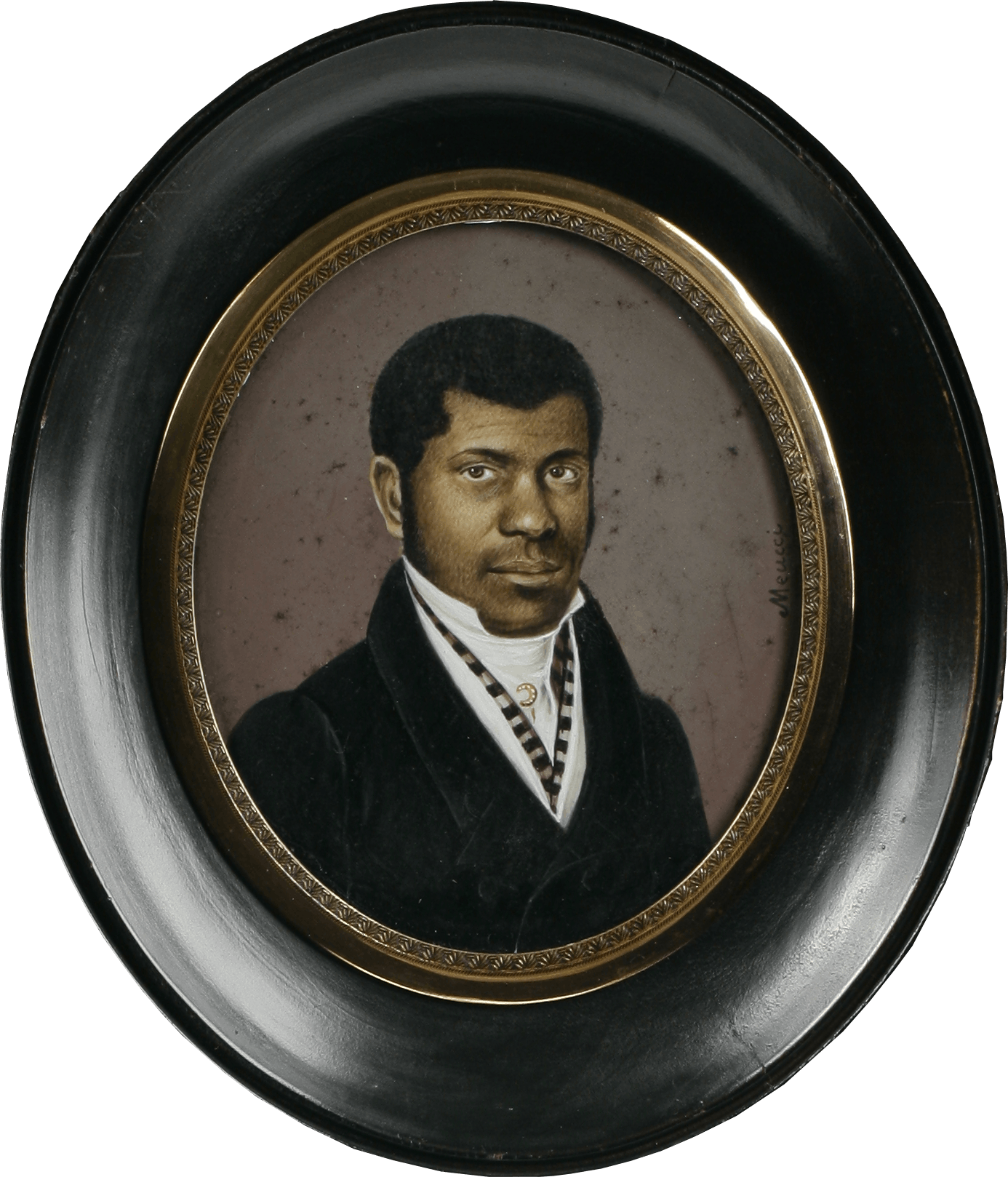
As the United States marks the 250th anniversary of the American Revolution, The New York Historical's recent exhibition Revolutionary Women examined the experiences of women whose political influence and wartime contributions have often been overlooked. Among them is Konwatsi’tsiaienni (Molly Brant), one of the most influential political figures of the colonial and Revolutionary War eras. A Mohawk woman of the Wolf Clan, her authority came from Haudeonsaunee political systems in which women of all clans exercised diplomatic influence through kinship and counsel. Brant occupied a powerful place within Haudenosaunee networks and maintained close ties with leading British officials—including and beyond her marriage to Sir William Johnson.
Having navigated complicated systems of British–Haudenousanee diplomacy throughout the 1760s, Brant was a seasoned political actor by the time the Revolutionary War broke out. When faced with a choice between loyalty to the British or to the emerging Revolutionary forces, Brant encouraged an alliance with the British Crown, believing it offered the best chance to protect Haudenosaunee lands from colonial expansion. Patriot forces well understood her influence. Her home was targeted in a violent nighttime raid by the Committee of Safety during the fall of 1777, forcing her to flee to Canada. After the war, she resettled with other Mohawks in southern Ontario, where the British government later awarded her a home and pension for her wartime service.
Historian Maeve Kane, Associate Professor of History at the University at Albany and author of Shirts Powdered Red: Haudenosaunee Gender, Trade, and Exchange across Three Centuries, discussed Brant's diplomacy and the challenges of recovering Native women's histories from the surviving sources with Rachel Pitkin, a recent Mellon Foundation Predoctoral Fellow at The New York Historical's Jean Margo Reid Center for Women's History.

Maeve Kane, Associate Professor of History at the University at Albany. Photo by Mario Sotomayor
What first drew you to Konwatsi’tsiaienni (Molly Brant) as a historical figure?
Brant is often mentioned as a side character in scholarship on her husband William Johnson and brother Joseph, but when I was reading through William Johnson's papers, there were these tantalizing glimpses of her as independently enmeshed in networks of other Indigenous women—for example, when a British Army lieutenant who had had a son with a Seneca woman and the British father wanted custody of the child, the father reached out to Johnson but it was clear that Brant did the communication and negotiation with the Seneca mother. Brant's story sometimes ends with Johnson's death in 1774, but she lived for quite a long time afterwards, which I thought would make her a good lens on the American Revolution and its long aftermath for Haudenosaunee people.
What do you wish more people understood about Brant's diplomacy and political authority?
Johnson described her as his housekeeper in his will, and I think a lot of historians since have followed that characterization in the English sense rather than the Haudenosaunee sense—reading their relationship in Haudenosaunee context I think places much more importance on the role of housekeeper than the English sense of common law wife (or an even older characterization of her as his "concubine"). In Haudenosaunee communities, the eldest woman in a lineage headed her longhouse, administered lineage property, and offered hospitality to traveling members of her clan and guests being hosted by condoled chiefs in her lineage. Brant's role as Johnson's housekeeper, in overseeing the hosting of visitors and their feeding, was a very important diplomatic and political role in Haudenosaunee contexts, independent of her marriage to him and explicitly political in ways that European connotations of "housekeeper" don't convey.
In your 2023 article “The Raid,” you write about the attack on Brant's home at Canajoharie. What does that event reveal about her influence during the war?
The sudden attack on Brant's home under cover of night suggests that she and other Mohawk families in the area were seen as dangerous enemies who could call on assistance if they had forewarning of an attack—we can see that Brant and other Mohawk families remained connected to Haudenosaunee and British communication networks despite William Johnson's death and the conflict between Brant and Johnson's successor and nephew Guy Johnson. The raid at Canajoharie really illustrates that Brant remained an influential and potentially dangerous figure to the American cause well after her husband's death and independent of him. The Mohawk scholar Audra Simpson calls this kind of Indigenous continued presence an interruption of settler sovereignty, and these interruptions are such threats to settler sovereignty that they must be eliminated.
You've described the political importance of Brant's role as a housekeeper. In the exhibition, we also considered Johnson Hall as a site of diplomacy. What does this setting reveal about the relationship between domestic space and Native women's political authority?
One of the core principles of feminism and feminist studies is that the personal is political, and in Indigenous women's history I think that has two meanings. First, that thinking about power in any domestic space tells us about the politics of that time and place, but second, that Native women like Brant were an essential part of intercultural diplomacy. Many European observers at the time assumed that women's presence, and by extension domestic spaces, were mutually exclusive with the functioning of diplomacy. But Brant's presence at Johnson Hall shows that intercultural diplomacy could not have functioned without women like her and constituted a major threat to settler colonialism that wished to extinguish both Indigenous sovereignty and the role of women in maintaining that sovereignty.
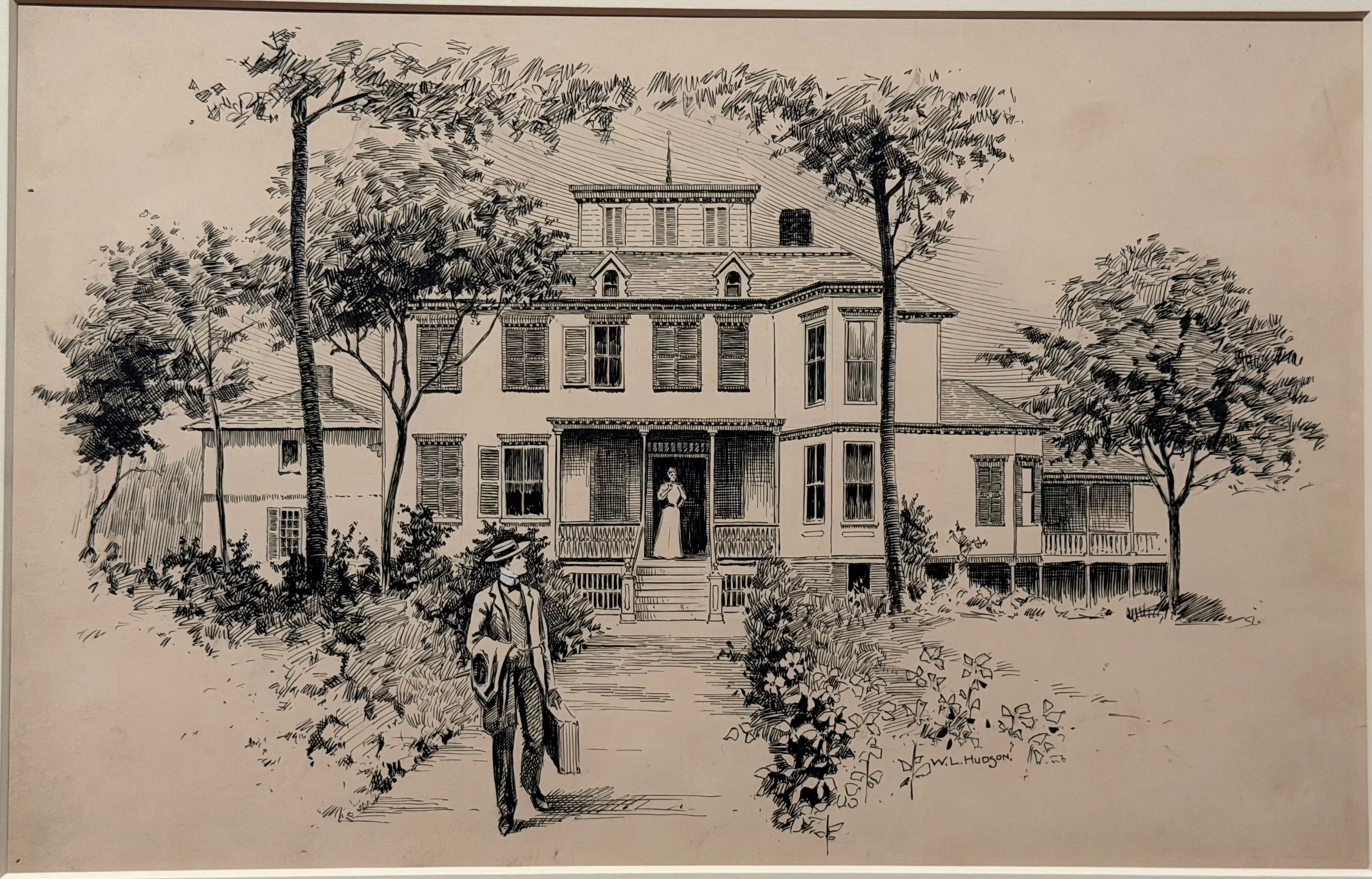
William Lincoln Hudson (active 1890–1905). Johnson Hall, Johnstown, New York, 1899–1903. Black ink and graphite with touches of white gouache on card. The New York Historical, Gift of E. H. Sauer, 1923.89
In Shirts Powdered Red, you argue for taking material culture and exchange seriously as part of Haudenosaunee diplomacy. What can objects help us see that written political records often miss?
An object is an accumulation of decisions made in contact with the world, and reading those decisions in context helps us understand the meaning of the object from manufacture to purchase to use, just as understanding the context of a document helps us understand its meaning from writing to reception. Written records can sometimes be read against their intended meaning—what's left out, how small asides add up—but objects can give us a window into a whole chain of decisions, often made by people who left few of their own written records or are left out of others' written records. Taking objects seriously as records of intentional decisions made in a wider political framework vastly expands our records for how people thought of themselves, their communities, and the world around them.
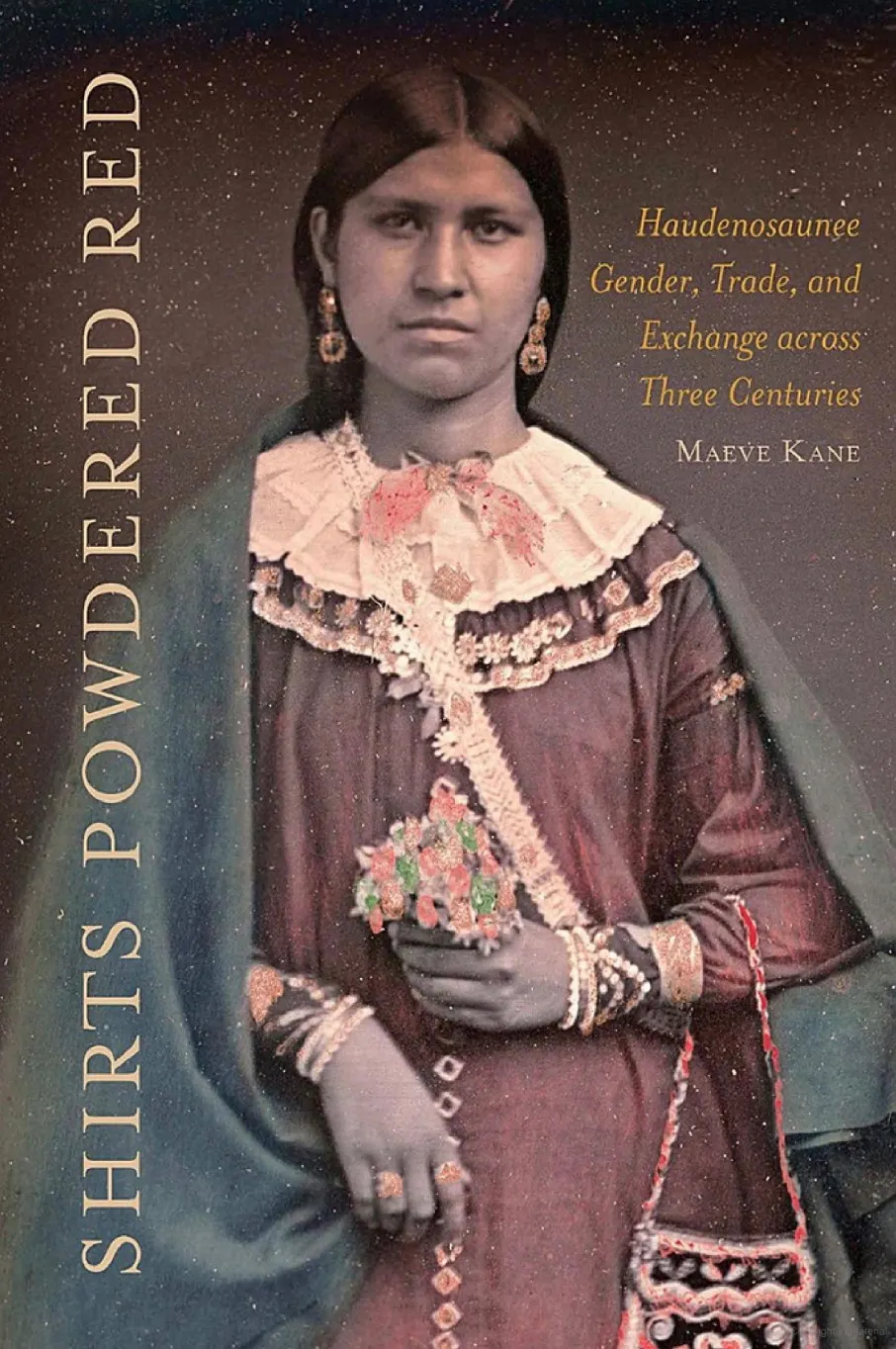
Maeve Kane, Shirts Powdered Red: Haudenosaunee Gender, Trade, and Exchange across Three Centuries (Cornell University Press, 2023)
In Shirts Powdered Red, Kane examines how Haudenosaunee women used clothing and exchange to sustain their communities and political sovereignty. Her work demonstrates how material objects can illuminate women's choices and authority, even when written records overlook them.
What kinds of evidence help you recover Native women's diplomatic work?
One of the wonderful things about working in the academic moment I was researching and writing was being able to draw on amazing theoretical and empirical work done by others. Indigenous studies as a field prioritizes considering multiple kinds of evidence in culturally relevant frameworks, and I was able to draw on political theory by Haudenosaunee scholars like John Mohawk, Audra Simpson, and Theresa McCarthy, as well as the work of archaeologists and archivists who helped me locate seemingly odd and disconnected archival records like baptism registers, pension claims, account books of purchases, and more traditional written diplomatic records to see a greater whole from smaller archival parts.
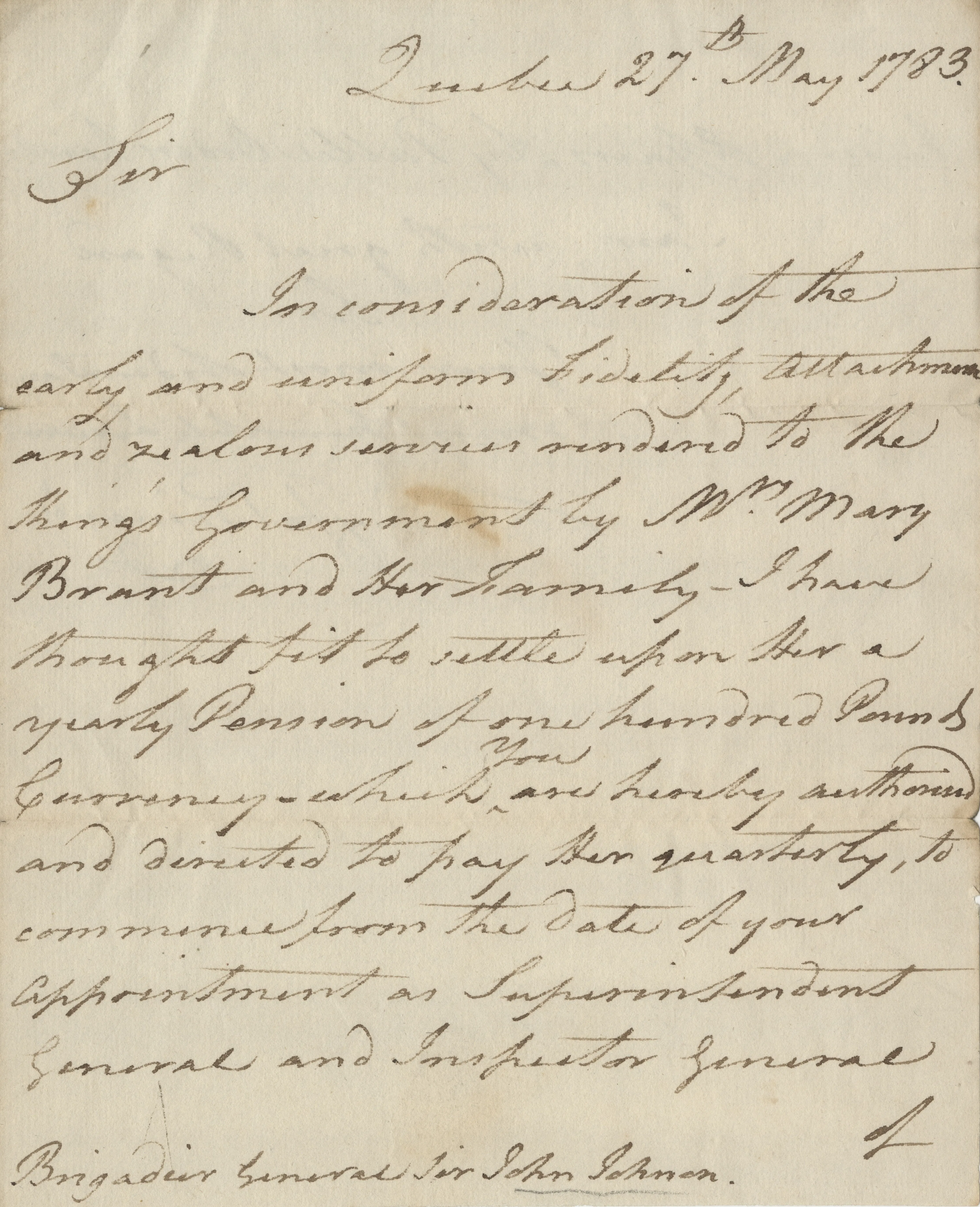
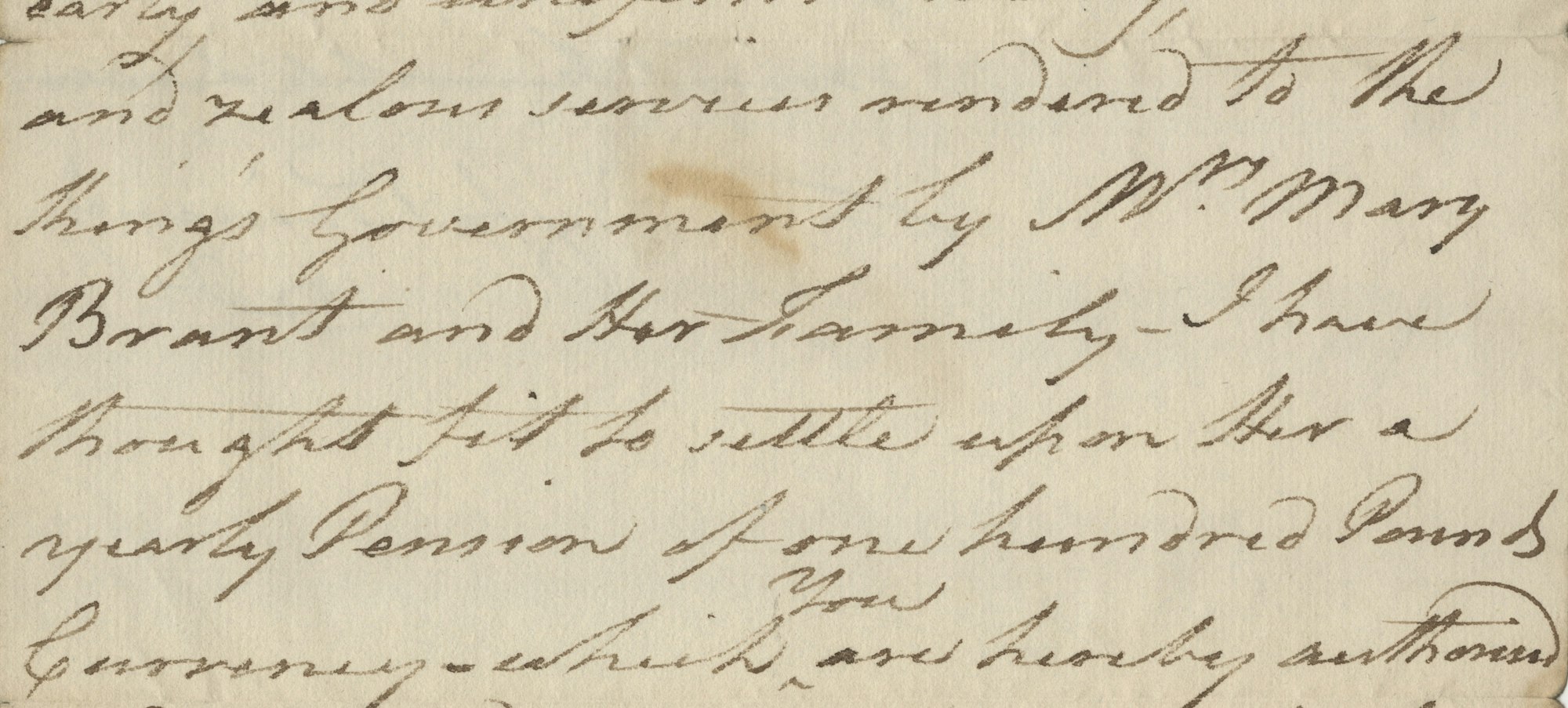
Sir Frederick Haldimand (1718–1791). Letter to Brigadier General Sir John Johnson (1741–1830), May 27, 1783, Quebec. Patricia D. Klingenstein Library, The New York Historical
The pension discussed in this letter attests to Konwatsi’tsiaienni Molly Brant’s authority and diplomatic role within the Mohawk and British communities.
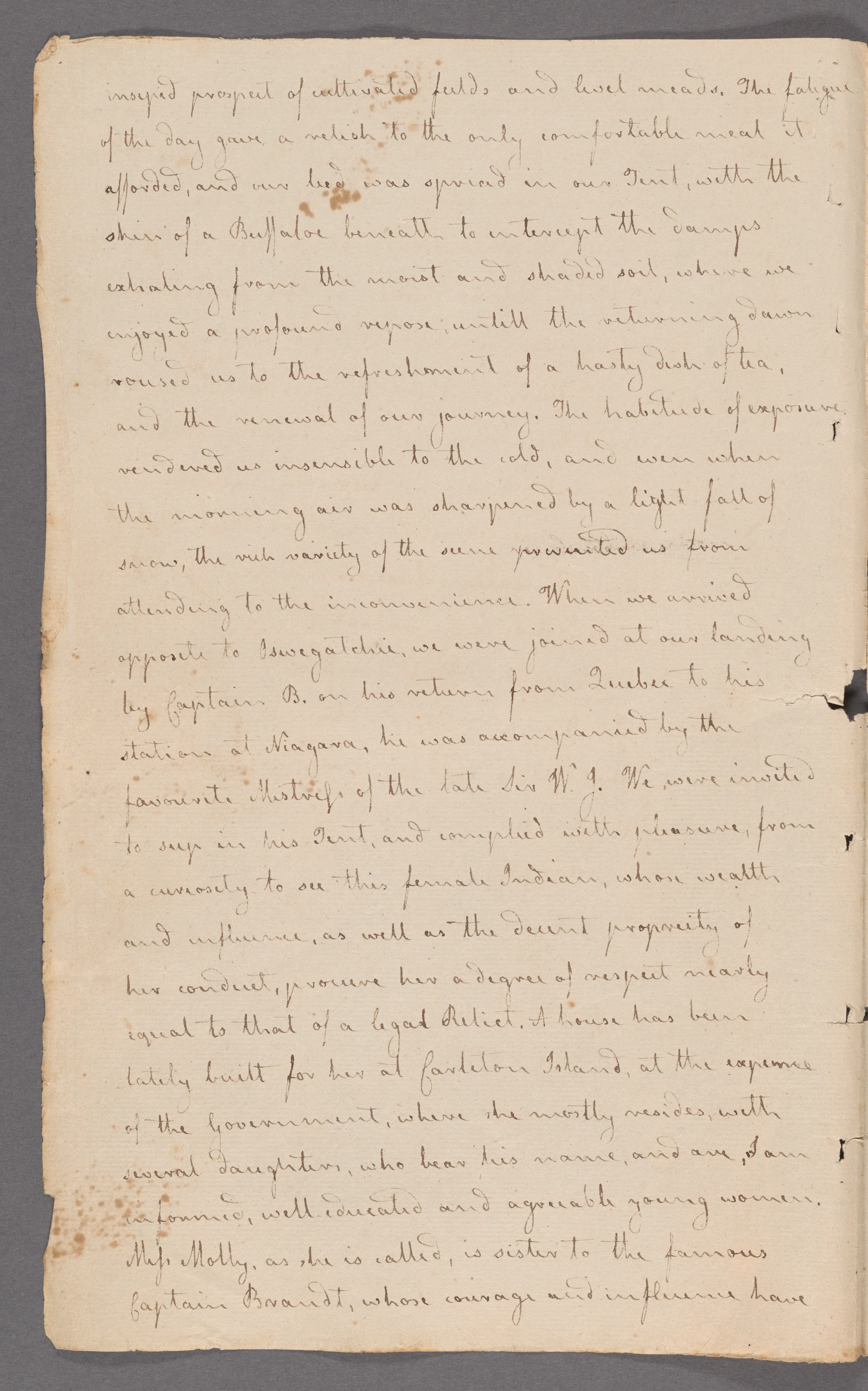
Hannah Lawrence Schieffelin, Narrative of Events and Observations that Occurred during a Journey through Canada in the Years 1780–81. Manuscripts and Archives Division, The New York Public Library
Hannah Lawrence Schieffelin recorded her observations during travels through British-controlled Canada in 1780–81.
Her manuscript illustrates the kinds of contemporary accounts historians must read critically to recover Indigenous women's experiences during the Revolution.
Many of those records were produced by colonial officials or other observers who did not always recognize Native women's authority. How do you interpret those sources?
As is the case with so many historical sources about Indigenous people and women generally, many archival records describe without really seeing, so it's up to the historian to interpret not only what the writer saw, but also what they thought they were seeing, why they thought that, and importantly, the meaning of what they saw. Often this means putting archival sources in conversation with each other, relevant cultural frameworks, and modern scholarship to understand how these layers of meaning interact in the text of a single document.
How does Haudenosaunee women's history change the larger story Americans tell about the Revolution?
I don't think we can understand the American Revolution, the creation of the American state, or the progress of American sovereignty without understanding gender and its intercultural meanings in the late 18th century. If part of the foundation of the Revolution was concerns about the sanctity of homes from British quartering, the safety of private property from appropriation, and the right to life, liberty, and the pursuit of happiness, the experience of Brant and other Haudenosaunee women in this period begs the question: for whom? Understanding Haudenosaunee and other Indigenous nations' sovereignty that predated the creation of the American nation, and the ways Indigenous women were central to maintaining that sovereignty, shows us how gender and women's work was really central to the course of settler colonialism and the promise that the American nation held out for some but not others.
What do you hope public audiences take away from Brant's story during the 250th anniversary?
During the Revolution, Americans were able to justify to themselves that the treatment of Brant and other Indigenous women was acceptable because Indigenous women weren't really women, and weren't really entitled to the protections of "civilized" women. During the raid on Brant's home, American members of the Committee of Safety stole her dresses and gave them to their white wives and daughters to wear, a very pointed removal of these symbols of protected femininity and their transfer from Brant to white women. As we mark the 250th of the Revolution, I hope that public audiences can think about how this kind of dehumanization functions in the present to justify the exclusion of some groups from the protections of US citizenship or universal human rights, and who benefits from that.
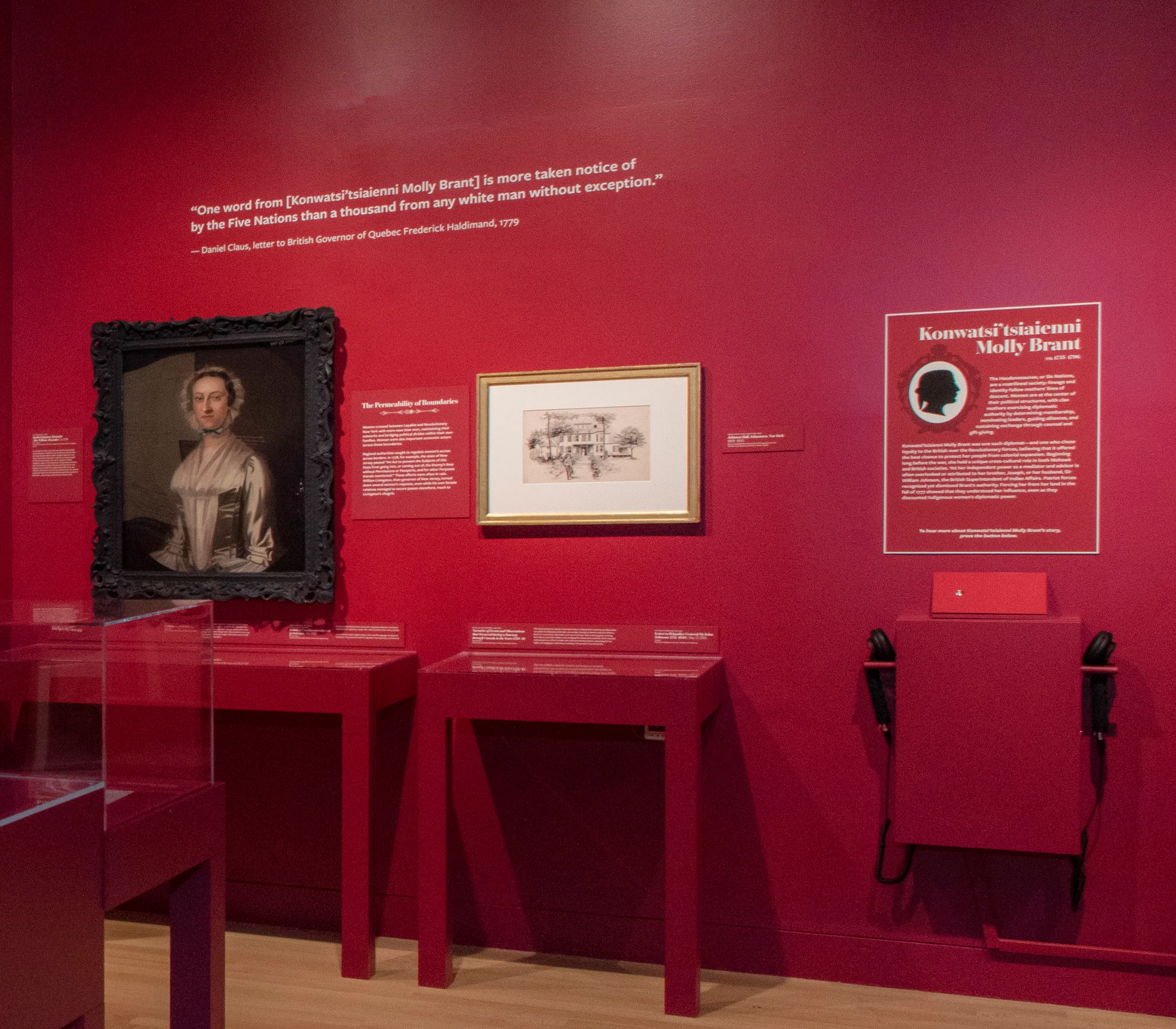
Revolutionary Women (May 2026–October 2026), photo by Glenn Castellano
Written by Rachel Pitkin, Ph.D. candidate in History at the CUNY Graduate Center, Senior Manager of Programs at Humanities New York, and Mellon Foundation Predoctoral Fellow at The New York Historical's Center for Women's History, 2025–2026.
Keep Reading
- Women at the CenterNovember 17, 2026
Yuppies: A Conversation with Author Dylan Gottlieb
How did young urban professionals transform New York City in the 1980s? - Women at the CenterNovember 10, 2026
How Levi’s Denim Jackets Helped Fight HIV/AIDS
On November 10, 1986, a fashion show held on the Barneys staircase offered a new model for funding HIV/AIDS programs. - Women at the CenterOctober 31, 2026
“More Than Witches Would Fly That Night”: Queer and Trans Femme Histories of Halloween
Years before the 1969 Stonewall Uprising, Halloween celebrations empowered and inspired queer and trans femme people, giving them the freedom to dress as they chose. - Women at the CenterOctober 9, 2026
Empire of Skulls: Reassessing Phrenology with Author Paul Stob
Is there anything we can learn from 19th-century phrenologists? Author Paul Stob argues that the phrenologists' legacy is still very much with us today.