On April 15, 1865, President Abraham Lincoln died, felled by an assassin's bullet fired the previous evening. To mark the 160th anniversary of Lincoln's death, we are looking at some of the ways that artists, writers, and ordinary people from across the nation sought to memorialize and make sense of the President's shocking murder.
In the wake of Lincoln's assassination, the mood of the country was bleak. The President's funeral was held in Washington, DC, on April 19, followed by a solemn procession of nearly 1,700 miles as the train bearing his body wound its way back to his hometown of Springfield, Illinois. At each stop—in Baltimore, Philadelphia, New York, Chicago—tens of thousands of people, women and men, both Black and white, attended public viewings of the President's body. Thousands of others lined the railroad tracks as the funeral train passed by.
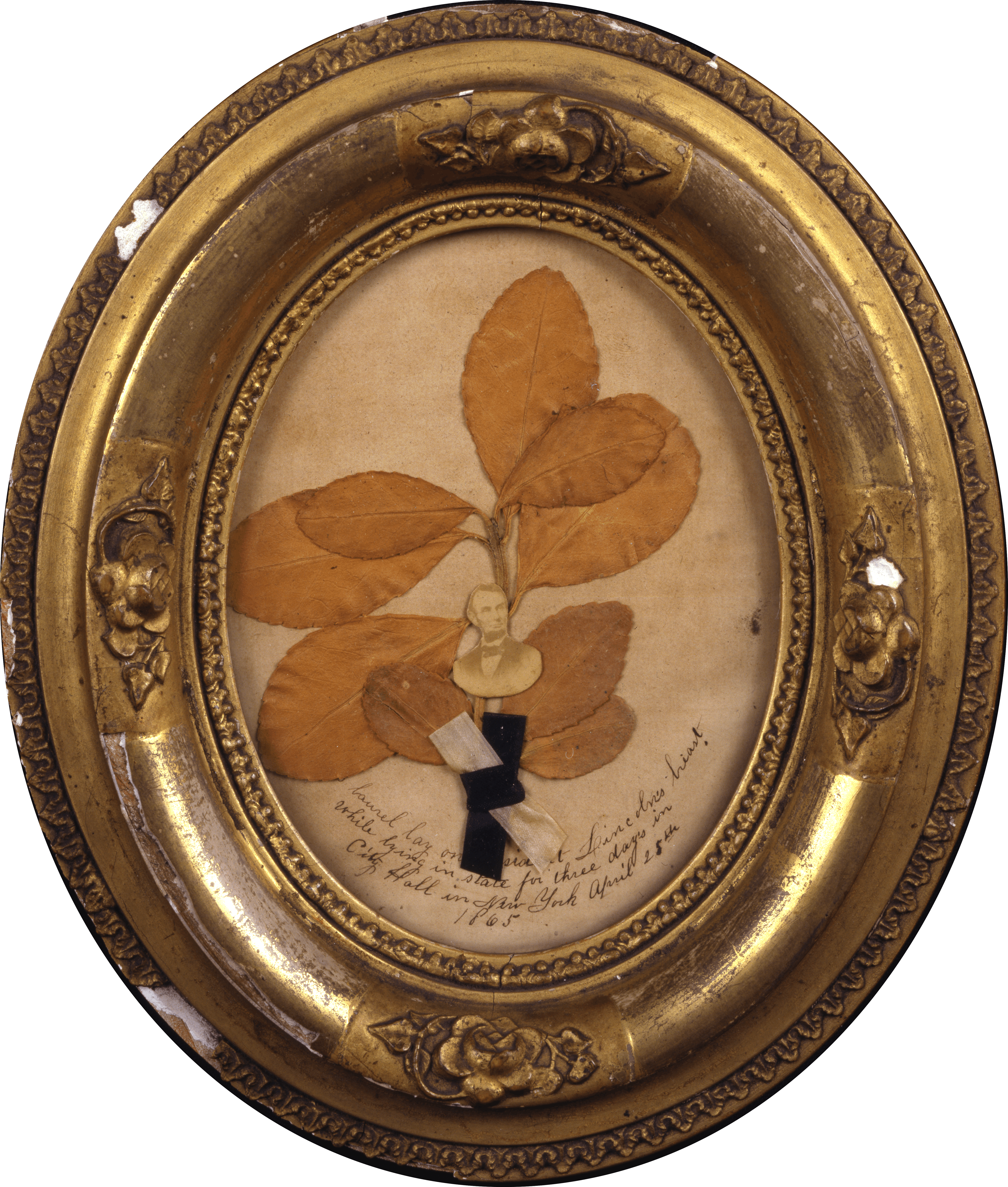
Framed leaves from Abraham Lincoln's bier, 1865. Albumen photograph, plant material, ink, silk ribbon, wood gilding. The New York Historical, Gift of Mrs. Georgine Wood Charlton, 1947.47
This laurel was taken by Jeremiah Wood from Abraham Lincoln's bier while he lay in state in City Hall. After Lincoln's assassination, his funeral train arrived in New York City early on April 24. The cortege followed a route from Desbrosses Street to City Hall Park, and Lincoln's body lay in state at City Hall from 1:00 PM until noon the next day.
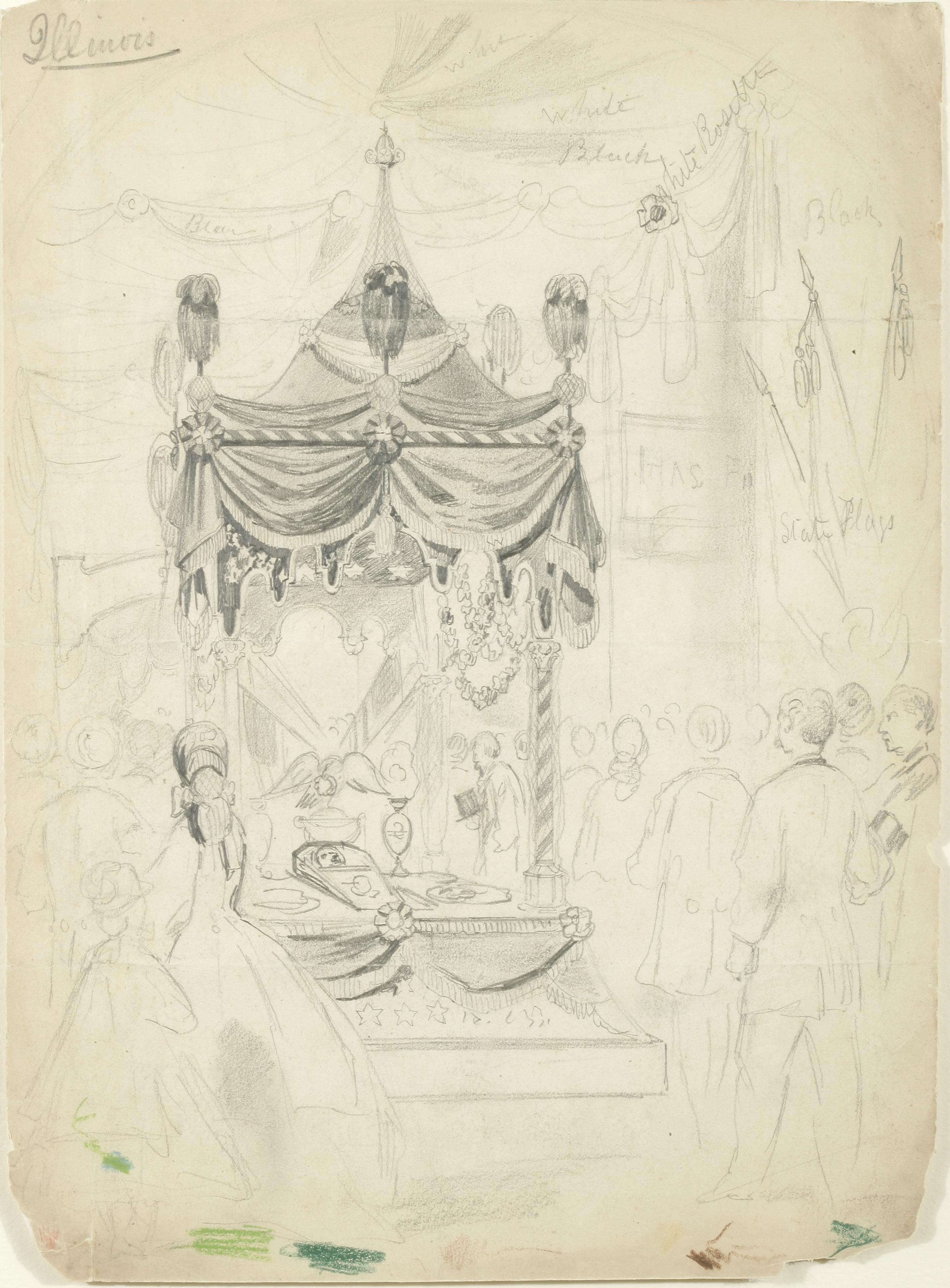
Unidentified artist. President Abraham Lincoln Lying in State in the Chicago Courthouse, Illinois, 1865. Graphite, Conté crayon, and pastel on ivory paper. The New York Historical, Purchase, James B. Wilbur Fund, 1945.580.25
After Lincoln had been laid to rest, the Reverend Reuben Jeffery stood before his congregation at the Fourth Baptist Church in Philadelphia. "The body of Abraham Lincoln has been followed to the grave by twenty millions of mourners," Reverend Jeffery said on the morning of Thursday, June 1, 1865. "His memory is enshrined in the hearts of all good men; and his name is bequeathed to us, a legacy of goodness and of greatness forever. What, therefore, remains to be said now?"
In other words, how should America and its citizens face their future?
Reverend Jeffery urged his listeners to "study the accomplished past." He reviewed the "embryotic and formative" years of American history—the Revolution, the Articles of Confederation, the adoption of the Constitution—before addressing the growth of political tensions in the years prior to the Civil War:
Thus it has come to pass, that for years, a restless, turbulent and ambitious portion of our own people have clamored for favors, and demanded privileges, while others, actuated by a love of peace, and fearing the threats of rebellion and secession, have weakly and wickedly yielded to these insolent demands, until those who made them began to imagine themselves the autocrats of the nation, and their brethren and equals mercenary vassals—men, who for the pottage of commercial gain, were willing to sell their freedom and the sovereignty of the nation.
Lincoln's Presidency had been divinely ordained, Jeffery argued, in order to correct this sorry state of affairs: "God chose him with special reference to coming events." Lincoln's rise to prominence was, he said, part of "the design of God to accomplish the things which have been accomplished," namely, the demise of slavery, the preservation of the United States and its Constitution, and the reaffirmation of the rule of law. But Jeffery's argument went even further: he asserted that Lincoln's sudden death was also part of God's design, martyring Lincoln to the cause for which he had fought.
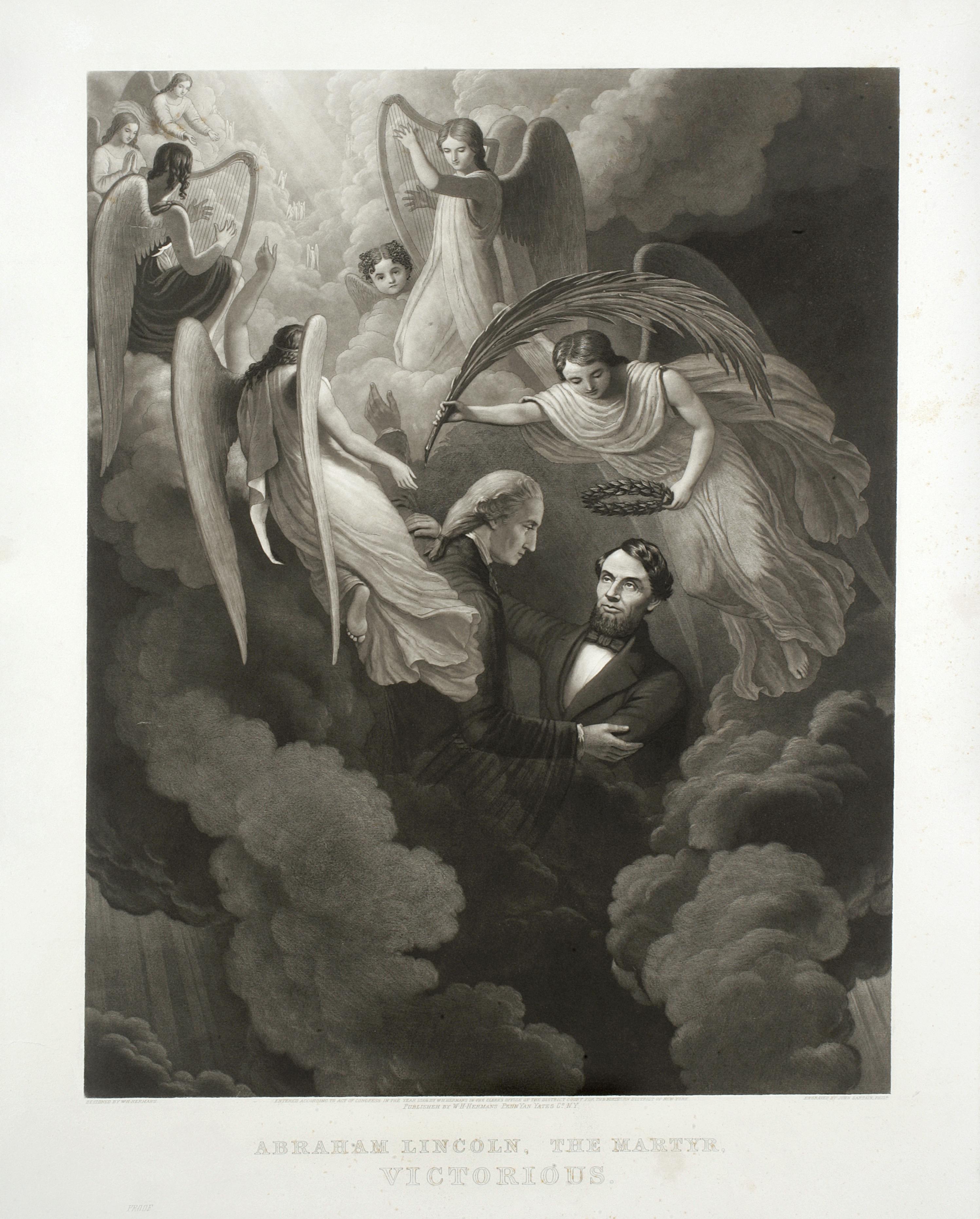
John Sartain (1808–1897), engraver. Abraham Lincoln, The Martyr, Victorious, 1865. Mezzotint. Patricia D. Klingenstein Library, The New York Historical
Lincoln's death, Jeffery concluded, passed the torch of his legacy to the American people:
Let the death of our great and good President consecrate us, to the realization in ourselves of the spirit which animated him. Let us dedicate ourselves to keeping that which he has given us. Let us forget past differences. Let us hate slavery. Let us love freedom. Let us honor labor. Let us respect the rights of the humblest and weakest and meanest of God's creatures. Let us go on to fulfill the mission to which God has called us of being the model of a pure and ennobling civilization. Let us prove worthy of Abraham Lincoln.
Written by Jeanne Gutierrez, Manager of Scholarly Initiatives
Keep Reading
- Behind the ScenesSeptember 28, 2026
The Great American Novel Revisited
Americans have always looked to certain literary masterpieces for a sense of who we are. - Behind the ScenesJune 29, 2026
Our Birthday Wishes for America
What's your wish for America's future? - Behind the ScenesOctober 20, 2025
#AskaMuseum—Our Curators Answer Your Questions
You asked, and our curators answered! For #AskaMuseumDay last month, we gathered the questions our social media followers. - Behind the ScenesJune 27, 2025
GAY PRIDE in '75: Fred McDarrah's Photographs of the 1975 Pride March
To celebrate the arrival of the historic Fred W. McDarrah Archive at The New York Historical, we are excited to share some of the stories behind McDarrah’s iconic photos of the 1975 Pride March in honor of its fiftieth anniversary.