Former New York Congresswoman Carolyn B. Maloney, along with Beirut-born designer and couturier Gassan Antonios, recently visited the Center of Women’s History bearing a surprising gift: a dress that Maloney wore to the 2021 Met Gala. The fundraiser—sometimes referred to as the Oscars of fashion—marked the opening of the 2021 Costume Institute exhibition In America: A Lexicon of Fashion. The floor-length gown is a nod to American women’s long struggle for equal rights. It features the suffrage colors of purple, white, gold, and green and has long trains recalling suffrage sashes. The dress was matched with a circular handbag with the words ‘ERA yes,’ a reference to pin-back buttons worn in the 1970s by activists for the passage of the Equal Rights Amendment. What is the significance of this dress, and why was it donated to us?
In 2021, the Center for Women’s History mounted the installation “Our Bodies, Our Power”: Women at the Forefront of the Equal Rights Amendment, which placed the 1970s activists for the passage of the Equal Rights Amendment (ERA) as a focal point in a lineage of women activists who have used their bodies as a canvas for political activism, dating back to the suffrage movement. It explores how activists both for and against the ERA borrowed strategies developed by suffragists, such as donning sashes, wearing lapel buttons and large hats, and prominently placing their bodies in the public sphere.
Maloney embodied this strategy when she appeared on the red carpet with the words “Equal Rights for Women” plastered on the sash-like trains of her dress, literally using her body as a conduit for the political message. She made her intentions explicit in a statement on Twitter, writing “I am calling 4 the certification of the ERA so women can be equal once and for all.” We were inspired by this gesture and included an image of Maloney on the red carpet in “Our Bodies, Our Power” to demonstrate the powerful ways that women continue to pay homage to the suffragette legacy of politicizing fashion. We were thrilled that upon finding out about the inclusion of her image, Maloney and Antonios decided to generously donate the dress to our permanent collection. In 2020, Maloney was among those who pushed the House of Representatives to remove the 10-year deadline to ratify the 1972 passage and put the ERA back on the table. Since she concluded her 30-year tenure as a congressional representative, Maloney is focusing now entirely on ERA activism.
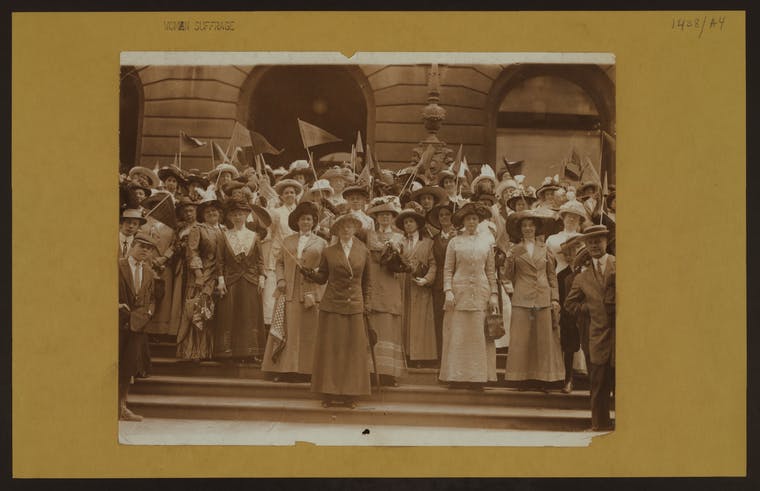
A group of suffragettes at a convention parade in support of extending the vote to women. Photograph by Burke and Atwell, courtesy of the New York Public Library Digital Collections.
Gassan Antonios sought to create a strong, visual statement on the red carpet that would reflect Maloney’s politics. It was not the first time Maloney used this platform to send a political message. In 2019, she attended the Met Gala draped in a firefighter jacket over a neon green gown to draw attention to a legislation she was pushing to compensate 9/11 victims and their families. Each year, the Met Gala has a theme that all invited guests have to follow. Famously, each outfit is vetted by Vogue’s editor-in-chief Anna Wintour, who has chaired the gala every year since 1995. But Maloney is not one to follow the rules. “I suggested working on a gown with a message and not just a regular dress following the theme,” recalled Antonios. “ERA was the best selection, because Ms Maloney always supported it.”
Antonios was born in Beirut, Lebanon, in 1969 and studied fashion at College Artistique de La Mode Moderne (Beirut), at a time when the Lebanese capital’s beaches drew elites from all over the European and Arab world. He defines himself as “an artist who transforms fabrics into unique pieces of living art, and a modelist that mixes to perfection the complexity of the body, design, fabric and colors.” Until he opened his own haute couture house in 1999, he worked as head of atelier (a position which entails turning the couturier’s two-dimensional sketches into three-dimensional garments) in several Lebanese houses catering to private clients in the Arab Gulf and Europe. While his couture house is still headquartered in Beirut, Antonios’ creative department has been located in the US since 2015. He attributes his ability to connect with clients hailing from Japan, England, Germany, the US, and the Arab world to his diverse background and his deep interest in culture. “The story of a dress starts like a dream,” he told us in an email correspondence. “It is the untouchable idea mixed with the precious fabric and passed through the hands of the artisan. That’s how [my] dresses become a reality—a reality that is like a dream.” It was this approach that he brought to the design of Maloney’s red carpet look.
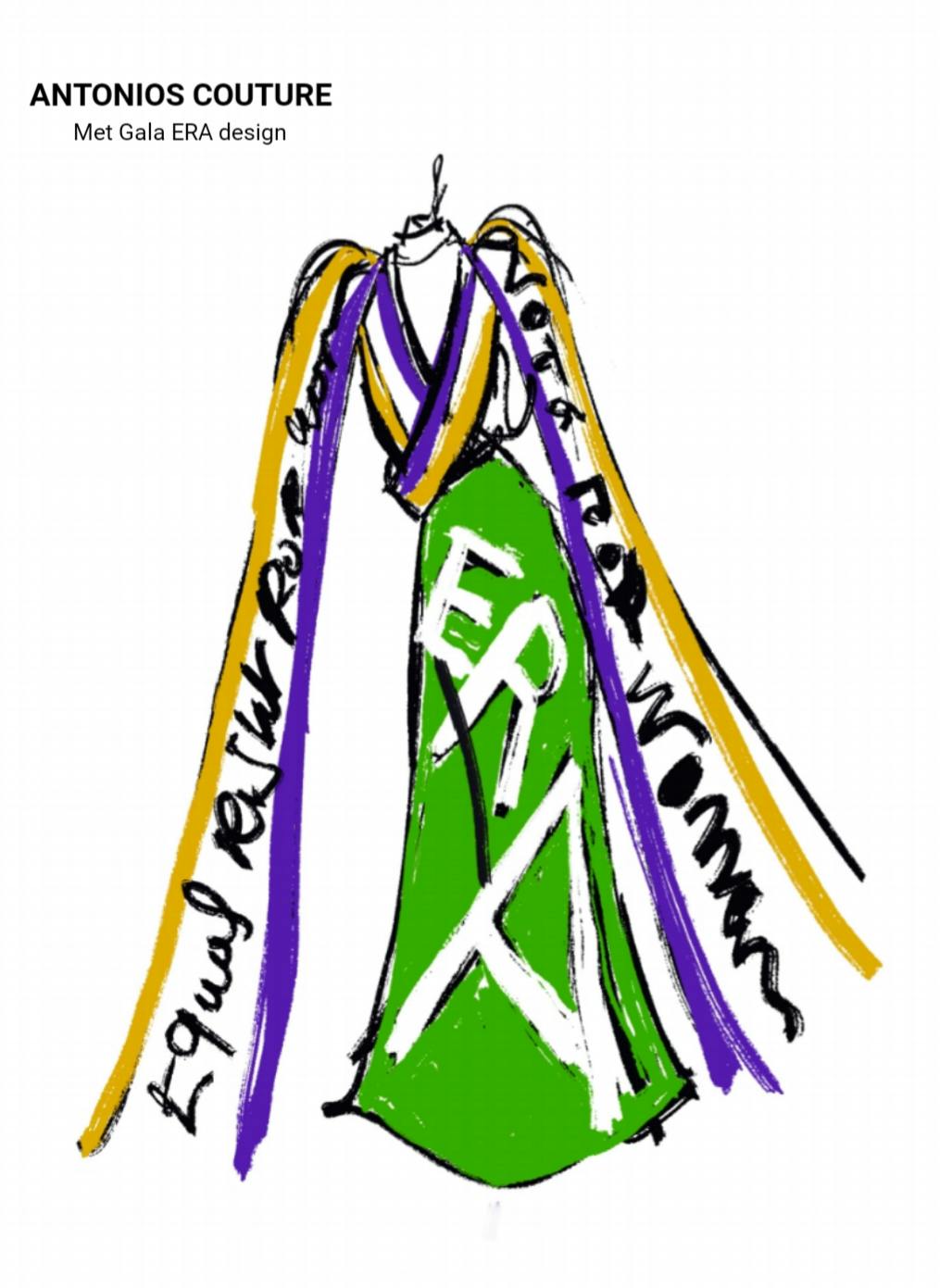
Fashion illustration by Gassan Antonios for the Met Gala, 2021. The letters ERA are made with white Chantilly laces attached with sequins and beaded embroidery to the green stain skirt, and the words Equal Rights for Women are made similarly made of black lace, hanging down from the shoulders in a way that echoes sashes worn by early 20th century Suffrage activists.
Together, Antonios and Maloney searched for images dating back to when the ERA was first drafted by members of the National Woman’s Party in 1923. Antonios sketched out several ideas inspired by early ERA activists and “their looks, costumes, colors and thoughts.” After Maloney chose the sketch for what would become her dress, Antonios wanted the dress to “be modern but at the same time reflect exactly the ERA spirit,” landing on a combination of soft and rigid fabrics including white, green, purple, and gold-yellow satin Duchesse and black Chantilly lace. Antonios explained to us that “the satin duchesse is a strong and stiff fabric that represents the power of the women” and the cut of the satin creates “very straight lines [that] represent the determination and the commitment to the movement.” At the same time, the white Chantilly lace used to construct the bodice and sleeves “represents the softness of the women and the clarity of the decision.” The letters “ERA” on the front of the skirt were also made of Chantilly lace and were applied to the skirt with sequins and beaded embroidery. Antonios’ work follows the tradition of haute couture, which means almost everything is entirely made by hand, the patterns, to the sewing, and applying the embellishments and finishing. Even the lettering on the dress was drawn by hand.
On Twitter, where Met Gala attendees are closely scrutinized, some praised the bold design. One said, “ finally someone who followed met gala’s 2021 theme. She did her assignment.” A user going by the name @dollymad1812, said “Rep @CarolynBMaloney knew the assignment and served.” As for Antonios, “the message was received,” he said. “Ms. Maloney was the star of the Met Gala in her own way. She was not to be compared to any other star. It was a moment of humanity and fashion melted together. We added a piece of modern history to be remembered forever.”
We are proud to give this little piece of history a permanent home in our collection. Come visit it on view now on the 4th floor of the Museum!
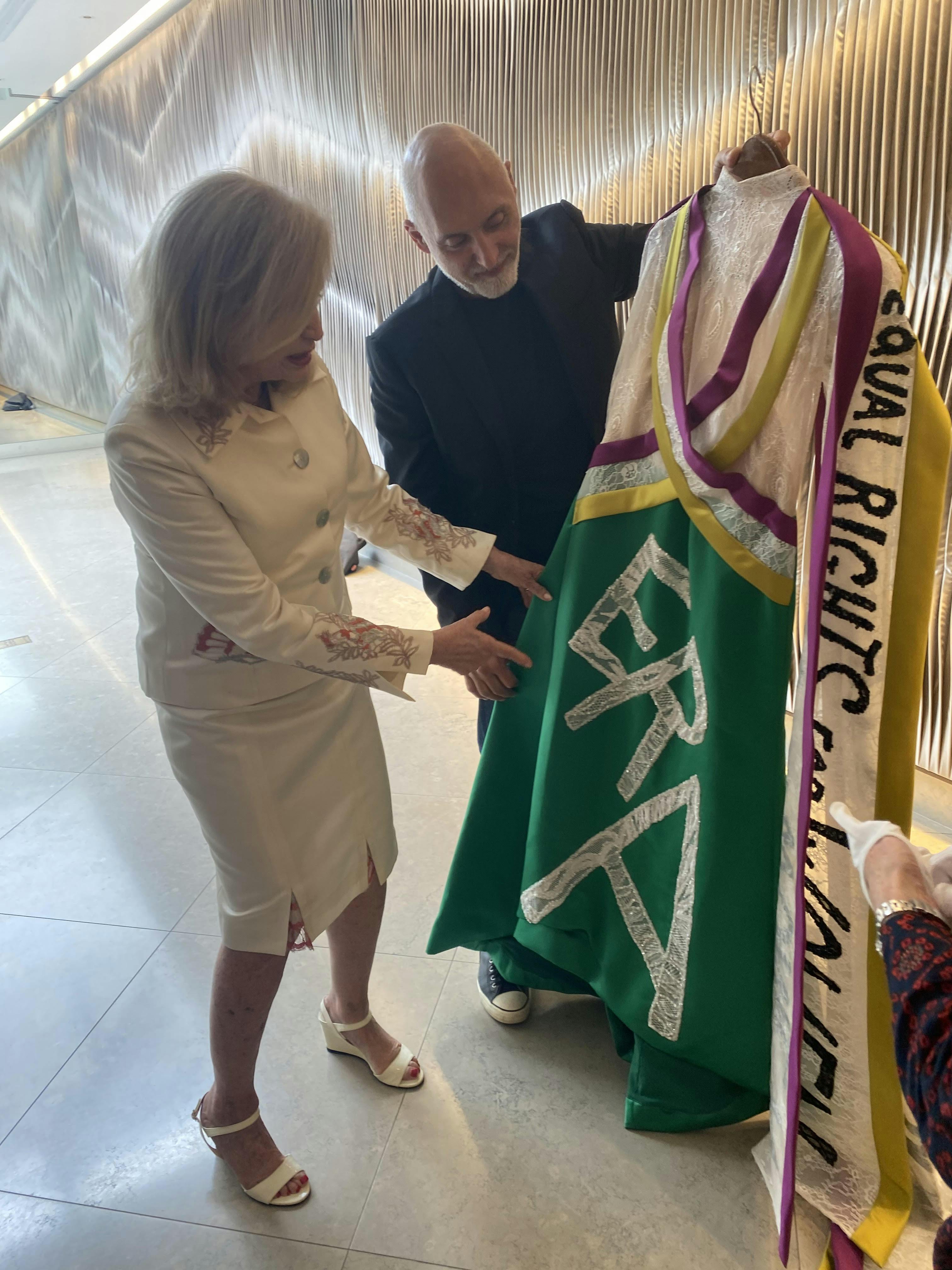
Representative Mahoney and Gassan Antonios with the ERA dress. Photograph courtesy of The Center for Women's History.
Keep Reading
- Women at the CenterMarch 13, 2026
The Conjuring of America: An Interview with Author Lindsey Stewart
With all eyes on Ryan Coogler's Sinners at the 98th Academy Awards, we spoke with philosopher Lindsey Stewart about her recent book on mojos, mermaids, medicine, and Black women's magic. - Women at the CenterFebruary 28, 2026
Tell Her Story: An Interview with Author LaShawn Harris
New York City would never be the same after the death of Eleanor Bumpurs in 1984. In her new book, author LaShawn Harris examines why. - Women at the CenterFebruary 4, 2026
Queer Olympians and Gay Games
Awaiting the start of the 2026 Winter Olympics? Learn more about LGBTQ+ Olympic history and the organization of the Gay Games. - Women at the CenterDecember 22, 2025
Child's Play
What can the playthings of the past tell us about how children understand "women's work"?