On November 28, 2025, The New York Historical will open a new exhibition of photography, Stirring the Melting Pot: Photographs from The New York Historical Collection. Drawn from the vast collections of the Patricia D. Klingenstein Library, the images on display will speak to the myriad immigrant stories that built New York.
One such story belongs to the Luong family.
An ocean away from Vietnam and a war she couldn’t forget, Mrs. Luong Cam found herself in a one-bedroom Brooklyn apartment in 1980. Her seven children attended either P.S. 249 in Brooklyn or Seward Park High School in Lower Manhattan, while her husband, Mr. Luong Diem, navigated the city clutching a small brown English-Chinese dictionary. “I feel like a child,” Mr. Luong said. “Everywhere I go I have to have this book.” Late at night, when Mr. Luong returned home from a long shift at a shoe factory, and Mrs. Luong quietly worried over how their children were adjusting to American life, the kids stayed up watching TV—“sometimes…till 12,” Mrs. Luong said—as if the flickering screen could offer an escape from the heaviness their parents carried.

Mel Rosenthal, photographer. Vietnamese children watching Aladdin in Endicott, NY, 1993. Patricia D. Klingenstein Library, The New York Historical
During the 1980s and 1990s, the Bronx-native photographer Mel Rosenthal documented the newest arrivals in America in his series “Americans By Choice: The Refuge Project,” capturing the faces and homes of people from conflict zones who sought refuge in New York.
For first-generation Vietnamese refugees, daily life in New York demanded a kind of constant navigation, as the experience of another Vietnamese refugee family indicates. Under the sponsorship of the International Rescue Committee (one of many refugee agencies, such as the Catholic Relief Services or the Church World Service, that extended support to Vietnamese refugees), the Dinh family arrived in New York five weeks after leaving their home. They got set up in a three‐room, fifth‐floor walkup in the West Bronx, while all were still ill with malaria. But sickness was the least of their problems. They needed money. “I am in a deep depression,” Mr. Dinh said through an interpreter. “We have nothing. We lost everything but our lives.”
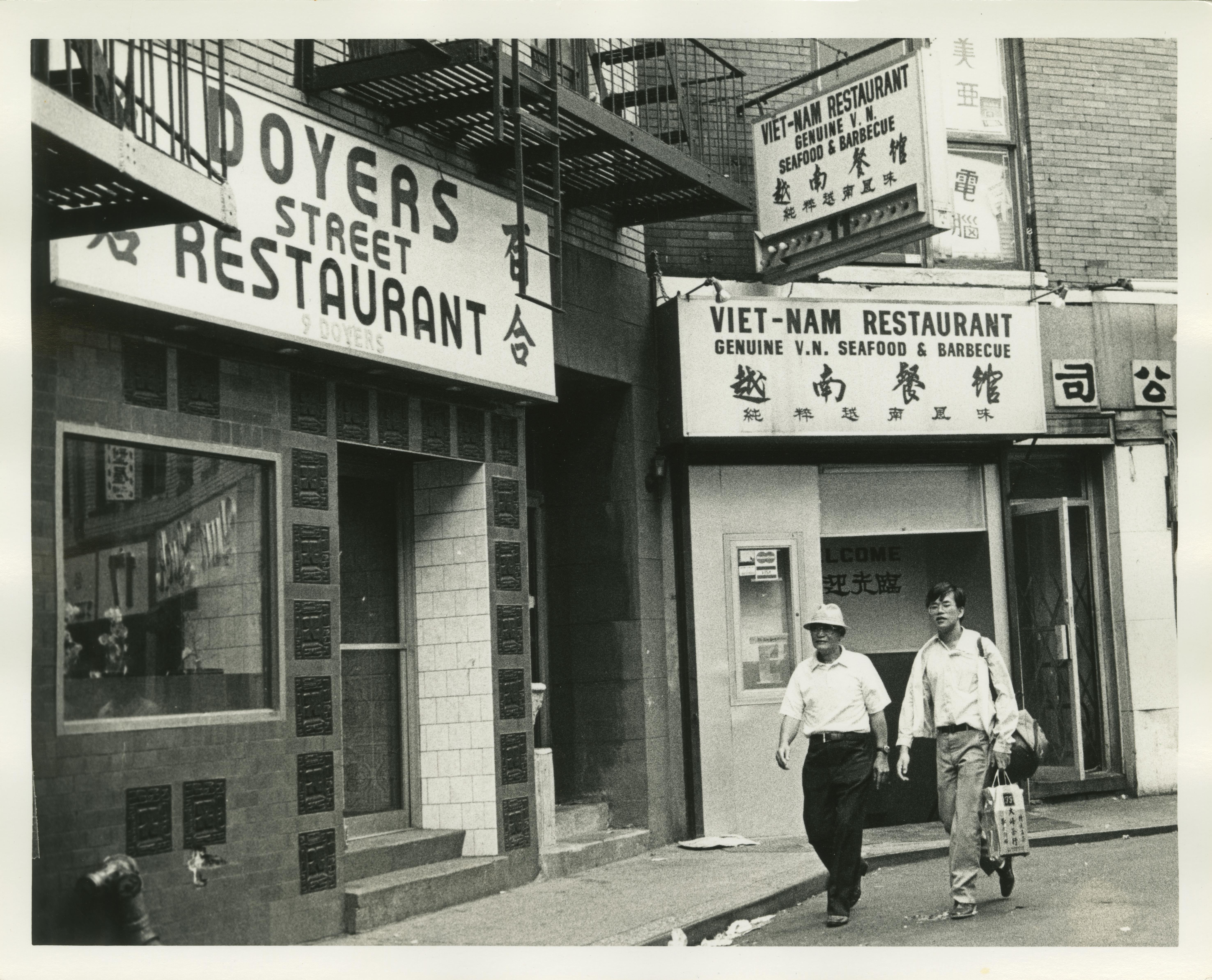
Eugene Gordon (b. 1923), photographer. Two men walking on Doyers Street, in front of Viet-Nam Restaurant and Doyers Street Restaurant, 1985. Patricia D. Klingenstein Library, The New York Historical
The physical and emotional displacement many Vietnamese refugees grappled with is perhaps most salient in Mr. Dinh’s recollections of his first brush with the subway. Transplants will begrudgingly admit: the subway often feels like a test designed to expose your limits. But for Mr. Dinh and his brother Ut, refugees fresh off a 9,000-mile journey, still recovering from malaria, and armed only with subway tokens, it was something of a concrete-wrapped labyrinth. Unfamiliar with the vast city, the brothers accidentally went downtown. Then somewhere else that they didn't recognize. “At one point we thought we would never get out of the tunnels,” Ut said. It took three tokens and blind trust to reach their apartment.
After finally securing employment cutting and polishing diamonds in a factory on 47th Street, Mr. Dinh did all he could to make his family’s life more comfortable. He needed to get warm clothing for his children aged five, seven, and ten, as well as furniture for his apartment, he reportedly told a visitor. “Furniture” was a word he learned from a book called Your New Country: A Guide to Language and Life in the USA. In the Dinh’s living room was a three-legged shell of a television set that contained “neither screen nor innards.” Mr. Dinh had found it in a garbage heap on his way home from work and had carried it on his back up the five flights to their home. Mrs. Dinh had spread doilies across its top and decorated it with yellow and pink roses she crafted from cloth. Inside, their children had placed drawings of the boat they had used to flee Vietnam. Though it was, in form and function, an empty object, the family made it a centerpiece. The children’s drawings made concrete what was on their minds: “I was not afraid of the sea,” Mr. Dinh's ten‐year‐old son, Chinh, recalled, “I was only afraid of being caught.”
Mrs. Luong’s children, though far more comfortable with English than their parents, still struggled to fit in at school. “They don’t play much with the others,” she said. But school in New York wasn’t all bad—after all, according to one of the Luong children, compared to singing slogans and “look[ing] at a blackboard,” their new life was “sort of like play.” It may have been easier for the Luong children to carry their memories of life in Vietnam lightly, or to keep them tucked away entirely. Forgetting the past may very well have made transitioning to life in America easier. But it wasn’t always possible. “My mother crie[d] every night,” said Loi Thi Nghiem, a 39‐year‐old secretary who was evacuated from Vietnam with part of her family. “She left four children behind.”
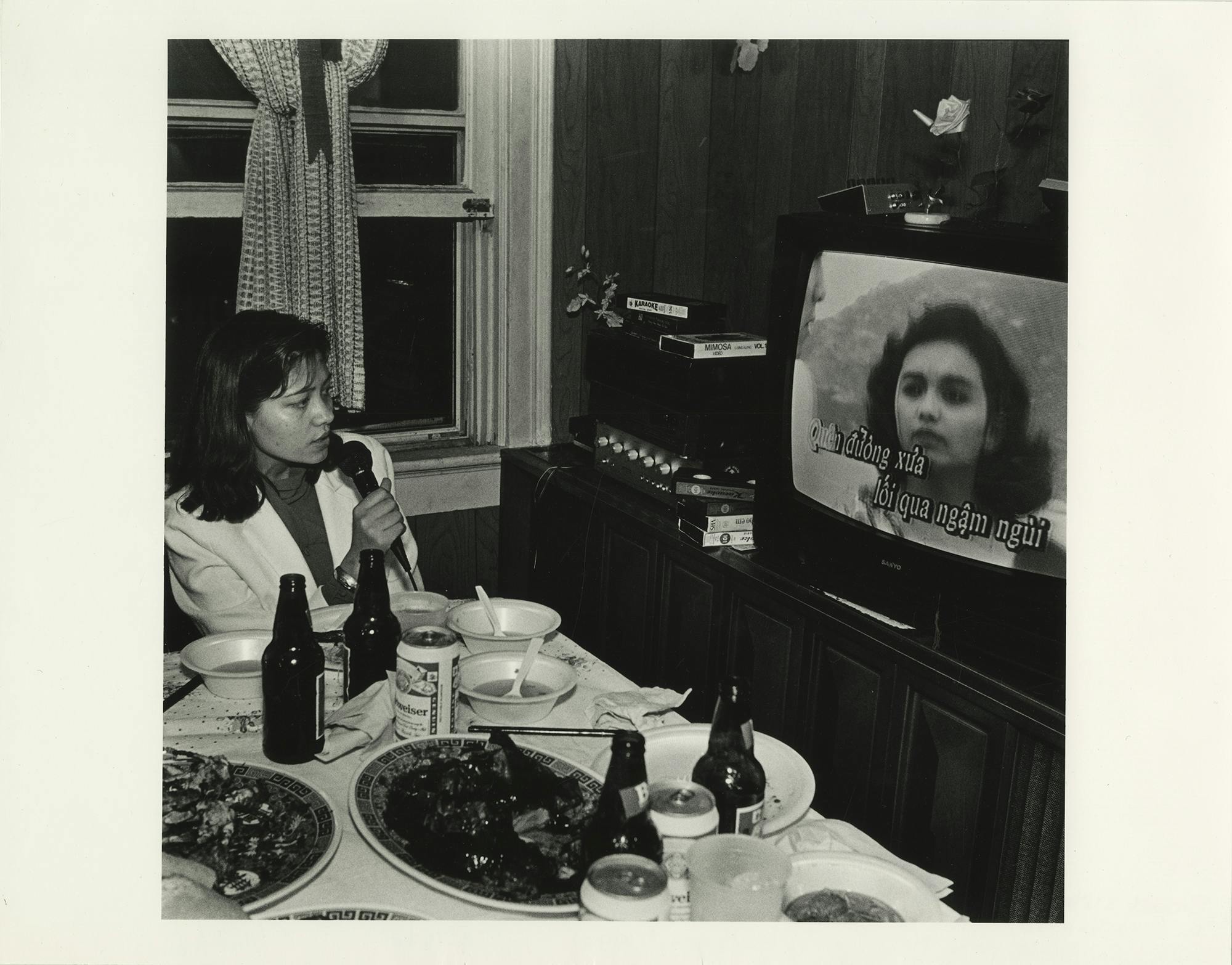
Mel Rosenthal, photographer. Sweet sixteen party of Vietnamese teenagers in Syracuse, NY, 1992. Patricia D. Klingenstein Library, The New York Historical
The words on the karaoke screen are "Forget the past. It will only hurt you."
Years later, on college campuses, children of Vietnamese refugees began to grapple with feelings of cultural isolation. At Queens College, Tina Tran, a student in Professor John Kuo Wei Tchen’s Urban Studies course “Asians in New York City,” reflected on her early childhood spent in Vietnam. “In Vietnam…I spoke the language. I knew people of my same background and they understood me,” she noted. “[In America,] the language and customs keep me from expressing my feelings. I have to translate [it all] into English and it takes a long time.”
While many Vietnamese parents bore their grief in silence—often shielding their children from stories of what had been lost—others outside the community urged that the past not be forgotten. Among the first to respond to the influx of Vietnamese refugees were Jewish relief organizations, who saw in the plight of the “boat people” a haunting parallel to their own. Elie Wiesel, chairman of President Jimmy Carter’s Commission on the Holocaust and himself a survivor of the Holocaust, called on all countries to “open their borders and to extend asylum” and to act “before it is too late.” Wiesel, along with many Jewish leaders, urged his community to “learn from the history of the Holocaust not to err again.”
Though the story of Vietnamese refugees in 1970s New York is often told through the lens of policy and politics, at its heart is a story of parents struggling to survive, and children learning how to translate that survival into a future. To discover more immigrant stories, please visit Stirring the Melting Pot: Photographs from The New York Historical Collection, on view from November 28, 2025 to March 29, 2026.
Written by Lauren Lee, Phillips Exeter Summer Intern, Jean Margo Reid Center for Women's History
Keep Reading
- Women at the CenterMarch 13, 2026
The Conjuring of America: An Interview with Author Lindsey Stewart
With all eyes on Ryan Coogler's Sinners at the 98th Academy Awards, we spoke with philosopher Lindsey Stewart about her recent book on mojos, mermaids, medicine, and Black women's magic. - Women at the CenterFebruary 28, 2026
Tell Her Story: An Interview with Author LaShawn Harris
New York City would never be the same after the death of Eleanor Bumpurs in 1984. In her new book, author LaShawn Harris examines why. - Women at the CenterFebruary 4, 2026
Queer Olympians and Gay Games
Awaiting the start of the 2026 Winter Olympics? Learn more about LGBTQ+ Olympic history and the organization of the Gay Games. - Women at the CenterDecember 22, 2025
Child's Play
What can the playthings of the past tell us about how children understand "women's work"?