Though we might often think of October only in connection with "spooky season," it is also Domestic Violence Awareness Month. Scream With Me: Horror Films and the Rise of American Feminism, a new book by Eleanor Johnson, Professor of English and Comparative Literature at Columbia University, makes the connection explicit with her discussion of six financially successful and critically lauded films, released between 1968 and 1980, that were "inextricably linked with the fight for women's rights in the United States." In her analyses of Rosemary's Baby, The Exorcist, The Stepford Wives, The Omen, Alien, and The Shining, she dissects precisely how these horror films engaged directly with topics such as physical and psychological abuse, reproductive coercion, and isolation. While her focus is primarily on the late 20th century, Johnson also makes it clear that these decades-old films—and the issues they raise—still resonate profoundly in the present day.
We are deeply grateful to Dr. Johnson for taking the time to speak with us about her new work.


Author photo by Jill Shormer. Cover image and author photo courtesy of Atria Books
I'd love to start with the group of horror movies your book discusses: six films, all released between 1968 and 1980, which at first glance don't seem to have all that much in common. However, you make a compelling argument in your Introduction that they can all be considered exemplary specimens of domestic horror. Could you explain how you define domestic horror, and why this particular moment in American history produced so many iconic domestic horror films?
Horror has many, many subgenres, many of which are familiar even to people who don't like horror: slashers, sci-fi horror, psychopathy horror, monster films, etc. But when I started working on this project, which began as a big article about Rosemary's Baby, I realized that there was something particular about that film. In it, the ostensible horror was supernatural, namely Satan and witchcraft. But the real horror, as I came to understand on repeated viewings, was in Guy Woodhouse, Rosemary's abusive and gaslighting husband. I realized, in fact, that the realest threat facing her was him, a male whom she trusted and was close to, and whom she couldn't reasonably be expected to escape, because he was her husband. I also realized that her imperilment was worsened because it was in her home, where she was alone and isolated. And I realized that the core of her vulnerability was her status as a woman of reproductive age. So then I started asking myself if there were other films with those criteria—films where something supernatural was going on, but where that supernatural danger was facilitated by men against women in the domestic sphere, and I immediately realized there were lots of movies like that, particularly in the 1970s (and again in the 2020s, as it turns out). So I define "domestic horror" in those terms: it's a horror genre in which there are supernatural elements, but in which the real point of origin for the horror is the entrapment of a woman in the domestic sphere, where she is tormented and dehumanized by one or more trusted male malefactors, whom she cannot easily escape. All of the films in my book fit those criteria.
Rosemary's Baby is famously set in New York City. New York now has laws in place to protect abortion access, but prior to the film's release in 1968, the state was a battleground for reproductive rights: although abortion was illegal unless the mother "was in provable and immediate medical danger," a confluence of many different factors came together and worked to change that. Can you talk a little bit about the situation in New York at the end of the 1960s, and how the release of Rosemary's Baby fit into the shifting narrative about abortion?
Yes, I'd love to. So, in 1967 and 1968, New York State attempted to pass legislation that would have liberalized—not legalized, just slightly liberalized—the very severe anti-abortion laws on the books at the time. Specifically, people wanted to allow women to terminate pregnancies that resulted from rape or that posed serious health risks to mother or child. In both 1967 and 1968, these liberalization measures were voted down, by a huge margin. So things were not looking good for women's reproductive rights, even in the relatively liberal state of New York, in the late 1960s. But in mid-1968, Rosemary's Baby was released. It's a film that forces viewers to watch and empathize with the suffering of a woman who is—specifically—a victim of rape (Satanic rape, no less) and whose life is seriously endangered by the fact of the pregnancy. Rosemary's case was exactly what women's rights groups were fighting about in the period. This film was on the silver screen for about a year, until near the end of 1969. And in 1970, New York state again voted on women's reproductive rights, and this time decided not to liberalize, but actually to legalize abortion, and the vote was a landslide. So what happened, in the space of a year, to so radically reverse state legislation? It was women's rights organizations, grass roots movements, for sure. But I believe that the fact that millions of people saw Rosemary's Baby, felt Rosemary's imprisonment, saw her pain, saw her suffering, saw how afraid and sick she was…I believe it became very, very hard not to vote for women's reproductive rights in the wake of that massive cultural experience. And of course, the fact that Rosemary is literally pregnant with the Antichrist helps: no one on earth, no matter how religious, could want Rosemary to maintain that pregnancy. So the film created a thought experiment, and the result was to radically and rapidly change public sentiment in New York around women's bodily rights and autonomy.

Underground rectifier station, Central Park West between West 72nd Street and West 73rd Street, Manhattan, 1930. Patricia D. Klingenstein Library, The New York Historical. © New York Transit Museum
The 1968 domestic horror film Rosemary's Baby, set in the fictional Bramford Building, used the exteriors of Manhattan's landmark Dakota Building, just a few blocks south of The New York Historical.
Now I'd love to skip ahead to 1976 and the release of The Omen. It has some similarities to Rosemary's Baby, but, as you write, this film "added a new layer to the feminist critiques of the 1970s" through the figure of Robert Thorn, as played by Gregory Peck. Can you walk us through how Robert Thorn differs from Guy Woodhouse (the malevolent husband in Rosemary's Baby) and how the differences between them inform both The Omen's take on domestic horror, and elucidate the growing tensions over reproductive rights in the mid-1970s, post-Roe v. Wade?
Yes, I love this question. Guy Woodhouse—the villainous and abusive husband of Rosemary's Baby—is easy to hate. Robert Thorn, played by Gregory Peck in The Omen, is very easy to like. Our point of view is located in him, for one thing, throughout The Omen. Plus, he's just a lovely, kind, even doting husband, completely besotted with his wife Kathy (Lee Remick). But when you watch the opening scenes of the film, what you see is that Robert Thorn decides to lie to his wife Kathy, telling her that an adopted foundling boy (Damien, who turns out to be the Antichrist) is the child she gave birth to. The reason he does this is that he doesn't believe she will mentally survive the truth, which is that her own baby boy died at birth. So Good Guy Robert Thorn decides to gaslight and lie to Kathy about one of the most basic things in life: the identity of her baby. As a direct result of his lie, Kathy winds up being tortured, assaulted, and eventually brutally murdered. So what The Omen does that Rosemary's Baby did not do is to lay blame for domestic horror at the feet of the "good guys." The film is saying, "Ok, sure, we know what bad husbands look like, but isn't it also true that very good, loving, well-meaning husbands can still cause grave harm to wives if the husbands are acting in a way that is, ultimately, patriarchal and controlling?" The Omen, then, is making a critique not so much of what we would now call "toxic masculinity" (which is Guy Woodhouse's problem) but of "benign patriarchalism," which is something more insidious and harder to diagnose than Guy's form of malice and cruelty. Indeed, one of the fascinating messages of the film is that if benign patriarchalism is allowed to rule the day, the result will be that the Antichrist winds up in the White House—literally, that's what happens at the end of the film. With both his parents having been killed, Damien goes to live with Robert Thorn's best friend, the US President. So, the film suggests, benign and well-meaning patriarchalism is dangerous not only to women, but to our very nation.
Let's turn now to The Exorcist, released at the end of 1973. You describe it as both a vehicle for "some deep anti-feminist sentiment" and part of "the vanguard of American feminist cinema," addressing this apparent contradiction by focusing on Chris MacNeil, the character played by Ellen Burstyn. Over the course of the film, this formerly liberated, self-sufficient, working single mother is "broken—both physically and psychologically—by a demon who has entered her home" and possessed her young daughter Regan. This situates the film within the context of a growing national conversation about domestic abuse in the early 1970s. What were some of the legal, institutional, and social realities that confronted women faced with domestic violence at that time? How were they reflected in the film?
In the first half of the 1970s, the "battered women's movement," as it was then called, was really just getting going. There were only two or three battered women's shelters in the US by 1973; laws that existed to protect women against battery were woefully inadequate. In fact, in 1966, even in New York State—again, a relatively liberal place—a woman seeking a divorce (forget about criminal prosecution) had to provide evidence of a prolonged pattern of physical battery to be taken seriously by the court. If her husband beat the hell out of her once, that wasn't even grounds for divorce. That is domestic horror for you, right there. Part of the reason for the law's toleration of battery was that, for nearly a thousand years in Anglo law (which of course evolved to become American law), it had been an accepted fact that married women belonged to—were possessed by—their husbands, and that those husbands were supposed to "correct" their wives physically (ie: beat them) if they acted in a way the husband did not like. This is called "the doctrine of correction." Domestic abuse, that is, was an accepted norm, and not an exception, for a very, very long time. That had changed somewhat by the 1970s, but not much. And in fact, medical and psychological practitioners in this period believed that women who stayed in domestic violence situations were "masochists," who liked the abuse. Can you imagine? Horrific. There was zero recognition—until the "battered women's movement" got going—that women stayed in domestic violence situations because they literally had nowhere to go, no money to use, no access to legal or psychological help, and were often less safe after they left than before. Then, the day after Christmas in 1973, The Exorcist hit theaters, and stayed there for two years, during which time Americans watched a beautiful woman and her daughter be severely beaten, violated, abused, and broken by a demon who, of course, "possessed" the daughter, and, by extension, also the mother. So The Exorcist is a supernatural film, no question, but it also is an allegory for the very logic of domestic violence: the man of the house possesses the women and children, and is free to abuse them at will. Watching all that stuff happen to Ellen Burstyn accelerated the anti-battery movement dramatically.
What changed by 1980, when The Shining came out and both reviewers and audiences recognized it as the ur-example of "domestic terror?"
By 1980, the American public had generally come to the conclusion that the battery of women and children in the home was bad, that the wives and children weren't "asking for it," and that batterers were the problem. There were also about 300 battered women's shelters in the US by this time, up by a factor of 100 in seven years, which is really incredible, if you think about it. There was also a broad cultural awareness that alcoholism—which Jack Nicholson's character suffers from in The Shining—was a major risk factor for domestic violence, as were prior acts of violence (Nicholson's character had harmed his son's arm years before the events of the film take place). Because Americans were aware of all these realities and behavioral types, Kubrick was able to take King's novel and make a film that really centers on domestic horror as full-blown terrorism: Jack Torrance (Nicholson's character) isn't "just" a toxically masculine man like Guy Woodhouse. Nor is he anything like a "benign patriarch," à la Robert Thorn. He is a deranged, lethal psychopath, who runs around with an axe ready to slaughter his family. And interestingly, in my favorite scene of the film, when Jack meets up with a ghost named Delbert Grady in a bathroom, Grady specifically tells Jack to "correct" his wife and child. The doctrine of correction is thus specifically invoked by the film, and is identified as the epicenter of all the horror.
Here at the Center for Women's History, we've written a lot about the Equal Rights Amendment (in exhibitions, curricula, and many blog posts) but never about The Stepford Wives, published as a book in 1972 and released as a film in 1975. This seems like a bit of an oversight on our part, as the macabre tale of women being killed and replaced by robot replicas appeared right at the same time that the ERA, having flown through Congress, was losing momentum during the state-by-state ratification process. One of the more outspoken opponents of the ERA was Phyllis Schlafly—can you describe why and how Schlafly successfully mustered opposition to the idea that equal rights for women should be part of the Constitution?
Well, as you know, the ERA was actually a very modest bill, one that didn't necessarily entail any immediate concrete gains for women. But Schlafly and her compatriots decided—with tragic cunning and savvy—to rebrand and repackage the ERA not as a "rights bill," which was what it was, but as a "lifestyle bill." That is, Schlafly and others convinced people that the ERA would radically change power dynamics in the home. It would change divorce law in ways that harmed stay-at-home mothers. It would bring more women into the workplace, and out of the home. It would enshrine the hated Roe decision even more deeply in American jurisprudence. It would allow women into active combat situations, so that American girls would be drafted and brought home in body bags. None of this was guaranteed by the ERA. But it didn't matter: over 50% of Americans had supported the ERA in 1972–73, but that number fell steadily, because Schlafly and her posse convinced people that the ERA would scramble the American family. Which, of course, is what The Stepford Wives satirizes, being a horror film in which the men of a suburban town get tired of their uppity wives, and replace them with sex slave robots.
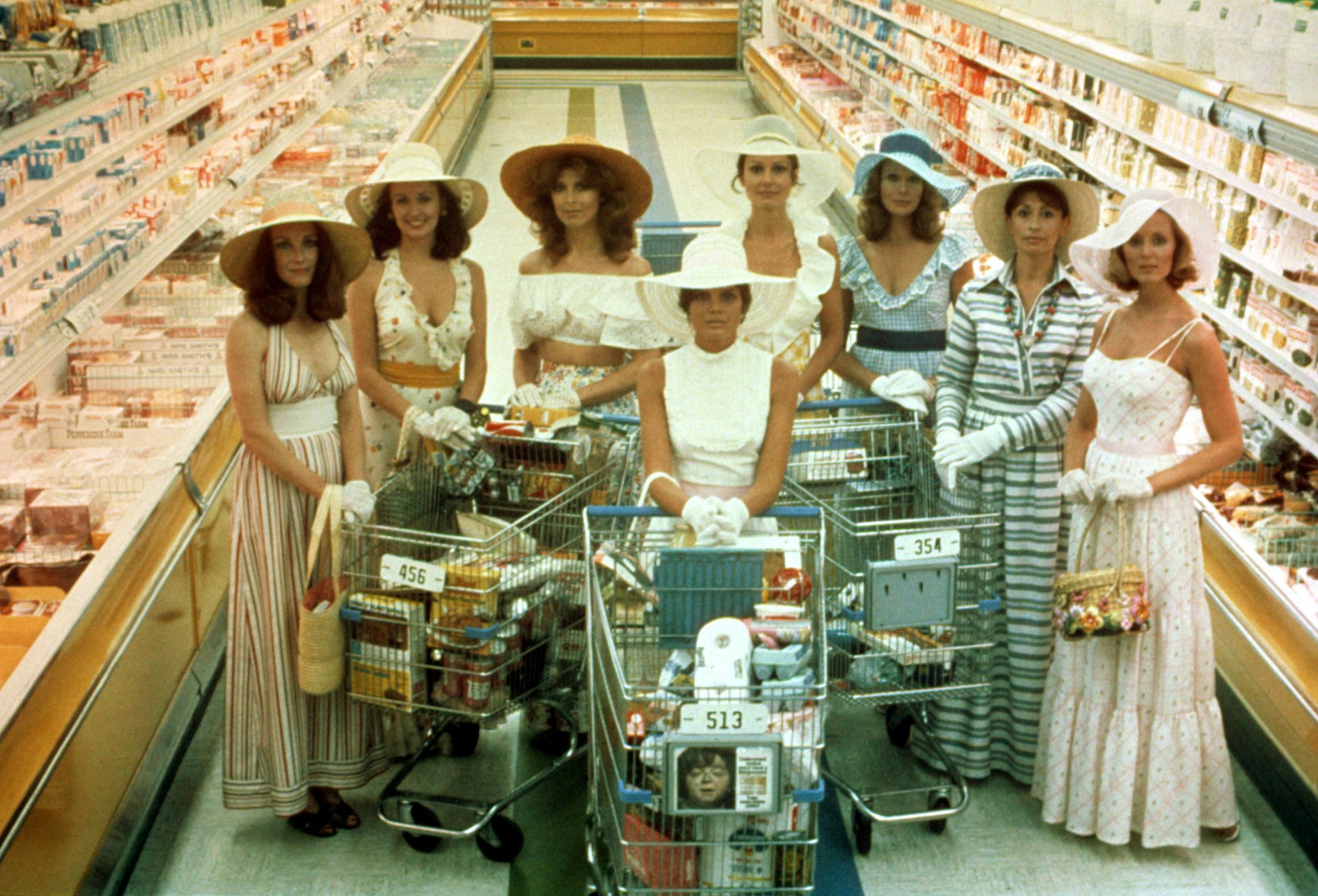
Toni Reid, Carole Mallory, Tina Louise, Katherine Ross, Paula Prentiss, Barbara Rucker, Nanette Newman, and Judith Baldwin in The Stepford Wives, 1975. Courtesy Everett Collection
This brings us to your discussion of Ridley Scott's Alien, released in 1979, just around the time that the ERA, unable to reach the 38-state threshold for ratification, passed its first expiration date. (By 1979, a handful of states had even rescinded previous ratifications.) As you've mentioned, the ERA was by this time understood less in terms of its legal impact, and more in terms of its potential to change gendered lifestyles—specifically in terms of whether or not women would be expected to serve in combat. Now, I am a terrible scaredy-cat when it comes to horror films, but even I have watched (and cheered for) the main character, Ellen Ripley, and her flamethrower. Is that what makes her "a powerful archetype for feminist horror," as you write, or is there something else going on that we should be aware of?
That is a big part of it, yes: Ripley gave the lie to conservatives who said that women couldn't be relied upon as soldiers. I, for one, would pick Ellen Ripley for my teammate in any battle situation, because she's smart, resourceful, and—most important—she really, really wants to live to fight another day. But the other thing that's so, so important to remember about Alien is that it's also a film about rape and forced reproduction. It's easy to miss that, since the first (and second and third) victims of rape and impregnation are men. The famous scene in which Kane (John Hurt) has the alien attached to his face is, of course, a scene of impregnation: the alien is laying an egg in Kane's belly. From there, in an even more famous scene, the baby alien will burst out to be born, very much against Kane's will—indeed, killing him in the process. So Alien is a film that says, "Ok, let's think about how we'd feel if men got raped and impregnated, and were forced to carry their pregnancies to term. How would we feel? We would feel terrified."
Finally, to come full circle—you wrote about how this project originated with a lecture on Rosemary's Baby that you taught in 2022, not long after the Supreme Court overturned Roe v. Wade with their ruling in Dobbs v. Jackson Women's Health Organization. Though the last chapter contains a discussion of three 2024 films, all dealing overtly with reproductive coercion and all explicitly referencing supernatural domestic horror (Immaculate, The First Omen, and Apartment 7A) the book's epilogue is focused on Sarah Polley's Women Talking (2022), which is not usually thought of as a horror film at all. What makes this "the finest domestic horror of the 2020s," and why did you choose to conclude your book with it?
Well, I start the book talking about the surprisingly close relationship between tragedy and horror, and I decided to end the book with a quiet return to that theme. Polley's film is far more often thought of as a "tragic drama" than as a "horror" film, but, to my mind, there's very little distance between the two, except that, as I say in the book's introduction, horror leaves you with a kind of emotional "hangover" in a way that tragedy doesn't. In Polley's film, we see horrific acts of domestic violence, rape, battery, drugging and abuse. All of which, by the way, really happened: Polley's film dramatizes a true story about a Mennonite colony in which atrocious acts of violence were committed against the women and children. That's a tragedy. And it's also horror, because, of course, even though the women of the colony ultimately escape in the end, there's no real sense that they'll ever be "safe," because they're going from one patriarchal world—a very archaic one—to a modern one that they don't know anything about. So even though we are happy to see them leave at the end, we do experience that "horror hangover" of knowing that the world they're stepping into is still very, very dangerous.
Written by Jeanne Gutierrez, Manager of Scholarly Initiatives
Keep Reading
- Women at the CenterFebruary 4, 2026
Queer Olympians and Gay Games
Awaiting the start of the 2026 Winter Olympics? Learn more about LGBTQ+ Olympic history and the organization of the Gay Games. - Women at the CenterDecember 22, 2025
Child's Play
What can the playthings of the past tell us about how children understand "women's work"? - Women at the CenterNovember 1, 2025
Vietnamese Stories from Stirring the Melting Pot: Photographs from The New York Historical Collection
At the heart of the story of Vietnamese refugees in 1970s New York is parents struggling to survive—and children learning how to translate that survival into a future. - Women at the CenterOctober 13, 2025
Show Us Your Sari!
Every sari carries a history. Now it’s your turn to add to it.