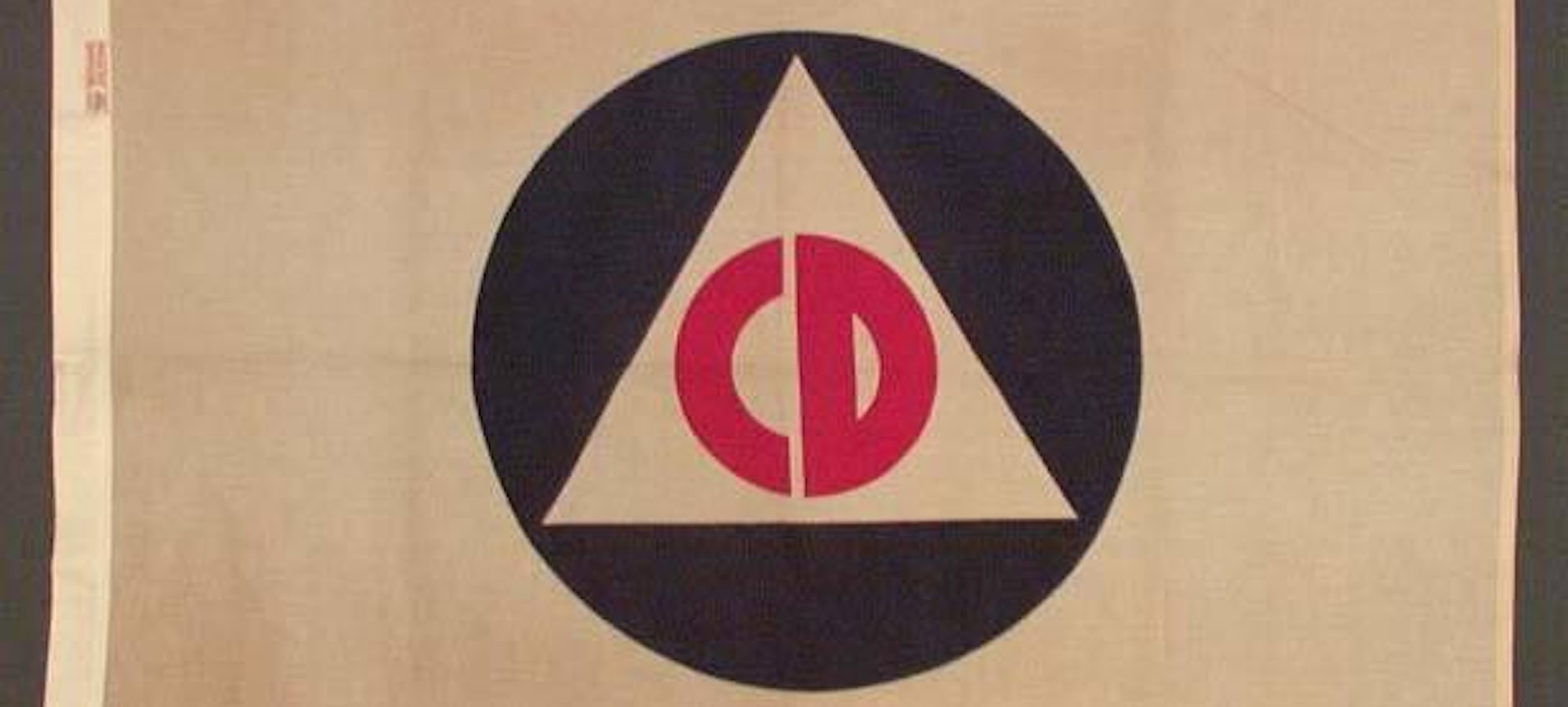
During World War II, Americans across the nation contributed to the war effort both abroad and at home. More than 400,000 New Yorkers, including women like Ann L. Adikes, answered the call to support the war by joining the Civilian Defense Organization, an organization founded to prepare the city for a possible German attack. New-York Historical's collection includes this uniform, worn by Adikes from 1942 to 1945. A blue wool suit purchased at Saks Fifth Avenue, it consists of a skirt and a single-breasted coat fastened with gold buttons cast with the Great Seal of the U.S. The Civilian Defense insignia and six diagonal red stripes, decorate the sleeve. Its side, large patch pockets give away the identity of the designer: this element was the signature of New York-based designer Claire McCardell. While she is no longer a household name, her influence on America’s fashion industry still ripples today. This Labor Day, the Center for Women's History takes a closer look at how her career shaped how women work.
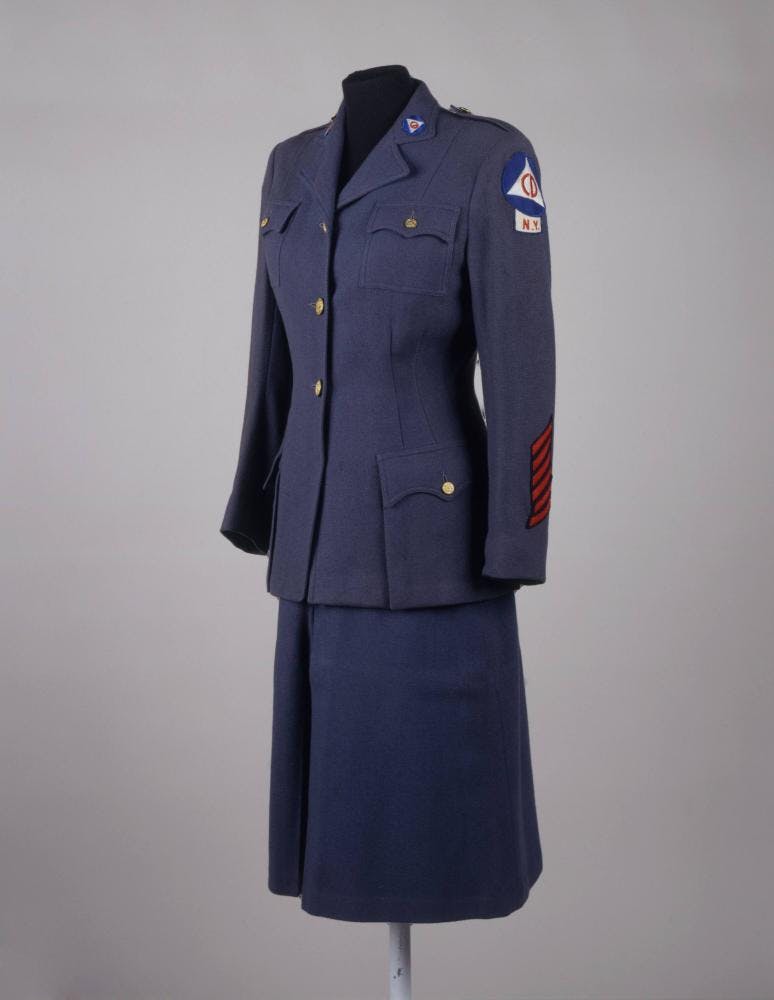
Civil Defense Uniform featuring a single-breasted wool coat with insignia worn by Ann Adikes, Claire McCardell (designer), Saks Fifth Avenue (retailer), Civil Defense uniform, 1942, wool, silk, metal New-York Historical Society, 1946.89a-b
McCardell was part of a cohort of women who between the 1930s and 1950s propelled the American fashion industry to the forefront of global fashion. Women designers, retailers, and fashion journalists—who themselves were working professionals with busy schedules—promoted a practical way of dressing that did not compromise comfort over style. Labeled as “sportswear,” Claire McCardell’s comfortable, versatile clothes were designed to be easily reproduced in the factories of New York’s garment district. While fashion magazines were still looking up to Paris’s Haute Couture, where garments were handmade with intricate traditional techniques, McCardell and her cohort focused on ready-to-wear “separates” in reasonable price points that catered to a growing class of professional women whose lifestyle required dynamic and easy-to-move-in clothes. She was already working with materials such as denim and wool jersey in the 1930s, so she had no trouble quickly adjusting to the shortage of other materials like silk during WWII. Since McCardell was always seeking to innovate women’s wardrobes, the restrictions of rationing only sparked her creativity further.
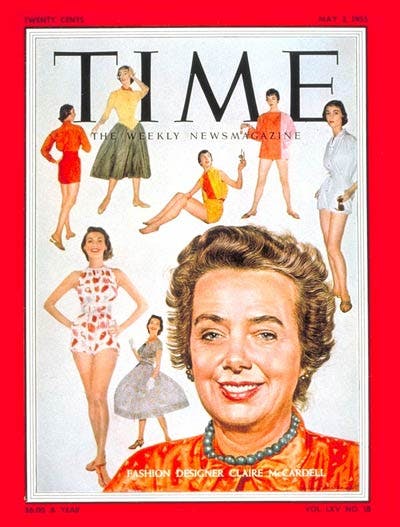
Claire McCardell on the cover of Time Magazine, May 2, 1955
McCardell introduced numerous iconic pieces while working for the Seventh Avenue manufacturer Townley Frocks. The “monastic dress” was a versatile, unstructured dress that shaped around the body with a belt. Her “popover dress" was a wrap dress that sold by the thousands for $6.95. McCardell also designed ballet flats and utilitarian decorations such as double top-stitching in contrasting color, patch pockets, and gold buttons. Time Magazine celebrated McCardell’s influence on women’s everyday lives with a cover story in 1955. She passed away three years later at the age of 52.
McCardell’s easy to wear dresses seem as modern today as they did in the 1940s. During her three-decade career, McCardell saw the life of women around her shift immensely from the home to the broader world—and she created the clothes that enabled them to get the job done.
Keren Ben-Horin, Curatorial Scholar, Center for Women's History
Keep Reading
- Women at the CenterMarch 13, 2026
The Conjuring of America: An Interview with Author Lindsey Stewart
With all eyes on Ryan Coogler's Sinners at the 98th Academy Awards, we spoke with philosopher Lindsey Stewart about her recent book on mojos, mermaids, medicine, and Black women's magic. - Women at the CenterFebruary 28, 2026
Tell Her Story: An Interview with Author LaShawn Harris
New York City would never be the same after the death of Eleanor Bumpurs in 1984. In her new book, author LaShawn Harris examines why. - Women at the CenterFebruary 4, 2026
Queer Olympians and Gay Games
Awaiting the start of the 2026 Winter Olympics? Learn more about LGBTQ+ Olympic history and the organization of the Gay Games. - Women at the CenterDecember 22, 2025
Child's Play
What can the playthings of the past tell us about how children understand "women's work"?