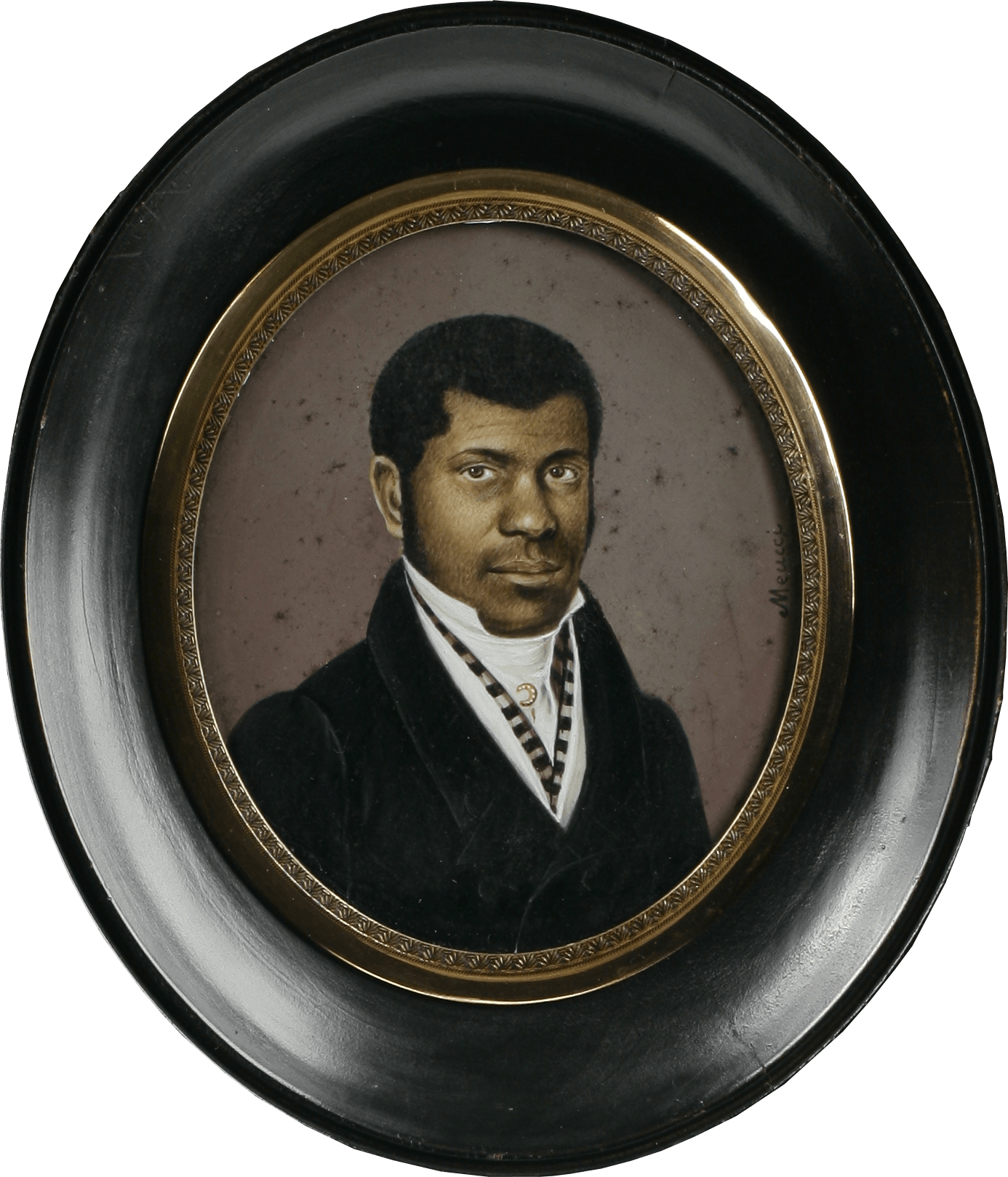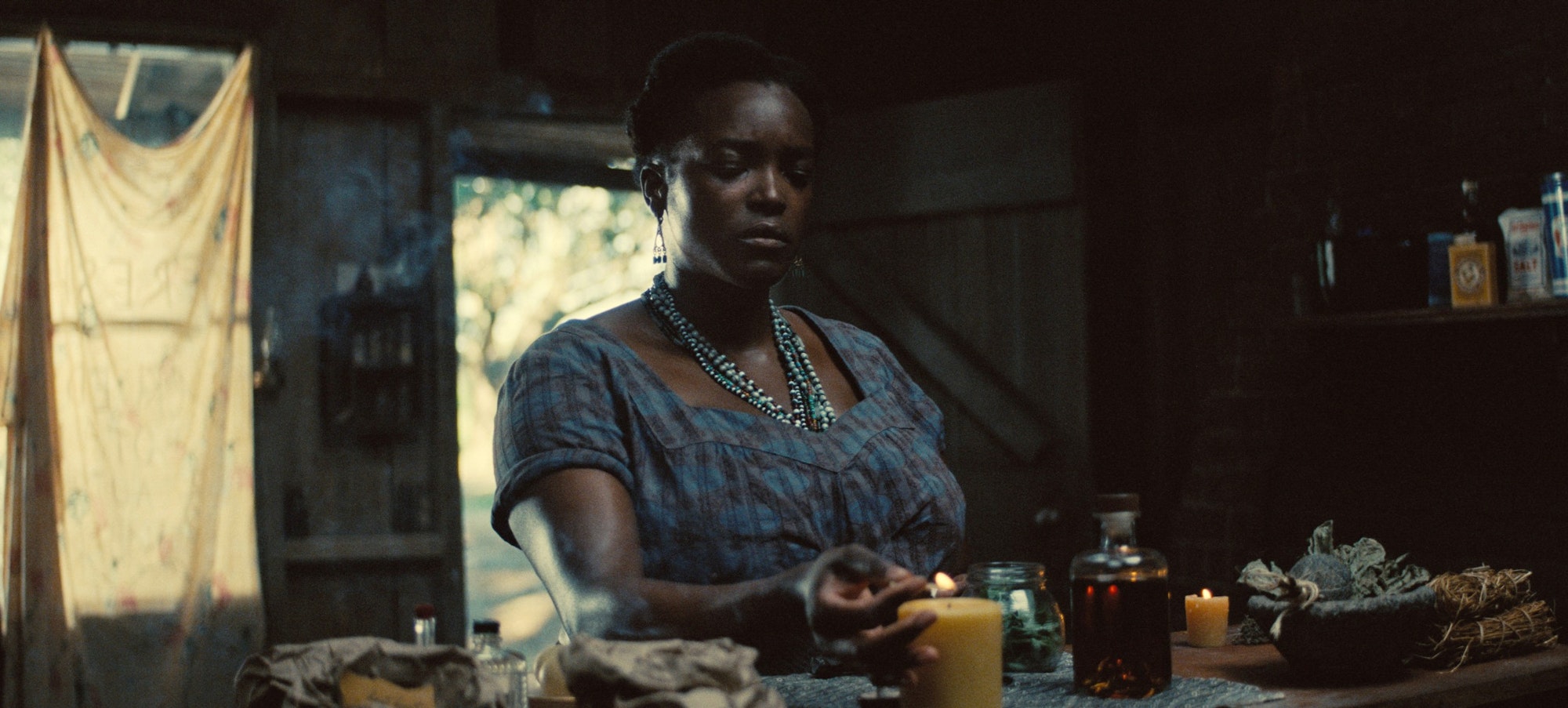
Those of us eagerly awaiting the 98th Academy Awards on Sunday, March 15, are keeping our eyes on Ryan Coogler's Sinners. The film earned a record-breaking 16 nominations, including a Best Supporting Actress nomination for Wunmi Mosaku, the BAFTA-winning, Nigerian-born British performer who plays Annie, the wife of Michael B. Jordan's Smoke and a hoodoo practitioner.
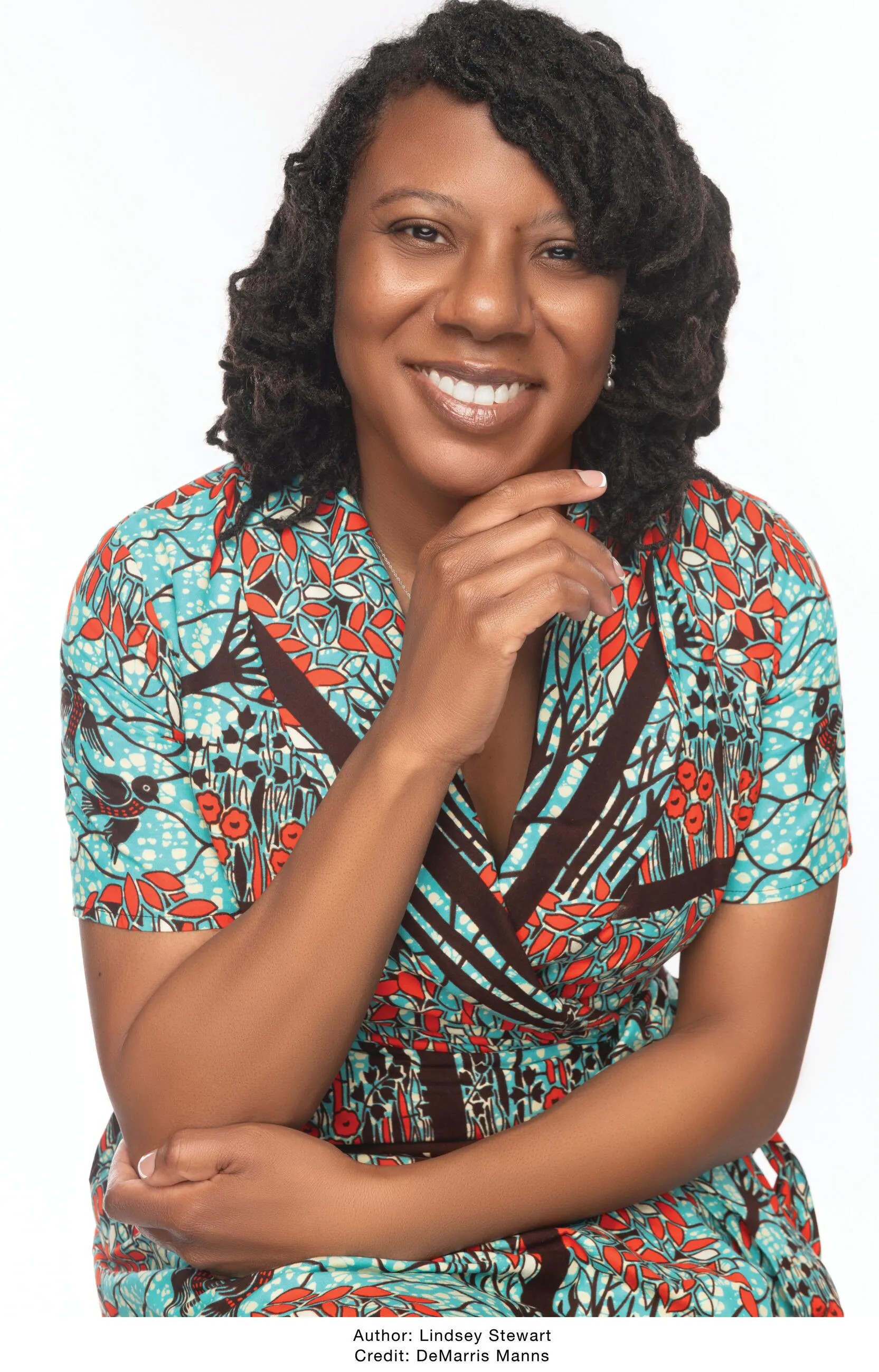
Courtesy of the author
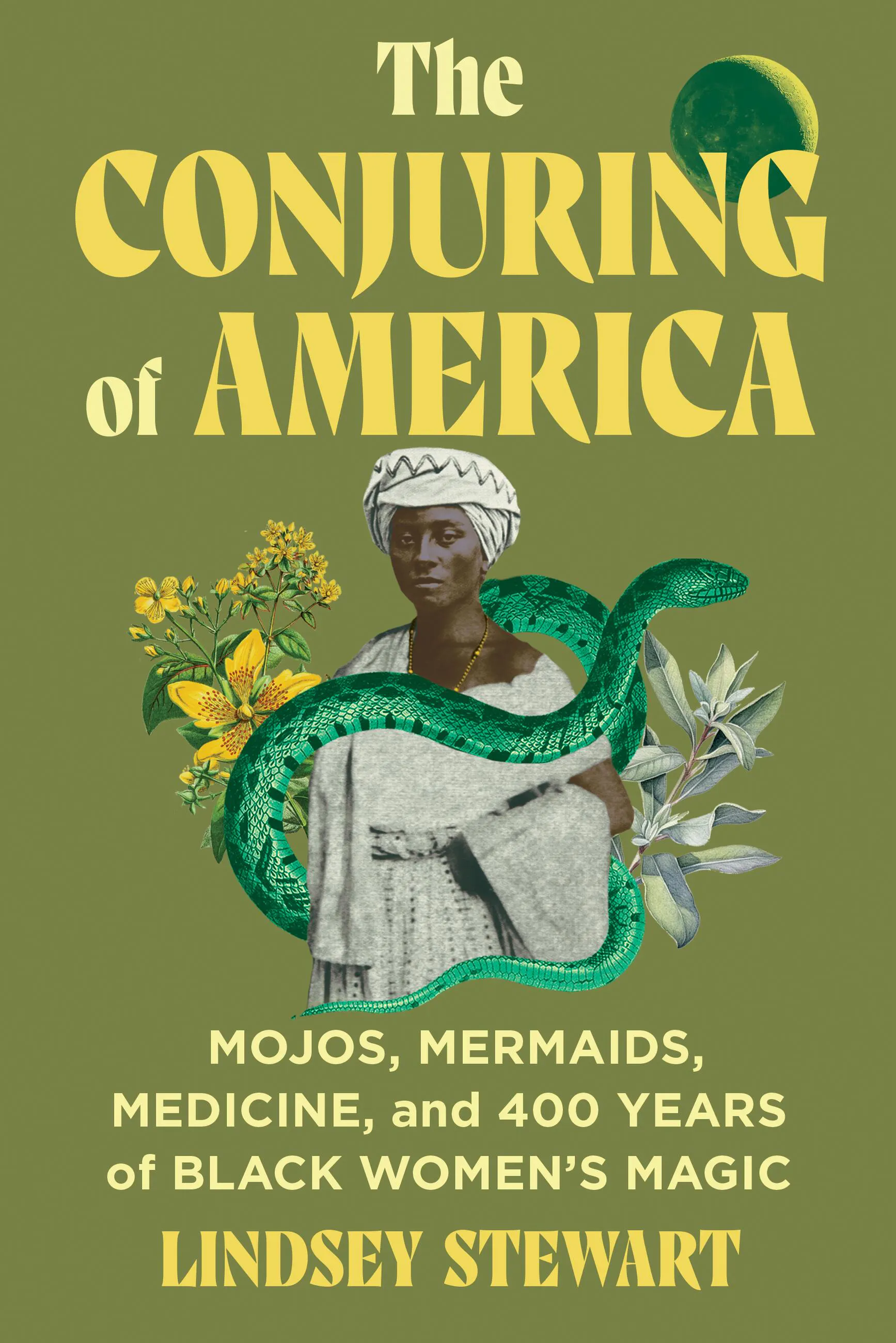
Philosopher Lindsey Stewart, author of the recent book The Conjuring of America: Mojos, Mermaids, Medicine, and 400 Years of Black Women's Magic (Hatchette, 2025) defines hoodoo, or rootwork, as a practice "which combines aspects of Yoruba religion (such as herbalism) with the minkisi [objects possessed by spirits] of the Congolese, and Protestantism," a strong strand in the larger "mix of spiritual beliefs, herbal rituals, and therapeutic practices" called conjure. Conjure, Stewart explains, is woven of the West and Central African religious beliefs that enslaved people carried across the Atlantic even before the founding of the United States; blended with aspects of Islam, Catholicism, and Protestantism, it is kin to Brazilian Candomblé, Haitian Vodou, Cuban Santería, and Jamaican Obeah. As Stewart demonstrates, conjure—which has endured throughout American history and into the present day—centers the needs, skills, and expertise of Black women, and if you have any doubts on that front, she points out, all you need to do is search #blackgirlmagic on any social media platform.
Stewart's book is "a genealogy of conjure," as essayist Danielle Amir Jackson put it in a review for The Atlantic. It charts the impact of conjure women throughout American history, from the time of slavery through Reconstruction, Jim Crow, and the civil rights movement. Each period that Stewart examines focuses on a different aspect of conjure, from herbal medicine to midwifery to the creation of gris-gris (charms or amulets with the power to bring health or harm). However, her overall focus is on continuity: the transmission of power, tradition, expertise, and resilience, across oceans and across generations. As Jackson's review concludes, "At a time when knowledge itself is being made to feel dangerous, when the Tuskegee Airmen and Harriet Tubman are being stripped from historical records, we can learn from conjure women how to maintain, and pass down, our heritage in a country that has frequently sought to quash it."
We are deeply grateful to Dr. Stewart for taking the time to answer our questions about her important and informative work.
Your book is arranged chronologically and thematically, with the first section examining the herbal teas, cures, and salves (such as Vicks VapoRub) that were created and dispensed by "negro mammies" under slavery. I want to ask more about this section specifically, but first could you speak a bit about how you came up with the structure of your book?
The 400-year story of the conjure woman in America is wide sprawling, so I wanted to shape this history in a way that would be easily accessible to Americans. To do this, I followed common understandings of how African American history is divided into periods: slavery, Reconstruction, Jim Crow, and the civil rights movement. To make this history tangible, I focused each part on everyday objects that are central to American culture: salves, mermaid stories, the blues, pancakes, quilts, blue jeans, hairstyles, and soul food. I chose objects that were crucial to conjure women of each historical period to help readers follow how the conjure woman evolved throughout generations of African Americans.
The conventional story about the creation of Vicks VapoRub erases enslaved Black women and sanitizes the institution of slavery. In your hands, the story is very different, centering "the old women who doctored among the slaves," as abolitionist Harriet Jacobs put it, and the various sources of their power. Could you explain some of the ways in which these elderly enslaved women were able to claim agency and authority for themselves?
Enslaved conjure women were remarkable in their widespread knowledge of botany, medicine, and spiritual traditions. This knowledge enabled them to heal common ailments that stumped doctors who were far behind the medicinal curve in the 18th and early 19th centuries (from flus and fevers to reproductive issues). In this sense, these women were widely revered and valued within and without the enslaved community. Their knowledge also provided methods of poisoning and abortions, which threatened their slave masters. Because of this knowledge, these conjure women were often instigators of slave resistance and rebellions.
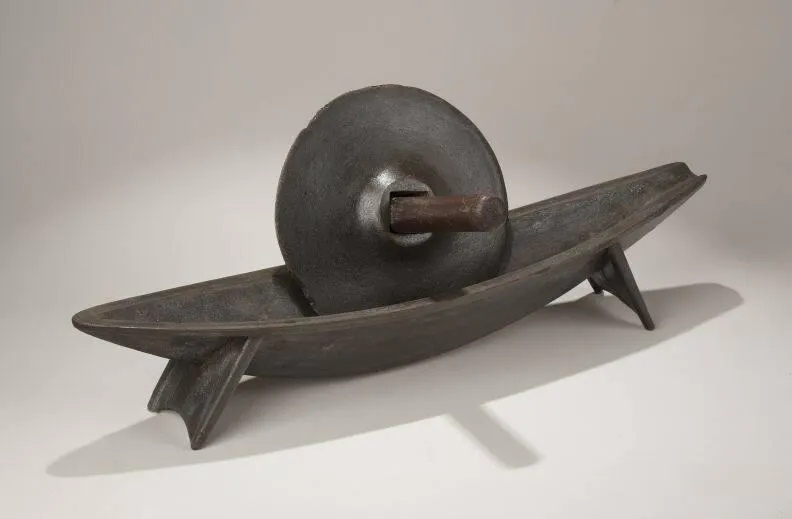
Unidentified maker. Herb grinder, 1820–1860. Iron, oak. Purchased from Elie Nadelman, 1937.1553ab
The second part of your book shifts the focus to antebellum New Orleans and the city's "Voodoo Queens." How do these conjure women differ from the hoodoo or rootwork practitioners that you discussed earlier? How did they challenge the patriarchal power of urban slaveowners?
Voodoo Queens were often free Black women who lived in town, unlike Negro Mammies who were tied to the plantation in rural areas. So, Voodoo Queens had a wider degree of freedom in some ways. The most famous Voodoo Queen, Marie Laveau, was also known for taking on clients who suffered domestic abuse. Many of Laveau’s charms and rituals, called gris-gris, were used to evoke revenge or even up the power dynamics between men and women.
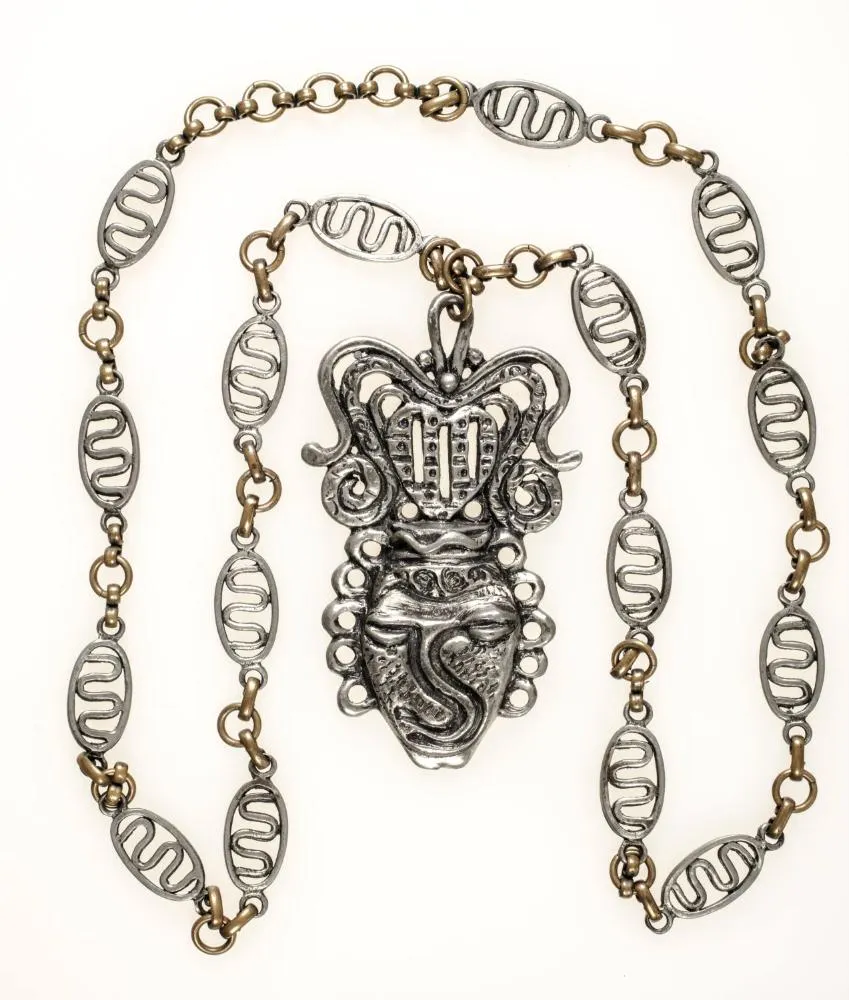
Left: Winifred Mason Chenet (1912–1993), artist. Pendant, 1951–1963. Mixed metals, possibly copper or brass, and pewter. The New York Historical, Gift of Rebecca Klassen, 2024.21
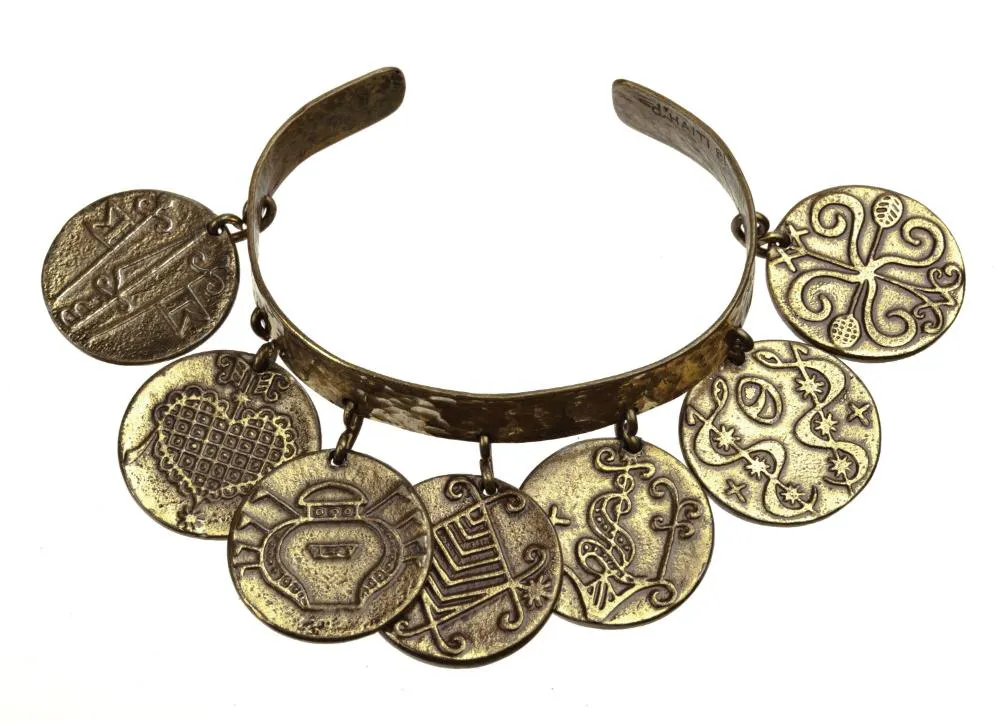
Right: Winifred Mason Chenet (1912–1993), artist. Chenet d'Haiti bracelet, ca. 1955–1962. Plated metal (probably copper or pewter). The New York Historical Purchase, 20th- and 21st-Century Acquisition Fund, 2016.13.
Winifred Mason Chenet, the first known African American professional jewelry designer, created a line of Vodou-inspired jewelry which incorporated Haitian folk and Vodou symbols. The pendant came from Chenet’s Vodou d’Haiti line, and probably depicts Damballah, a Vodou deity known as the god of all spirits. The line, renamed Chenet d’Haiti once the jeweler began selling to Bloomingdale's, also included this bracelet. The charms are Vodou vevets—emblems representing saints that are ceremonially drawn on the ground with powdered chalk, as in the image below.
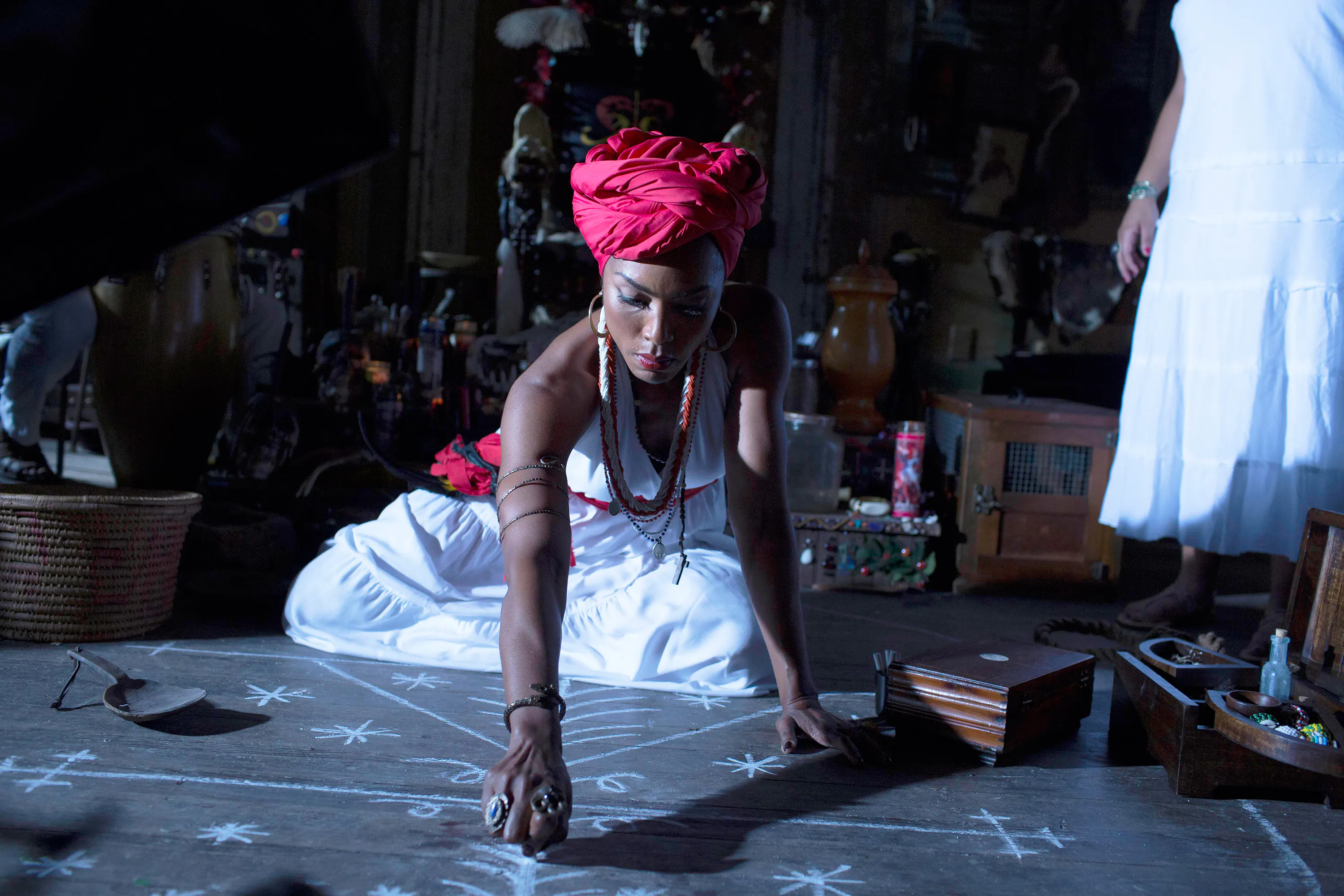
Angela Bassett as Marie Laveau in American Horror Story: Coven, Season 3, Episode 4, October 30, 2013. Michele K. Short/©FX Networks/courtesy Everett Collection
I expect that most people who reach for your book will have at least some familiarity with Marie Laveau, if only from watching Angela Basset in season 3 of American Horror Story. Still, your discussion of Laveau's connection with West African water deities and her facility with gris-gris was totally new to me. Can you speak a little more about the connections between these two aspects of Laveau's conjure? Do you think they are related to our enduring fascination with her life and story?
Across the African diaspora, a water goddess (and mermaid) called Mami Wata is greatly revered. Mami Wata is an amalgamation of many West and Central African water spirits like the Yoruba orishas Oshun and Yemaya and the Congolese simbi. In many parts of the Caribbean, Mami Wata was known as Mama D’lo; in the Georgia and South Carolina Sea Islands, she’s known as Mama Jo. In my book, I argue that in New Orleans, Marie Laveau became our Mami Wata figure.
Like Mami Wata, Marie Laveau’s magic, gris-gris, is also an amalgamation of many spiritual practices: the minkisi of the Congolese, the wanga of Haitian Vodou, the mojos of Hoodoo. I think we still pass down stories of Marie Laveau’s gris-gris because many of these tales involve the struggle against oppression—slave against master, wife against husband.
Your next section is one of my favorites. It begins with the Chicago World's Fair of 1893, where Aunt Jemima made her debut: the "imaginary Negro Mammy" who became the face of Pearl Milling Company's pancake mix. It ends with Betye Saar's The Liberation of Aunt Jemima, and the reclamation of her legacy as one of "covert resistance, strength in the face of nearly insurmountable adversity, and joyful defiance." But the section is mostly about music—minstrelsy, ragtime, and the blues. How did music and the figure of the Negro Mammy interact with and inform each other?
I’ve always been interested in Black music traditions, because it’s one place where you can see what was important to African Americans during different historical periods. During Reconstruction, a period of intense national transformation, you have minstrel shows and ragtime and the blues mixing and laying the foundation of contemporary American music. I was fascinated with how one of the most popular American products during that period, Aunt Jemima’s pancake mix, was drawn from an enslaved protest song, “Promises of Freedom,” that was turned into a minstrel skit. There are really two versions of Aunt Jemima—one from Pearl Milling Company and one from an enslaved protest song—and they challenge how we remember slavery. I can’t help but feel like this challenge is still relevant today, given how much Black history is under attack.
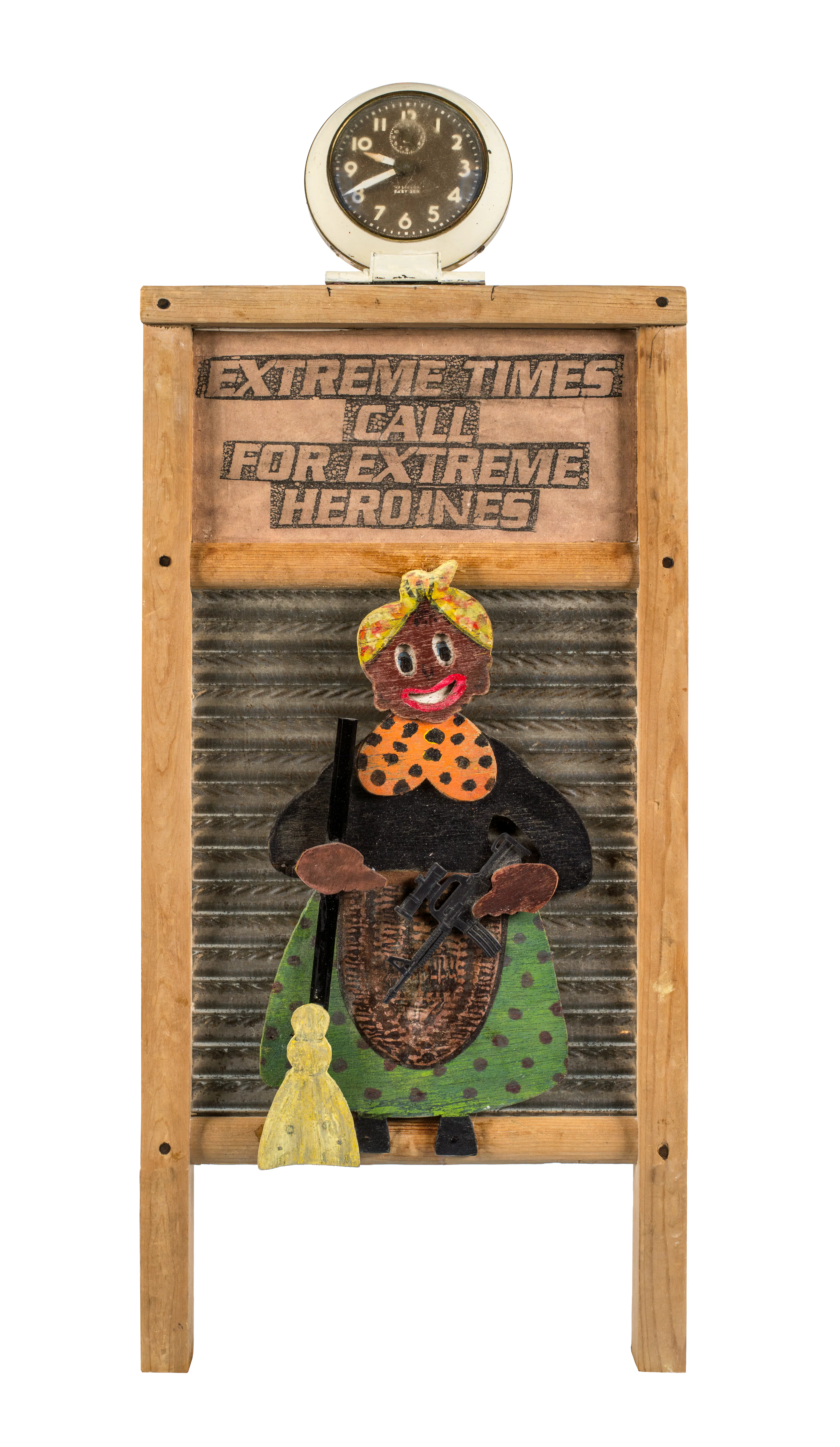
Betye Saar (b. 1926), artist. Extreme Times Call for Extreme Heroines, 2017. Mixed media and wood figure on vintage washboard, clock. The New York Historical, Purchased through the generosity of Louise Mirrer; Ernest Tollerson and Katrinka Leefmans; Pam and Scott Schafler; Marilynn Gelfman Karp; Margi and Andrew Hofer; Linda S. Ferber; Frances Ann Schulman; Nicole, Nathan, and Brian Wagner; an anonymous donor; and members of the Frederick Douglass Council. Additional support provided through the Women Artists Fund in memory of Mildred Mirrer, 2019.76
Section four demonstrates how textiles and midwifery were literally woven together by Black women's bodies—their work on indigo and cotton plantations enriched slaveholders, but the plants could also be used as abortifacients; a way for enslaved women to reclaim control over their bodies. Your book describes how the struggle over Black women's fertility continued into the Jim Crow era, as white male doctors sought to supplant the knowledge and practices of the "Granny Midwives." How did this struggle play out? What was at stake?
Granny Midwives were largely responsible for the reproductive and day-to-day health care of many Blacks and whites in Southern, rural communities. They filled an important gap, as many rural communities did not have medical infrastructure like hospitals. White male doctors of the time—especially gynecologists—were threatened by Granny Midwives who were revered and preferred by many in these rural communities. During the Jim Crow era, these Granny Midwives were eventually forced into “retirement” by the medical establishment. This fight between Granny Midwives and doctors had significant ramifications that still impact us today, from “zombie” anti-abortion laws to the high level of (Black) maternal deaths in this country.
Your section on midwifery ends with a chapter on Black women's hair, which you refer to as "the one place where the conjure of our textiles lives on." Could you explain the significance of hair and hairstyling within the context of conjure?
In many West African religious traditions, hair is spiritually potent. For instance, among the Yoruba, your hair contains your ori, your soul and spiritual destiny. Because of this, hairstylists were believed to be quite powerful—they handled the very fibers of your soul and could manipulate your future. Its striking to me that this relationship to the hairstylist, and this belief that your hair is spiritually potent, has been maintained throughout so many generations of African American women. Even to this day, we are extremely careful about who touches our hair!
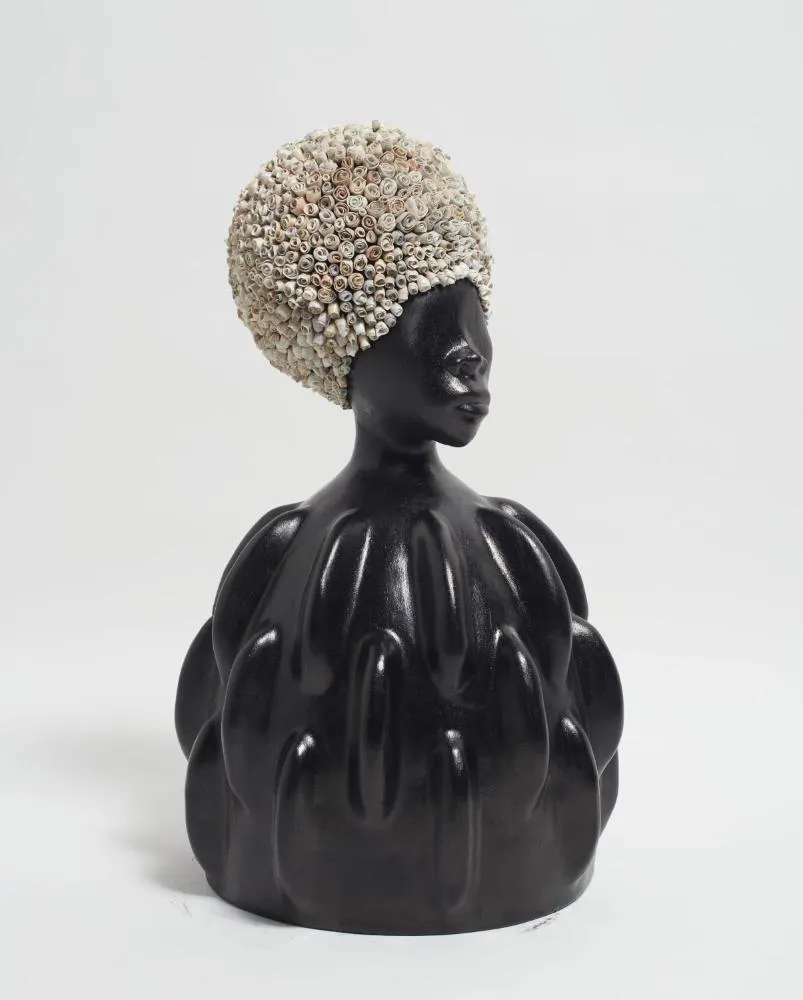
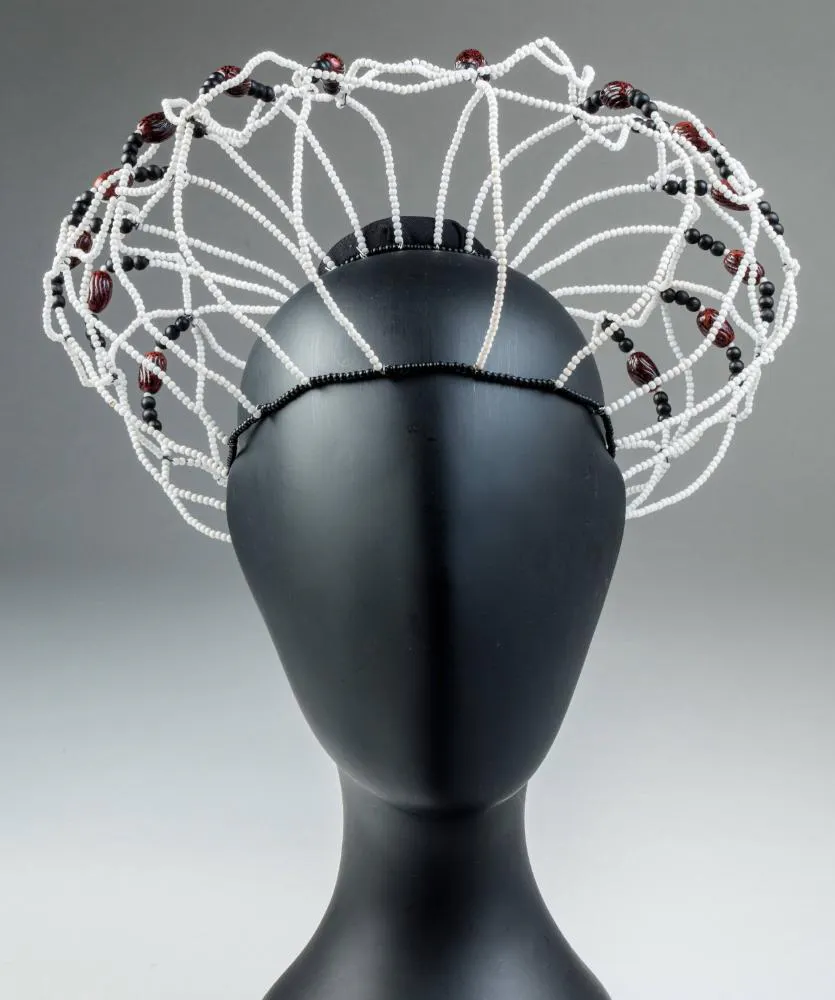
Left: Simone Leigh (b. 1968), artist. Basse Terre, 2017. Fired clay, porcelain, resin, India ink. The New York Historical, Purchased through the generosity of Pamela and Arthur Sanders, Pam and Scott Schafler, 2017.74
Right: Carolee Prince (active ca. 1955–1970), artist. Beaded headdress, 1964. Beads, wood, string, leather. The New York Historical Purchase, Satloff Decorative Arts Fund, 2024.17
Your final section returns to New Orleans and brings forward the long history of "Candy Ladies," from the praline-selling marchandes of the 18th century to Leah Chase, the "Queen of Creole Cuisine" and proprietor of the soul food restaurant Dooky Chase during the civil rights era. How does the seemingly simple every-day act of cooking fit into the conjure tradition, and what were some of the ways in which the preparation (and sale) of food can help overcome social injustice?
For many generations of African American women, the act of cooking has been a source of freedom. Spiritually, the cooking pot has sacred value that is derived, in part, from West African spiritual traditions that view pots as vessels for spirits. So when Black women are cooking, like Leah Chase was fond of saying, they’re also praying! Many ex-slave interviews include stories of Black people using these pots to pray for freedom.
Economically, enslaved women sold the products of our cooking pots (in places like New Orleans, who practiced coartación) to earn money to purchase their freedom. This tradition continued on in Jim Crow, where many women called Candy Ladies (like my great-grandmother, after whom I am named) sold their wares to earn money to ensure some economic independence.
For my final question, I'd like to ask about the ideal audience for your book. You wrote in your conclusion that it was written in part for your students, especially your Black women students. What do you hope they—and others—will take away from your work?
I hope that, upon reading the book, people grasp this crucial lesson: no matter how dire things seem, it’s always possible to drum up power in unexpected places.
Keep Reading
- Women at the CenterSeptember 1, 2026
The 11th Annual Diane and Adam E. Max Conference on Women's History
The 11th Annual Diane and Adam E. Max Conference on Women's History used the semiquincentennial of the signing of the Declaration of Independence to explore the legacy of the Revolution today. - Women at the CenterAugust 31, 2026
The 1876 Women’s Exhibition
What role did women play in commemorating the 100th anniversary of American Independence? - Women at the CenterAugust 3, 2026
A Revolutionary Chocolate Maker: The Business Records of Rebecca Gomez
How did Rebecca Gomez, a Jewish widow and businesswoman, help finance the first home of the New York Stock Exchange? - Women at the CenterJuly 27, 2026
Star-Crossed Lovers of the Revolution: The Letters of Eliza Shipton and Aquila Giles
Was it possible to fall in love across ideological lines during the Revolutionary War?