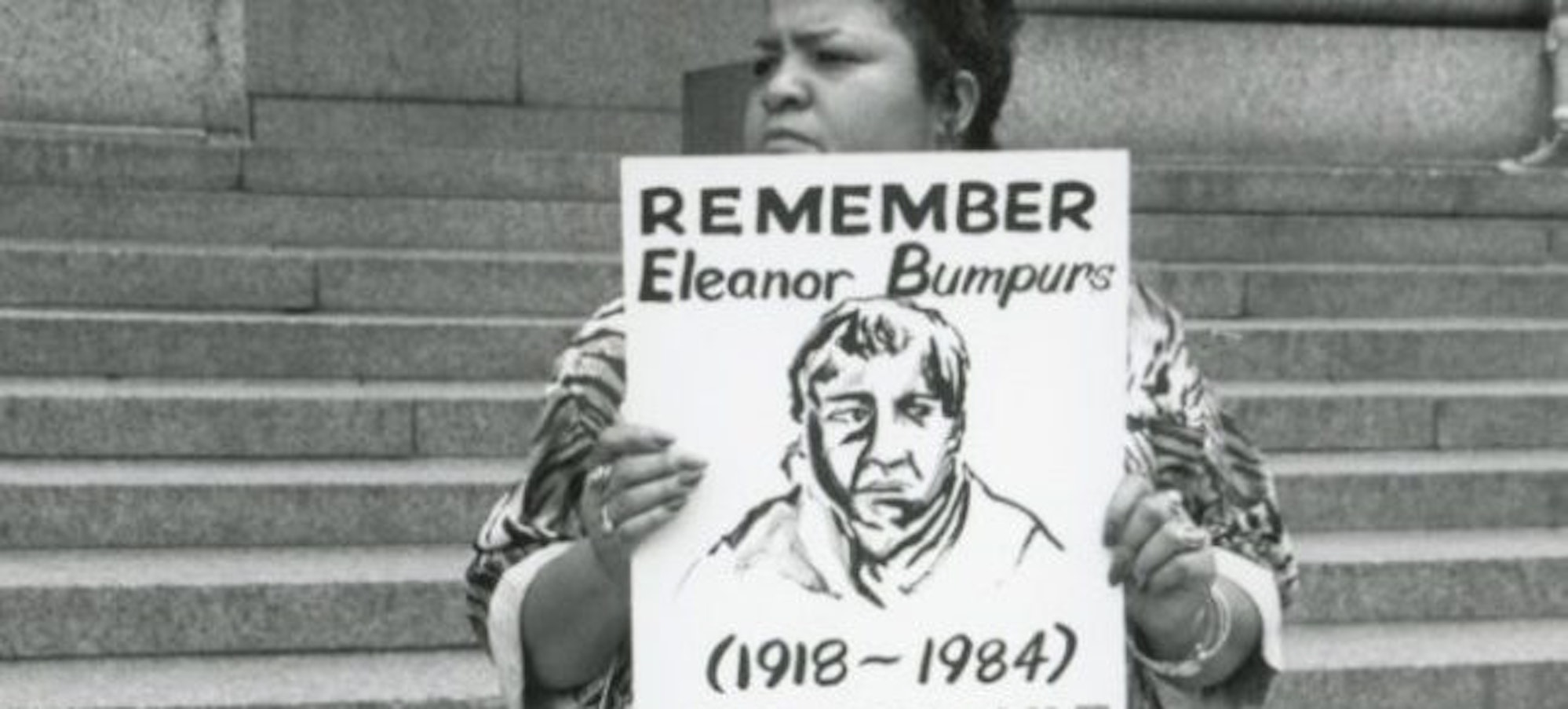
Eleanor Bumpurs, a 66-year-old Bronx resident and disabled grandmother, died just before Halloween in 1984. She had been shot twice by a police officer carrying a 12-gauge shotgun as officials from a half-dozen municipal agencies attempted to evict her from her apartment. In the wake of her murder, historian LaShawn Harris argues, New York City would never be the same. But, as Harris makes clear in her new book, Tell Her Story: Eleanor Bumpurs and the Police Killing that Galvanized New York City, neither Bumpurs' life—nor her death—was as straightforward as the competing narratives about her that swirled through the city and the media at large would allow.
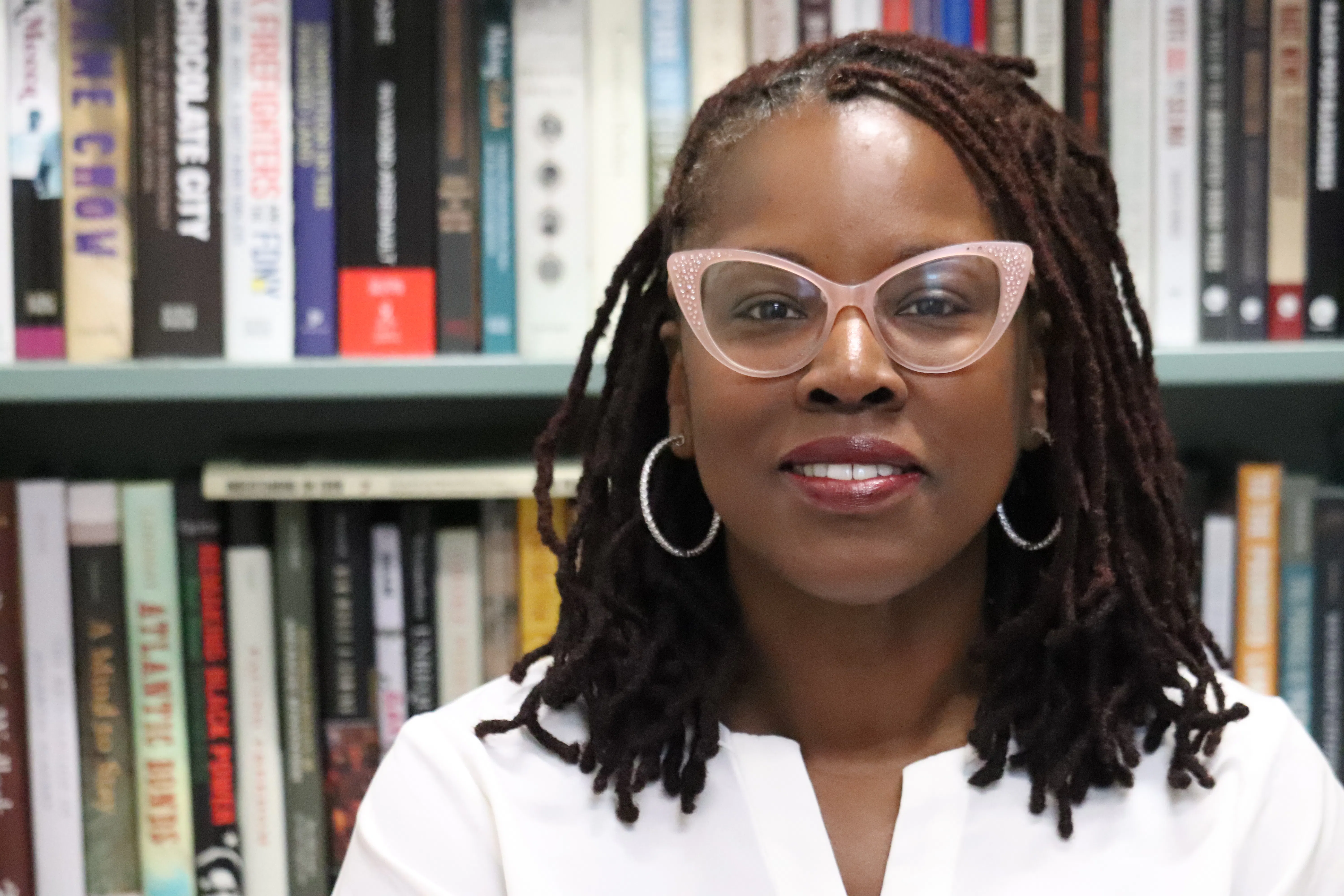
Author photo by Jared Milburn. Image courtesy of Beacon Press
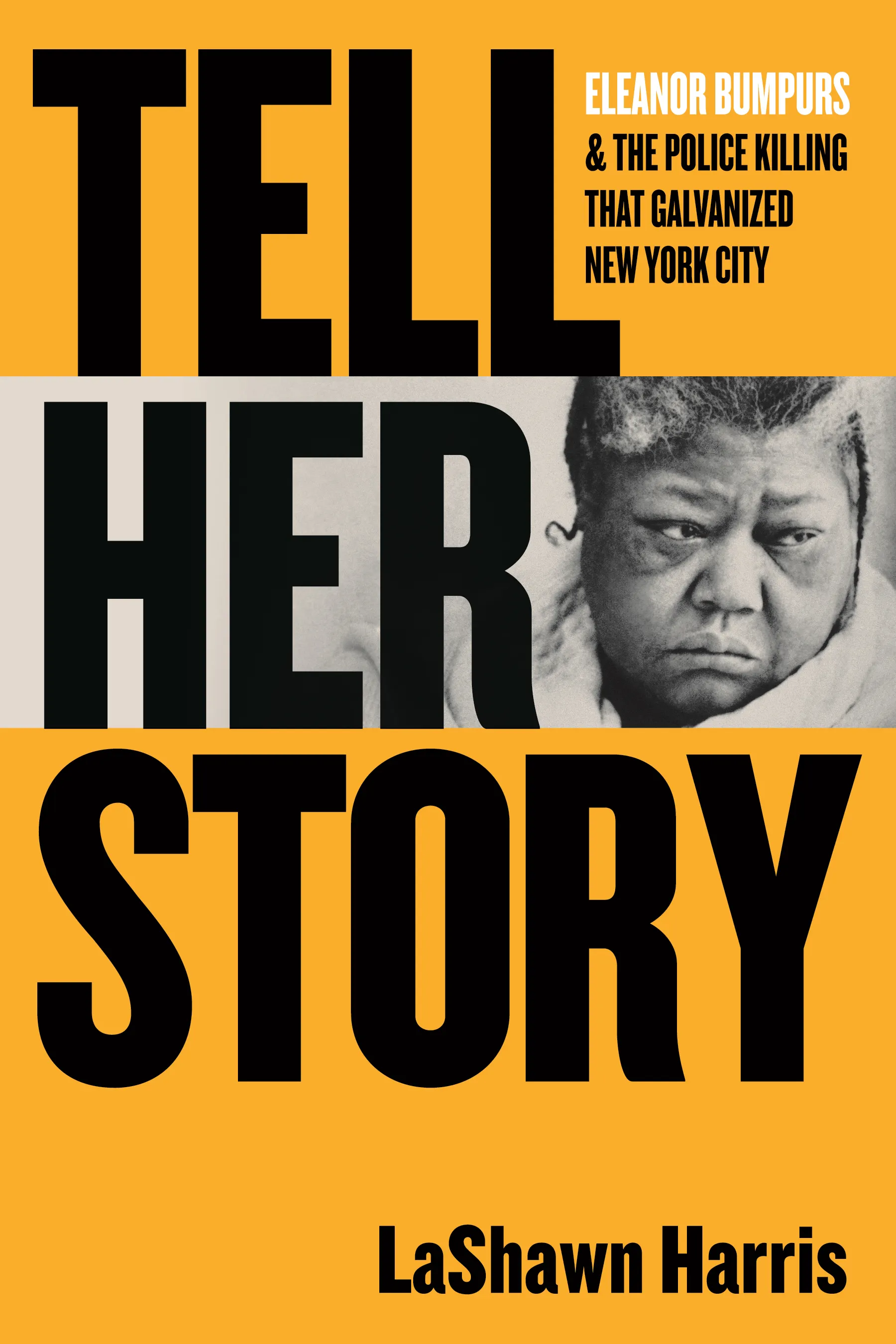
Image courtesy of Beacon Press
The first section of Harris's three-part book constitutes a nuanced and complicated portrait of Eleanor Bumpurs. Born Eleanor Gray Williams in 1918, she grew up in North Carolina under Jim Crow and moved to New York towards the end of the Great Migration, like the millions of other Black women who sought to build better lives for themselves and their families under difficult circumstances. She arrived in New York City in the 1940s, a time when racial segregation was enforced with red lines and zoning rules that crowded Black families into dense neighborhoods of substandard housing. Long before New York faced its "Drop Dead" financial crisis in 1975, these neighborhoods—most famously the South Bronx—became emblematic of the city's economic and physical deterioration.
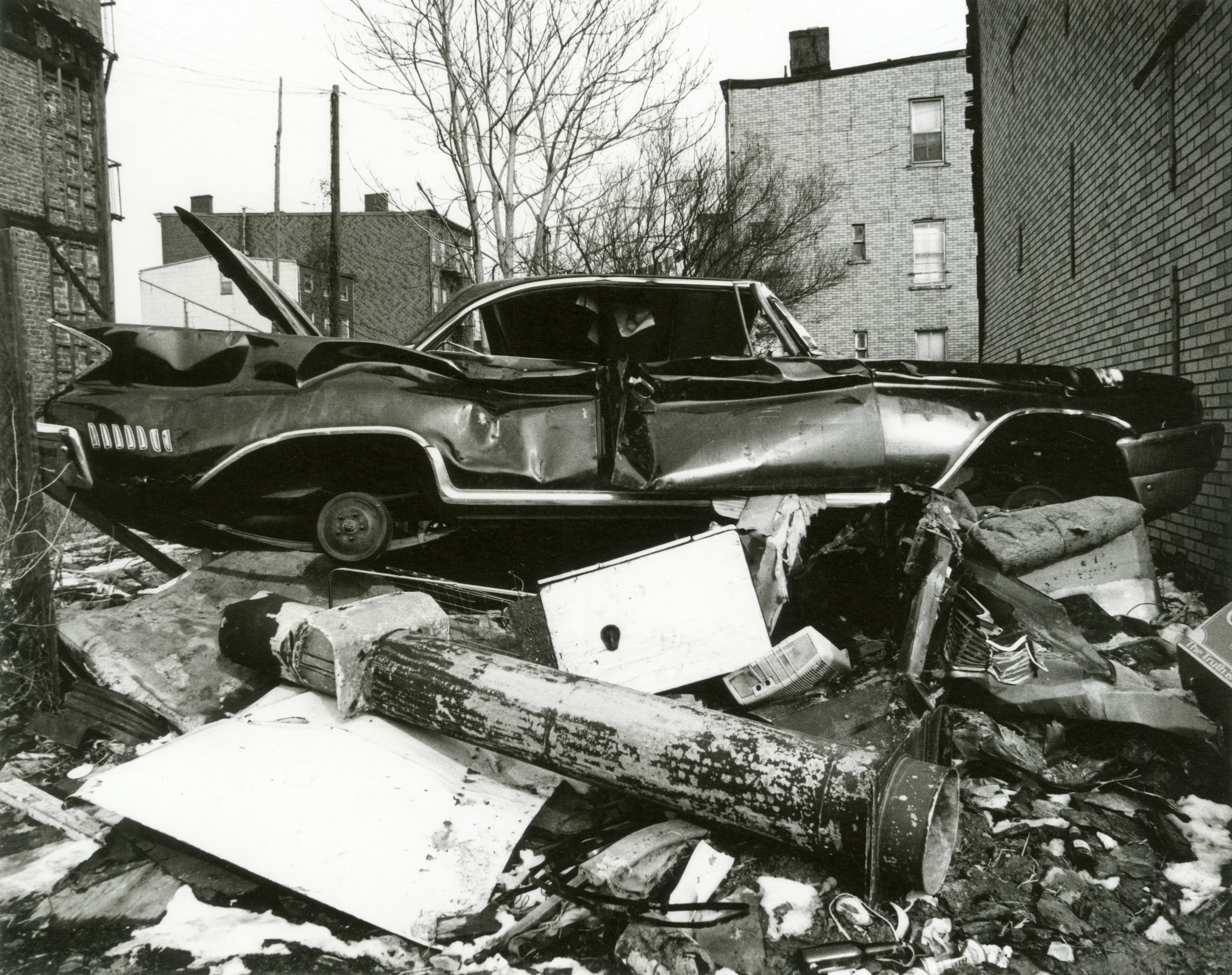
Eugene Gordon, photographer. Junked Car in Lot, South Bronx, New York, 1984. Patricia D. Klingenstein Library, The New York Historical
Discriminatory hiring practices concentrated Black women in low-paid domesic service jobs. Eleanor Bumpurs worked as a hotel chambermaid until health issues forced her to quit: She had arthritis, diabetes, and high blood pressure; she also received treatment for auditory hallucinations and anxiety. She raised her seven children as a single mother in various rentals in Harlem, East New York, and the Bronx. One of these, an apartment in a private building in University Heights, had no heat or hot water throughout the bitter winter of 1980-81; one of Bumpurs' neighbors, Jessie Smalls, froze to death. A year after fire rendered the entire building uninhabitable, Eleanor Bumpurs became a tenant of the New York City Housing Authority (NYCHA), moving into a fourth floor apartment at Sedgwick Houses. She remained there until NYPD officer Stephen Sullivan took her life during the botched eviction two years later. When NYCHA scheduled the eviction proceeding, she owed $417 in unpaid rent.
But in the aftermath of Eleanor Bumpurs' murder, the NYPD, associated organizations, and some news outlets seized upon a different story—one that justified their actions by reducing her to a dangerous, threatening Black woman with a history of mental illness and criminal behavior. Bumpurs' family and community responded with outrage, forming grassroots activist groups to press for justice and pointing out the links between Bumpurs' death and the city's long-standing conflicts over police brutality, racism, poverty, and housing. An accounting of the community's mobilization and advocacy for Eleanor Bumpurs forms the second part of Harris's book, while the third part of Tell Her Story recounts the Bumpurs family's efforts to hold Stephen Sullivan accountable for Eleanor's death, a legal battle that went on for years. Though a grand jury indicted Sullivan on second-degree manslaughter charges, Bronx Supreme Court Justice Vincent Vitale dismissed the charges, a ruling that was upheld at the appellate level before being overturned by New York State's Court of Appeals. When the case finally went to trial in January 1987, Sullivan was acquitted. The FBI declined to bring federal charges, and the courts dismissed the Bumpurs family's wrongful death lawsuit against NYCHA. In the end, the family settled their civil suit out of court.
Though it seems a bleak conclusion, when Harris asked Mary Bumpurs, Eleanor's daughter, to define her mother's legacy, her response was, "to keep her spirit moving. To let people know what happened to her. No more people killed by police." Harris set herself the task of helping to carry forward the story of Eleanor Bumpurs, in dialogue with new generations of activists and their ongoing efforts to combat police violence. We are incredibly grateful to Dr. Harris for taking some time to answer our questions about her work via email.
As you note, Eleanor Bumpurs was not the first Black woman to die because of police violence, nor was she the last. Could you share what about her life, and her death, inspired you to write this book?
Being raised in the Bronx, I grew up seeing a 1981 New York Daily News picture, featuring 66-year-old Eleanor Bumpurs. I grew up hearing Eleanor Bumpurs’ name in hip-hop music and seeing her name in movies, particularly Spike Lee’s 1986 film She’s Gotta Have It and his 1989 film Do the Right Thing. And my family lived across the street from Eleanor Bumpurs. I was 10 years old when she was killed.

Do the Right Thing end credits, 1989
These personal connections inspired years of scholarly research. I was curious about what happened to her and my Bronx community of Morris Heights on October 29, 1984, and the impact of New York City’s socioeconomic and political landscape of the 1980s on the lives of Black women. Moreover, I was curious about Eleanor Bumpurs’ life prior to her killing, the impact of state violence on families, and the citywide legal justice campaign launched on her behalf. The Bumpurs social justice campaign is an early iteration of what legal scholar Kimberlé Crenshaw and the African American Policy Forum would call #SayHerName in 2014; a movement dedicated to bringing invisibility to violence against Black women and girls.
My interest in Eleanor’s interior life was also inspired by historian Brenda Stevenson’s 2015 book, The Contested Murder of Latasha Harlins, filmmaker Ryan Coogler’s 2013 film Fruitvale Station, political activists Sybrina Fulton and Tracy Martin’s 2017 book Rest in Power: The Enduring Life of Trayvon Martin, and journalist Matt Taibbi's 2017 book I Can’t Breathe: A Killing on Bay Street. These works offer readers and moviegoers glimpses into the lives of Latasha Harlins, Oscar Grant, Trayvon Martin, and Eric Garner, those African Americans killed by police and white civilians. These accounts underscore victims’ less familiar interior lives, highlighting their ambitions, familial relationships, and pleasures and fears. These important texts humanize victims. They also illuminate the impact of police and state sanctioned violence on victims’ families; those left behind to mourn and pursue legal justice.
For me, one of the strengths of your book is that it captures to an incredible degree the sheer volume of work that activism requires—the number of meetings, marches, speeches, and rallies needed to advance even the most incremental change, or take the smallest step towards justice, the amount of communication and coordination required. There's also the fact that most of this work is done on a volunteer basis, often by women of color, like the "fighting family" that coalesced to support the Bumpurs family after Eleanor's murder. Can you walk us through the process of researching, digesting, and writing this story?
Researching and writing stories about less privileged urban Black women requires consulting a variety of primary sources. I employed mainstream, African American and left-wing newspapers, oral history collections and interviews, legal records, radio and television news broadcasts, songs, labor records, and the writings of 1980s journalists and writers such as James Baldwin, Jimmy Breslin, and Alice Walker. These sources made it possible to paint a complex view of Eleanor Bumpurs and the citywide protests launched on her behalf. Having an abundance of primary documentation for certain sections of the book required me to make difficult decisions about what narratives to include. I decided to privilege primary sources and stories that supported the book’s argument and structure, as well as documentation that visualized New York City’s rich socioeconomic, political, and cultural landscape.
The third part of your book traces the multi-year legal battle that the Bumpurs family endured, which eventually ended in an out-of-court financial settlement of about $200,000. You quote one attorney who characterizes this as an "insultingly low," and another who states "$200,000 only reinforces the concept that [Black] lives are not of any value to the cops who take them." Given this, I have to admit I was startled when I went back into the book and reminded myself that the third section is entitled "Justice." I would love to hear more about how you came to that decision: what might justice mean for Eleanor Bumpurs and her family?
“Justice” seemed fitting for the third section of the book. The previous section of the book is entitled “Protest.” That section of the book is about New Yorkers’ pursuit of legal justice for Eleanor Bumpurs. The third section “Justice” surveys the legal journey toward holding the NYPD and other city workers accountable for Eleanor Bumpurs’ eviction and ultimate death.
The public testimonies of family activists inform my perspective on justice for victims and survivors of police and state violence. At protest rallies and in public writings and media interviews, families are clear about what justice looks like for victims of brutality. They call for activists, elected officials, and community members to: eradicate excessive and deadly force police policies, provide trauma informed care for survivors, reframe ideas about public safety, limit police encounters with vulnerable populations, invest in social services (housing, healthcare, and employment) for vulnerable and marginalized communities, pursue legal accountability for victims, and uplift victims’ stories about state violence. Ultimately, justice, for many, is about establishing community-based systems that protects all citizens’ rights and respects the humanity of all people.
Who, in your mind, is the ideal reader or readers for your book? Who do you think would benefit the most from absorbing the history that you convey?
Tell Her Story appeals to a public audience interested in histories about African Americans and women and histories about police brutality and New York City; those interested in Black women’s distinct encounters with police; and those interested in our present moment of economic precarity and mobilizations against state sanctioned and police violence. Reading the book presents an opportunity for audiences to draw important lessons and insights from the past and place contemporary moments within historical context. The 1984 Bumpurs case spotlights the nation’s unbroken history of pervasive anti-Black and state violence, race, gender, and class oppression, inadequate housing facilities and mental health services, and other urban ills; and how the tragic 1984 killing of a poor grandmother inspired modern-day national anti-police brutality campaigns committed to bringing visibility to Black women’s brutal and deathly encounters with police.
Written by Jeanne Gutierrez, Manager of Scholarly Initiatives, Jean Margo Reid Center for Women’s History
Keep Reading
- Women at the CenterMarch 13, 2026
The Conjuring of America: An Interview with Author Lindsey Stewart
With all eyes on Ryan Coogler's Sinners at the 98th Academy Awards, we spoke with philosopher Lindsey Stewart about her recent book on mojos, mermaids, medicine, and Black women's magic. - Women at the CenterFebruary 4, 2026
Queer Olympians and Gay Games
Awaiting the start of the 2026 Winter Olympics? Learn more about LGBTQ+ Olympic history and the organization of the Gay Games. - Women at the CenterDecember 22, 2025
Child's Play
What can the playthings of the past tell us about how children understand "women's work"? - Women at the CenterNovember 1, 2025
Vietnamese Stories from Stirring the Melting Pot: Photographs from The New York Historical Collection
At the heart of the story of Vietnamese refugees in 1970s New York is parents struggling to survive—and children learning how to translate that survival into a future.