On November 9, 1917, a bespectacled man in his late fifties ascended the steps of The New York Historical to deposit a three-volume album in its library. Opening the handmade, leather-bound album, the receiving librarian found 302 photographs, covering Broadway from the bottom of Manhattan to the top. The photographs—“principally” taken in 1905 according to the title page—were mounted singly or in pairs, each with a neatly drawn ink border and, in most cases, a handwritten caption. Arranged geographically, they depicted all kinds of subjects to be found on this kaleidoscopic street, but with an emphasis on those that seemed to be disappearing from modern, urban life. They were interspersed with 88 newspaper clippings that provided contexts for those subjects, and were prefaced by seventy pages of typewritten text that narrated Broadway’s rich history. Together these elements created a dense, multimedia representation of that street.
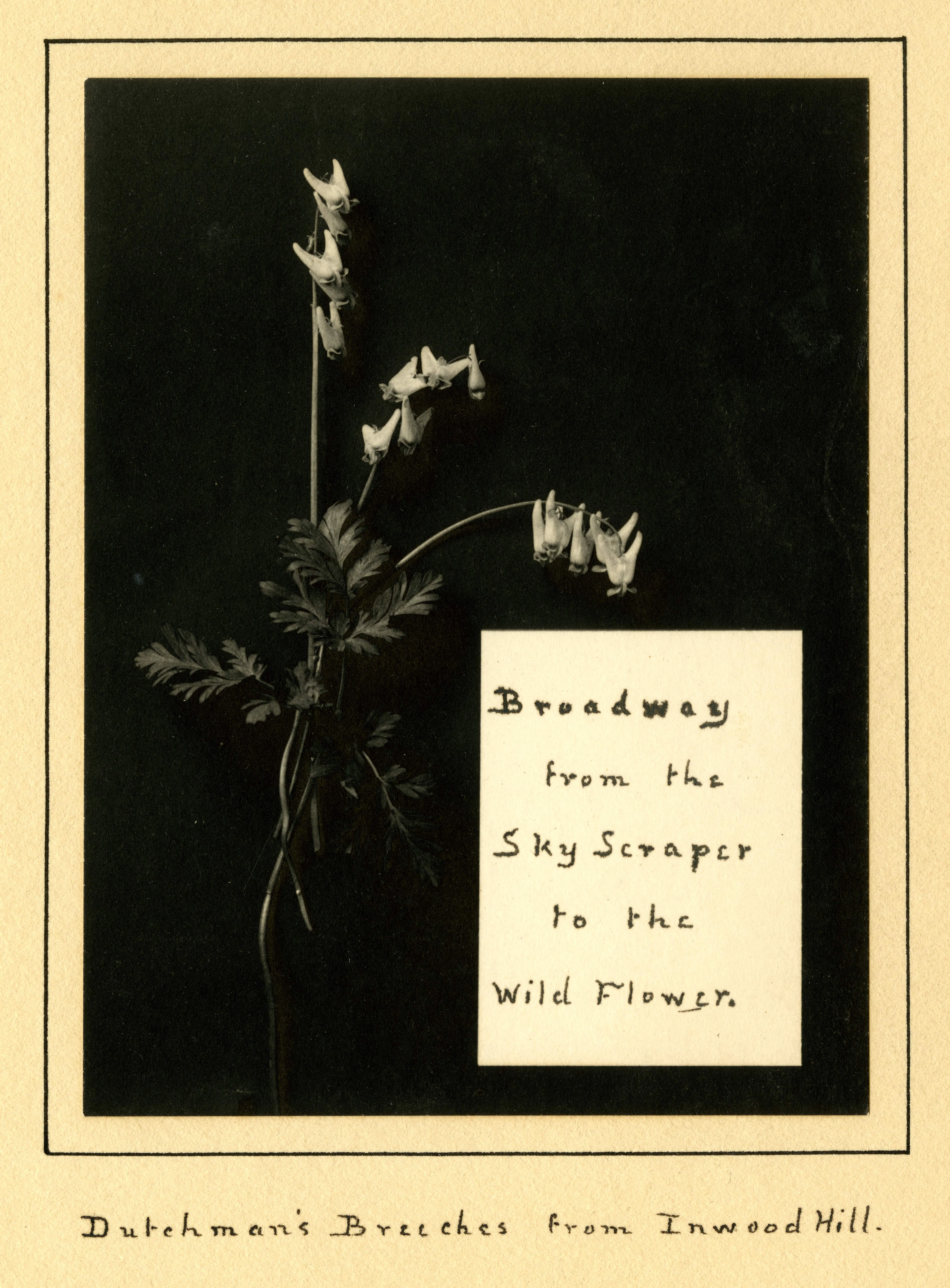
C. G. Hine, “Broadway from the Sky Scraper to the Wild Flower” (unpublished photographic album, 1905), Charles Gilbert Hine Photograph Collection, New York Historical.
The photographer who made this album, Charles G. Hine, was a resident of Newark and later of Staten Island. He commuted by ferry every day to work in his family’s insurance publishing company at 137 Broadway (and later, 100 William Street). But his abiding passions were local history and photography; he was an active member of at least three historical societies (including the New York Historical), and a co-founder and secretary of the Newark Camera Club. Hine combined these twin passions by researching and writing a series of books about historic thoroughfares in the region, which he illustrated with his own photographs and printed with his company’s presses—although he never published this Broadway album.
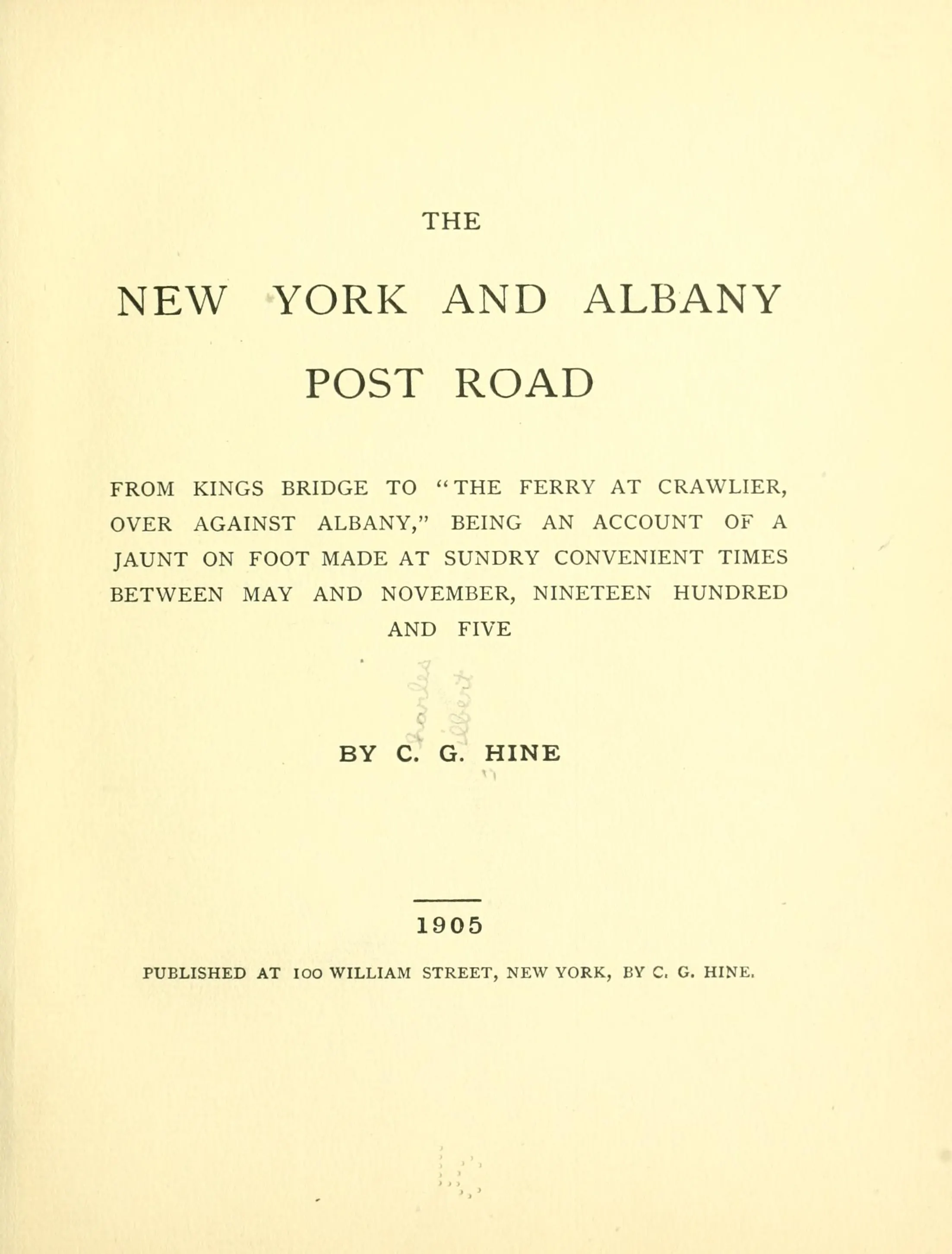
C. G. Hine, The New York and Albany Post Road (privately printed, 1905), Library of Congress. This book picked up where the Broadway album ended, at the southwestern edge of the Bronx.
He enacted each survey as an expedition on foot or by bicycle—another of his passions—with a camera and a set of dry plates in his knapsack. Or rather, they were a series of expeditions, as these routes were too long to survey in one day. The photographs in this album indicate that Hine toured Broadway multiple times in 1905, at varying times of day from dawn to twilight (a favorite time of day for many photographers) to late at night; on weekends as well as weekdays; and in all four seasons.
Some outings may have been prompted by a particular article that he had encountered in that day’s newspaper; Hine was evidently a regular reader of the New York Sun, the Evening Mail, the World, and the New York Times, all of which reported on the fate of a wide variety of old buildings. A slip of paper he inserted into the album indicates that one photographic excursion—on May 20, 1905—yielded as many as 10 photographs, from City Hall Park all the way to the Upper West Side. He subsequently assembled these various explorations into a single, composite journey along the road’s entire length.
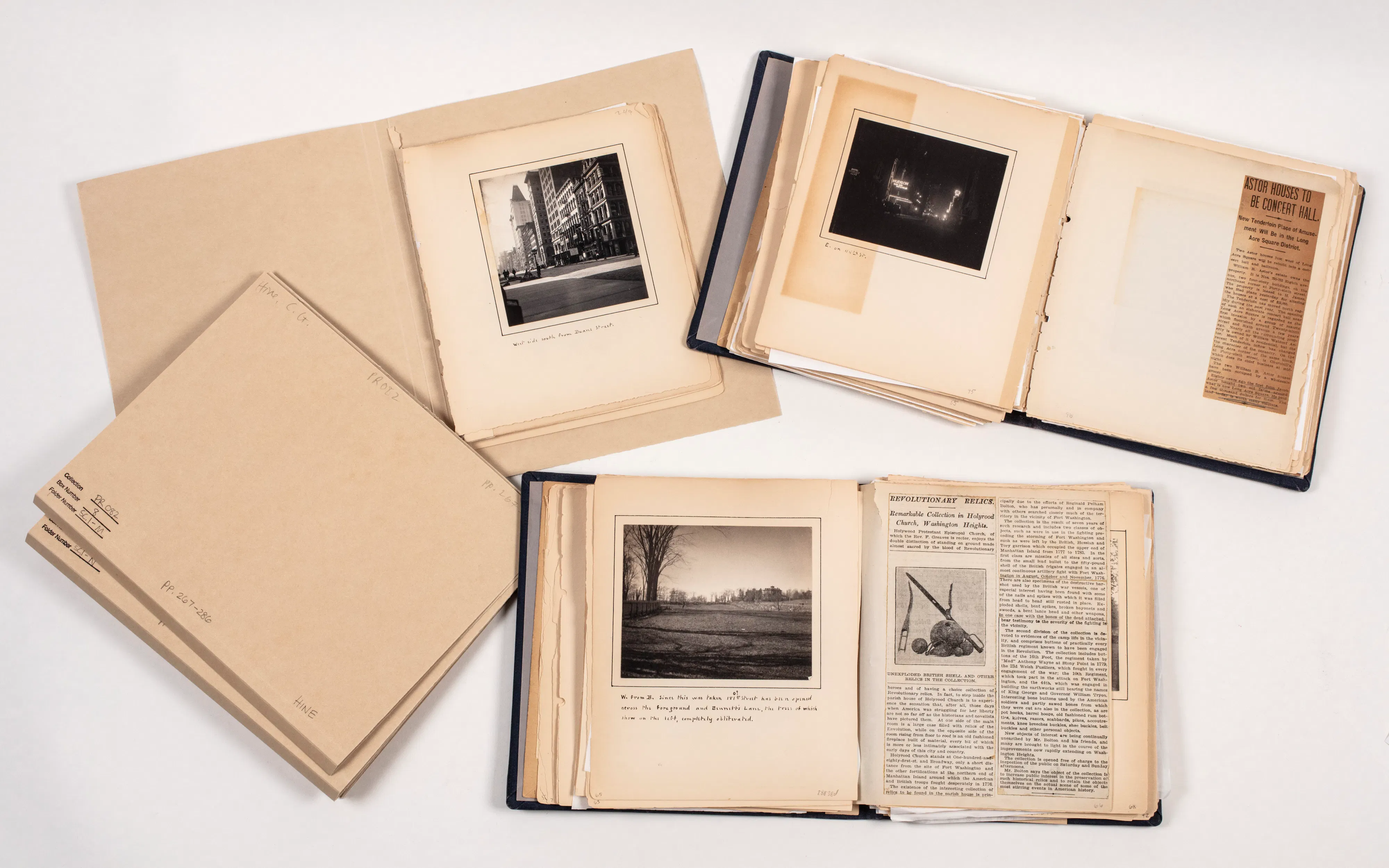
Newspaper clippings pasted alongside photographs in Hine’s “Broadway” album. Unfortunately, the acid from the newspaper has bled onto the facing pages, and the first volume became disbound. Otherwise, the album is in good condition.
Unlike preservationists of the period, who fixated on Colonial or Revolutionary-era edifices, Hine focused his camera on all kinds of structures that seemed endangered by the rapid urban development that the subway was accelerating. He photographed 19th-century commercial buildings, such as the earliest hotels, department stores, fine-dining restaurants, and of course the succession of majestic theaters that had come to define the street in the national imaginary, even before their gravitation toward Times Square circa 1900. Also included are the less reputable sites of leisure—penny arcades, dance halls, and saloons—that troubled bourgeois reformers of the period.
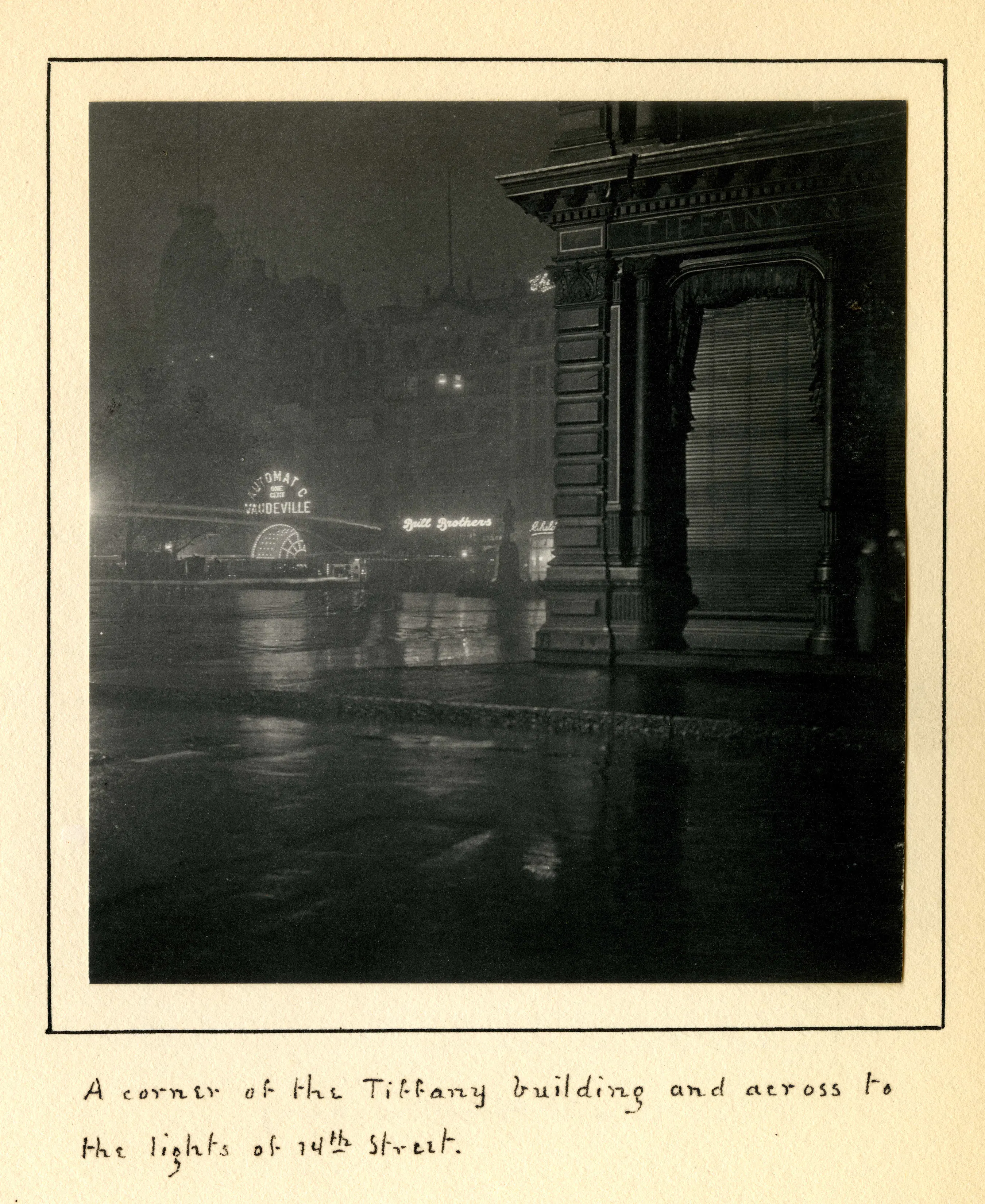
Hine, “A corner of the Tiffany building and across to the lights of 14th Street,” from the “Broadway” album. Hine contrasts the shuttered Tiffany building, then in its last days on Union Square, with the bright lights of the Automatic Vaudeville Company’s penny arcade, which opened in 1903 and was popular with working-class immigrants.
Hine was equally receptive to humbler structures: specimens of what we now call vernacular architecture, such as wood-frame buildings that had persisted below the “fire line,” or one-story stores (known as “tax-payers”) that speculators erected as a short-term means to pay the property tax while they waited for land values to rise. Even “shanties”—shacks that were improvised out of building scraps by Black and immigrant residents, and that aroused aesthetic, physical, and moral disgust in middle-class and elite New Yorkers—qualified for photographic preservation in Hine’s album.
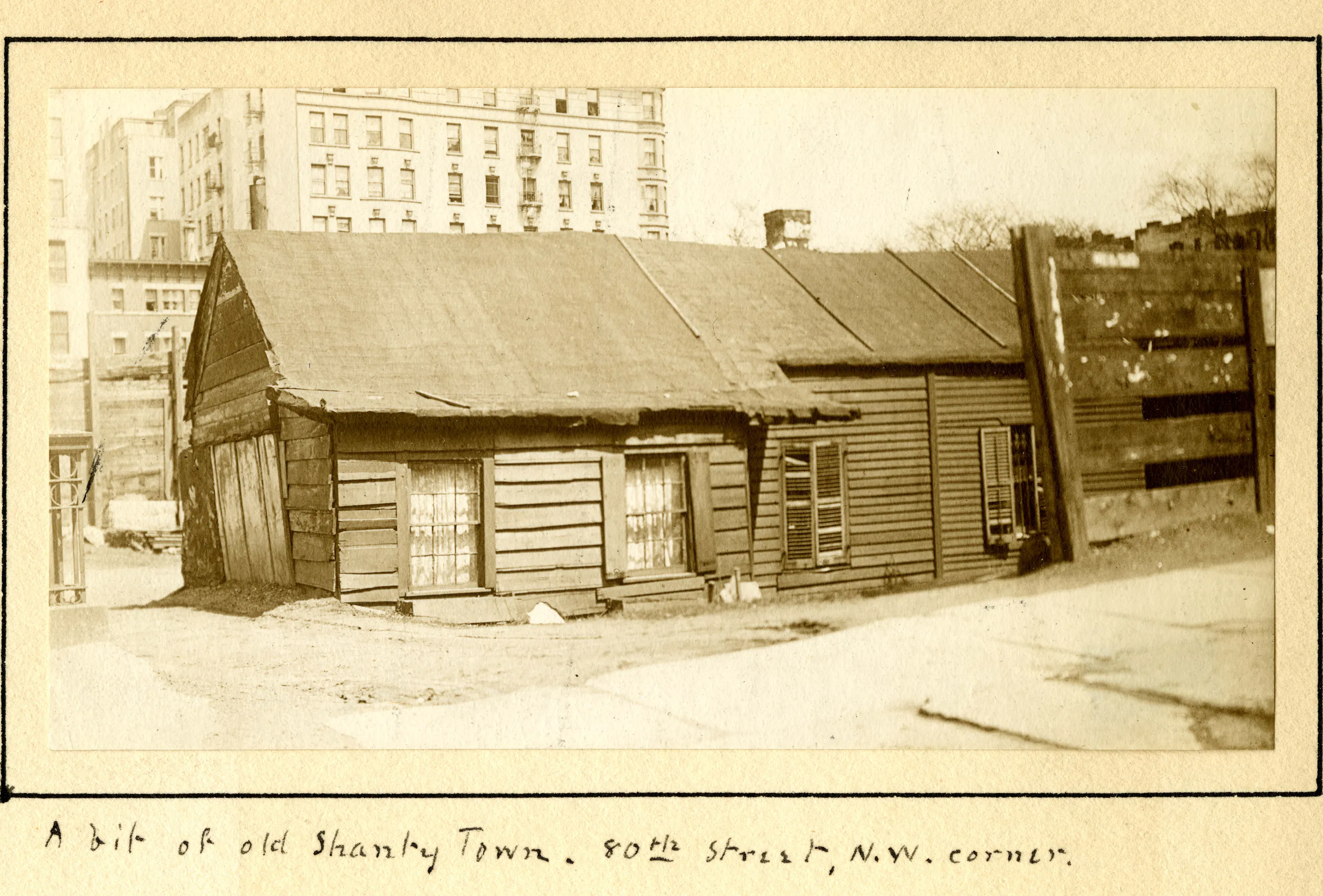
Hine, “A bit of old Shanty Town. 80th Street, N.W. corner,” from the “Broadway” album. Hine documented how, despite aggressive campaigns against them, shanties survived on upper Broadway well into the twentieth century, in part through their inhabitants’ efforts to assert their legal rights. Their persistence, in the shadow of new apartment houses, belied the linear conception of urban progress in which new land uses neatly erase old ones.
Hine’s archaeological eye extended beyond the buildings themselves to the physical infrastructure of the streetscape. He documented, or noted the fate of, pedestrian bridges, telegraph posts, hitching posts, mile markers, and other instances of what urban planners now call street furniture. Of particular interest to him were the commercial lettering and imagery that adorned Broadway—from the giant billboards that covered condemned buildings downtown and the flashing electric “sky-signs” of Midtown to the circus posters that were pasted, often illegally, onto shacks and fences uptown.
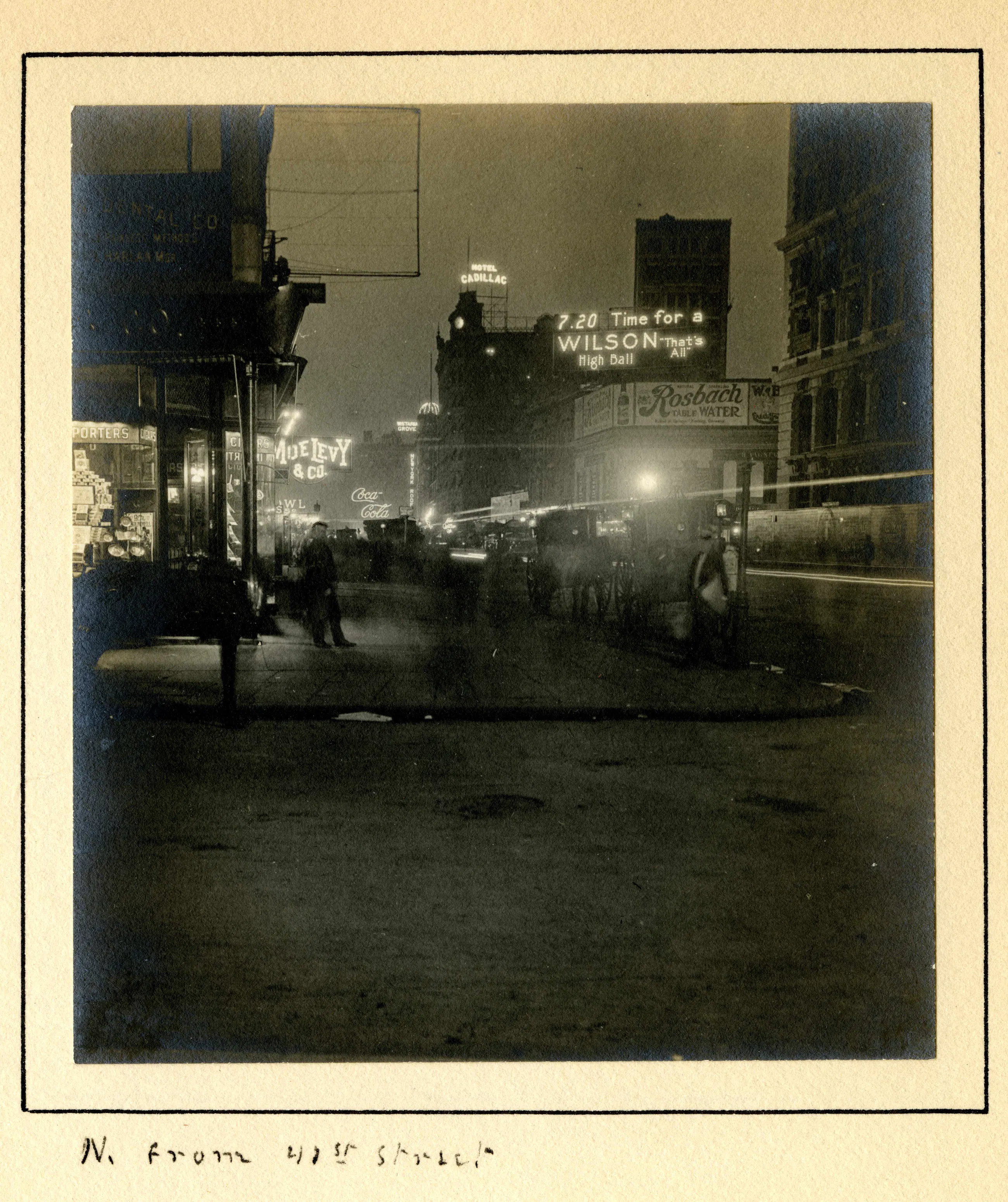
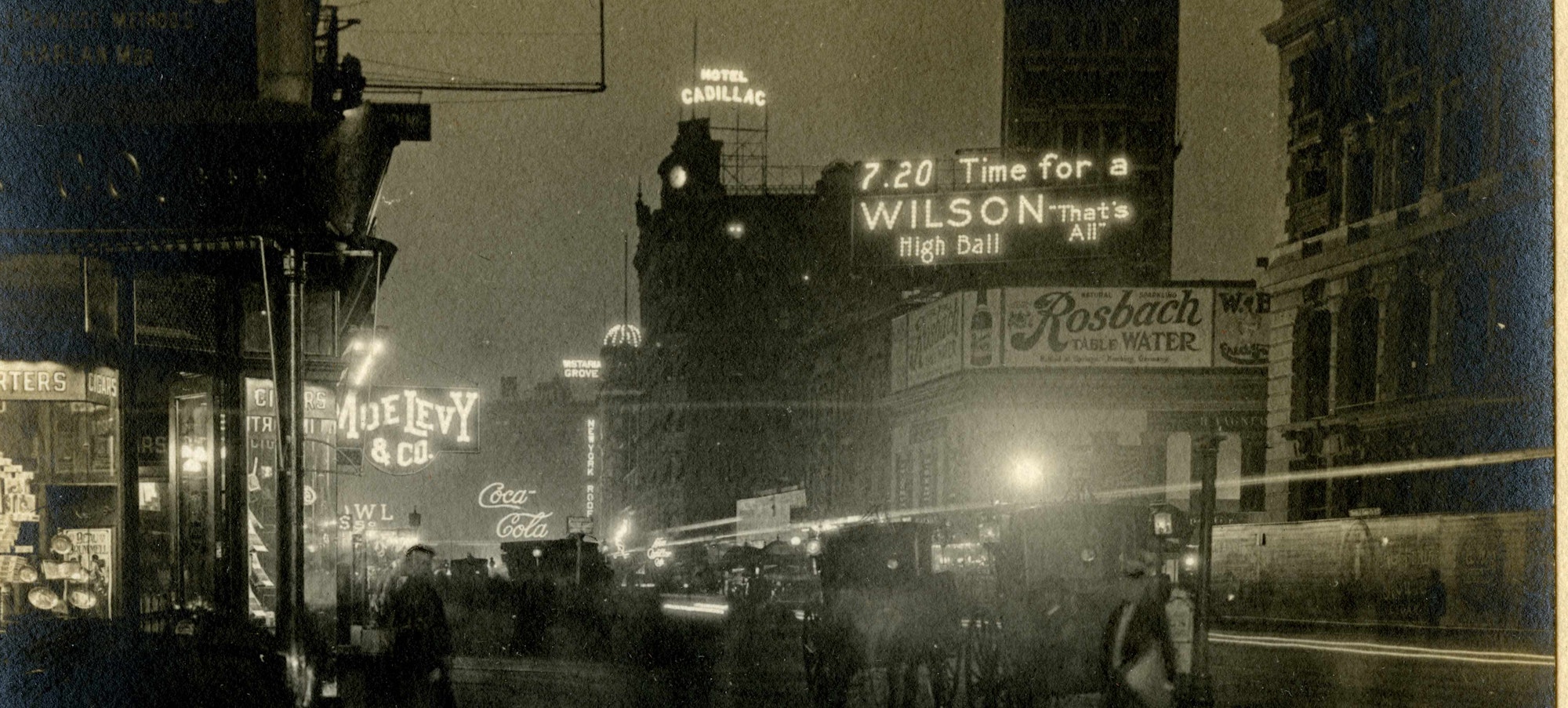
Hine, “N[orth] from 41st Street,” from the “Broadway” album. Although Times Square did not acquire its first illuminated sign until 1904, within a year it was the centerpiece of the Great White Way. The largest displays – Coca-Cola and Owl cigars – became a source of entertainment in their own right. Sightseers arrived in coaches to marvel at the “phantasmagoria of lights,” while others viewed them on foot; as one of Hine’s clippings observed, a walk through Times Square is like “a journey with Alice through the looking glass.”
In all of these photographs, Hine enlarged his depth of field to take in the built environment as a whole. Ancient structures appear not in isolation, but as embedded in the urban fabric and, crucially, surrounded by pedestrians. Hine particularly highlighted—and humanized—those who labored in the street, such as sanitation workers and construction crews, along with those whom Progressive reformers sought to eradicate from the street, such as pushcart vendors, child workers (bootblacks, newsboys), and sex workers. While other photographers in the NYH collections feature posed figures, Hine preferred to catch them unawares, and especially in motion through the city, hustling through the crowds of pedestrians. Contemporary preservationists frequently took another tack, preferring to isolate historic landmarks - literally or photographically - from the messiness of everyday life.
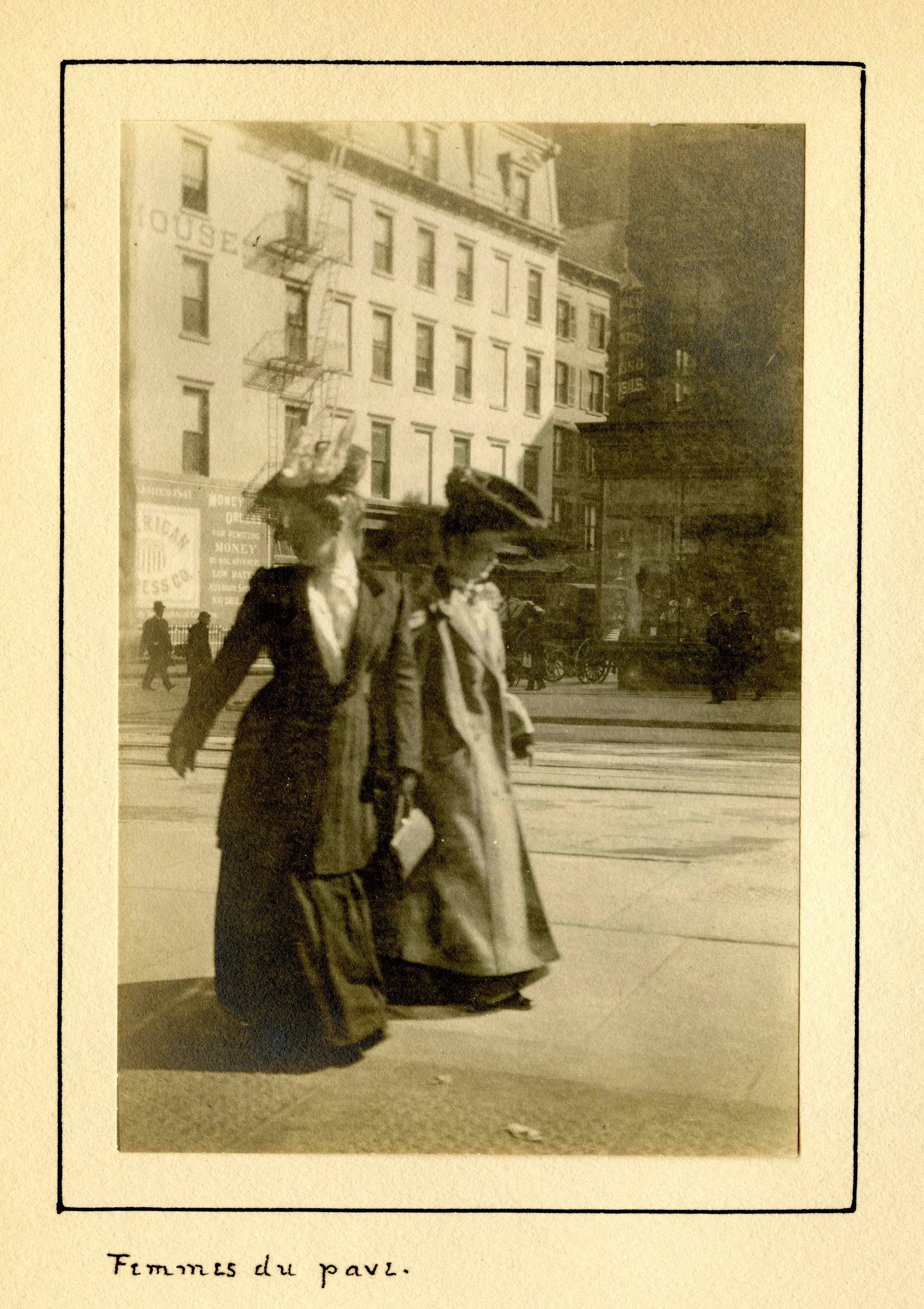
Hine, “Femmes du pave,” from the “Broadway” album. After the Civil War, the area around Union Square emerged as a red-light district. Nearby brownstone houses, vacated by the elite, became brothels, and women allegedly patrolled the neighborhood in shifts, from early afternoon to early morning. They identified themselves with large feathered hats, worked in pairs, and kept walking (perhaps glancing back at the police) to avoid arrest. On this basis, Hine bluntly labels these women “femmes du pave” – a faux-French euphemism for sex workers.
Hine’s eyes were also open to Broadway’s natural history: the blasting and leveling of its hills and rock outcroppings; or, conversely, the draining and in-filling of its valleys and brooks. Like another photographer in The New York Historical collections, James Reuel Smith, he noted how springs and wells persisted for a time in the landscape. Similarly, despite assumptions about the imminent extinction of equine labor in the electrical city, Hine found numerous horses along Broadway, still pulling carts, coaches, and streetcars; a handwritten scrap, included in the endpages, listed 10 sightings on one excursion alone.
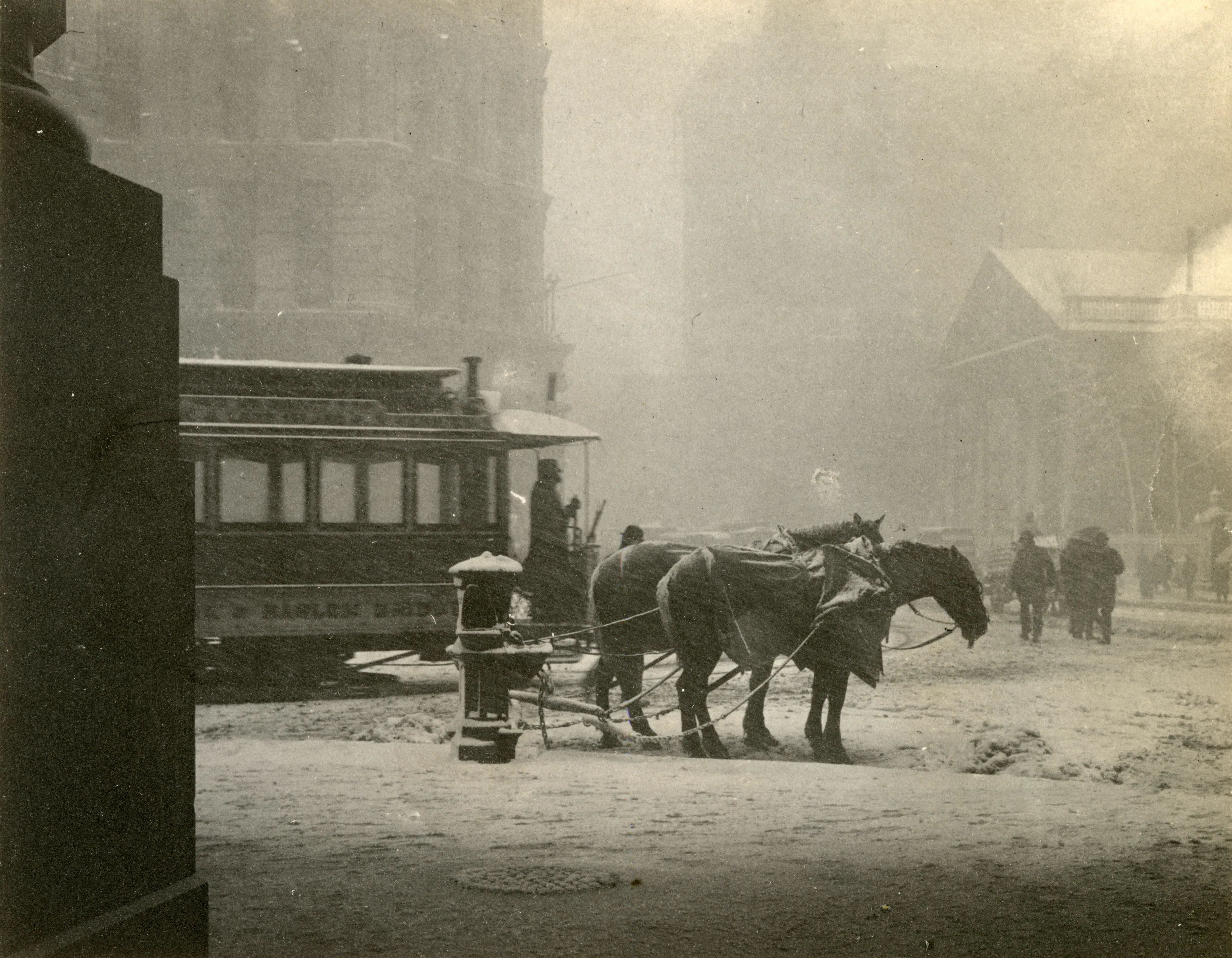
Hine, untitled photograph from the “Broadway” album, depicting two horses tied to an old, cast-iron hitching post at the foot of Park Row, as an electric streetcar speeds past. The St. Paul Building (left background) and St. Paul’s Chapel (right) are just visible through the snowstorm. Progressive reformers viewed hitching posts as a danger to public health, due to the “dust and filth [that] accumulated by horses standing” next to them (“Hitching Posts Danger to Health,” Municipal Journal and Engineer 29, no. 16 [1910]: 545).
An amateur botanist as well, Hine seems to have had a special predilection for Broadway’s plant life. Trees are the main subjects of several photographs in this book, their importance underscored by the caption. As was common in the period, he commemorated certain famous ones, such as the last surviving elm in St. Paul’s churchyard, allegedly used by George Washington as a hitching post. Yet, he also captured numerous trees that lacked such nationalist associations, standing instead as memorials to more subtle, forgotten histories—until they, too, succumbed to the opening of new roads.
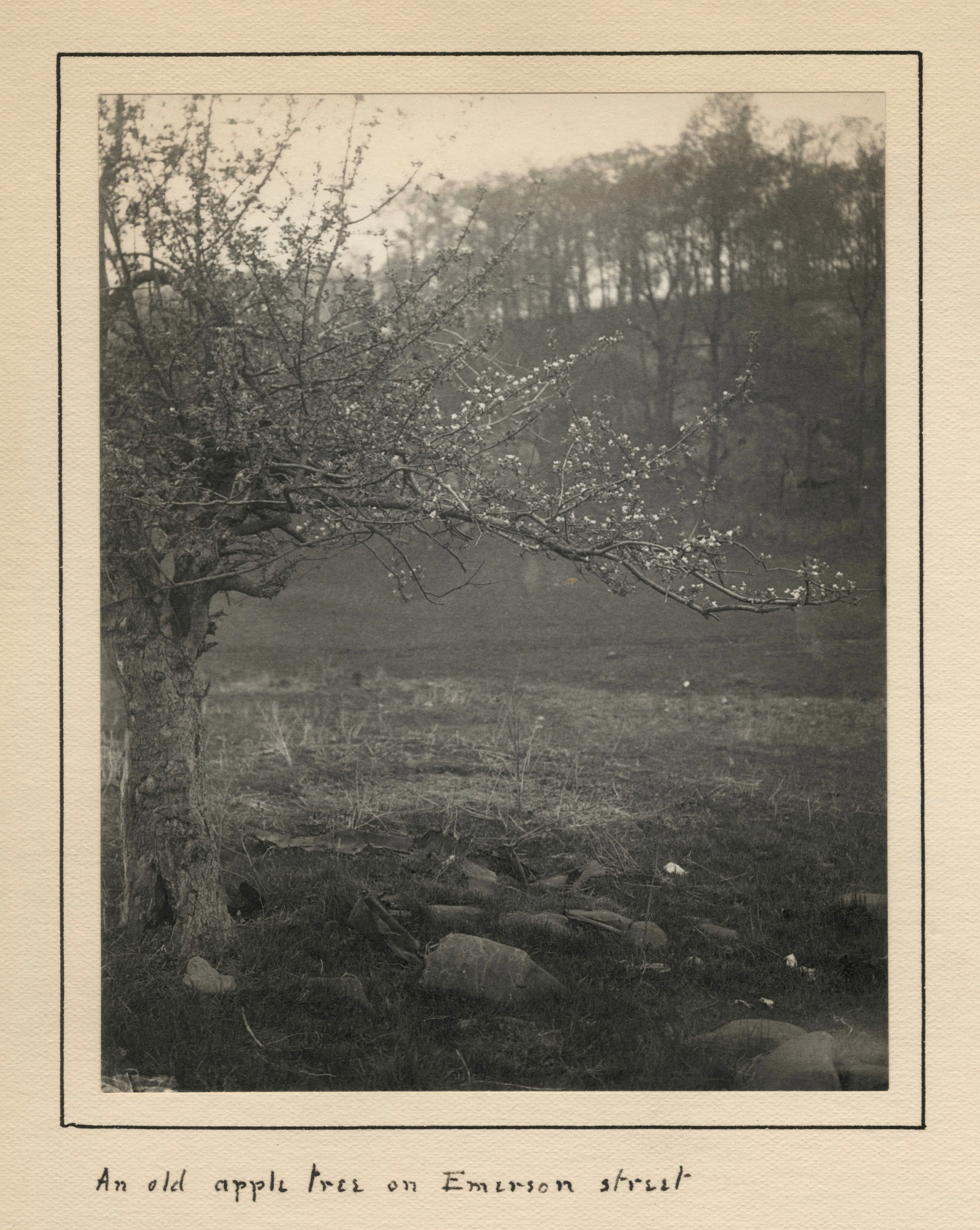
Hine, “An old apple tree on Emerson street,” from the “Broadway” album. Hine found this tree near the site of an orchard that the Dyckman family had planted in Inwood after the Revolution. By 1870, the Dyckmans had lost interest in farming, instead viewing their land as prospective urban lots. Yet, apple trees continued to spring up wild, prized by some for their fruits’ sharper taste.
Even more ephemeral were the wildflowers that crop up in the final volume—and in the book’s very title. The photographs here of elder blossoms, wild geraniums, dandelions, and other species, Hine explained, are just some of “the many pictures of wild flowers and ferns that [I have] taken” in the hills, fields, and hollows bordering Broadway’s course through Inwood. Just as historic preservationists warned about the threat that urban development posed to ancient buildings, field naturalists like Hine warned of its threat to wildflowers and to natural landscapes more generally. At the end of the album, Hine pasted in newspaper clippings about an amusement park project that was then jeopardizing the plans to preserve Inwood Hill as a park.
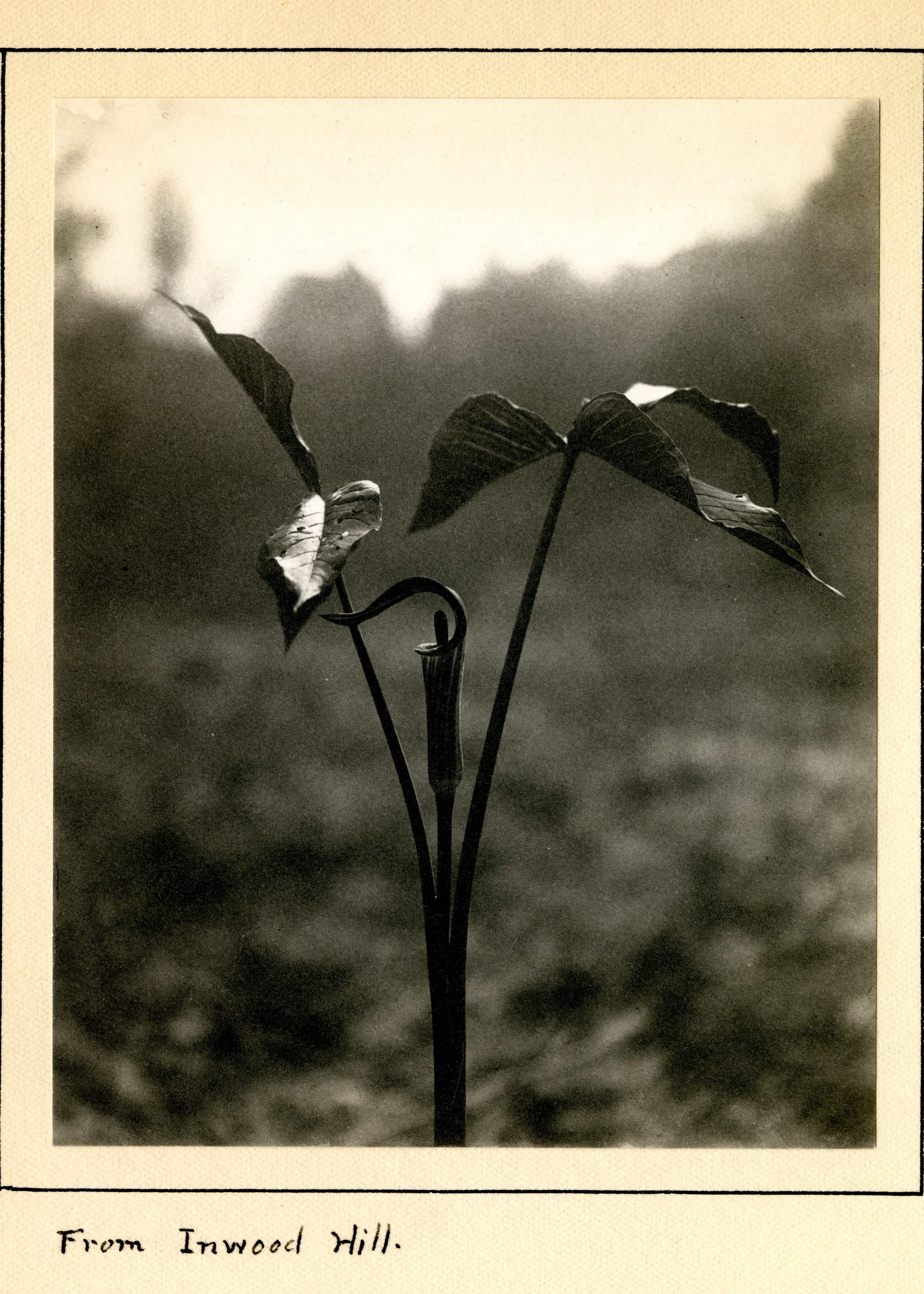
Hine, “From Inwood Hill,” from the “Broadway” album. Botanical photographers typically brought specimens back to their studios, where drapery provided a neutral backdrop. Others, like Hine, sought to document plants in their native habitat. By including, and naming, Inwood Hill in his spring-time photograph of a jack-in-the-pulpit (Arisaema triphyllum), Hine highlighted the fragility of its local ecology. The draining of Dyckman’s meadow and the ongoing loss of woodland were stripping away the moist, shady, humus-rich conditions on which this plant depended.
Photograph albums such as Hine’s open up rich avenues for urban-historical exploration. We can draw inferences from how he selected 302 photographs from his larger collection of Manhattan photographs (also held at The New York Historical), and from what he chose to exclude. We can examine how he cropped the photos to emphasize certain details, captioned them, and juxtaposed them with newspaper clippings. The materiality of the album itself deserves attention. Hine did not use a store-bought album, but crafted one himself, using materials and skills that he shared in his article on amateur book-binding for Harper’s Bazaar. And while he arranged the photographs in a simple, geographic sequence from Bowling Green to Inwood, by plotting them on a GIS map we can determine which blocks he lingered and which he passed through. We can thus follow Hine through every stage of his project, as he gathered scattered fragments of Broadway and assembled them into a larger portrait of a street—and a city—in transition.
This blog post was written by Nick Yablon, Professor of History at The University of Iowa. Dr. Yablon will speak about C. G. Hine's “Broadway from the Sky Scraper to the Wild Flower” album at The New York Historical on April 21 (free and register here). His book, From the Skyscraper to the Wildflower: C. G. Hine's 1905 Photographic Survey of Broadway, can be ordered from Columbia University Press here. You can also visit the book's website.
Keep Reading
- From the StacksAugust 5, 2026
A Revolutionary Tunebook
An American tunebook kept in 1776 captures the soundtrack of revolution. - From the StacksJuly 20, 2026
"Oh Eliza, I'm Undone": A Journey from Storage to Display
Explore the conservator's role in this three-part blog series through the lens of a Revolutionary War-era love poem as it moves from storage to the conservation studio and finally to an exhibition. - From the StacksJune 29, 2026
The Patriotick Barber Gets a New Look
An 18th-century satirical print depicting the interior of a barber shop speaks volumes about style and politics in New York City. - From the StacksMay 1, 2026
How New York City—and the Nation—Got Its First Cancer Hospitals
Two different approaches—epitomized by two early New York City hospitals—characterize divergent views about early cancer treatment in the United States.