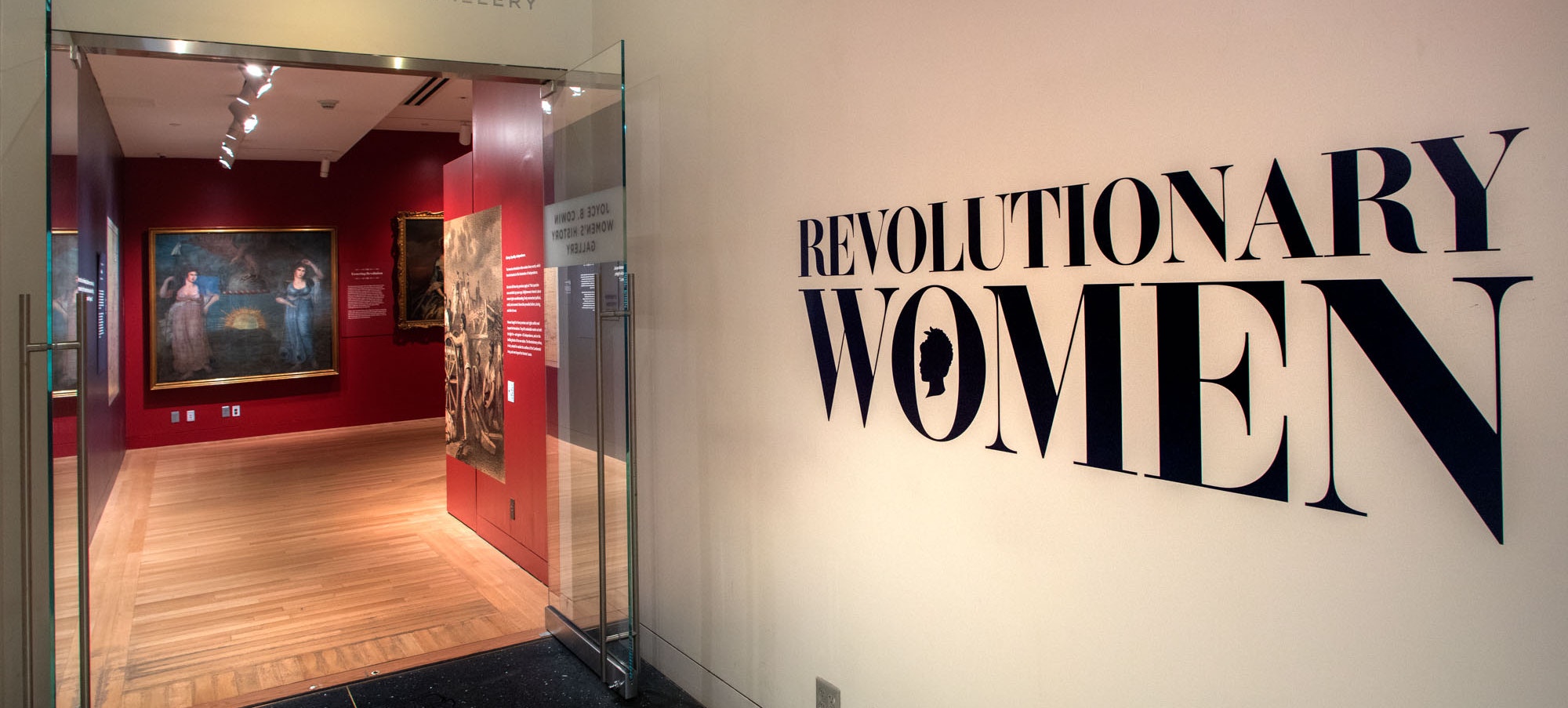
One of the central themes of the Jean Margo Reid Center for Women’s History’s exhibition Revolutionary Women is that tracing the real stories of women living through the Revolutionary War offers new insights on the founding moment of our nation. As historians such as Judith Buskirk have shown, the Loyalist and Patriot division is often presented as a firm binary, yet families often consisted of individuals who were sympathetic to competing visions living side by side. Others were opportunistic; they may never have declared an allegiance to either or did so changeably, depending on how it benefited themselves.
The New York Historical's Patricia D. Klingenstein Library preserves one set of juicy letters between a Patriot prisoner of war, Major Aquila Giles, and the niece of a Loyalist colonel, Eliza Shipton. They show us how lines of allegiance to the Patriots’ cause or to the Crown were blurred—and how it was possible to fall in love across that forbidden divide. The Giles Family Papers are extraordinary in that we hold both sides of this correspondence. A historian writing about Aquila and Eliza in the 1930s claimed that the letters “may be consulted by the serious student, or by the sentimental busybody who looks like a serious student.” We at the Center for Women’s history will proudly take on the mantle of “sentimental busybody,” but also insist on the historical significance of the letters and the star-crossed relationship they describe for shedding light on the daily experience of war. One of their illicit letters is currently on display in the exhibition—alongside Aquila’s writing desk and one of Eliza’s gloves. (For more about the letter’s journey from storage to display, read this blog series from our conservator Kate Vargas!)
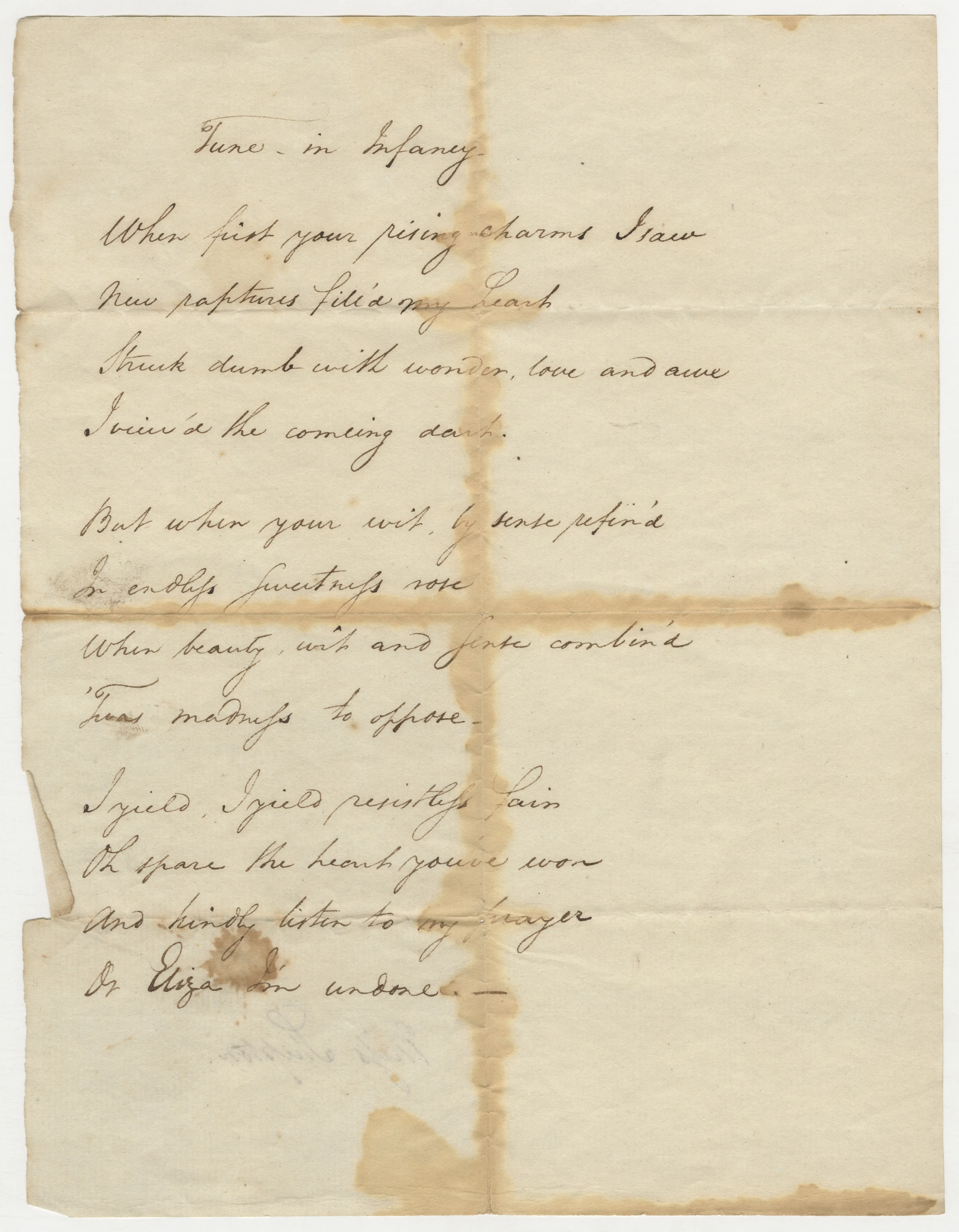
Aquila Giles (1757–1822), Poem for Elizabeth Shipton, 1778–80. Patricia D. Klingenstein Library, The New York Historical
Born in Maryland in 1758, Major Aquila Giles was taken prisoner by the British forces in early 1778 and sent to Flatbush on parole. Eliza Shipton, born in 1757, lived nearby with her uncle, the loyalist Colonel William Axtell, in an estate at the corner of Flatbush and Parkside in what is now Prospect Lefferts Gardens; their grounds also hosted his regiment, nicknamed the Nassau Blues. With the help of go-betweens, Aquila and Eliza passed letters back and forth until 1780, when they eloped. Some of their letters used coded language—she was the “Rose” to his “Leaf"—while others reveal the sometimes sneaky methods they used to see one another. For example, in one letter, Eliza wrote, “Well I fancy the glimpse I’ve just had of you, my G, must satisfy me for today as I don’t think the weather will be fit for me to ride.” In another, she wrote, “You will think I have a vast deal of temerity when I tell you that I am writing at the same table with my uncle…The old Gentleman begins to look as if he had an inclination to know who I am scribbling to, so I think I had best fold up as fast as I can.” Eliza frequently lamented how they could not court openly; in one letter, she wrote, “Believe your Eliza when she tells you few things would give her more satisfaction than to participate with you the pleasures of a snug fireside free from restraint…”
Our curatorial team’s favorite letters are love poems. The poem currently on display ends with this swoony verse, revealing how Aquila has fallen for Eliza:
I yield, I yield, resistless fair
Oh spare the heart you’ve won
And kindly listen to my prayer
Oh Eliza I am undone
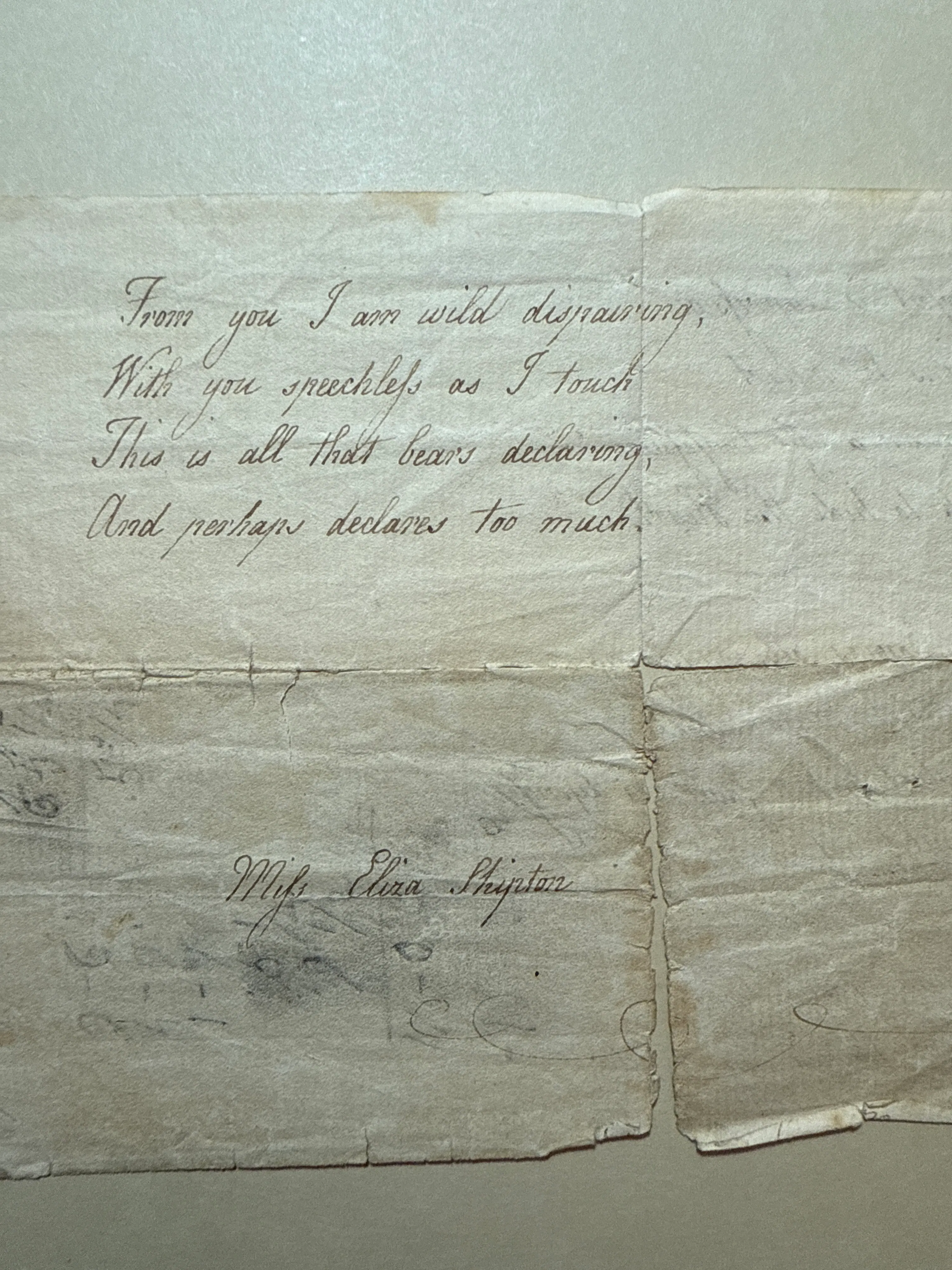
Aquila Giles (1757–1822), Poem for Elizabeth Shipton, 1778–80. Patricia D. Klingenstein Library, The New York Historical.
Another’s conclusion was perhaps even racier:
From You I am wild despairing,
With you speechless as I touch
This is all that bears declaring,
And perhaps declares too much
Eliza’s uncle caught on to their affair, and in the winter of 1779, separated the lovers by exiling Eliza to Manhattan. Yet despite the distance, the two managed to stay in touch. Aquila received a letter from a mutual acquaintance commiserating with him and sharing that Eliza missed him as well: “Tis a hard fate no doubt of it. Nothing more cruel than such a separation… I know you are impatient, the sweet creature is very well and echoes every sigh you waft across that cruel river.”
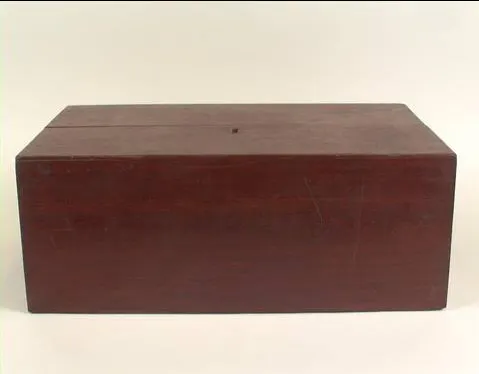
Writing desk, 1770–80. Mahogany, brass, textile, leather, paper, metal, wax. The New York Historical, Gift of Mrs. Edgar Saltus, 1917.6
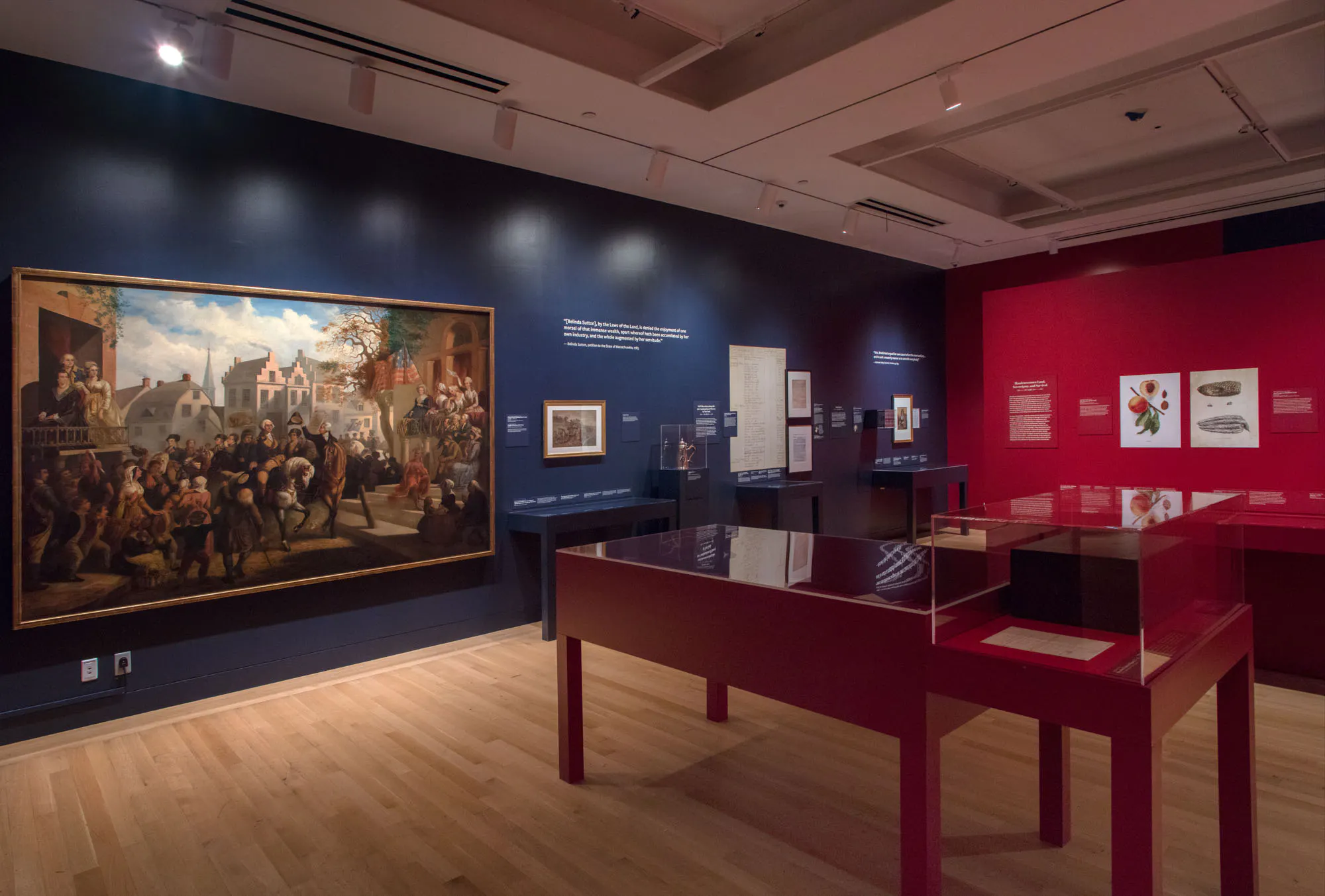
Photo by Glenn Castellano
The writing desk belonging to Aquila Giles is visible in the case on the right side of the image.
Despite helpful friends like this, their courtship was difficult to maintain. Many of the letters are not dated, so the chronology is difficult to follow, but at one point, Eliza wrote, “As long as you remain a prisoner, so long must I— …What shall I, what can I, what must I do? Adieu. Be advise’d forget me and enjoy sweet returning peace and tranquility of mind.” Yet Aquila would not take the bait to end their relationship. Whether to this plea to forget her or another, he wrote, “I am really at a loss my Dear Miss Shipton to know in what manner to answer your note of yesterday—I cannot presume to give my advice—I must repeat my Dear Girl, that my love for you is sincere, real and unaffected—and the compliance with your request ‘of forgetting you’ is totally out of my power—If you choose to forget me, I shall by no means blame you…”
Eliza returned to Flatbush in the spring of 1780, but by the fall, her uncle was threatening to separate them again. In late September, she prepared to say goodbye for good: “I have this moment my dear G- received orders to get ready. Hard task—but yet I must obey it—but first let me entreat you to be calm, and forget as much as possible the injury done us both.” Yet, their separation was not to be: Eliza fled her uncle’s home to elope with Aquila in October 1780. Following the war, her uncle was forced to flee to England, and Eliza and Aquila took over his Flatbush estate and enjoyed a long marriage.
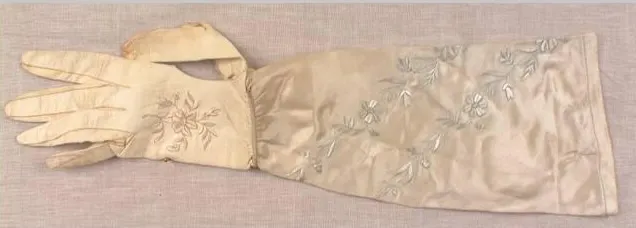
Original owner: Elizabeth Shipton Giles (ca. 1758–1822). Former owner: William Ogden Giles (ca. 1827–1907). Pair of gloves, late 1700s–early 1800s. United States (Probably: New York) Kidskin, silk. The New York Historical, Gift of Mrs. Edgar Saltus, 1917.7ab
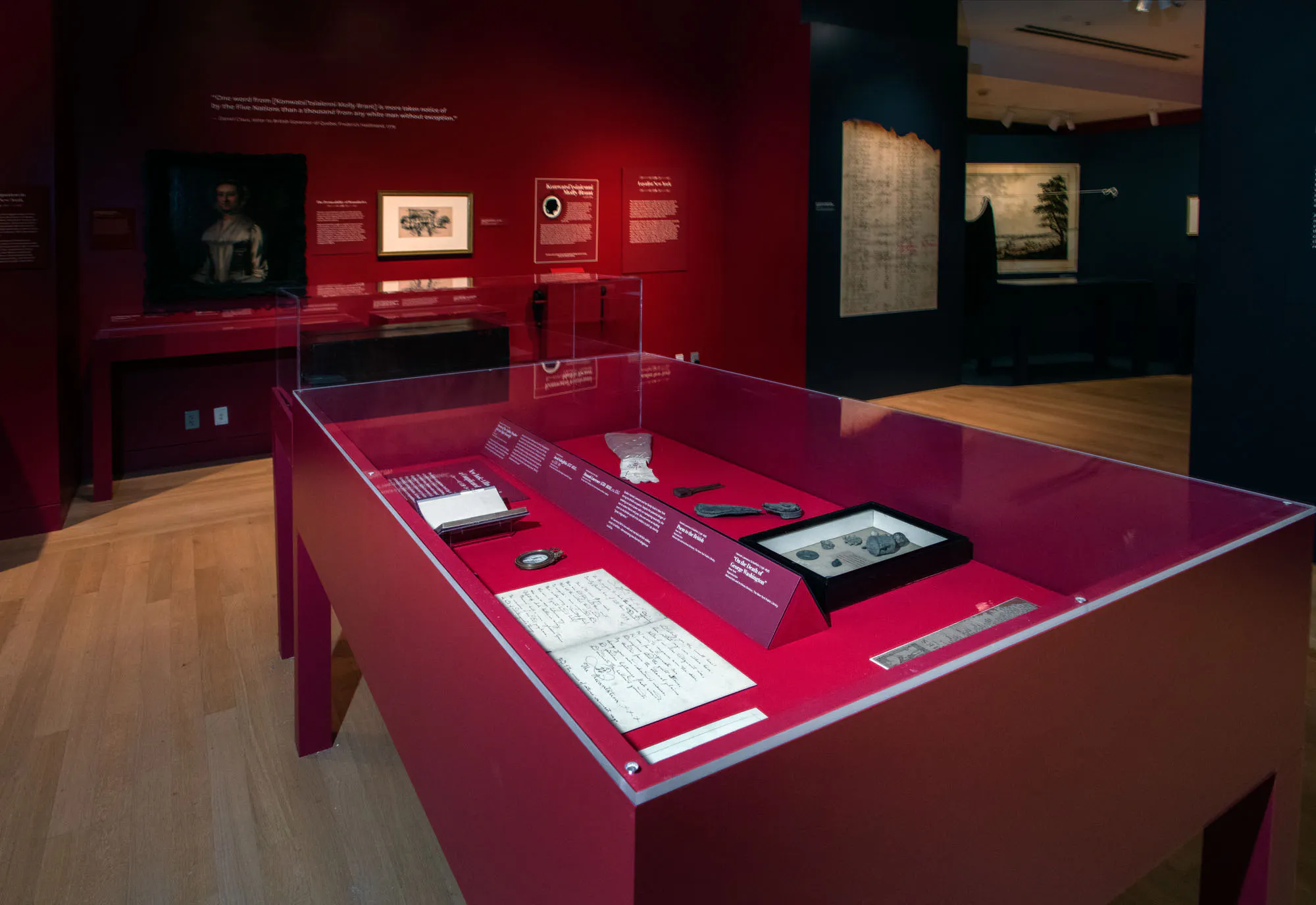
Photo by Glenn Castellano
A glove belonging to Elizabeth Shipton Giles is visible in the back right corner of the case at center.
While the lovers were star-crossed, their marriage was supported by those on both sides of the war. According to a later witness statement attesting to the marriage, the wedding was attended by Patriot Captain Edward Hale, and Eliza received well-wishes after the fact from British General William Phillips, who wrote, “my regard and respect for Miss Shipton has not diminished from her having changed her name.” And, while their story is extraordinary—and the record of their romance extraordinarily well-maintained—Aquila and Eliza were far from the only couple to cross military lines in pursuit of their hearts’ desires. A witness statement from their wedding reveals they were not even the only couple in Flatbush to elope across military lines: their wedding was attended by Abigail Lefferts Lloyd, who had previously fallen in love and married Patriot soldier Bateman Lloyd.
To see Aquila’s love poem, desk, and Eliza’s glove—and to learn more about women’s lives during the Revolutionary War—visit our Joyce B. Cowin Women’s History Gallery before October 25!
Anna Danziger Halperin is the director of the Jean Margo Reid Center for Women's History
Keep Reading
- Women at the CenterSeptember 1, 2026
The 11th Annual Diane and Adam E. Max Conference on Women's History
The 11th Annual Diane and Adam E. Max Conference on Women's History used the semiquincentennial of the signing of the Declaration of Independence to explore the legacy of the Revolution today. - Women at the CenterAugust 31, 2026
The 1876 Women’s Exhibition
What role did women play in commemorating the 100th anniversary of American Independence? - Women at the CenterAugust 3, 2026
A Revolutionary Chocolate Maker: The Business Records of Rebecca Gomez
How did Rebecca Gomez, a Jewish widow and businesswoman, help finance the first home of the New York Stock Exchange? - Women at the CenterJuly 20, 2026
The Things She Carried: Discussing the Power of Purses with Author Kathleen B. Casey
Historian and author Kathleen B. Casey discusses purses as adaptable toolkits that lead multidimensional lives of their own.