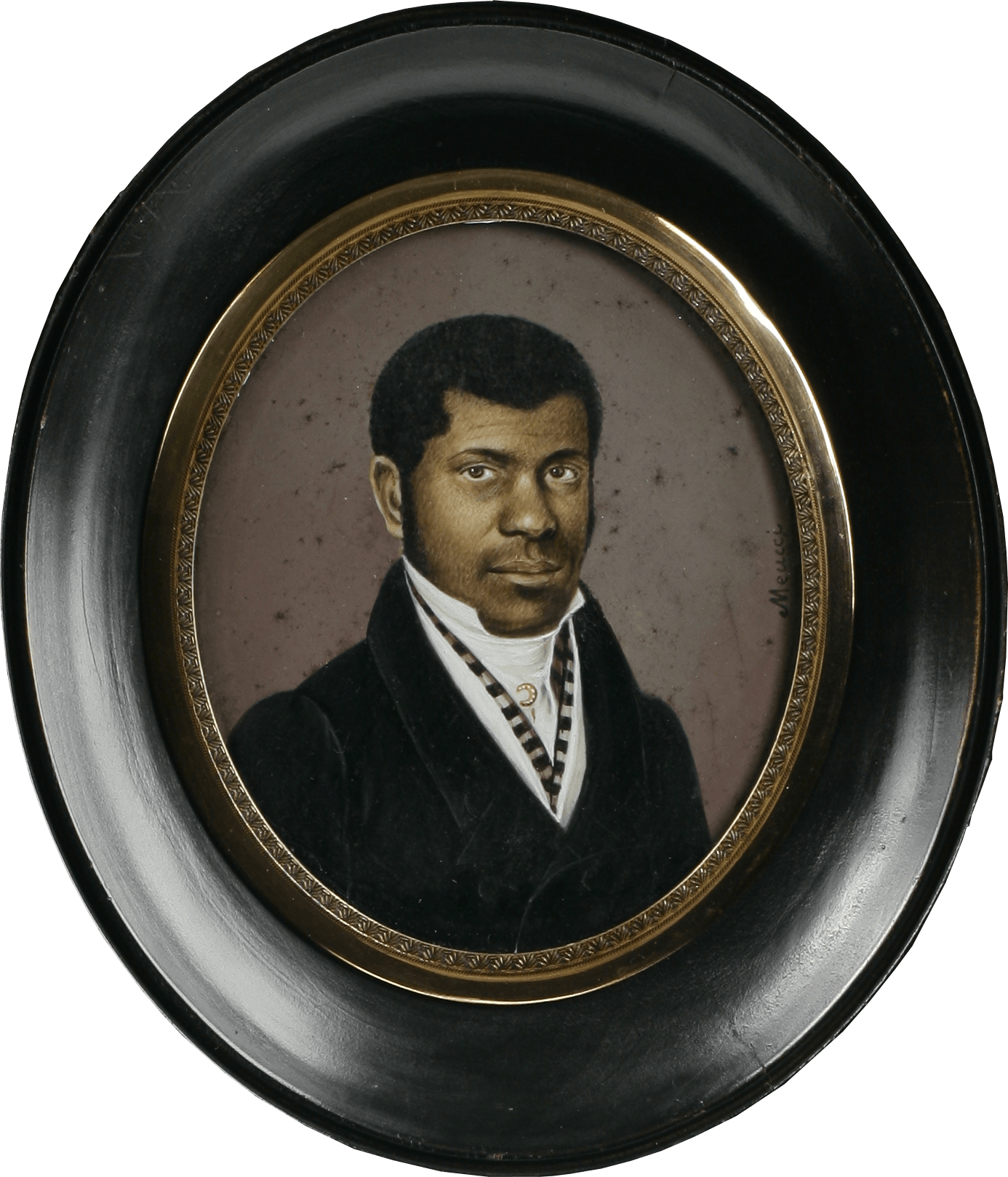
Despite being largely written out of the story of the American Revolution and our nation’s founding, two hundred and fifty years ago women left indelible marks on the fight for—and against—Independence, and on the very building blocks of the new nation. One such woman was Rebecca Gomez (1713–1801), a chocolate merchant and manufacturer. Part of the influential Gomez and de Lucena families, she was a direct descendant of the first Sephardi settlers in New York.
These first Jewish settlers founded Congregation Shearith Israel, the oldest Jewish congregation in North America and the only Jewish congregation in New York until 1825. They had fled the Iberian peninsula at the end of the 15th century and first settled in the Dutch colony of New Holland (which occupied the northeastern part of today's Brazil). But when the Portuguese expelled the Dutch from Brazil in 1654, the Jews faced renewed persecution from the Inquisition. While some of their number stayed in the Caribbean, a group of 23 Jewish refugees arrived in what was then New Amsterdam later that year. Some remained when the British took over in 1664, renaming the city New York. Though they faced discrimination, these early Jewish arrivals successfully petitioned the government for the right to worship, own property, and trade freely. For example, the opportunity to work in gold and silver was denied to Jewish craftsmen in most European countries, but silversmith Meyer Meyers (1723–1795) took advantage of the colonies' relative tolerance to create some of the first ritual objects made in New York, including the Torah finials and pointer still used at Congregation Shearith Israel today.
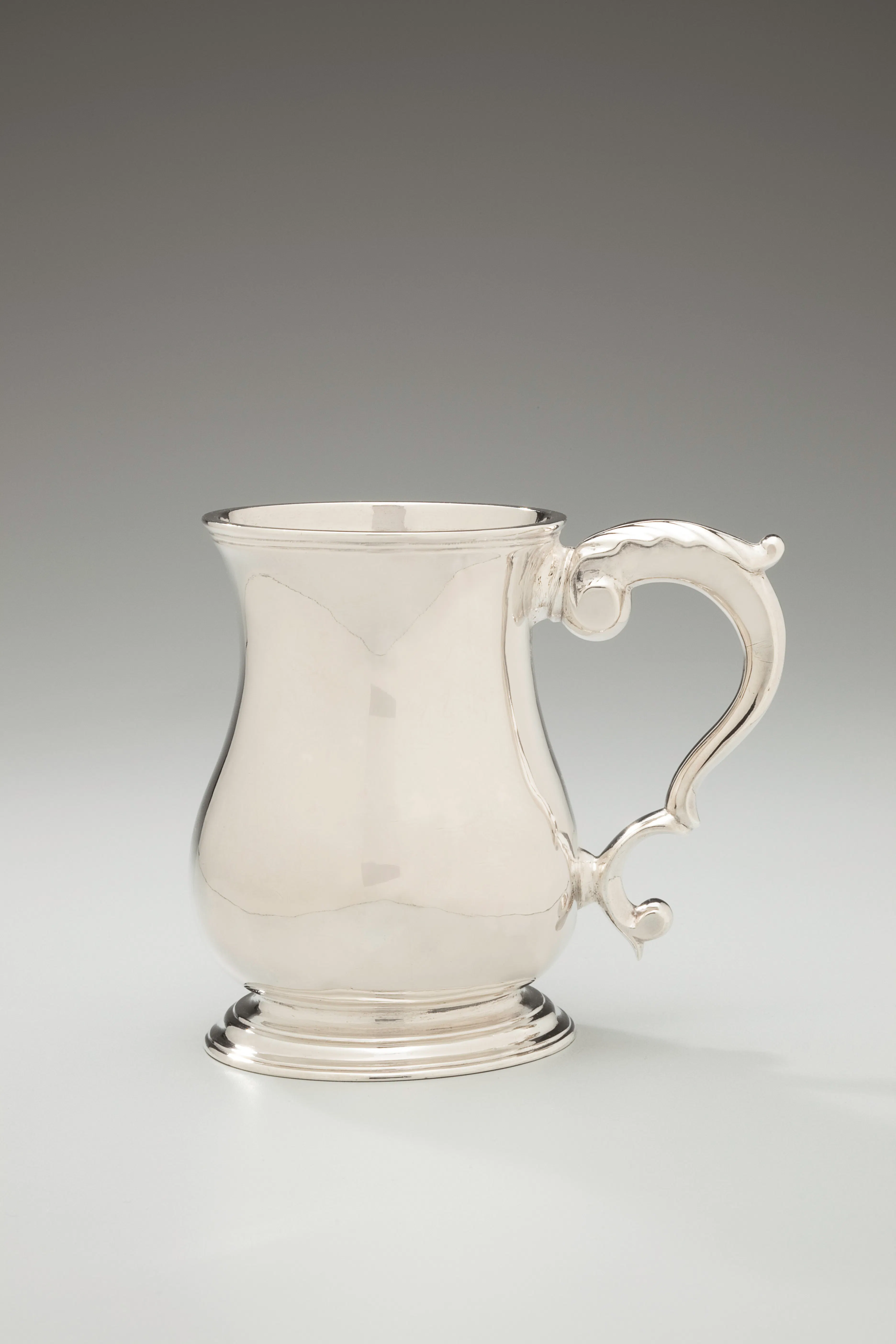
Myer Myers (1723–1795), maker. Cann owned by Reverend Alexander McWhorter (1734–1807), ca. 1750–65. New York City. Silver. The New York Historical, Gift of George C. McWhorter, 1895.12
The owner of this cann, the first piece of domestic silver acquired by The New York Historical, was Presbyterian minister Reverend Alexander McWhorter. An ardent patriot, McWhorter joined George Washington’s army and eventually became chaplain of Henry Knox’s artillery brigade.
In New York, the Sephardic Jews were joined by increasing numbers of Ashkenazic Jews (like Myers, who served several terms as Congregation Shearith Israel's parnas, or president), who hailed from central and eastern Europe. Still, Congregation Shearith Israel continued to follow Spanish-Portuguese customs, as indicated by the title page of the first Jewish prayer book to be published in North America, pictured below. This was also the first Jewish prayer book to be translated into English, after Isaac Pinto, a Sephardic merchant and scholar, realized that many of his fellow congregants could not understand the Hebrew service. In 1766, he completed a translation of all the prayers recited on the weekly Sabbath and the yearly holidays. As Pinto wrote in the preface, services would still be conducted in Hebrew, “the sacred tongue with which God chose to reveal himself to our ancestors,” but now those members who did not understand Hebrew could follow along in English— including the prayer for King George III and the royal family of England.
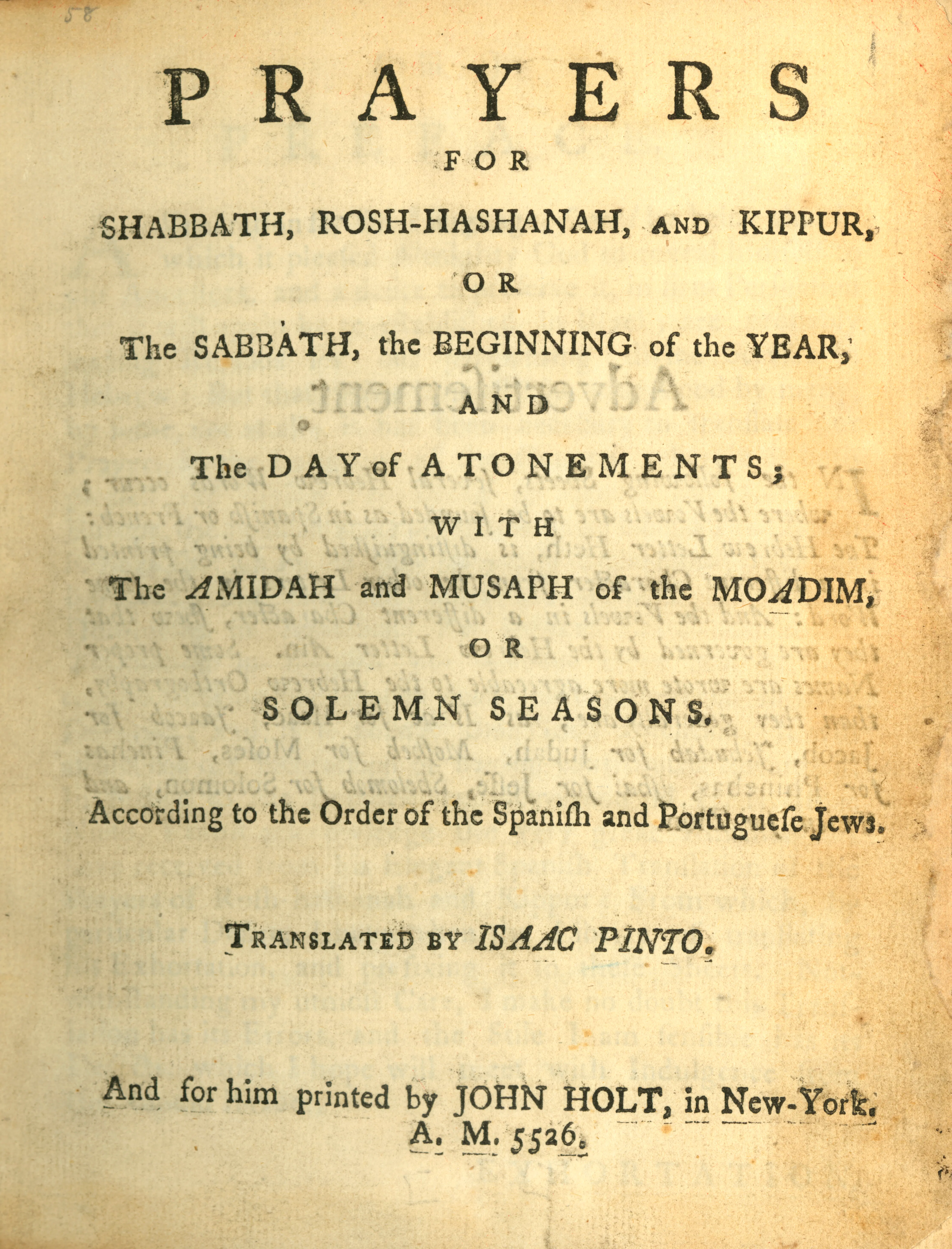
Isaac Pinto (1720–1791), translator. Prayers for Shabbath, Rosh-Hashanah, and Kippur; or, The Sabbath, the Beginning of the Year, and the Day of Atonements. New York: John Holt, 1766. Patricia D. Klingenstein Library, The New York Historical
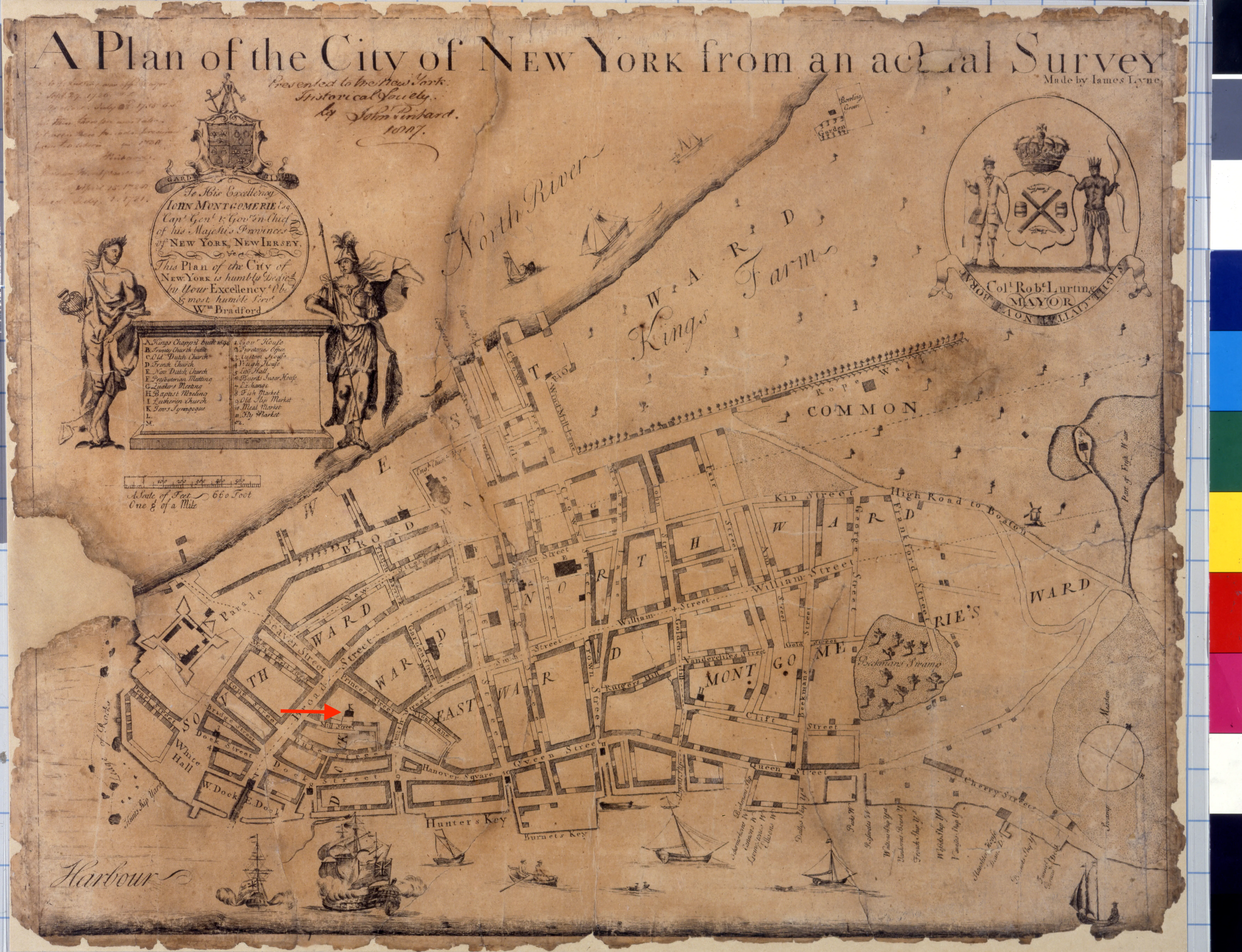
James Lyne (active 1728–44), surveyor. A Plan of the City of New York from an Actual Survey, Made by James Lyne. New York: William Bradford, 1731. Patricia D. Klingenstein Library, The New York Historical
The "Jews Synagogue" was originally located on Beaver Street, but moved to its first purpose-built building on Mill Street in 1730, which is noted on the Lyne Bradford map—the first plan of New York printed in the city itself. Abraham Haim de Lucena, Rebecca's father, was the second hazan, or cantor, of Congregation Shearith Israel.
Little is known about Rebecca's early life. She married the wealthy merchant Mordecai Gomez in 1741, and the couple had several children, among them sons Abraham and Moses Gomez Jr. Their daughter Esther later married into the equally prominent Hendricks family—her husband Uriah and son Harmon would go on to pioneer the American copper industry, which was vital to the growth of the US Navy and commercial shipping concerns.
Rebecca, in contrast, dealt in chocolate.
Chocolate is made by fermenting, drying, roasting, and grinding the beans of the cacao tree, which is native to the tropical Americas. It was widely traded and consumed as a beverage by Indigenous civilizations from the Amazon and Orinoco river basins in South America (where cacao cultivation is now thought to have originated), throughout Mesoamerica (where the Maya considered cacao trees sacred and used the beans as currency) and north into what is today the southwestern US. When chocolate arrived in Europe, carried by Spanish and Portuguese colonizers, the continent's elite went wild for the "exotic" drink, spiking demand and profoundly altering cacao production, distribution, and preparation. By the 19th century, most cacao was grown on plantations worked by enslaved Black and Indigenous people. (In addition to Central and South America and the Caribbean, the Portuguese also introduced cacao plantations to West Africa.) Enslaved workers also labored at roasting, shelling, and grinding the cacao beans, and in preparing the chocolate to suit European palates: heated, sweetened, whisked with milk, and flavored with vanilla or cinnamon, rather than chili or maize.
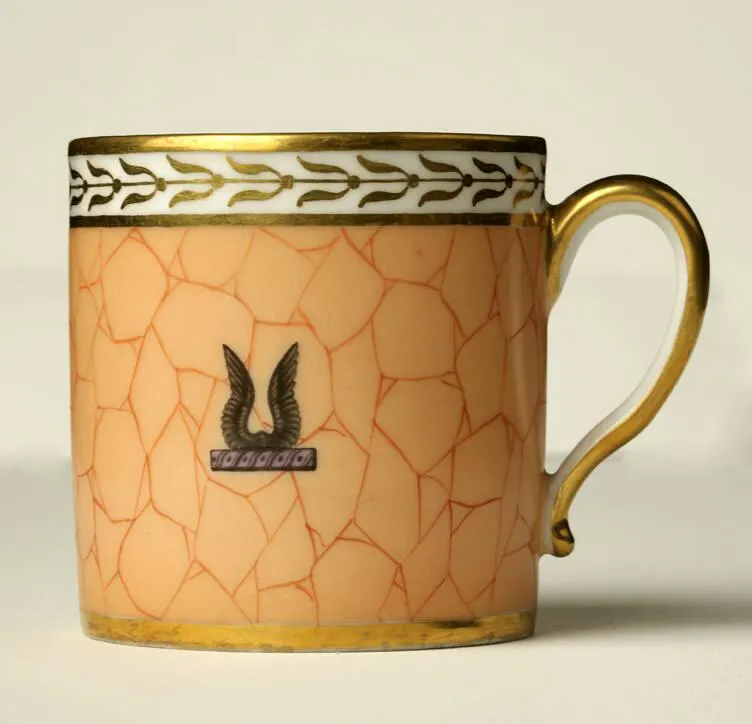
Jean Népomucène Hermann Nast (active 18th century), maker. Chocolate cup, ca. 1805. Paris. Porcelain. The New York Historical, Gift of Mrs. Bradford Boardman, 1954.9y
As Rabbi Deborah R. Prinz explains, the Jewish people who sought refuge in the Dutch (and later British) North American colonies "packed with them new chocolate tastes, techniques, and opportunities, thereby supplying and extending chocolate to larger markets." Sephardi merchants, including the Gomez family, imported cacao beans from the Caribbean, Central America, or South America, and sold them in Philadelphia, New York, and elsewhere. The colonies' relative proximity to cacao's point of origin helped keep prices reasonable, Prinz explains, and while France imposed a monopoly on chocolate and Britain taxed it heavily, "the colonies did neither." In 1776, Prinz reports, the colonies supported 50 chocolate makers, with 24 in the city of Philadelphia alone.
By the time the Revolutionary War erupted, Rebecca Gomez was both an established business owner and a widow. She was part of a trade network that stretched between the West Indies, Madeira, Barbados, Curacao, London, and Dublin; the Gomez family imported and sold both cacao beans and prepared chocolate but Rebecca Gomez is the only woman we know of to make her own "manufactured Chocolate, warranted free from any sediments and pure," as she put it in an advertisement that ran in the New York Gazette and Weekly Mercury on January 25, 1779.
From advertisements like this, we can tell that Rebecca Gomez remained in the city during the British occupation. Throughout the Revolutionary War, she continued to advertise her shop and goods in New York newspapers. There are records of sales made to her in the account book of Robert Townsend, a key figure in General George Washington’s Culper Spy Ring, which provided intelligence to the American cause.
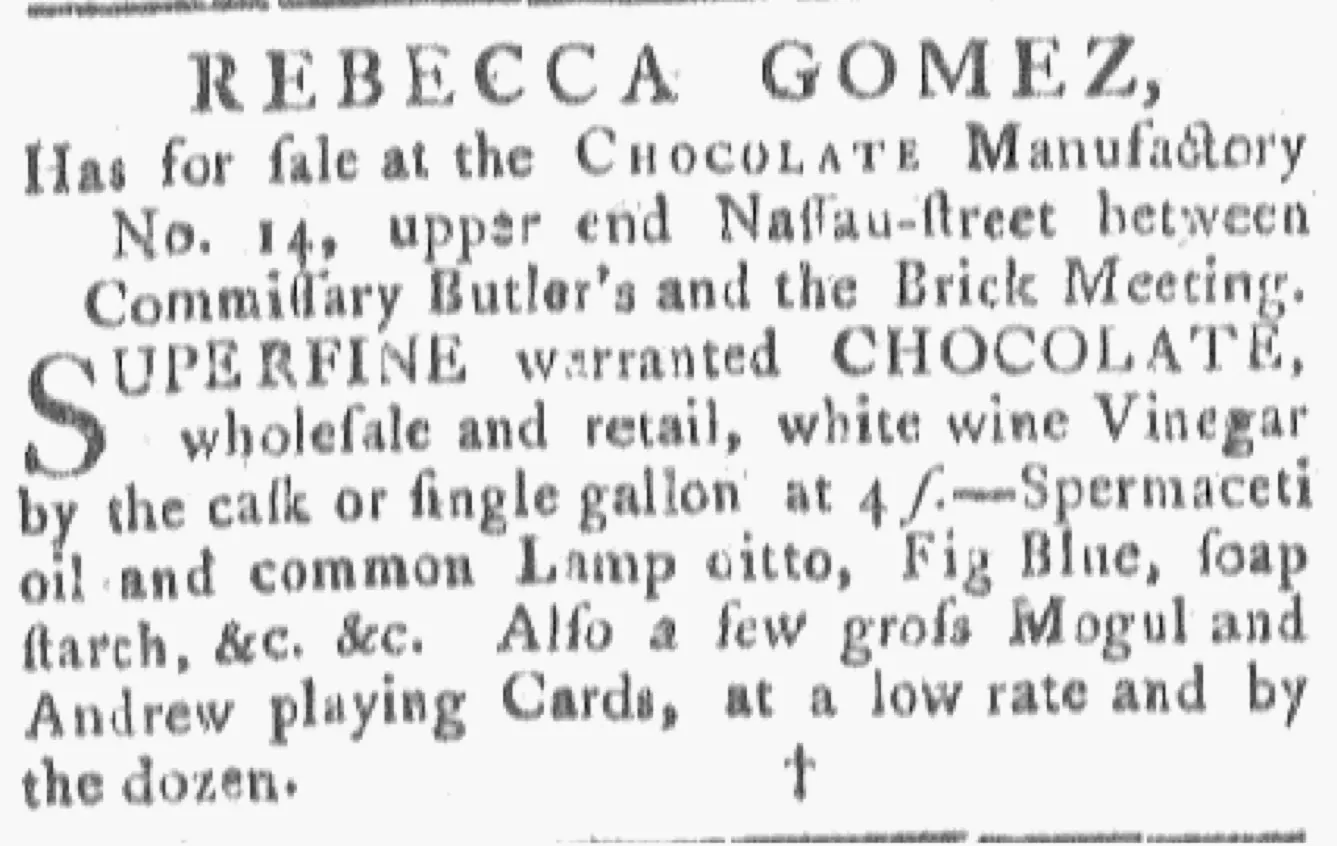
Advertisement published in The Royal American Gazette, December 2, 1780
However, we also know that Rebecca's sons and son-in-law signed the New York Loyalists' Address to Lord and General Howe and Sir Tryon in October 1776, probably in the hopes that the family would be able to remain in the city and their property would be spared confiscation (or destruction) under occupation and martial law.
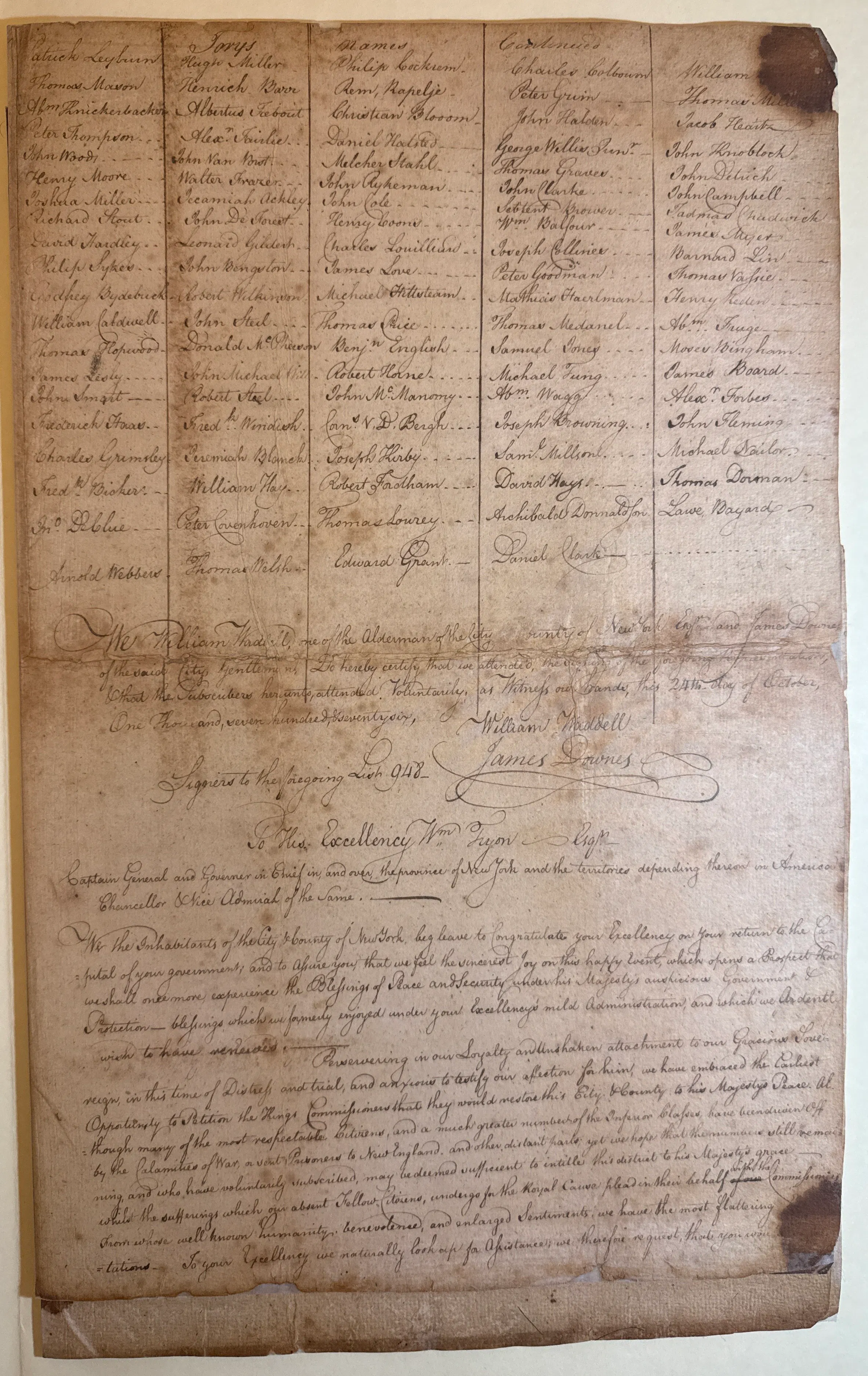
New York Loyalists' Address to Lord and General Howe and Sir Tryon, October, 1776. Patricia D. Klingenstein Library, The New York Historical.
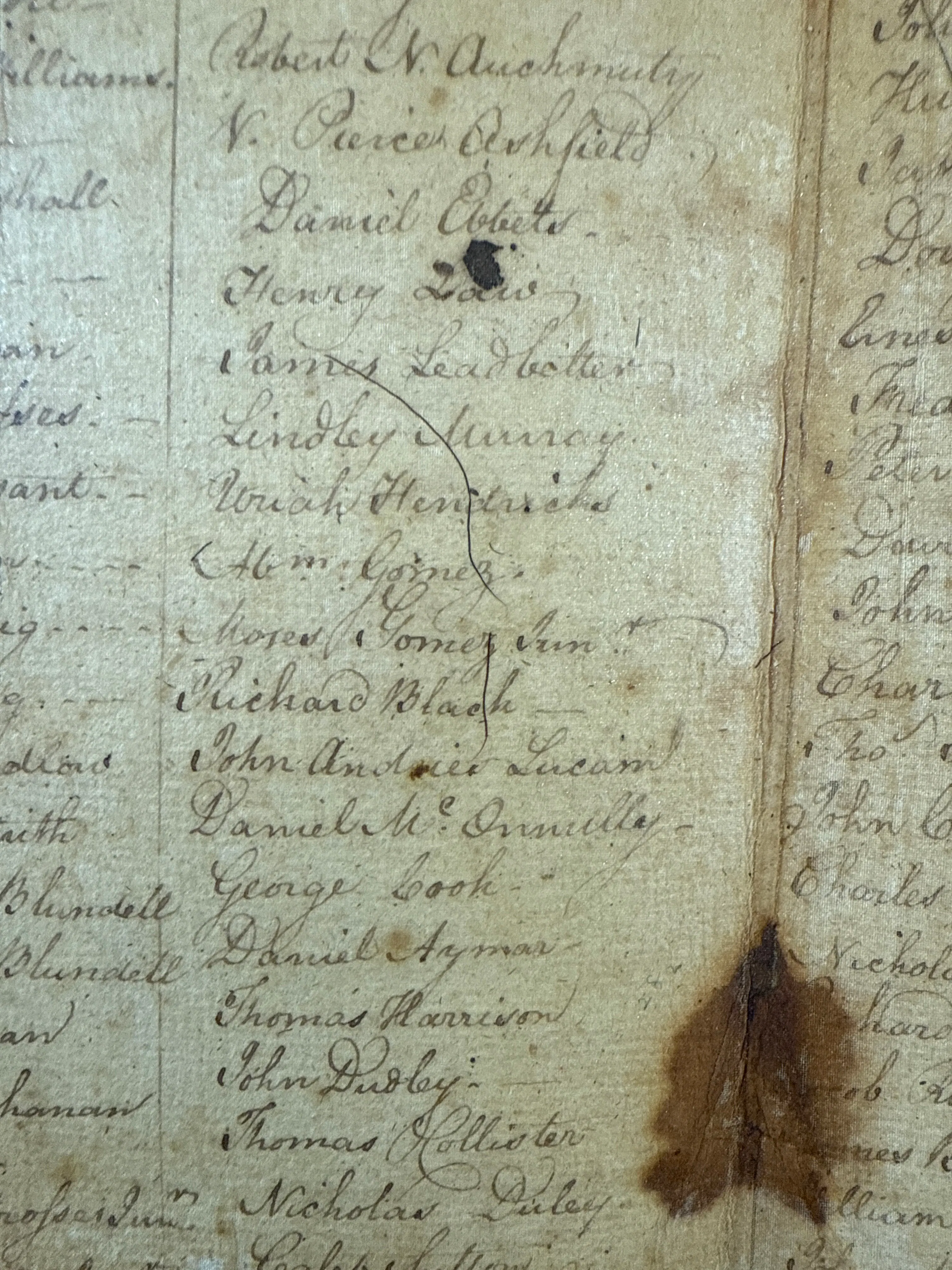
This close-up of a page in the October 1776 Loyalists' Address shows the signatures of Uriah Hendricks, Abraham Gomez, and Moses Gomez Junior.
Congregation Shearith Israel was not so lucky—in 1776, British soldiers damaged and desecrated two of the synagogue's Torah scrolls, even though they had been left under the care of Loyalist congregants. Such damage makes a Torah unfit for ritual use according to Jewish law, but in the September 14, 1782, issue of Rivington's New York Gazette, synagogue member Barak Hays offered a reward for the return of the two Torah scrolls. The congregation's determined pursuit of the missing scrolls—even before the British army evacuated New York City—speaks to their significance as historic, as well as ritual, objects.
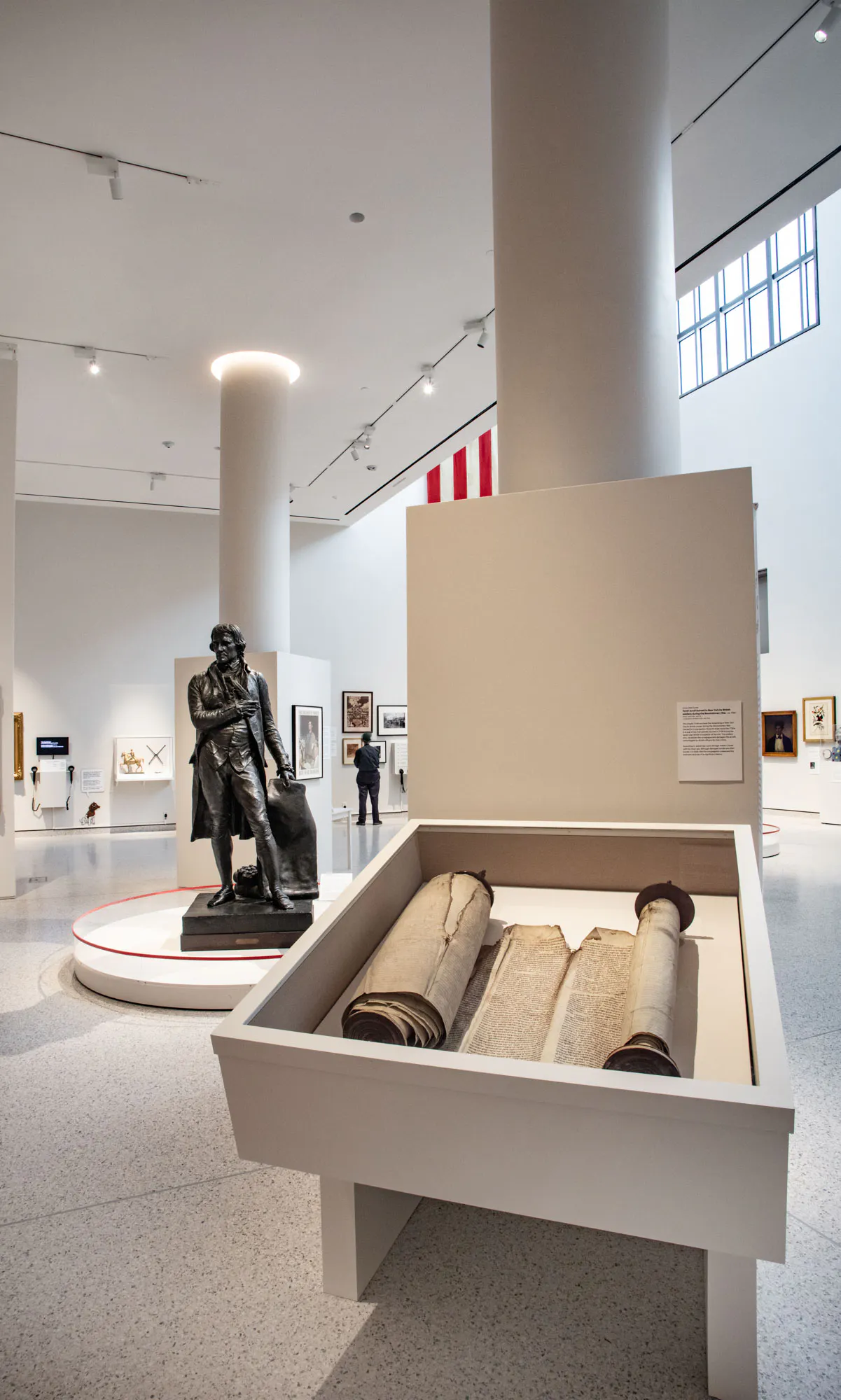
Unidentified scribe. Torah scroll burned in New York by British soldiers during the Revolutionary War, ca. 1730. Wood, parchment, and ink. Congregation Shearith Israel, display made possible by the David Berg Foundation Jewish Treasures Initiative. Photo by Glenn Castellano
This Torah scroll will be on view in Democracy Matters, an exhibition in our new Tang Wing for American Democracy, until November 1, 2026.
Having survived the war, Rebecca Gomez left her mark on a very different city landmark when she participated in the creation of the Tontine Coffee House, built in the early 1790s at the intersection of Wall Street and Water Street. At a time when New York City was transitioning from a center of government (the Federal government relocated to Philadelphia in 1790) to a center of finance, banking, and trade, the Tontine Coffee House was far more than a place for patrons to sip hot beverages. Its second floor served as the first home of the New York Stock Exchange, making it the heart of New York’s growing financial might. It was a crucial meeting place for merchants and traders to socialize, exchange information, and bargain over cargo from ships arriving at the East River wharves. From the Tontine’s earliest minutes, we see further evidence of Gomez’s role as a thriving merchant in the city’s economy: she sold the land on Wall Street on which the coffee house was built.
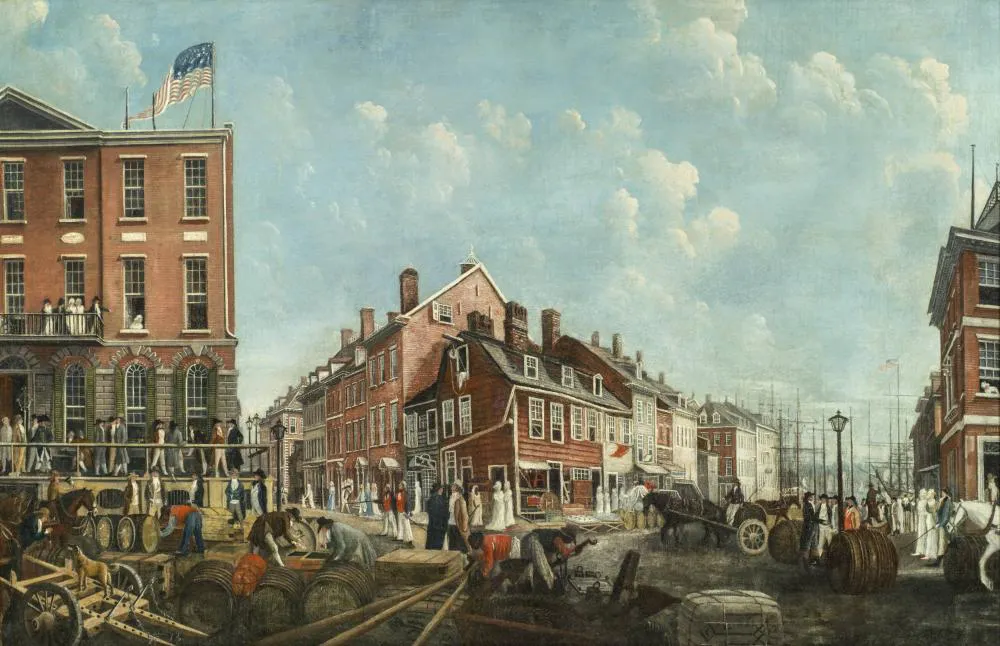
Francis Guy (1760–1820), artist. Tontine Coffee House, New York City, ca. 1797. Oil on linen. The New York Historical Purchase, The Louis Durr Fund. Sponsored by Laurie and Sy Sternberg, 1907.32
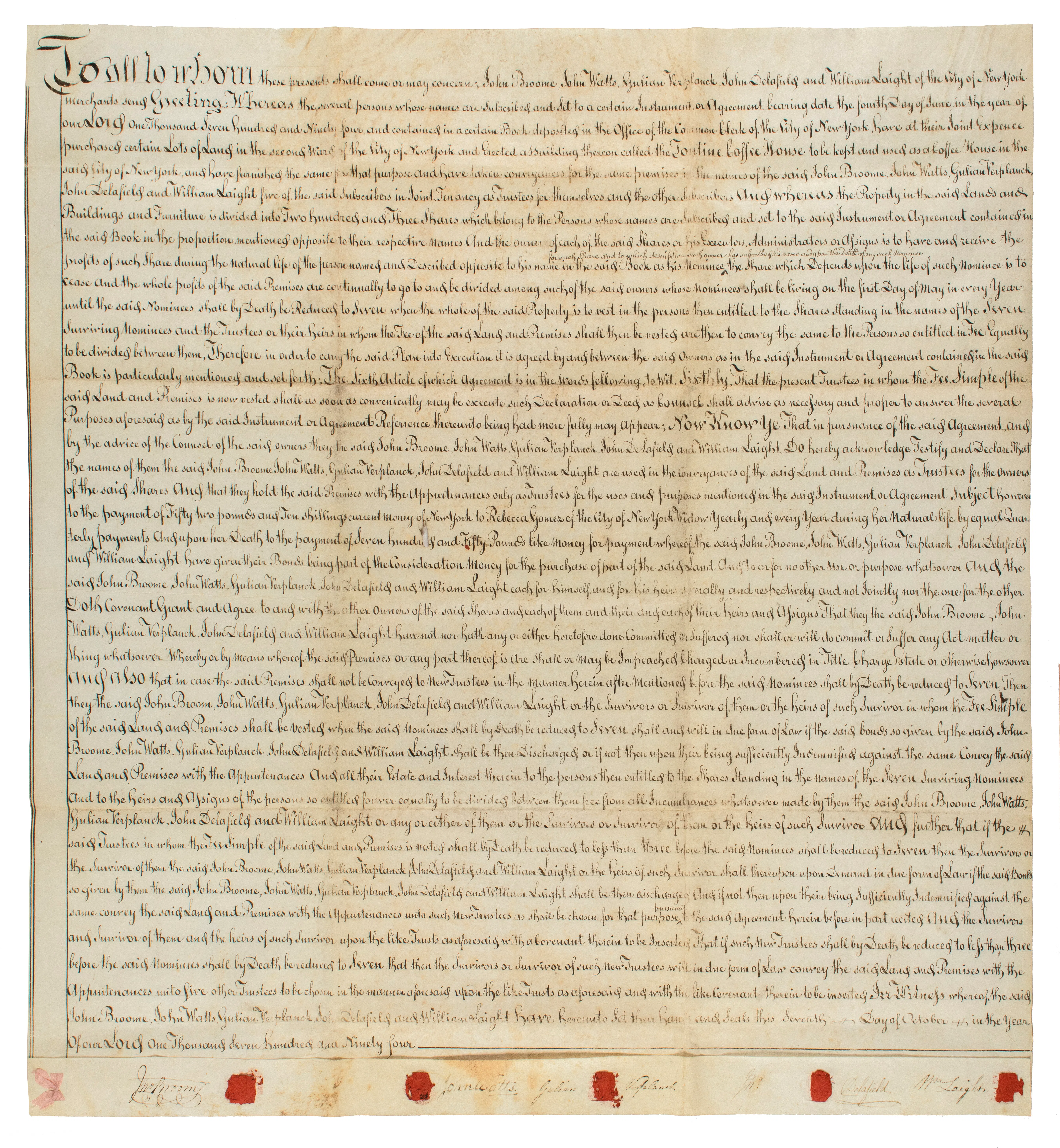
Tontine Coffee House (1790–1870). Declaration of Trust with Rebecca Gomez, 1794. Patricia D. Klingenstein Library, The New York Historical.
This legal document records Gomez’s sale of the land on which the Tontine Coffee House was built.
What exactly, you may ask, is a tontine? Broadly speaking, it is a type of joint investment that allowed people to raise significant amounts of capital at a time when New York City only had one bank. Records held by The New York Historical’s Patricia D. Klingenstein Library show that 203 shares in the tontine were sold at $200 each to fund construction of the building in 1792–94. Each shareholder selected a nominee, who was often a young child. During the lifetime of that particular shareholder's nominee, he or she was entitled to an equal division of profits derived from the coffee house. When that nominee died, the shareholder stopped receiving his or her dividends and was out of the tontine. Those dividends were re-divided amongst the remaining shareholders, meaning that as the number of nominees decreased, each remaining shareholder received more money.
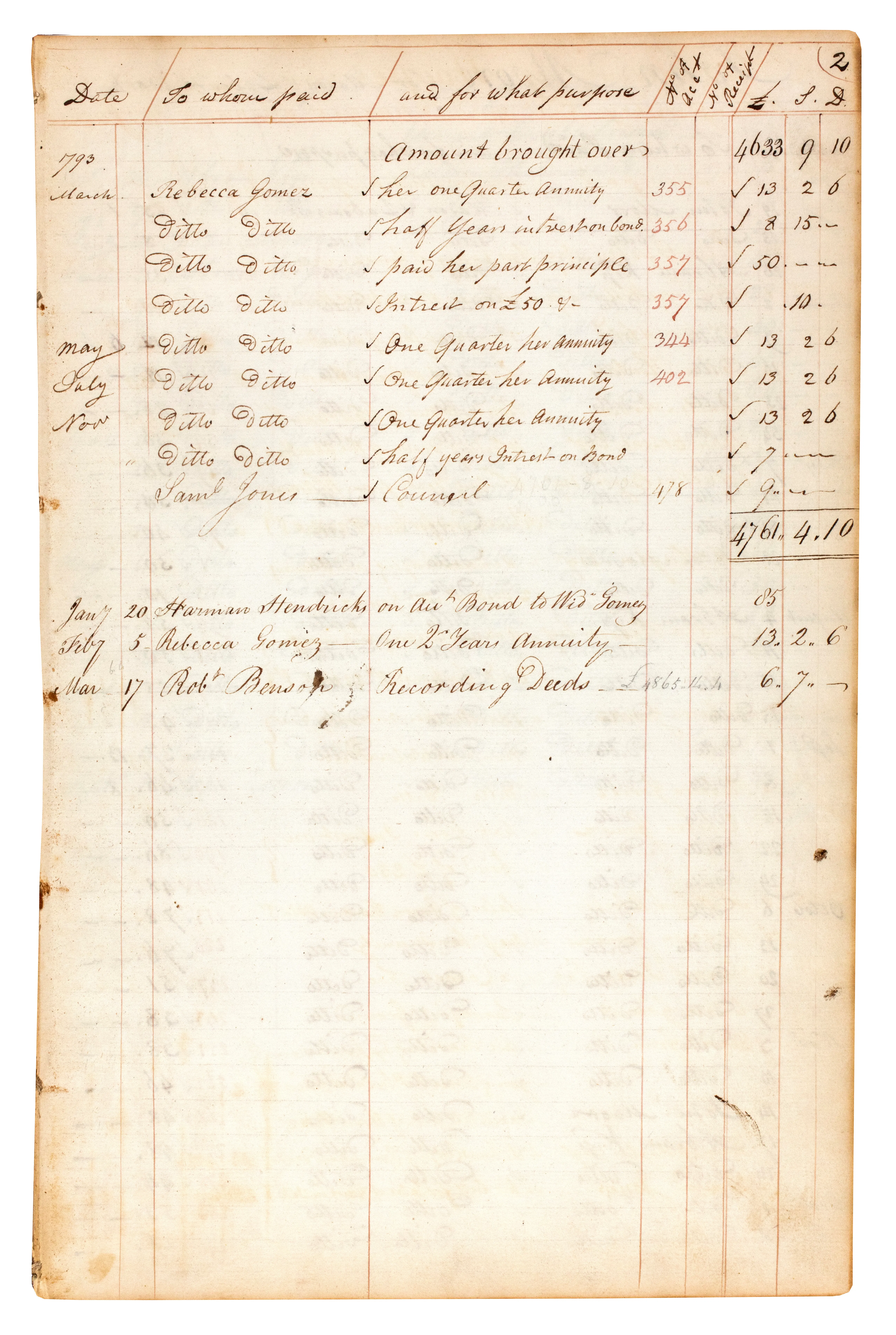
Tontine Coffee House (1790–1870). Ledgers volume, March 1793. Patricia D. Klingenstein Library, The New York Historical
Many of the richest citizens of New York owned shares within the coffeehouse. Women were active participants and their names populate the record books—including repeated entries for Rebecca Gomez.
The Coffee House not only hosted the New York Stock Exchange, it relied upon and helped facilitate the slave trade. Like the city’s financial and merchant community as a whole, the Tontine profited from the sale of enslaved men and women. It was built across the street from the former site of the municipal slave market, and the bonds and annuities listed in the account book here attest to the wealth that afforded many upper- and middle-class white women and men the ownership of others. We know that Rebecca Gomez owned enslaved people thanks to the will of her late husband, Mordecai Gomez, the same document in which he also stated, “I leave to my beloved wife Rebecca, all that my dwelling house and lot on the Dock in the East Ward in New York…”
That parcel of land would become the site of the Tontine Coffee House.
Rebecca Gomez's story may be unfamiliar, but it was representative of many New York women of the time, including Jewish women: they had wealth; financial institutions and businesses were premised on their property, credit, and involvement; and they were intricately woven into the economy of Revolutionary New York.
Yet history has not remembered women like Rebecca as financially powerful in their own right. Archival documents can rectify this misconception: their names—not their husbands’ or fathers’—are scattered throughout account books, estate inventories, and wills. Many women had money and property of their own, even in the face of restrictive legal structures, and the burgeoning city relied on their loans, credit, and words to become the financial center that it is today. For more stories like these, visit Revolutionary Women, on view through October 25, 2026.
Written by Anna Danziger Halperin, Director of the Jean Margo Reid Center for Women's History, and Tessa Bangs, Mellon Foundation Postdoctoral Fellow in Women's History and Public History, Jean Margo Reid Center for Women’s History
Keep Reading
- Women at the CenterSeptember 1, 2026
The 11th Annual Diane and Adam E. Max Conference on Women's History
The 11th Annual Diane and Adam E. Max Conference on Women's History used the semiquincentennial of the signing of the Declaration of Independence to explore the legacy of the Revolution today. - Women at the CenterAugust 31, 2026
The 1876 Women’s Exhibition
What role did women play in commemorating the 100th anniversary of American Independence? - Women at the CenterJuly 27, 2026
Star-Crossed Lovers of the Revolution: The Letters of Eliza Shipton and Aquila Giles
Was it possible to fall in love across ideological lines during the Revolutionary War? - Women at the CenterJuly 20, 2026
The Things She Carried: Discussing the Power of Purses with Author Kathleen B. Casey
Historian and author Kathleen B. Casey discusses purses as adaptable toolkits that lead multidimensional lives of their own.