As the notes of “Washington’s March” rang out in the early morning streets of Philadelphia on May 10, 1876, the opening ceremony of the Centennial International Exhibition officially began. The grand exhibition commemorating the 100th anniversary of American Independence took place from May 10 through November 10. Over the course of these six months, over 2 million people from all over the country and world paid admissions to attend the exhibition. Seven exhibition buildings were created in Fairmont Park alongside the Schuylkill River for the celebrations: the Main Building, Memorial Building, Machinery Hall, the United States Government Building, and the Women’s Pavilion. Each of these buildings were built to represent the triumphs of American democracy after independence.
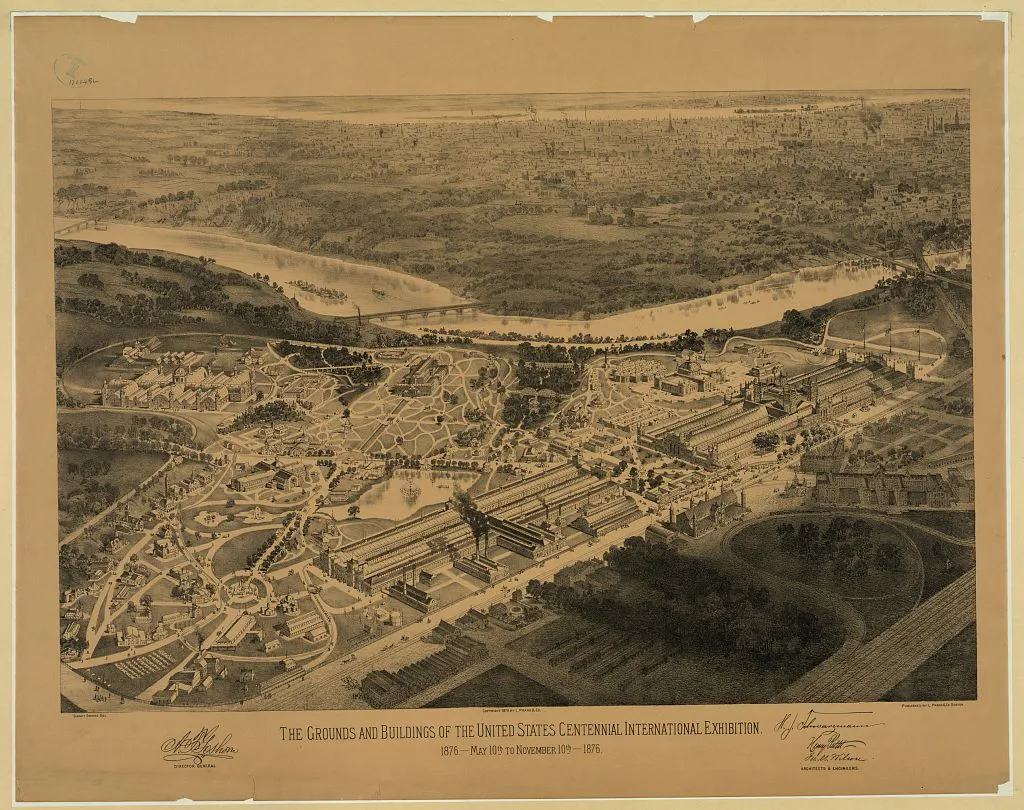
The Grounds and Buildings of the United States Centennial International Exhibition, May 10th to November 10, 1876. Boston: Louis Prang & Co., 1876. Prints and Photographs Division, Library of Congress
The road to the Centennial celebration was long and fraught—Congress did not approve the exhibition until 1871. However, once the bill was finally passed, it stated that the Exhibition “should be held under the auspices of the United States; at the same time leaving it to the people to raise the necessary money therefor by voluntary contributions.” For a time, the exhibition struggled to fundraise; the Panic of 1873 greatly reduced the number of donations. In January and February of 1876, only three months before the opening ceremonies, the board running the Centennial Commission turned to Congress for assistance and asked for one and a half million dollars to fund the exhibition. The timing of this request made it politically fraught; by the end of the Reconstruction era, even much of the Northern electorate felt increasingly burdened by the government's economic expenditures. Congress debated it for a while, but the Centennial Commission eventually won out. The Senate passed the bill by 41 to 15, and the exhibition was officially in full swing.
Almost every government department was represented at the Centennial Exhibition. The Department of the Interior showcased vignettes of America’s natural wonders, including Yellowstone National Park, as well as representations of Native Americans, while the Quartermaster’s Department displayed costumes from branches of service from the Revolutionary War, and the Navy Department demonstrated how naval appliances had improved over time. Additionally, 26 states had their own pavilions. As one correspondent of The New York Times put it in 1876, “Every variety of the genus Americanum is here.” People from all walks of life came together to celebrate American independence. American citizens from all over the country were represented in the exhibitions.
One of the most significant, yet controversial, buildings created for this exhibition was the Women’s Pavilion. The idea behind the Women’s Exhibition was promulgated in 1873, when a Women’s Centennial Executive Committee was established. This committee was supposed to generate enthusiasm for the celebrations. People believed that women’s “gentle nature” would bring the nation back together after the antagonism of the American Civil War. The leader of the committee, Elizabeth Duane Gillespie (the great-granddaughter of Benjamin Franklin) and other volunteers canvassed the streets of Philadelphia, obtaining signatures to raise $1 million for the Centennial Exhibition. Additionally, when Congress debated whether they should provide funds for the exhibition in the winter of 1876, a group of women (including Gillespie) testified before the Senate, presenting signatures from hundreds of American women in support of the exhibition. This helped tip the scales in favor of the Congressional decision to provide $1.5 million for the exhibition.
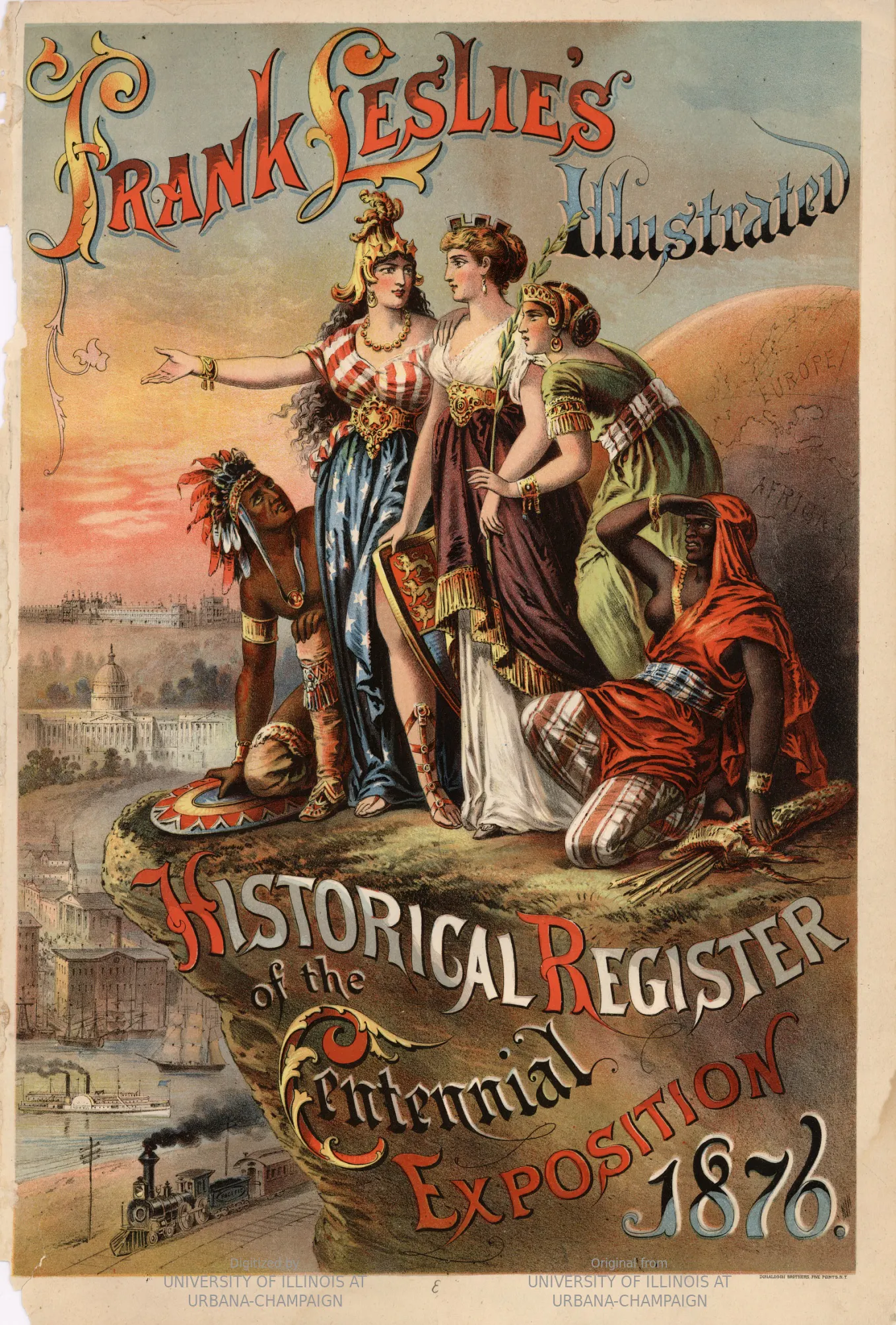
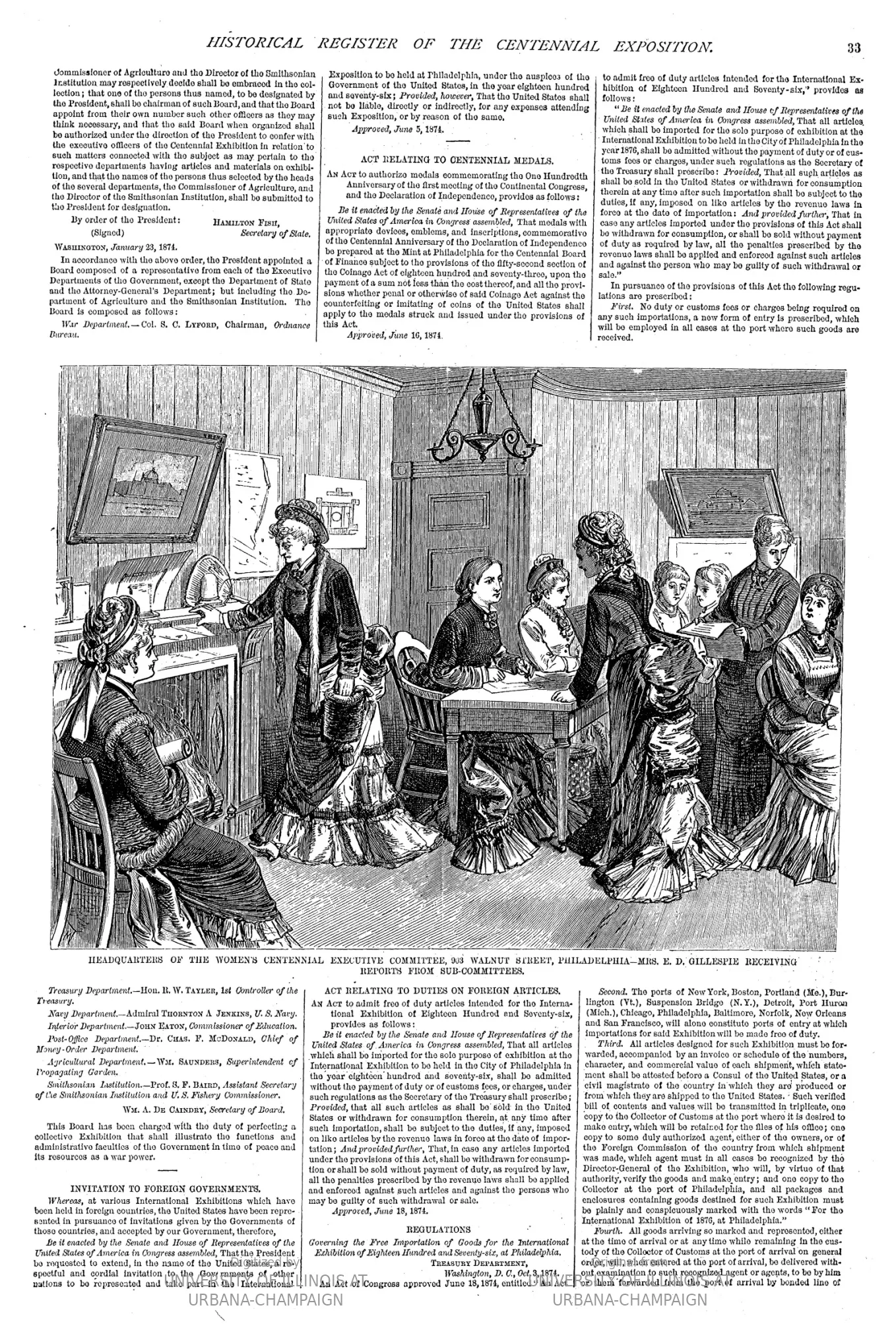
Historical Register of the Centennial Exposition. New York: Frank Leslie, 1877. The cover of this publication alludes to the long-standing artistic convention of using racialized allegorical figures to represent different countries or continents. The interior image depicts Elizabeth Duane Gillespie at the headquarters of the Women's Centennial Executive Committee in Philadelphia.
Originally, the Women’s Committee was going to receive funds from the men of the Centennial Commission to create a building, but in 1875 they were informed that, due to an increase in foreign exhibits, their exhibition would no longer be possible unless the women paid for it entirely on their own. This did not dissuade the women of the committee, and in about four months they raised the funds necessary to construct the Women’s Pavilion. Women from all over the country pitched in to make it possible.
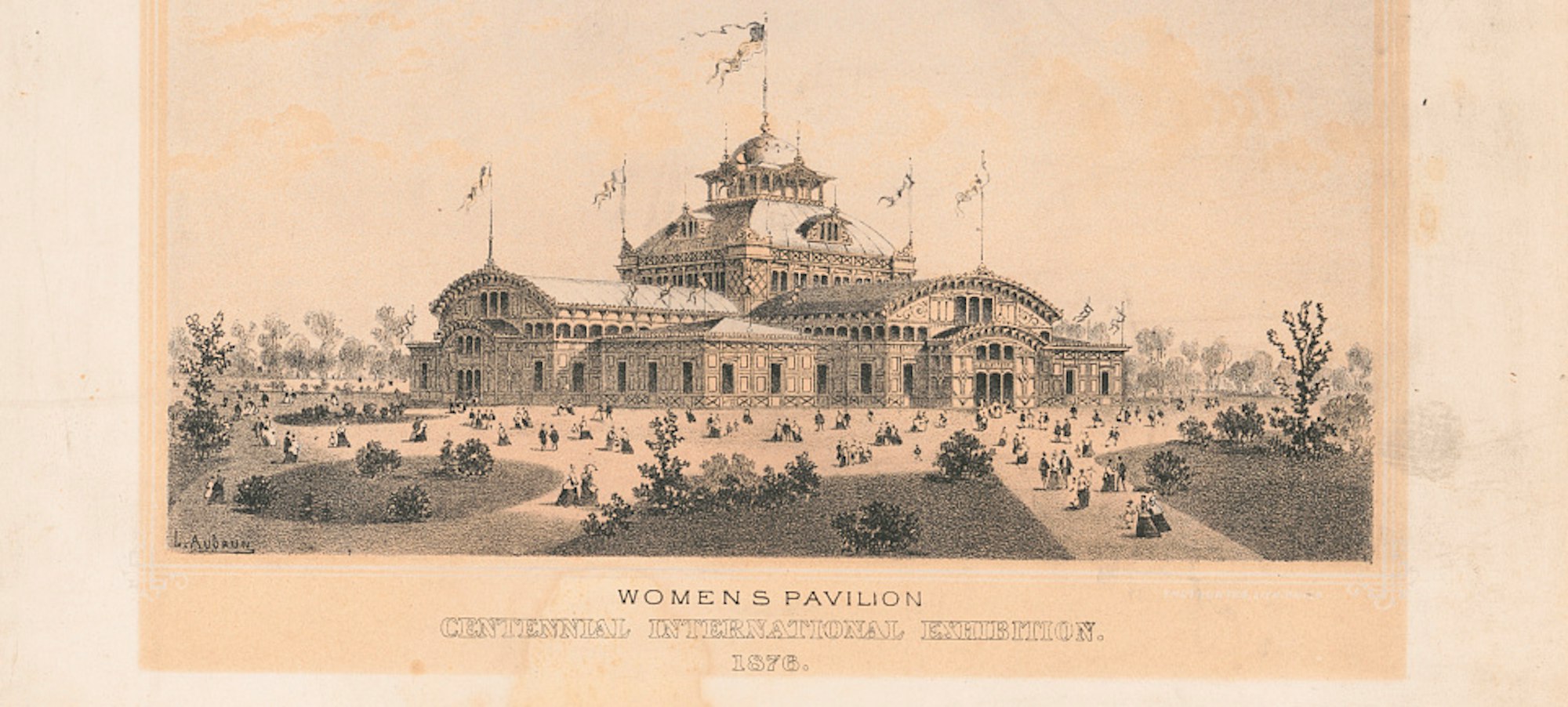
The Women’s Pavilion was designed by architect Hermann J. Schwarzmann and was built in the shape of a Greek cross. As people entered the building they passed through the doors on which the proverb “Let her works praise her in the gates” was written in six different languages.
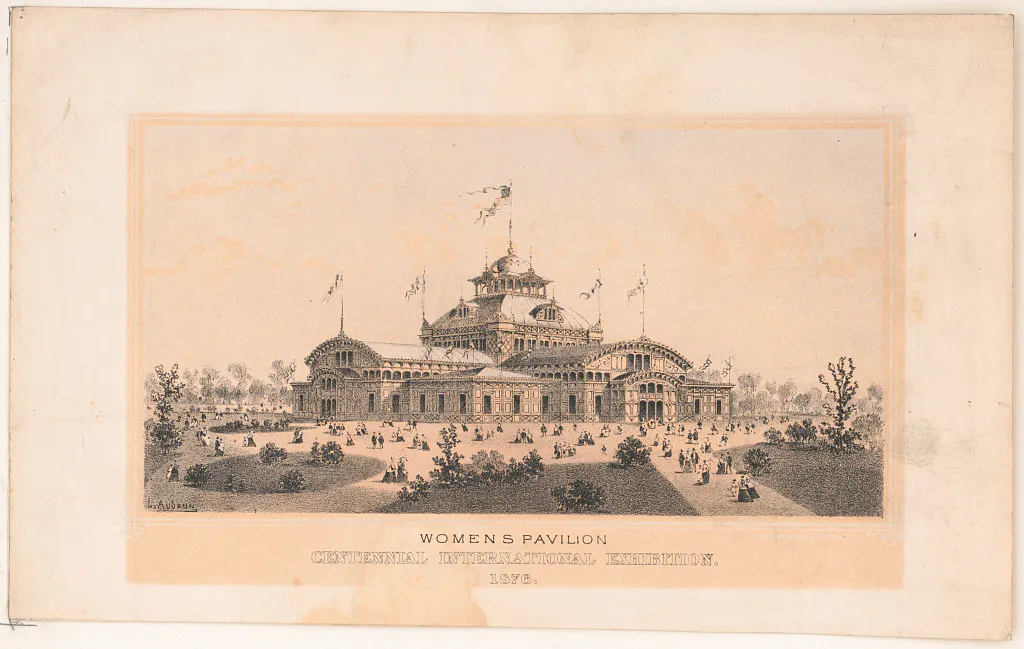
Women’s Pavilion, Centennial International Exhibition, 1876. Prints and Photographs Division, Library of Congress
The Women’s Pavilion featured material culture from women from all around the world. The objects were not only for domestic use: as well as the section dedicated to ‘useful’ products, the Women’s Medical College of Philadelphia provided a Materia Medica Cabinet, while the Lowell Art School and Cooper Institute displayed artistic designs. Women showcased etchings and pressed flowers and furniture. They exhibited china and carpets and sea mosses and wood carvings. Countries from all over the world participated in this exhibition, which displayed figurines from China, jewelry from Sweden, needlework from English royalty, embroidered cushions from Brazil, and wool from Scotland.
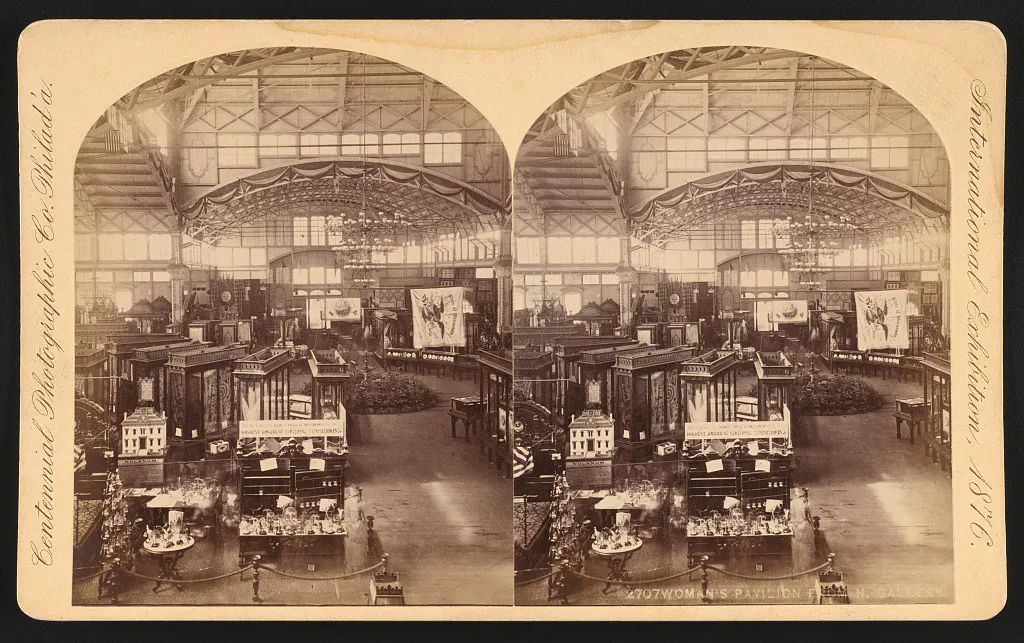
International Exhibition, Phila., Pa: Women’s Pavilion from North Gallery. Philadelphia: Centennial Photographic Co., 1876. Prints and Photographs Division, Library of Congress
But despite the ennobling and unifying themes of the exhibition, plenty of women were not represented. Black women, in particular, were excluded from participating. They were not allowed to showcase their material culture, even though many of them had helped raise money for the exhibition. Members of the Executive Committee attempted to enforce segregation within the organizing ranks, though Black women used newspaper coverage to protest this exclusion, successfully forcing them to retract this decision. This was in line with a Centennial commemoration that celebrated the reconciliation of the North and the South following the Civil War, as Reconstruction ended and the Jim Crow era began.
The Women’s Pavilion also isolated suffragists; organizers did not publicly display a case sent from the American Woman Suffrage Association that claimed “Protests of Women Against Taxation Without Representation.” The Women’s Pavilion did not want to align themselves with the contemporary women’s rights movement because they believed this would ostracize and anger women who were content with women’s political status. They believed this information might be too polarizing.
As a result, suffragists and feminists criticized the Women’s Exhibition as catering to male interests, and suffragists Elizabeth Cady Stanton, Susan B. Anthony, and Matilda Joslyn Gage organized meetings and protests throughout the months of the Centennial Celebrations. On July 4th, the suffragists held a public protest: Susan B. Anthony went on stage in Independence Hall, after the reading of the Declaration of Independence, and presented a copy of the Women’s Declaration of Rights to several political figures. Hundreds of copies of this document were scattered throughout the building and Anthony, among others, went outside to read the Women’s Declaration of Rights to a crowd of people. They then marched down the streets to a church where they held a daylong session to discuss women’s rights. Simply, suffragists wanted people to know that “the women of 1876 know and feel their political degradation no less than did the men of 1776.”
It was not just the suffragists who were unimpressed by the Women’s Exhibition at the Centennial celebrations. While most people thought that it was an incredible feat, others argued it actually further alienated women. The buildings at the Centennial Exhibition were supposed to represent every aspect of American society, so why have a pavilion just for women when their work could be displayed in the other buildings? In fact, as a newspaper article mentioned in August of 1876, some of the best work done by women was not represented in the Women’s Pavilion, but rather in the other exhibition halls: “The best and strongest women workers prefer to have their work judged on its own merits, rather than to challenge or deprecate criticism by displaying the badge of sex,” the author wrote.
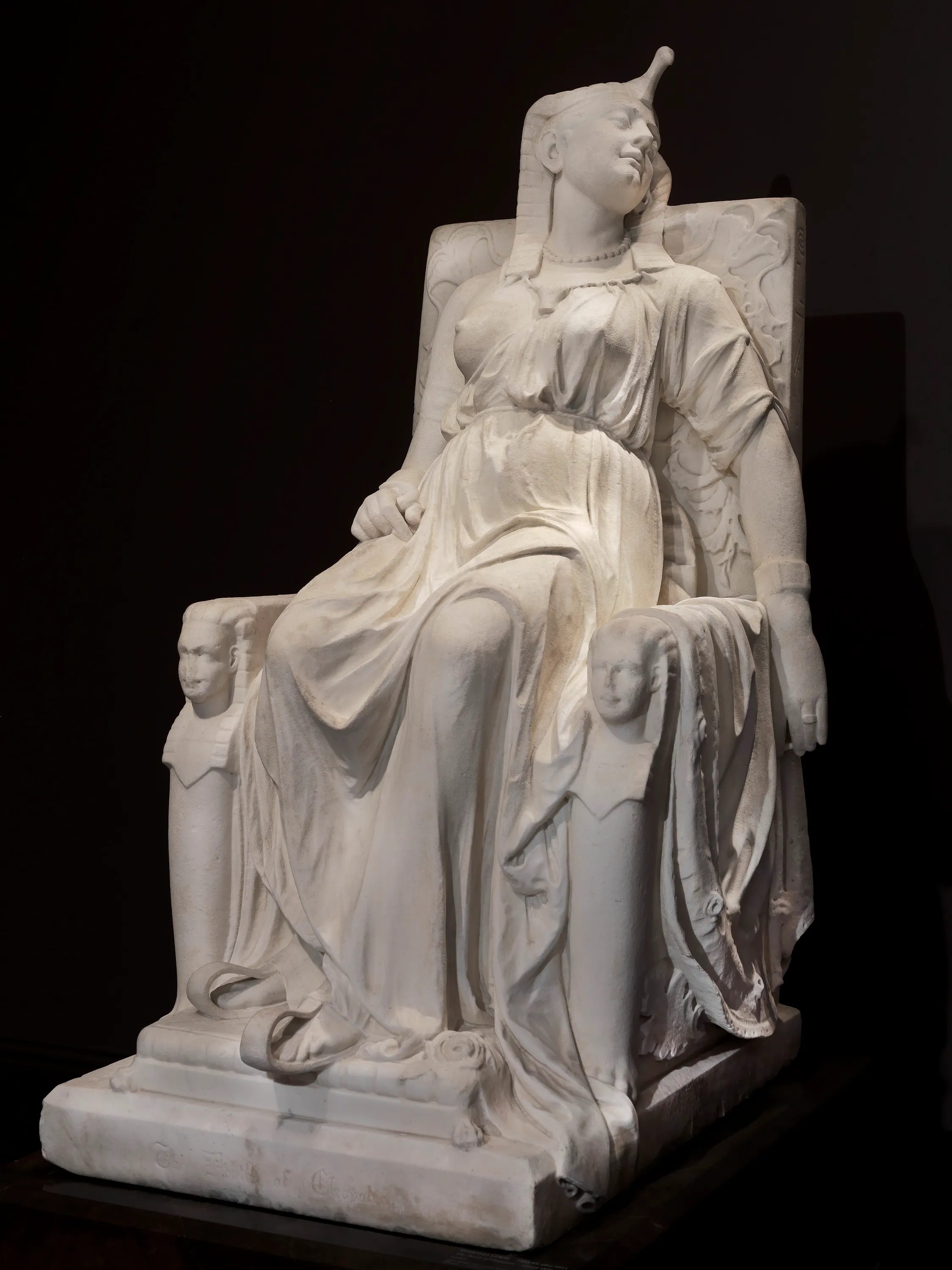
Edmonia Lewis (1844–1907), artist. "The Death of Cleopatra", 1876. Marble. Smithsonian American Art Museum, Gift of the Historical Society of Forest Park, Illinois, 1994.17
Take, for example, the work of sculptor Edmonia Lewis. An artist of both African and Native American descent, by 1876, Lewis was living and working in Rome, for, as she said, “the land of liberty had no room for a colored sculptor.” She carved The Death of Cleopatra specifically for display at the Centennial Exhibition after receiving an invitation from John Sartain, the artist and engraver who was in charge of the Centennial's Bureau of Art. Sartain placed Lewis's piece not in the Women's Pavilion, but at the center of the Rotunda Gallery in the Memorial Building, where enthusiastic crowds gathered to admire its “striking qualities” and the “genuine endowments” of the sculptor.
In short, the Women’s Pavilion was in some sense a step forward, including the work of hundreds of women from around the world on a global stage for the first time. The exhibition connected women from all different walks of life, establishing a sisterhood to celebrate women’s labor. Women were inspired by the work of their peers to push the status quo and fight against gender prejudices. At the same time, many women were left out of the exhibition, showcasing the contradictions of liberty that shadowed the 1876 Centennial Exhibition. The Centennial Exhibition was supposed to be a celebration of 100 years of American independence, but slavery had only been abolished 11 years prior and women would not receive the right to vote for another 40 years. How could this exhibition truly represent the triumph of American democracy, when it was clear not everyone was equal and free? Yes, there were many positive attributes that came from the Centennial Exhibition and the Women’s Pavilion, but there were also many negatives. In order to see the full picture, we must consider them all.
Visit The 1876: Centennial: Bringing the Revolution Home, on view in the Joyce B. Cowin Niche Case beginning August 28.
Written by Carolyn Tananbaum, Summer Intern in Women’s History, Jean Margo Reid Center for Women’s History
Keep Reading
- Women at the CenterSeptember 1, 2026
The 11th Annual Diane and Adam E. Max Conference on Women's History
The 11th Annual Diane and Adam E. Max Conference on Women's History used the semiquincentennial of the signing of the Declaration of Independence to explore the legacy of the Revolution today. - Women at the CenterAugust 3, 2026
A Revolutionary Chocolate Maker: The Business Records of Rebecca Gomez
How did Rebecca Gomez, a Jewish widow and businesswoman, help finance the first home of the New York Stock Exchange? - Women at the CenterJuly 27, 2026
Star-Crossed Lovers of the Revolution: The Letters of Eliza Shipton and Aquila Giles
Was it possible to fall in love across ideological lines during the Revolutionary War? - Women at the CenterJuly 20, 2026
The Things She Carried: Discussing the Power of Purses with Author Kathleen B. Casey
Historian and author Kathleen B. Casey discusses purses as adaptable toolkits that lead multidimensional lives of their own.