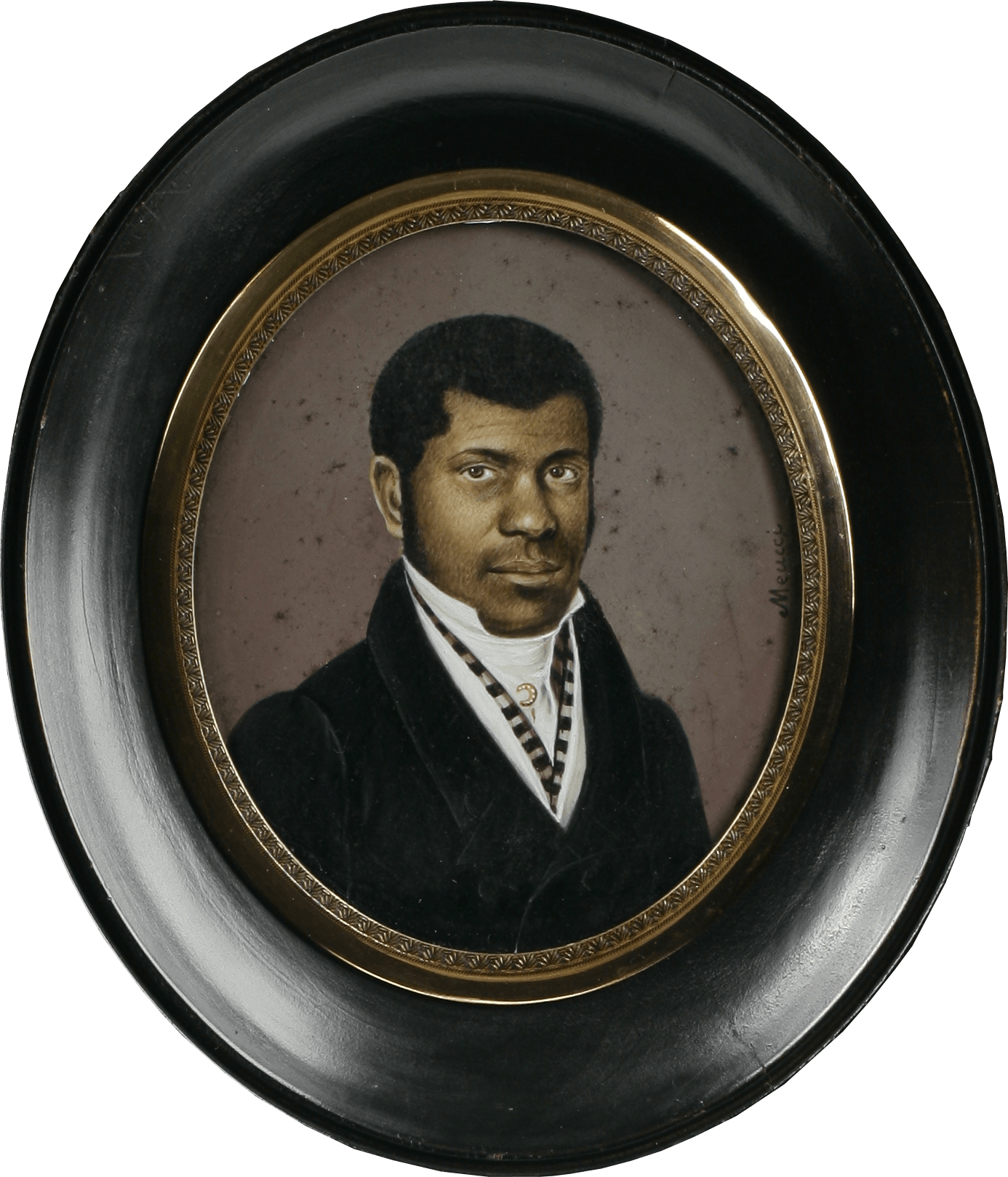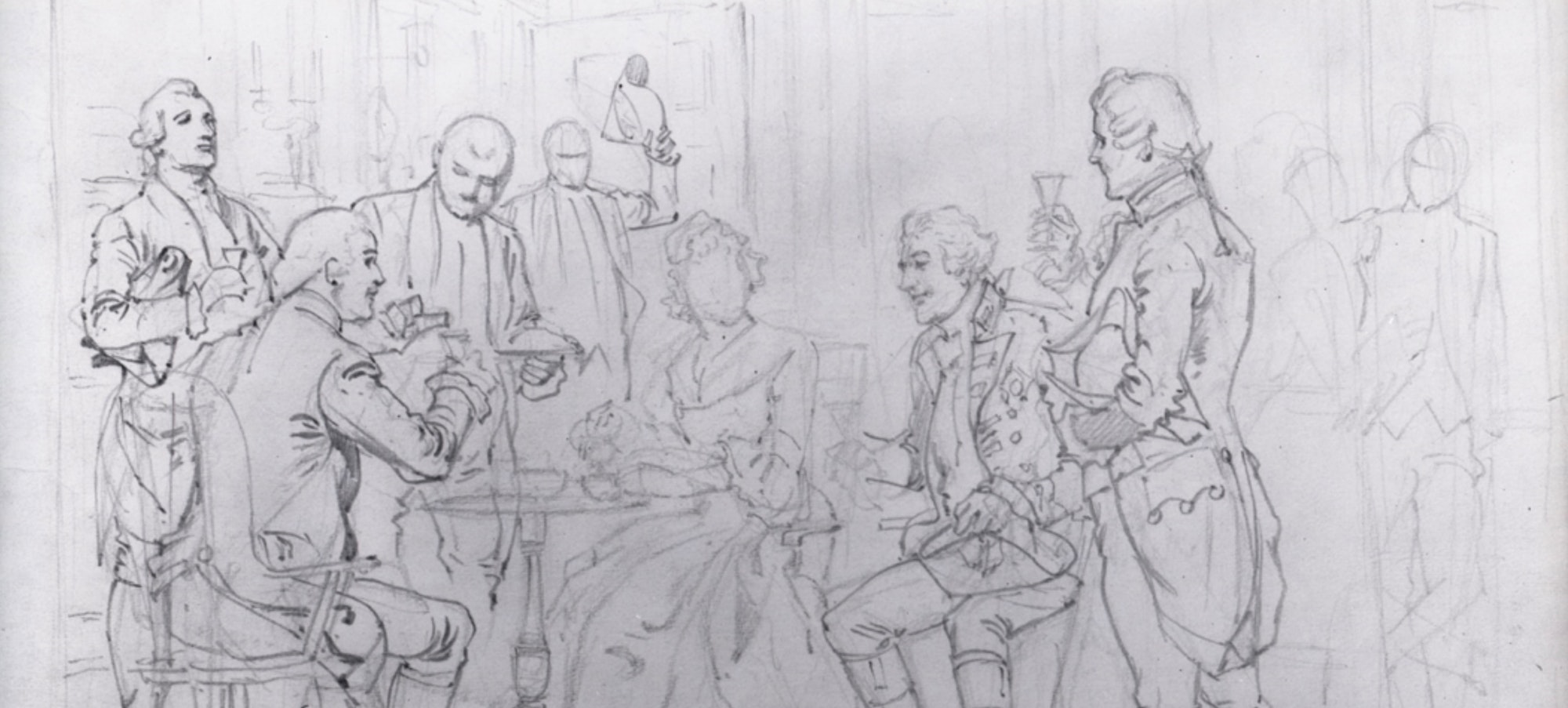
Ahead of the semiquincentennial, the Center for Women’s History is celebrating our new exhibition Revolutionary Women, which traces the lives of women in Revolutionary New York. This series of blog posts focuses on the women whose contributions to the Revolution became something larger than life. (See Part One and Part Two here!) How and why did their lives become myths, symbols, and legends? What do we lose by transforming them in this way, and how can we recover the lives behind the myths?
In September of 1925, the musical Dearest Enemy opened on Broadway. A story of love, deception, and intrigue during the Revolutionary War, it was a hit, staying open for 286 performances. It was conceived, the story goes, when songwriters Richard Rodgers and Lorenz Hart were on a walk and saw Mary Lindley Murray’s plaque on Park Avenue and East 37th Street. Murray, as the plaque commemorates, is remembered for holding the British General William Howe and his officers at her home on September 15, 1776, as the British army entered Manhattan, allowing 4,000 Continental soldiers to retreat unopposed.
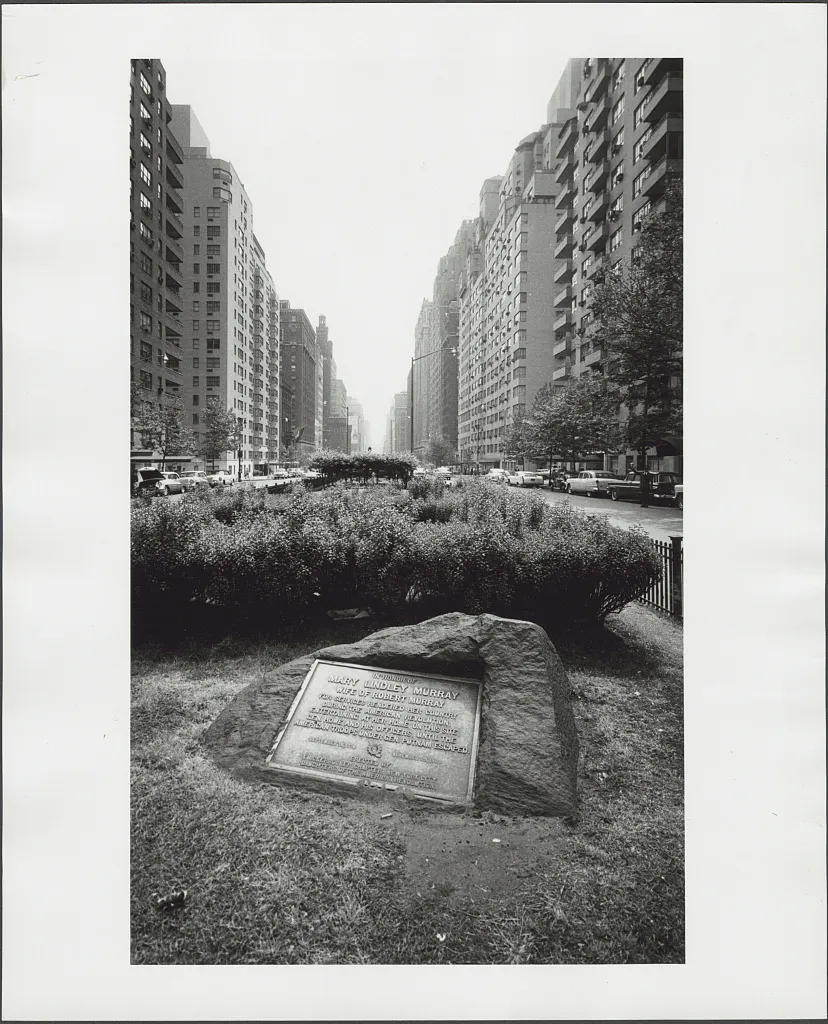
Angelo Rizzuto, photographer. A plaque dedicated to Mary Lindley Murry at the intersection of Park Avenue and 37th Street, May 1959. Library of Congress, Prints and Photographs Division
The musical turned Murray’s feat into a grand three-act spectacle, adding in a subplot about an “unapologetically fictionalized love story” between Murray’s daughter and one of the British soldiers, as Thomas Allen Greenfield put it in his 2021 American Musicals in Context. (Famously, Murray’s daughter was portrayed by the actress Helen Ford, who made her first onstage entrance wearing only a barrel.) Murray’s heroism became the starting place for what is considered by some to be one of the first truly American musicals, in its topic and its musical form.
Though Murray’s story has been exaggerated over time (in part because of the musical) there is some truth to the myth. Mary Lindley Murray, according to at least one soldier’s report, really did host the British that day. She also played a significant role in her own family’s interactions with the changing politics of the Revolution. In this post, the Center for Women’s History will explore the ways in which Murray’s story reveals changing views around Revolutionary women. How did Murray go from being the wife of a scandal-tainted merchant to the namesake of Murray Hill and P.S. 116?
In the lead-up to the Revolutionary war, the Murrays were important members of New York's trading elite. Robert Murray, Mary’s husband, was a merchant whose business stretched across shipping, insurance, and the importation of goods. In 1774, the First Continental Congress established the Continental Association, an agreement between the colonies that included a nonimportation clause. This meant a total blockade against the importation of British goods, set to begin in full on February 1, 1775. The previous years had seen several attempts at nonimportation agreements between the colonies, with varying levels of specificity, enforcement, and efficacy; this time, though, was to be one of the last attempts at peaceful reconciliation with the British.
As Charles Monaghan chronicles in his history of the Murrays (“The Murrays of Murray Hill”), the Murrays’ wharf became the testing ground for the agreement. The first ship to land at a New York port after the agreement went into effect landed at their wharf, and was quickly turned away. The next ship to test the blockade though was owned by a trading firm run by Robert Murray and his younger brother John. The ship tried to dock at New York but was blocked by a patrol boat; Murray petitioned to allow the goods to come in, but was denied. Three weeks later, while the ship was ostensibly waiting for the right wind to sail back to England, Murray’s men unloaded the British goods and brought them to shore.
Unfortunately for the Murrays, the inspection committee responsible for enforcing the blockade quickly discovered their actions. The subsequent investigation only inflamed public opinion against the Murray brothers. Breaking the agreement was not only approaching treason, but it was seen as harming colonial unity—which would be key if better terms or independence were to be won from the British. The Murrays had to be punished. The full details of their smuggling were published, and they paid a fine. But calls for boycotts of their stores and even the exile of the Murray brothers continued.
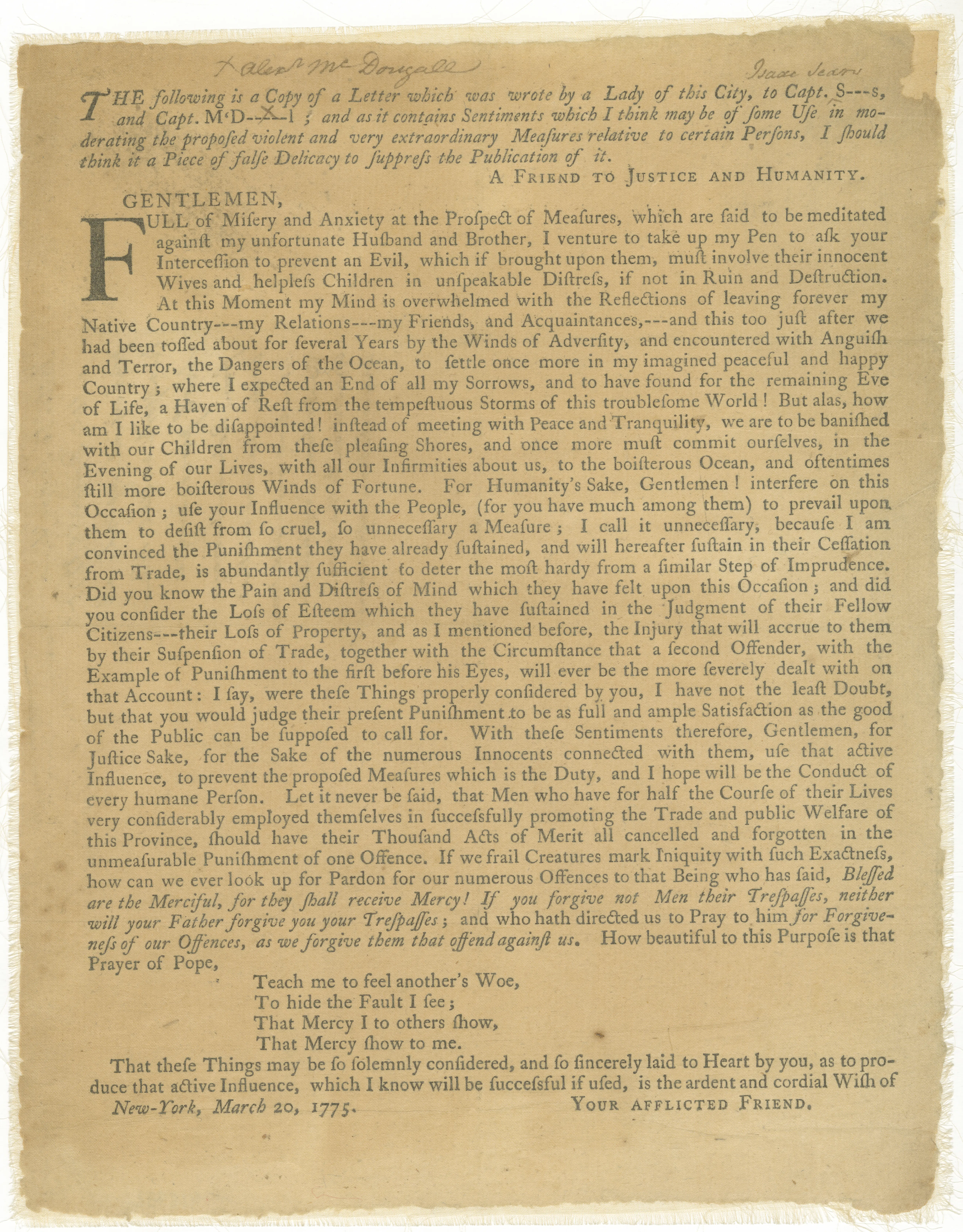
Mary Lindley Murray, author. The following is a copy of a letter which was wrote by a lady of this city…, March 20, 1775. Shelby White and Leon Levy Digital Library, The New York Historical, SY1775 no.72
Was Mary Lindley Murray involved in the decision to smuggle the goods in? How much of a role did she play in the Murrays’ shipping business? These are questions that are impossible to answer from the historical record. What we do know is that at this point in the proceedings, she became a key player: she wrote a letter to key committee members arguing for a lighter punishment, noting that exile would leave the Murrays’ “innocent Wives and helpless Children in unspeakable Distress, if not in Ruin and Destruction.” Monaghan credits her letter with preventing the Murrays’ immediate banishment.
This kind of legal intervention was not completely out of the question for women at the time, though it was restricted. Other women—many of whom will also be featured in Revolutionary Women—intervened in legal and extralegal proceedings to protect their rights and families. Martha Bradstreet, for instance, fought for three decades to recover her inherited property, even bringing lawsuits through the judicial system to the Supreme Court. Murray was one of many Revolutionary women who found ways to claim power in systems that typically assumed they had none. Of course, Murray's ability to do so was aided by her status as a wealthy white woman from a well-respected family. Her social position gave her the agency and respect that she needed to successfully intervene in these proceedings.
Once the war began, however, Murray’s actions put her on the path to legendary fame. Her story was recorded in the military journal of James Thacher, a military surgeon for the Continental Army. Patriot General Israel Putnam and thousands of Continental troops were attempting to retreat from Manhattan after the Battle of Brooklyn, he wrote, but General Howe and a section of the British army were coming down the same road. Murray invited the British in, he wrote, for “cake and wine, and they were induced to tarry two hours or more.” Murray’s delay allowed Putnam and his soldiers to safely retreat. Tucher writes:
… One half-hour, it is said, would have been sufficient for the enemy to have secured the road at the turn, and entirely cut off General Putnam’s retreat. It has since become almost a common saying among our officers, that Mrs. Murray saved this part of the American army…
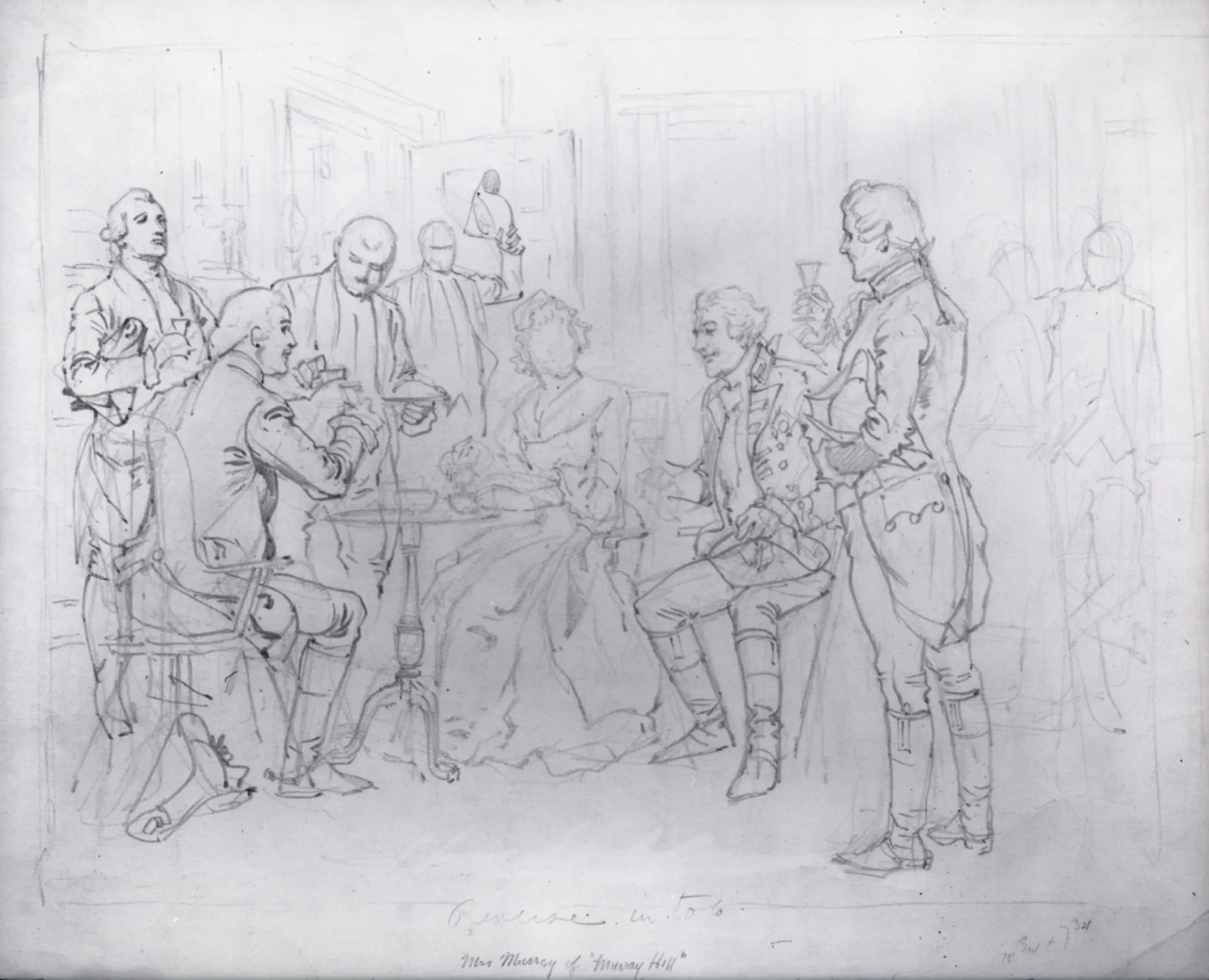
Henry Alexander Ogden (1856–1936) artist. Mrs. Murray of “Murray Hill,” between 1856 and 1936. Graphite on paper. The New York Historical, Gift of the Estate of Harry A. Ogden, 1936.956
Of course, like so many stories, the tale of Murray’s party was embellished as it spread. Some variations claimed that her daughter was in the attic, watching for Putnam’s forces’ safe retreat; or that Murray seduced Howe; or, as in the case of the musical, that Murray’s daughter fell in love. None of this is substantiated by the historical record. Indeed, as Monaghan writes, it’s possible that the delay would have happened regardless: Howe, waiting on the rest of his army to land in Manhattan, “would not have personally moved” anyway, he argues. Still, the positive gloss on Murray's actions persisted—likely rooted in at least some truth—and she has since been memorialized as a Revolutionary heroine. Her plaque in Murray Hill commemorates her “for services rendered her country during the American Revolution.” In Elizabeth Ellet’s 1848 The Women of the American Revolution, Thacher’s tale of Murray’s feat was reprinted as one of several anecdotes to illustrate “the spirit and character of the women of those days.” For Grace Humphrey, compiling American women’s histories in 1919, Murray’s story—which Humphrey embellished with dialogue and drama—served as a reminder that “patriotism and courage do not exist only behind a bayonet.” Just as Murray became a symbol of hope and patriotism for Thacher and his fellow soldiers, she became a symbol of female capability for these early scholars of women's history, revealing women’s roles in every part of the war.
In part, this symbolism is a limited one. Murray’s actions fell squarely within her expected domain: the home. Her revolution was fought through the means available to her within gendered constraints. She could become a heroine in part because her feat of sociability and hospitality did not push at the boundaries of acceptable femininity, in contrast to those like Deborah Sampson, whose gender transgression had to be confronted or removed before the story could become legend.
When one character in Dearest Enemy argues that “war is men’s business,” the character of Murray’s daughter snaps back. “War is women’s business,” she counters. “This wilderness was made livable by women, and we’re all going to fight for it, every one of us.” Like the rest of the mythology of this musical, this statement is perhaps overblown, but Murray’s story reminds us of an important truth: women played a role in every part of the Revolution, from Murray’s assistance helping troops evade capture, to the women who fought, organized, sewed, cleaned, and labored in numerous other ways for and against the war effort.
Written by Avery Braumel, Columbia University American Studies Intern, Jean Margo Reid Center for Women's History
Keep Reading
- Women at the CenterSeptember 1, 2026
The 11th Annual Diane and Adam E. Max Conference on Women's History
The 11th Annual Diane and Adam E. Max Conference on Women's History used the semiquincentennial of the signing of the Declaration of Independence to explore the legacy of the Revolution today. - Women at the CenterAugust 31, 2026
The 1876 Women’s Exhibition
What role did women play in commemorating the 100th anniversary of American Independence? - Women at the CenterAugust 3, 2026
A Revolutionary Chocolate Maker: The Business Records of Rebecca Gomez
How did Rebecca Gomez, a Jewish widow and businesswoman, help finance the first home of the New York Stock Exchange? - Women at the CenterJuly 27, 2026
Star-Crossed Lovers of the Revolution: The Letters of Eliza Shipton and Aquila Giles
Was it possible to fall in love across ideological lines during the Revolutionary War?