The Semiquincetennial is here, and people are marking it in many ways. There will be tall ships that will sail along the East Coast. The National Archives will host a festival that will honor the Declaration of Independence. And across the country, communities are creating Wish Walls—pop-up installations that ask “what’s your wish for America’s future?”
The Wish Walls take different forms, from murals to chalkboards to quilts and paper chains. As of now, there have been 137 Wish Walls installed and 85 more planned, at museums and community spaces.
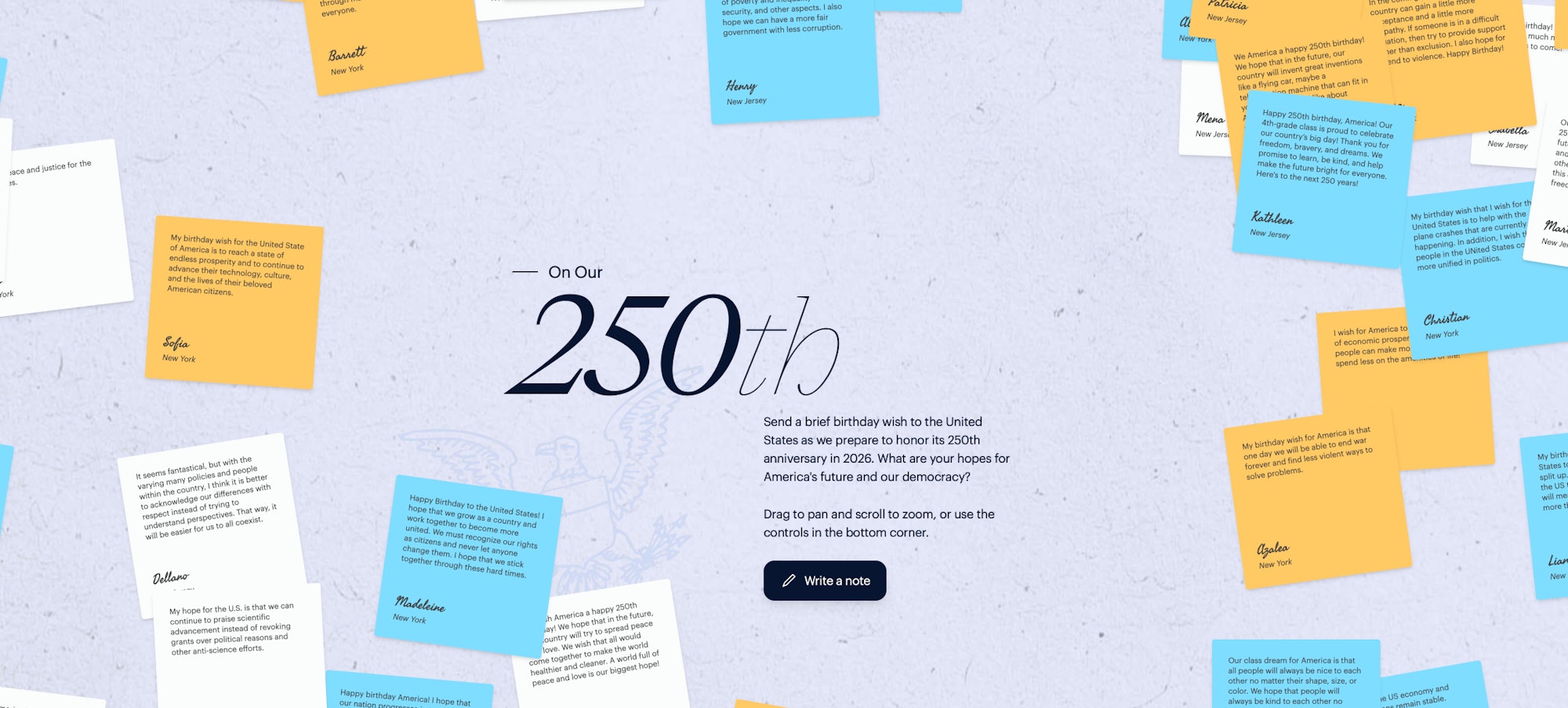
Hundreds have already added their birthday wish for the U.S. at 250 online at OnOur250th.org. Many of these wishes call for things such as harmony and world peace. Others express concern about the divisive political climate and many of the wishes have a hopeful tone.
Take, for example, this wish from New York: “Happy Birthday America, my wish is for democracy to endure and for you to continue to be the beacon of hope for all people.”
Making wishes can make some people cynical in a moment of political division. But, wish-making is especially important in troubled times like these.
Throughout American history, people articulated wishes that symbolized bold possibilities. However, these wishes couldn’t be granted overnight. They were problems that required people to gear up for the long haul, even if they would not live to see the outcome.
In May 1909, W.E.B. Du Bois, Ida B. Wells, and Mary Church Terrell were among the Black leaders who went to New York to attend the National Negro Conference. It was there that they founded the National Negro Committee, which would later become the National Association for the Advancement of Colored People. At the conference, the platform called for strong civil rights laws, equal educational opportunities, and full voting rights.
The three activists who attended the conference didn’t live to see the full promise—their wish for America—realized.
Wells died in 1931, Terrell in 1954, and Du Bois in 1963—on the day before the March on Washington, when 250,000 people took to the National Mall in the nation’s capitol to demand equal civil and economic rights.
At the March, civil rights leader Roy Wilkins asked the crowd to honor Du Bois with a moment of silence. It was the activists gathered that day who would carry the work forward and help secure the Civil Rights Act of 1964 and the Voting Rights Act of 1965.
The same could be said for the cause of women’s right to vote. In the late 19th century, after exhausting other avenues for change through existing constitutional amendments, activists such as Elizabeth Cady Stanton and Susan B. Anthony had to put forward a bold wish. They called for a new amendment to the Constitution, guaranteeing women the right to vote.
In January 1878, at their behest, Senator Aaron Sargent introduced a proposal that would eventually become the Nineteenth Amendment.
Stanton and Anthony didn’t live to see the amendment pass. Their wish would be fulfilled by leaders such as Alice Paul and Carrie Chapman Catt, who helped secure its ratification in August 1920. And even still, it took additional generations of women to make equal rights and suffrage for women a reality, especially women of color.
Not all wishes are about political change. Some push the limits of human possibility. One example is the dream of putting a man on the moon.
In the early 1960s, President John F. Kennedy challenged Americans to land a man on the moon and return him safely to Earth before the decade ended. He didn’t live to see this goal achieved, as he was assassinated in November 1963. The mission was ultimately accomplished in July 1969 by NASA and astronauts Neil Armstrong, Buzz Aldrin, and Michael Collins. On the day Apollo 11 landed, Mission Control in Houston displayed President Kennedy’s words, followed by: “TASK ACCOMPLISHED, July 1969.”
These wishes from history show us that even in extremely dark and difficult times, people found ways to imagine better possibilities. And they didn’t stop there—rather than presuming that change will happen on its own, they got to work. Having hope is not enough. It does not replace marching, dedication, and sustained effort. These wishes required work, sometimes over generations and decades. Those of us today might consider which wishes we can start to work toward—and who might carry that torch forward 20, or even 50 years from now.
For this Semiquincetennial, I invite you to visit a Wish Wall in your community.
Writing and sharing your wish for the U.S. can inspire you to pursue your own dreams, while also connecting you with others who share similar hopes. Together, these shared aspirations can help build a community focused on realizing a better future, for ourselves and for the country. It’s our future—but we have to build it.
Jewel Navia is a writer in Los Angeles and a member of the Youth250 Content Corps.
Keep Reading
- Behind the ScenesSeptember 28, 2026
The Great American Novel Revisited
Americans have always looked to certain literary masterpieces for a sense of who we are. - Behind the ScenesOctober 20, 2025
#AskaMuseum—Our Curators Answer Your Questions
You asked, and our curators answered! For #AskaMuseumDay last month, we gathered the questions our social media followers. - Behind the ScenesJune 27, 2025
GAY PRIDE in '75: Fred McDarrah's Photographs of the 1975 Pride March
To celebrate the arrival of the historic Fred W. McDarrah Archive at The New York Historical, we are excited to share some of the stories behind McDarrah’s iconic photos of the 1975 Pride March in honor of its fiftieth anniversary. - Behind the ScenesApril 16, 2025
The Mission of Abraham Lincoln