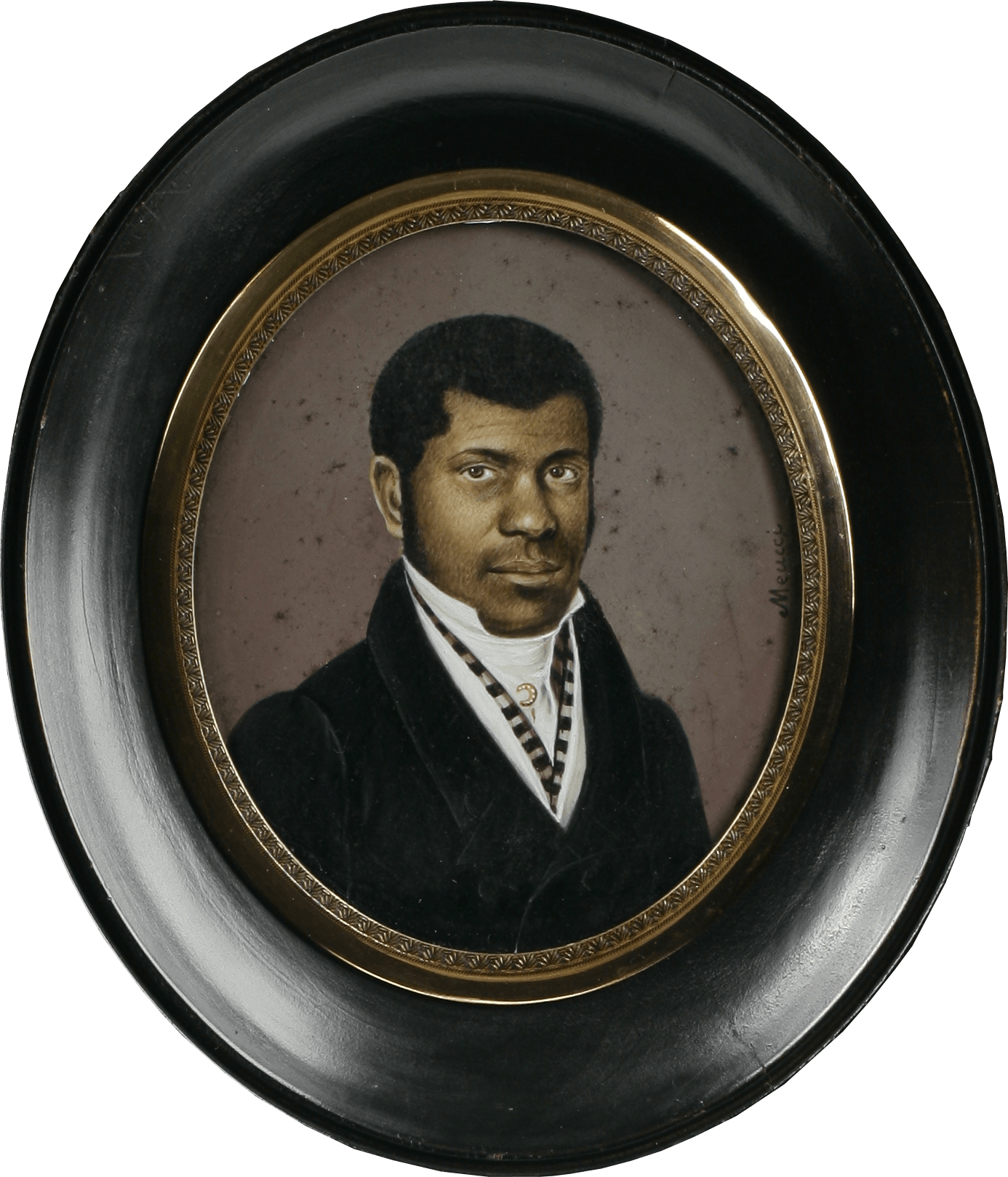
In celebration of the United States' semiquincentennial on July 4, the Center for Women’s History presents the exhibition Revolutionary Women (opening May 29), which traces the lives of women in Revolutionary New York. This series of blog posts will focus on the women whose contributions to the Revolution became something larger than life. How and why did their lives become myths, symbols, and legends? What do we lose by transforming them in this way, and how can we recover the lives behind the myths?
On May 1, the Fort Tryon Park Conservancy and the Daughters of the American Revolution honored Margaret Corbin Day with a tribute at Corbin’s memorial in the West Point Cemetery. “Margaret Corbin Day reminds us,” the conservancy writes, “of the vital role women played in the American Revolution and the enduring spirit of those who fought for freedom.” In honor of Margaret Corbin Day, we wanted to take a moment to explore who Corbin was and what her story reveals.
Margaret Cochran Corbin was the first woman to receive a pension from the newly formed Continental Congress for military service after she took over her husband’s position as a soldier in the Revolutionary War. She will be featured as one of the women in the Center for Women’s History’s Revolutionary Women exhibition (opening May 29). Like many Revolutionary women, Corbin’s life has been mythologized and distorted over time. As centuries pass, oral and written histories record lives that often become more myth than fact as they are passed down. Uncovering the real stories behind the myths reveals the extraordinary feats of everyday women in the revolution. It also demonstrates the power of myth in the commemoration and retelling of historical narratives.
Who was Margaret Corbin? Pensions, letters, and newspaper articles tell us that she was born in Pennsylvania and that when her husband, John, joined the Continental Army in 1775, Corbin became what was known as a "camp follower," though this is a less popular term today. These were typically wives or children of soldiers who lived alongside the army and were paid small wages for their domestic work. Many also entered into battle alongside their family members to provide water, carry supplies, care for the wounded, and do the camp’s laundry. Women were a central part of the army, making battle possible by taking care of many of the tasks of military camp life.
As the story goes, when John was killed as Hessian mercenaries for the British attacked the patriots at Fort Washington, Corbin took over and began firing John’s cannon. Though she was hit by enough cannon fire to lead the pension office to describe her as “utterly disabled” three years later, she kept firing with impeccable aim until she was captured. Congress awarded Corbin a pension in 1779 for her heroism, and she was the first female soldier whose service was federally recognized in this way. Corbin became known as “Captain Molly,” her actions affording her a legendary reputation passed down over the generations in Highland Falls, where she lived at the end of her life. As the decades passed, Corbin’s identity was lost to history, and only stories of Captain Molly remained.
The identification of the real-life Margaret Corbin with the quasi-mythical figure of Captain Molly was far from straightforward. The Captain Molly story, which quickly became myth, was entangled with another mythical Revolutionary heroine, Molly Pitcher. This myth told of a woman who fought in the Battle of Monmouth alongside her husband. Carrying water to the soldiers, she took over her husband’s cannon when he fell (either from heatstroke or a wound). She was later thanked and, depending on which version of the story you hear, promoted to sergeant by George Washington himself.
Molly Pitcher was likely not a single woman, historians believe, but instead an amalgamation of many women who fought in the Revolution. The nickname may have come from the fact that many camp followers brought water to the soldiers during battle—thus “Pitcher”—and “Molly” was a common nickname for many women at the time. By subsuming multiple women into a single myth or nickname, though, we run the risk of forgetting actual women’s work and lives. Even this nickname reduces the physical and emotional labor of women camp followers to the task of carrying water—when, as Corbin’s story and others demonstrate, they did so much more.
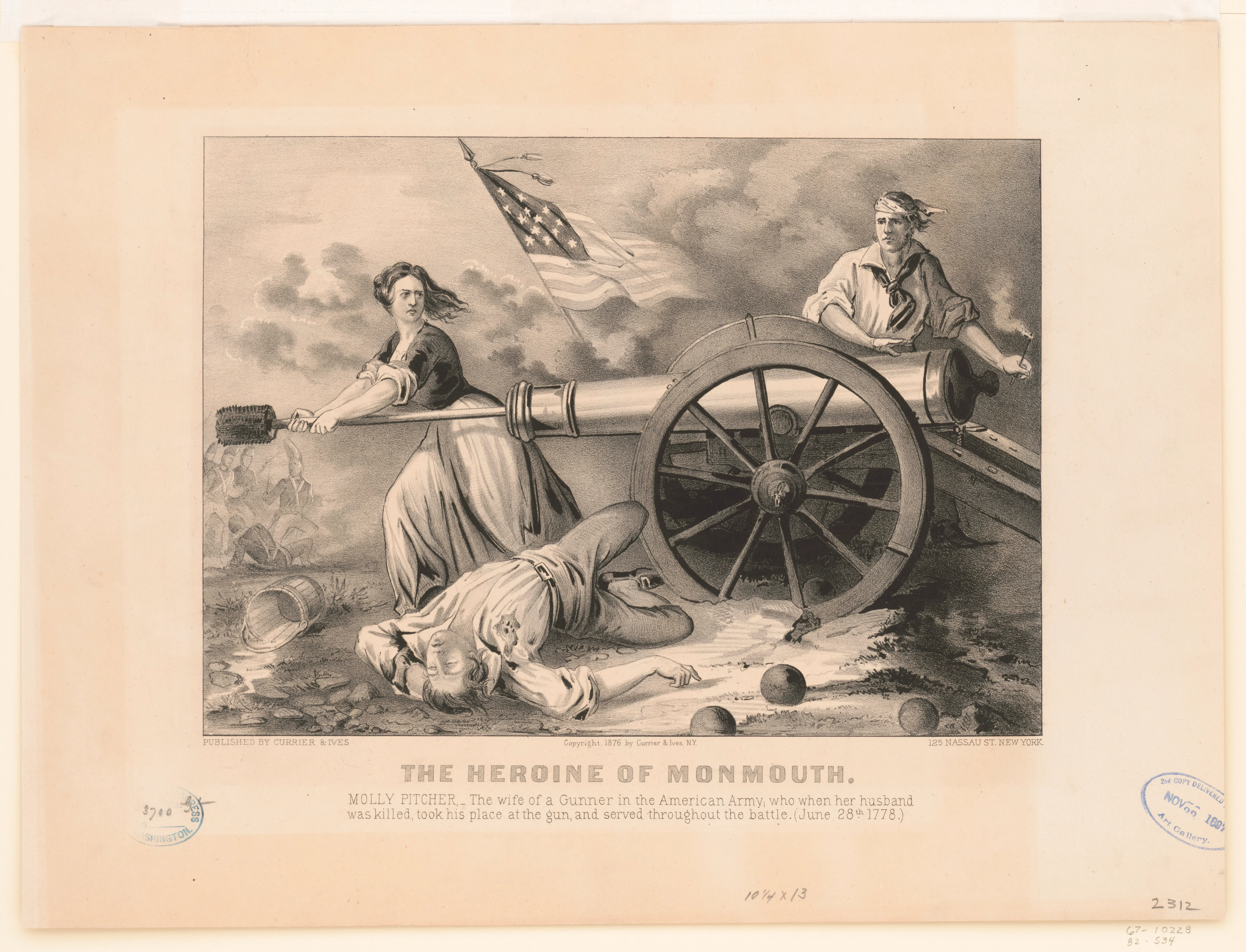
Currier & Ives, printmakers. The Heroine of Monmouth, Molly Pitcher, 1876. Library of Congress, Prints & Photographs Division
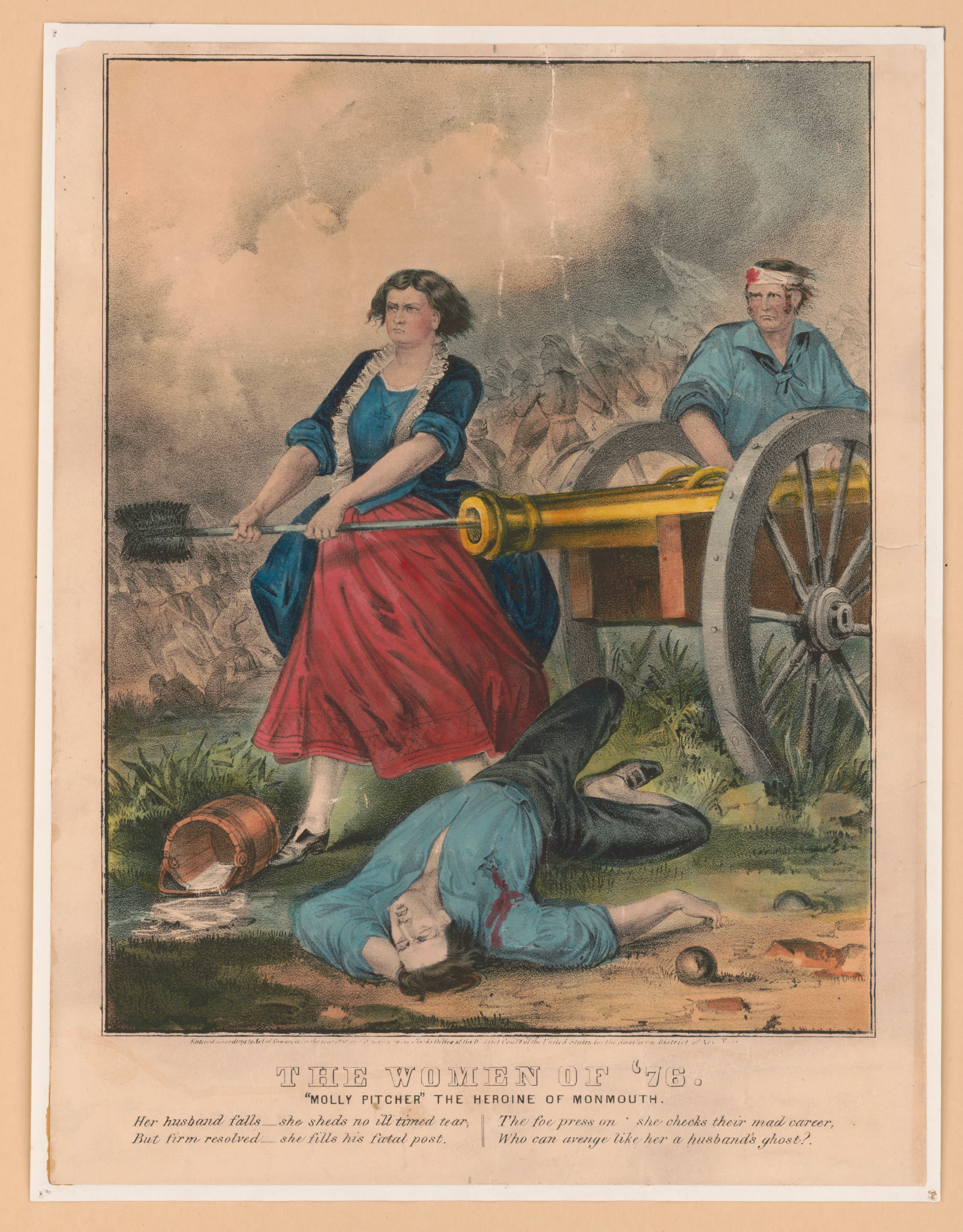
Currier & Ives, printmakers. The Women of '76: “Molly Pitcher,” The Heroine of Monmouth, between 1856 and 1907. Library of Congress, Prints & Photographs Division
By 1851, the Captain Molly and Molly Pitcher myths were so intertwined that they had become nearly indistinguishable. Benson J. Lossing’s 1851 history of the Revolutionary War recorded this version from a local resident near Highland Falls:
Mr. Garrison remembered the famous Irish woman called Captain Molly, the wife of a cannonier, who worked a field-piece at the battle of Monmouth, on the death of her husband… this bold camp-follower [was honored by] Washington… with a sergeant’s commission for her bravery… (emphasis in original)
Even in this short anecdote, the decades since the Revolution had clearly led the two myths to become one. Corbin was Irish; Molly Pitcher served at Monmouth; Corbin’s husband died; Molly Pitcher was (possibly) honored by Washington. Lossing’s myth persisted, though, and Molly Pitcher and Captain Molly became one and the same.
In the mid-1920s, efforts initiated by a combination of local residents of Highland Falls, the Daughters of the American Revolution, and the American Scenic and Historic Preservation Society sought to find the real Captain Molly. This effort was likely initiated in part because of the renewed interest in Revolutionary history at the time: 1926 marked the 150th anniversary of the signing of the Declaration of Independence. In the post-World War I period, the Revolution and its imagery contributed to efforts to justify the more recent war. At the national and local levels, Revolutionary history was re-investigated.
Drawing on letters, pension applications, and oral history, the historical investigation concluded that Captain Molly was Margaret Corbin, and that Molly Pitcher was someone else entirely. The coverage at the time reveals how entrenched these myths had become: the telephone game-like history had gone so far that some newspapers referred to Corbin as the hybridized “Captain Molly Pitcher.” Regardless, the unmarked Highland Falls grave that local oral history had preserved in memory as Captain Molly’s was finally interred in 1926 and relocated to the West Point cemetery (though her remains’ true location has since come under question). Corbin received the full military honors she deserved.
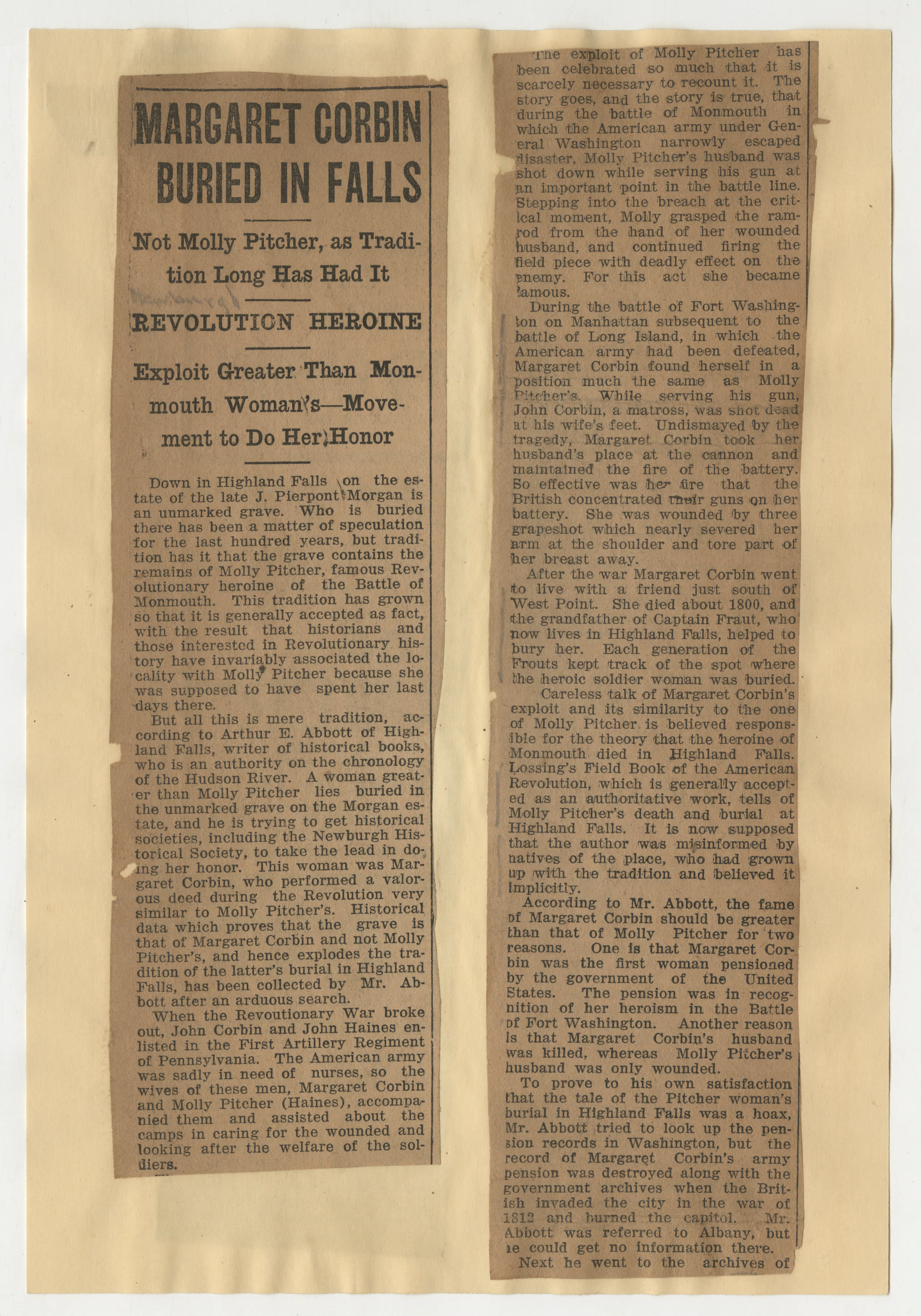
Services of Margaret Corbin in the War of the Revolution. S.l: N.p. Print. Patricia D. Klingenstein Library, The New York Historical
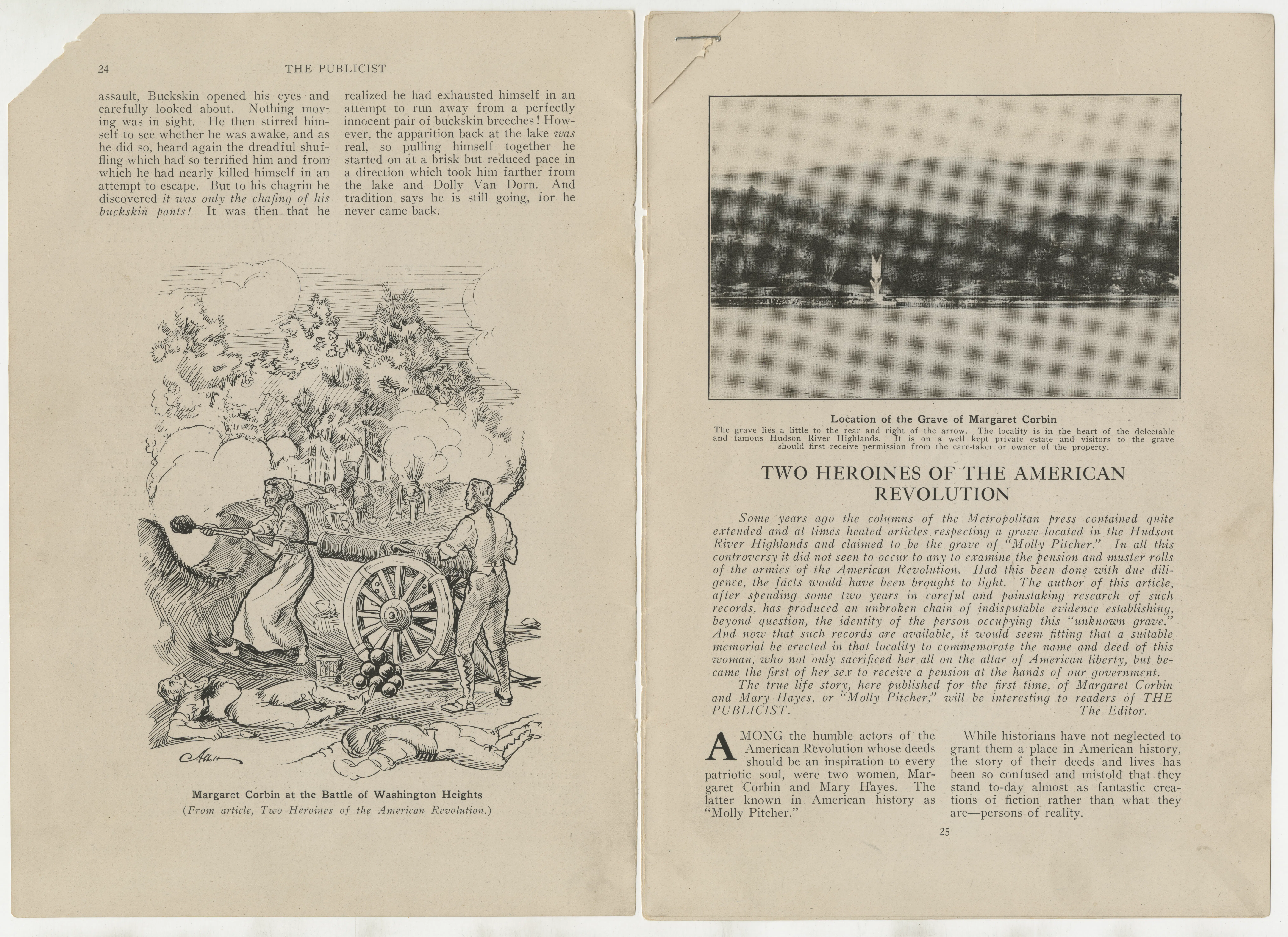
Two Heroines of the American Revolution. S.l: N.p. Print. Patricia D. Klingenstein Library, The New York Historical
If Corbin was Captain Molly, then who was the Molly Pitcher who fought at Monmouth? The most plausible answer, as historian Emily Teipe argues, is another camp follower, Mary Ludwig Hays or Hayes, later Mary McCauley. Paralleling both Corbin’s story and the Molly Pitcher myth, Hayes was accompanying her husband into battle at Monmouth when he was wounded or collapsed, and she took control of the cannon. She, too, was awarded a government pension, though it came over 40 years after the war’s end. McCauley’s grave in Carlisle, Pennsylvania, was honored with a memorial in 1876 declaring her to be Molly Pitcher. Historian Cassandra Good, however, notes that the historical record tying McCauley/Hayes to Monmouth is limited. Her identification as Molly Pitcher, and the proliferation of her story, only happened after her death; her obituaries make no mention of her heroic feat. Without more information, it’s hard to know if this gap is the product of the limited record of women’s lives in general during this period, or, as historian Ray Raphael argues, if Hayes’ family created or exaggerated the connection—yet another example of the active process of mythmaking.
But Teipe argues that the Molly Pitcher myth might also be inspired by a third figure, born under the name Deborah Sampson and who later used the name Robert Shurtliff. (In line with queer historian Jen Manion, I use they/them pronouns for Shurtliff.) Though we know that they chose a gender-nonconforming path, their full identity is impossible to know with the limited historical record and the limitations of language to describe gender at the time. Assigned female at birth, they ran away from home at 21 and fought in the Revolutionary War dressed in male clothing. Fellow soldiers gave Shurtliff the nickname “Molly,” which in this context was slang for a gay man, because of Shurtliff’s complexion and voice. Shurtliff was honorably discharged after they were discovered to be assigned female at birth. They continued to live as a man for a period after the war.
Shurtliff’s existence as a single, cross-dressing person assigned female at birth was dangerous. If publicly revealed, they likely would have been suspected of sex work. Thus, in a published, ghostwritten memoir, a lecture event tour that was the first of its kind for American women, and in pension applications, Shurtliff and their advocates emphasized their femininity, chasteness, and delicacy. Their gender nonconformity was held up as proof of their patriotism, rather than as a part of their identity. Shurtliff’s story—and the fact that it has not remained in public memory as Captain Molly and Molly Pitcher have—demonstrates the limitations on who we remember as revolutionary.
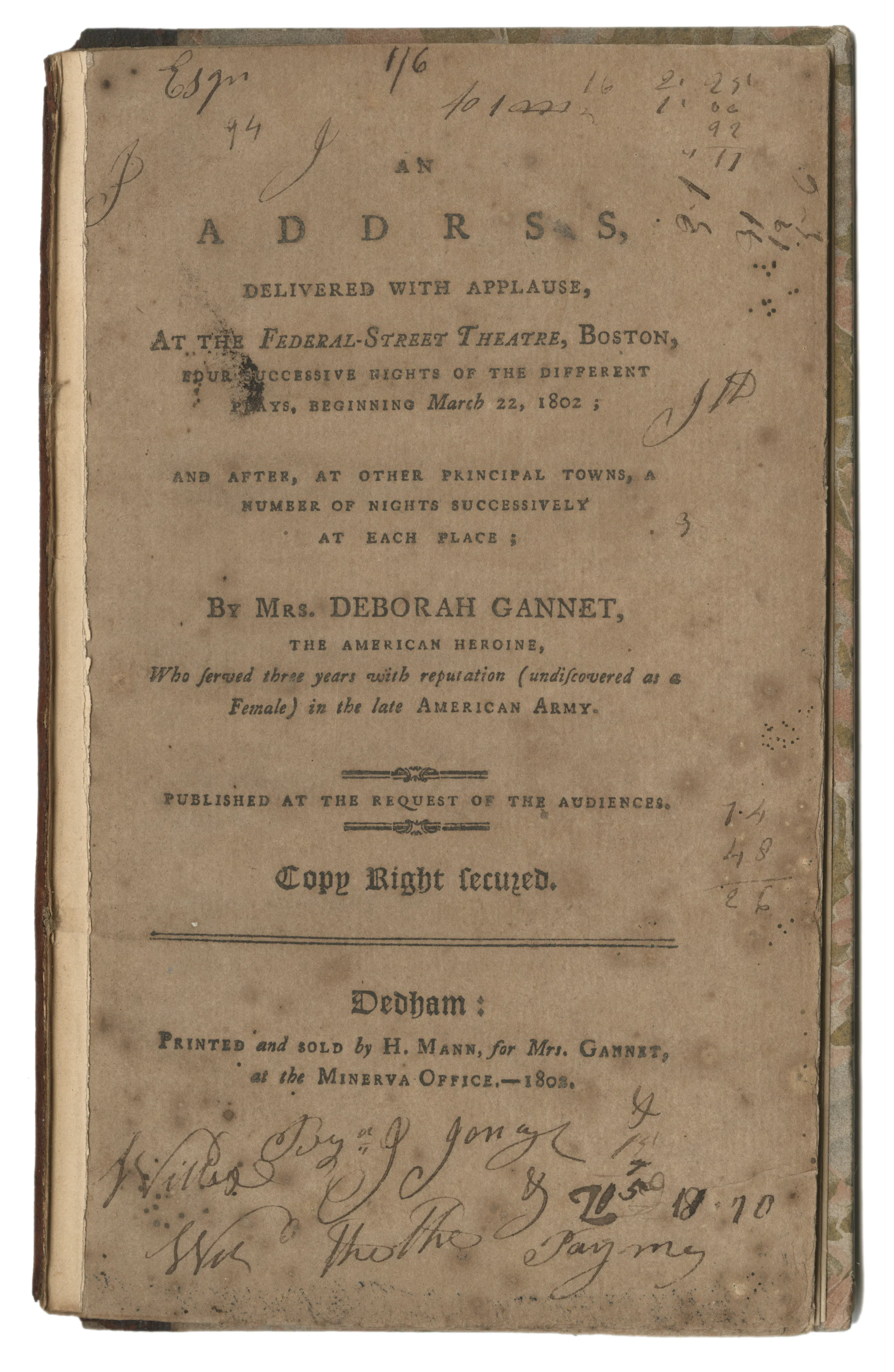
Deborah Sampson (1760–1827). An Address, Delivered with Applause, at the Federal-Street Theatre, Boston. Book. Dedham, Mass.: Printed and sold by H. Mann, for Mrs. Gannet, at the Minerva office, 1802. Patricia D. Klingenstein Library, The New York Historical
So why has the Molly Pitcher myth persisted even as these women were lost to history? One potential answer is that transforming these real-life stories into myths allows them to fit a very particular conception of the acceptable ways for women to step out of the domestic sphere. Shurtliff’s divergence from gender norms is left out of the legend; so is McCauley’s reported bawdiness and masculine appearance. We are left with a “safe” story about a woman who only temporarily took on the role of the soldier, but was otherwise chaste, feminine, and delicate. The myth cements the idea of women in wartime as supportive of, but not overtaking, men.
Another is that in the search for women in history, it is easy to cling to small details—a nickname, a repeated pattern—and expand it into something larger than what it was. In doing so, however, these real-life women disappear from the record. What we learn from their stories tells us that women were likely a far more present and crucial part of the war than even these few stories demonstrate. The traces of names, nicknames, and stories in war diaries, pension applications, and letters, alongside the excavating work of historians, have ensured that Corbin, Hays, and Shurtliff have remained present in the historical record. It is likely that countless other women’s stories have been lost to history. How many individuals assigned female at birth, like Shurtliff, fought as men but were never discovered? How many women, like Corbin and Hays, took over their husbands’ positions, but never applied for pensions? Archives by nature privilege those whose actions were recorded in writing—which almost certainly would not have been the case for many women.
Finding these real stories demonstrates that women were clearly active contributors to the Revolution, even beyond what we can piece together from these scraps of historical records. Finding the truth behind the myth is increasingly important in the contemporary moment when the achievements of women are actively removed from the historical narrative. A year ago, the Corbin Forum—a club at West Point named after Margaret that provides mentorship and support for women at the academy—was disbanded as part of the current administration’s efforts to end DEI.
Over the next few weeks, in these blog posts and in our Revolutionary Women exhibition, we will continue to explore the stories of these women, the efforts to distinguish truth from myth, and why these legends still have such a grip on our understanding of women in Revolutionary history. For now, plan your visits to Revolutionary Women on May 29 to learn more about Margaret Corbin and the women—and myths—of the Revolution.
Written by Avery Baumel, Columbia University American Studies Intern, Jean Margo Reid Center for Women’s History
Keep Reading
- Women at the CenterSeptember 1, 2026
The 11th Annual Diane and Adam E. Max Conference on Women's History
The 11th Annual Diane and Adam E. Max Conference on Women's History used the semiquincentennial of the signing of the Declaration of Independence to explore the legacy of the Revolution today. - Women at the CenterAugust 31, 2026
The 1876 Women’s Exhibition
What role did women play in commemorating the 100th anniversary of American Independence? - Women at the CenterAugust 3, 2026
A Revolutionary Chocolate Maker: The Business Records of Rebecca Gomez
How did Rebecca Gomez, a Jewish widow and businesswoman, help finance the first home of the New York Stock Exchange? - Women at the CenterJuly 27, 2026
Star-Crossed Lovers of the Revolution: The Letters of Eliza Shipton and Aquila Giles
Was it possible to fall in love across ideological lines during the Revolutionary War?