The New York Sari is now on view in the Joyce B. Cowin Women’s History Gallery at The New York Historical!
One of the oldest-known garments in the world, the sari is worn globally today. Its drape, pattern, style, and fabric vary by region, occasion, cultural identity, religious practice, or simply the style of the wearer. While it cuts an iconic form, each particular sari reflects the story of the person wearing it. The sari is a diaspora garment, carried across the world by the currents of global trade, colonialism, indenture, and opportunity-seeking, and The New York Sari explores how the sari—and those who wear it—made a home in New York City.


Narbada Chhetri (active 21st century), owner. Traditional Nepali sari, undated. Nepal. Zerzet. Courtesy of Narbada Chhetri.
Adhikaar (which translates as “rights” in Nepali) was founded in 2005. It now serves over 10,000 members of New York City’s Nepali-speaking community, who trace their roots to Nepal, Bhutan, India, Burma, and Tibet. Adhikaar strives to create a maati ghar, or home, where members can come together to educate and support one another. Together, they have won protections for nail salons and domestic workers, championed the rights of migrants, and mentored the next generation’s diasporic leaders. Narbada Chhetri is co-executive director of Adhikaar.
Although the sari has roots in the Indian subcontinent, fragments of patterned wool and pashmina cloth found at stops along the Silk Road and in Egyptian port cities suggest that patterned Indian textiles circulated the globe for centuries before the first Portuguese ships landed on the western coast of India in 1498. While early European traders initially purchased Indian cloth primarily as a means of bartering for other goods, they soon discovered a robust demand for these textiles in their own countries. British trade networks brought these goods to the North American colonies, where middle- and upper-class households prized them as a means of reinforcing their social status via participation in a new kind of consumer’s empire.
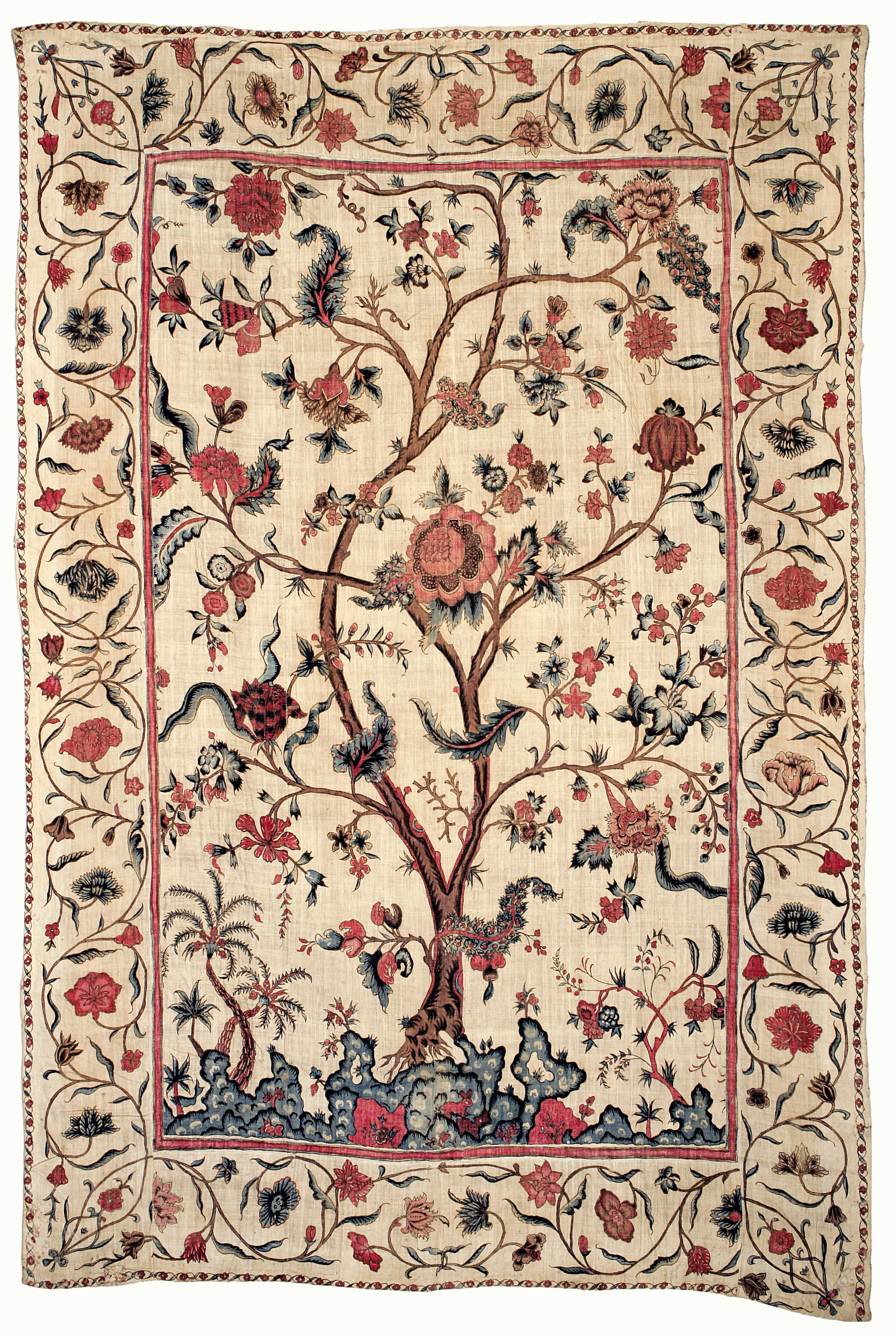
Unidentified maker. Bedcover or wall hanging (palampore), ca. 1720–40. India. Cotton, linen, paint. The New York Historical, Gift of Mrs. J. Insley Blair, 1938.1
By the end of the 19th century, South Asian dance and performance also captivated and inspired American audiences. The first “natch” or “nautch” dancers to arrive in New York City were brought from Bombay (now Mumbai) in 1881. In 1904, Indian performers took center stage at Coney Island’s newly constructed Luna Park, where sari-clad dancers, elephants, and entertainers imported from the subcontinent profoundly influenced American culture. Yet, at the same time, immigration restrictions and discriminatory practices limited the settlement of South Asian people in the United States: in 1917, Congress restricted immigration from what they called the “Asiatic Barred Zone,” which included all of South Asia, and the Supreme Court ruled in 1923 that South Asians were racially ineligible for citizenship, effectively denaturalizing those who had attained citizenship prior to the ruling.
Despite legal restrictions preventing the permanent migration of individuals from Asia, American and South Asian students, intellectuals, artists, and activists were able to travel and communicate across borders. Just as South Asian textiles, dance, and culture had captured the imaginations of American consumers, the region’s struggle for freedom from British colonial rule captured the attention of Americans reckoning with racial segregation, gendered inequality, and economic injustice at home. Women's work in cloth and textile production was integral to the anticolonial struggle, as activist and author Sonya Soni makes clear:
"My great-grandmother, Saraswati Soni, was a freedom fighter during India’s struggle against the British colonial empire. Based in Dehra Dun, she helped lead the women’s movement to hand-spin khadi, or indigenous cotton, as a means to boycott European imports and to confront cultural erasure… She believed that the sari in all its forms was a site of resistance that celebrated histories of women who were unapologetically visible on the front lines of liberation."
Examples like these, of nonviolent mass protest, lent inspiration to Black American liberation thinkers. W.E.B. Du Bois's 1928 novel The Dark Princess was helmed by the fictive sari-wearing ruler Princess Kautilya, and decades later, the work of legal scholar Pauli Murray centered the Gandhian term of satyagraha (truth force, or civil disobedience). Likewise, young feminist radicals like Agnes Smedley made connections between the oppressions they faced at home and those enacted around the globe through interactions with students and scholars from the subcontinent in New York City, while others—including Gloria Steinem—traveled to India to learn from activists like Kamaladevi Chattopadhyay.
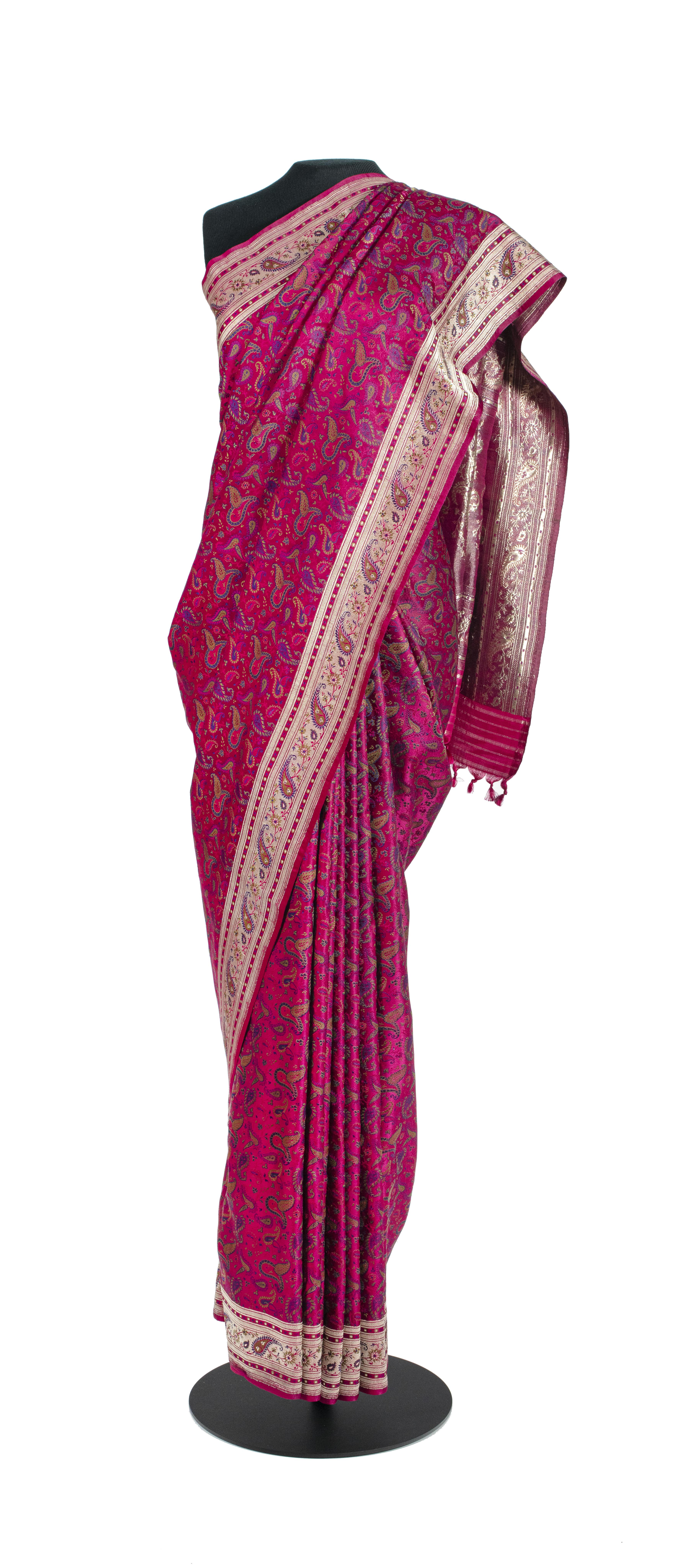

Sudha Acharya (active 21st century), owner. Banarasi Jamawar weave sariweave sari, undated. Silk with gold thread. Courtesy of Sudha Acharya
In operation since 2000, the South Asian Council for Social Services (SACSS) serves over 220,000 immigrants every year in Queens. Its founder and executive director Sudha Acharya currently represents the All-India Women’s Conference at the United Nations, following in the footsteps of leaders like Kamaladevi Chattopadhyay.
In 1946, the advocacy of groups like the India League of America and the Pakistan League of America resulted in the passage of the Luce-Celler Act, which allowed 100 Indian nationals to immigrate to the United States per year, and permitted those already residing in the US to become naturalized American citizens. The 1965 Immigration and Nationality Act opened the door further for newcomers who would come to call the city home, including Indo-Caribbean migrants who traced their ancestry to the subcontinent and hailed from Trinidad, Guyana, Suriname, and Jamaica. Vibrant South Asian enclaves in neighborhoods like Jackson Heights, Kensington, Richmond Hill, and South Ozone Park trace their roots to this moment. Photographs of the time capture the appearance of shops, groceries, and restaurants where immigrants could hear familiar languages, taste and smell familiar foods, and feel the familiar weight of cotton and silk.
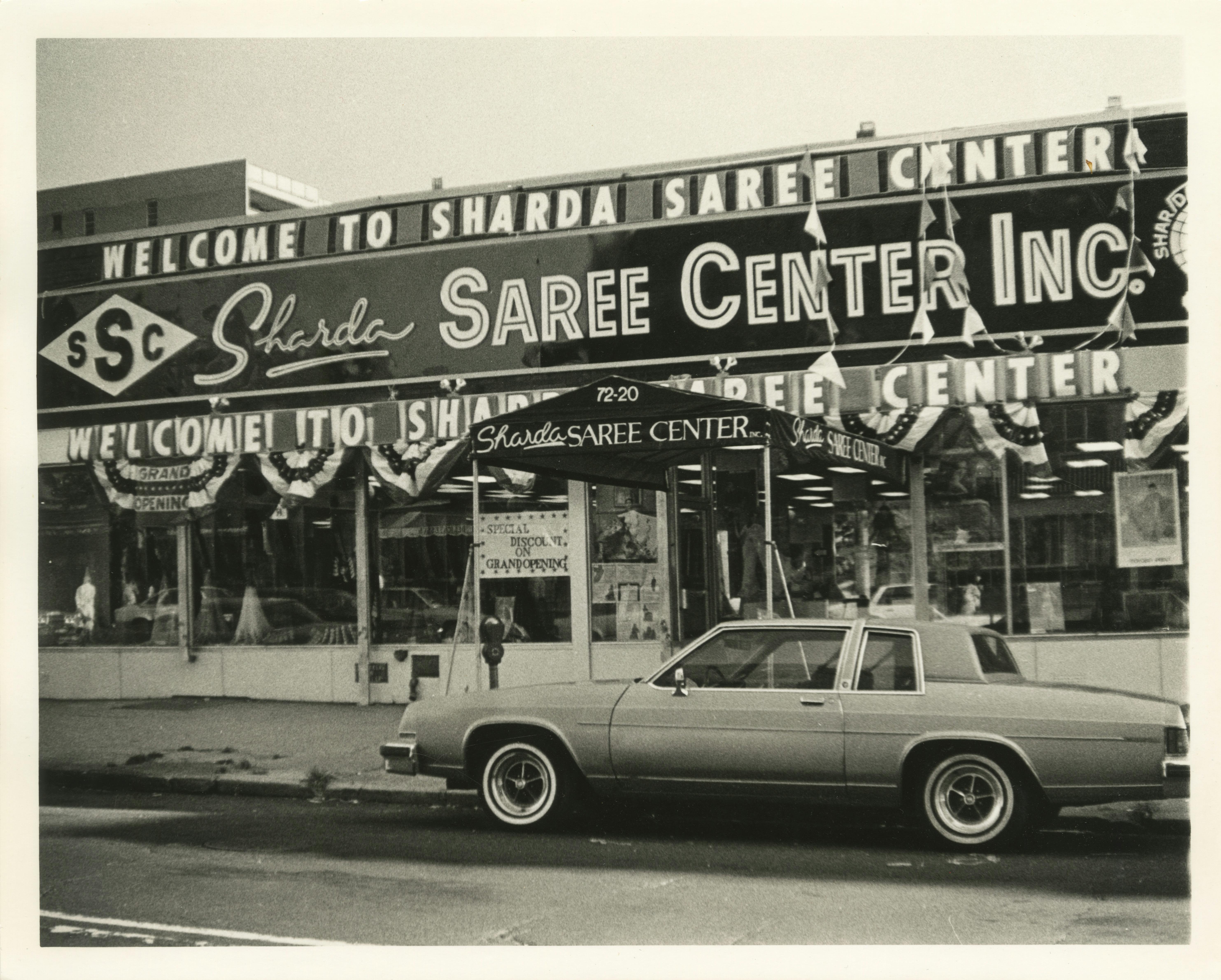
Eugene Gordon (b. 1923). New York, Jackson Heights, Queens, 1984. Patricia D. Klingenstein Library, The New York Historical
Today, the sari remains a visual expression of identity with many different meanings for its wearers and weavers. The New York Sari features saris from Sudha Acharya, founder of South Asian Council for Social Services; Narbada Chhetri, founder and co-executive director of Adhikaar, a Nepali grassroots community organization; RuAfza, a visual and drag artist; Shahana Hanif, New York City 39th District Council Member; and Dr. Lalitha Krishnan, a scientist, educator, and mother of New York City Council Member Shekar Krishnan.


Dr. Lalitha Krishnan (b. 1955), owner. Sari, undated. Silk. Courtesy of Dr. Lalitha Krishnan and New York City Councilmember Shekar Krishnan
We'd like to invite you to become part of this groundbreaking exhibition too, by sharing photos and stories to our "Show Us Your Sari" video slideshow. What does the sari mean to you? Are there occasions when you reach for it? Do you carry memories stitched into its folds? Does your community wear or make a particular style? When did you first wear or receive a sari? Is your sari formal or casual? New or old?
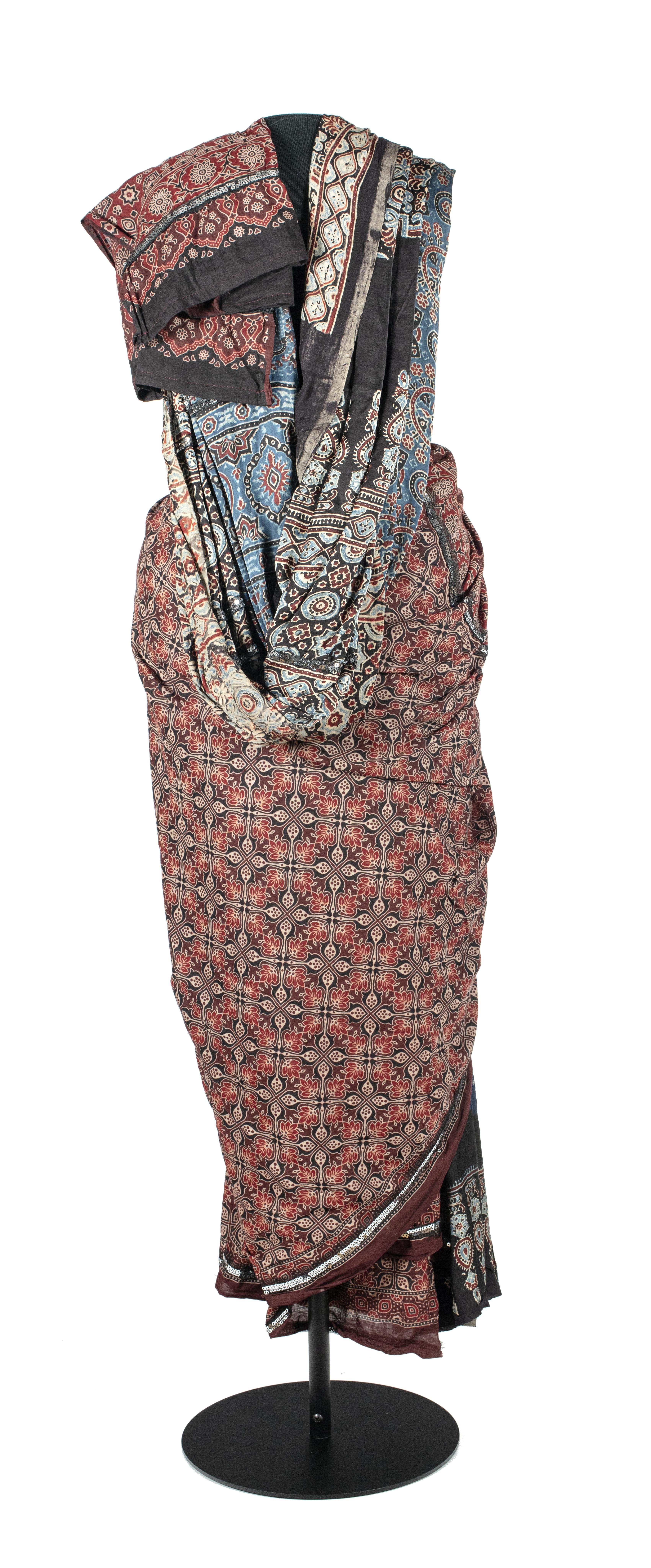

Original maker from Gujrat. Nikita Shah (b. 1990) and RuAfza (b. 2000), alterers. RuAfza (b.2000), owner. Sari (two Ajrakh saris, draped with a corset with sequins added) (two Ajrakh saris, draped with a corset with sequins added), undated. Ajrakhpur and Bhujodi, India. Gajji silk. Courtesy of RuAfza
You can share your sari through the QR code below, and at the exhibition, which is on view through April 26, 2026.
Every sari carries a history. Now it’s your turn to add to it.

Written by Salonee Bhaman and Anna Danziger Halperin, co-curators of The New York Sari, and Sabaa Ahmed, summer intern in women's history.
Keep Reading
- Women at the CenterDecember 22, 2025
Child's Play
What can the playthings of the past tell us about how children understand "women's work"? - Women at the CenterNovember 1, 2025
Vietnamese Stories from Stirring the Melting Pot: Photographs from The New York Historical Collection
At the heart of the story of Vietnamese refugees in 1970s New York is parents struggling to survive—and children learning how to translate that survival into a future. - Women at the CenterOctober 31, 2025
Scream With Me: An Interview with Author Eleanor Johnson
Which six classic horror films, released between 1968 and 1980, are "inextricably linked with the fight for women's rights in the United States"? - Women at the CenterSeptember 29, 2025
An Interview with Eve M. Kahn, Author of Queen of Bohemia Predicts Own Death
A Kentucky belle turned Kansas housewife turned New York journalist wrote passionately about the plight of impoverished East Siders in the early 20th century's version of a blog.