
About the Curriculum
“If our action shall be in accordance with the principles of justice, liberty, and perfect human equality, no eloquence can adequately portray the greatness and grandeur of the future of the Republic.”
-Frederick Douglass, "Composite Nation"
Welcome Letter
Dear Educator,
The New York Historical is proud to present this collection of educational materials and resources to accompany Our Composite Nation: Frederick Douglass’ America, a special installation that explores Douglass’ vision of freedom, citizenship, and equal rights in the years following the Civil War. At the core of this curriculum guide is Douglass’ “Our Composite Nation” speech, which still resonates today as our nation continues to grapple with the tension between its founding ideals and its ability to realize those ideals in an increasingly polarized United States.
The materials included here highlight the important and prescient themes of Douglass’ speech and his aspirations for America. They are arranged into five thematic sections: “Composition Nation” on Tour; Absolute Equality; Composite Nationality; Religious Liberty; and Hope. Each section includes primary and secondary sources and life stories intended to probe and deepen our understanding of Douglass’ ideas as well as the complex social and political challenges Americans faced in the second half of the 19th century.
The Education Division of the The New York Historical is committed to providing stimulating curricular materials to enhance the teaching and learning of American history and civics in classrooms across the country. It is our hope that this collection of resources will support you and your students in discussing our nation’s past, present, and future; in Douglass’ words, “a composite, perfect illustration of the unity of the human family.”
Sincerely,


About the Materials
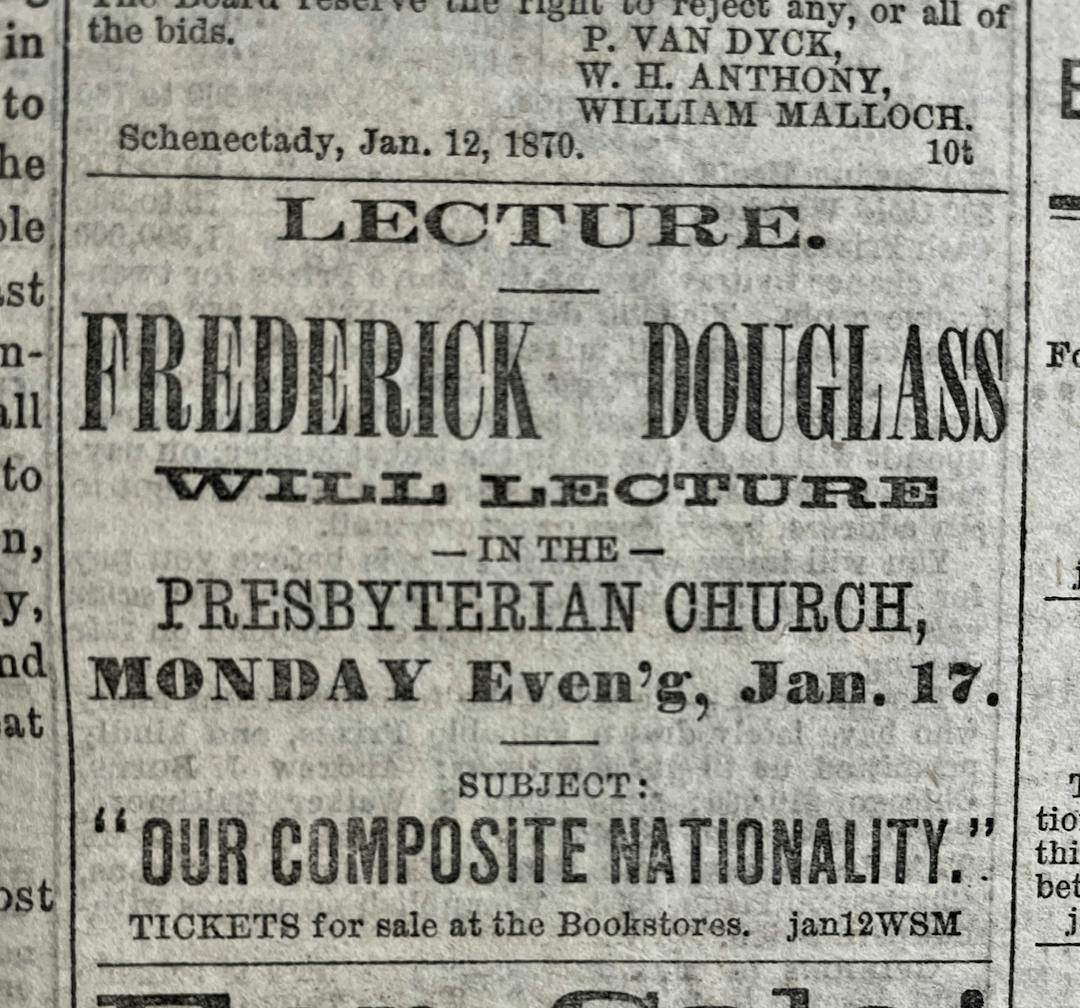
In 1869, at the peak of Reconstruction, Frederick Douglass was hopeful about America. His boyhood self and his tireless abolitionist self would have been stunned by the nation’s progress since the Civil War. Douglass thought the United States was entering a new era where true equality would become the foundation for a vibrant and just nation. He was inspired to write a lecture called “Composite Nation” and took it on tour to share his vision with audiences all over the country. “Composite Nation” is a prescient and powerful speech that still resonates today. Douglass’ vision has not yet been fully realized, but his words invite us to try.
The Our Composite Nation curriculum guide provides resources that allow you and your students to take a deep dive into Frederick Douglass’ hopeful vision for America and connect it to important historical events of the late 19th century. The first section takes a close look at the speech and how Douglass shared it with the world. The other four sections explore important themes from the speech. Each section includes a life story and primary sources that will allow students to investigate a theme and place it in its historical context. Many of these resources interconnect in interesting ways, allowing you and your students to compare and contrast the political, economic, and social realities that informed Douglass’ vision for America. Each resource comes with background information, a vocabulary list, and suggested activities for how you might integrate it into your lessons. Resources can be printed out individually or with various supplements included, depending on how you want to use them. There are also links included on each resource page that will connect to other curriculum guides, so you and your students can follow interesting threads.
Key Ideas
Frederick Douglass was a leading champion in the 19th-century fight for equality for all Americans.
Frederick Douglass believed that the United States needed to embrace its increasing diversity, ensure absolute equality, and protect religious liberty in order to enter a new era of peace and prosperity.
Frederick Douglass’ vision for the United States has not yet been fully realized, but many courageous Americans have continued to follow his lead.
Essential Questions
Why did Frederick Douglass believe the US was entering a new era of justice and prosperity?
What steps did Frederick Douglass recommend the country take to encourage it to live up to its potential?
Has the US realized Frederick Douglass’ hopeful vision? What steps could the nation take to fully embrace the ideal of “composite nationality”?
Acknowledgements
Acknowledgements
Developer and Writer
Allyson Schettino, Director of Curriculum and Instruction
Project Manager
Lee Boomer, Manager of Education Special Projects
Scholar Reviewer
Eric Foner
Producer
The New-York Historical Society Education Division
Leslie Hayes, Vice President for Education
Allyson Schettino, Director of Curriculum and Instruction
Leah Charles-Edouard, Associate Director of School Programs
Pauline Noyes, Associate Director of Teen Programs
Samantha Rijkers, Senior Manager of the Citizenship Project
Lee Boomer, Manager of Education Special Projects
Schuyler Schuler, Manager of Professional Learning
Olivia Paige, Manager of School Programs
Michael Hearn, Manager of School Programs
Rachel Ebersole, Manager of Teen Programs
Marianne De Padua, Assistant Manager of Professional Learning
Mia-Michelle Russell, Assistant Manager of School Programs
Kionah Tucker, Education Coordinator
Jenni Rein, Academy for American Democracy Coordinator
Maria Betancur, Coordinator of Teen Programs
Lynn Saltonstall, Professional Learning Coordinator
Elizabeth Scully, Education Associate
Diane Tinsley, Bookkeeper
Our Composite Nation Exhibition Team
Louise Mirrer, President & CEO
Marci Reaven, Vice President for History Exhibits
Lily Wong, Associate Curator
Dominique Jean-Louis, Associate Curator
Eric Foner, Scholar Advisor
Martha Jones, Scholar Advisor
Marjorie Waters, Exhibition Text
Dayna Bealy, Rights Clearance Specialist
Eleanor Gillers, Supervisor of Rights & Reproduction
Gerhard Schlansky, Exhibition Design
Kira Hwang, Graphic Design
Our Composite Nation has been made possible in part by a major grant from the National Endowment for the Humanities: Democracy demands wisdom.
Additional support is provided by New-York Historical's Frederick Douglass Council.

Any views, findings, conclusions, or recommendations expressed in this exhibition do not necessarily represent those of the National Endowment for the Humanities.