Religious Liberty
“I know of no church, however tolerant; of no priesthood, however enlightened, which could be safely trusted with the tremendous power which universal conformity would confer. We should welcome all men of every shade of religious opinion, as among the best means of checking the arrogance and intolerance which are the almost inevitable concomitants of general conformity. Religious liberty always flourishes best amid the clash and competition of rival religious creeds.”
Frederick Douglass was a practicing Protestant who viewed religious liberty as a key American principle. Civil equality, he told his audiences, must be granted “to people of all races and all creeds, and to men of no creeds.”
Freedom of religion is written into the First Amendment, but the events of the 19th century put this principle to the test. Throngs of new immigrants arrived with a variety of faiths, just as the United States expanded its territory and authority over new diverse populations. The nation redefined citizenship and debated what it meant to be American. And race and religion played central roles.
Frederick Douglass believed that religious liberty was essential to promoting the equality of every American citizen.
The principle of religious liberty faced many challenges in the 19th century.
Religion was an important way for marginalized groups to assert their culture and heritage.
Why did Frederick Douglass believe religious liberty was an important principle in American society?
How did religious communities assert their freedom in the 19th century?
What challenges did religious communities face in the 19th century?
- Life Story: David Pharoah
The story of a Montaukett leader who used a religious ceremony to assert his community’s independence.
Topics: Indigenous history, Montaukett, religious liberty, U.S. policies towards Indigenous people, legal history, June Meeting
- Resource: Building Religious Communities
These images commemorate the construction of Central Synagogue in New York City.
Topics: immigration, German immigrants, Jewish Americans, religious liberty, immigrant communities
- Resource: Religious Liberty Tested
This drawing depicts Mormon women marching in support of the practice of polygamy.
Topics: Church of Jesus Christ of Latter-day Saints, Mormon, westward expansion, religious liberty, legal history
Life Story: David Pharoah
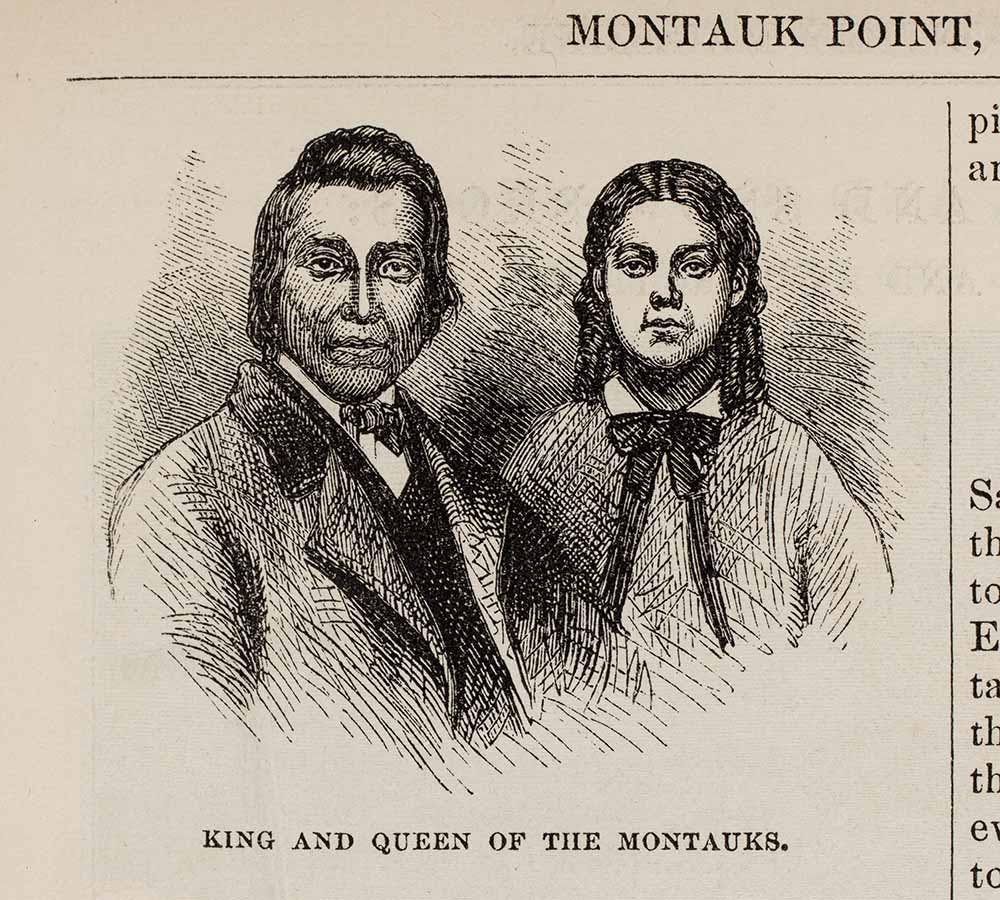
“David and Maria Pharoah,” Harper’s New Monthly Magazine, 1871. New-York Historical Society.
David Pharoah (1835–1878)
Asserting Indigenous Rights
David Pharoah was born into the Montaukett community on Long Island in 1835. His parents, Samuel and Aurelia Pharoah, lived in a settlement called Indian Fields, part of a larger reservation of land held by the Montaukett in eastern Long Island. Pharoah’s grandfather, Sylvester Pharoah, was the leader of the tribe. The Pharoah family led the Montaukett since the mid-1600s.
The Montaukett were once an influential Indigenous community, but centuries of white settlement and colonization devastated the tribe. By the time Pharoah was born, there were only six Montaukett households in the settlement at Indian Fields. Most of the Montaukett supported themselves by working for white families. The women found jobs as domestic servants. The men were laborers on farms or ships. When he was a young man, Pharoah served aboard a whaling vessel at least once.
Pharoah married Maria Fowler in 1863. Maria was the daughter of another Montaukett family with a long history of tribal leadership. Pharoah and Maria settled in Indian Fields, and eventually Maria gave birth to five children. They named four of their children after heroes from North American Indigenous history: Wyandanch, Tecumseh, Pocahontas, and Powhatan. These names reveal that Pharoah and Maria took great pride in their cultural heritage. They wanted to preserve Indigenous history for future generations.
Pharoah’s grandfather died in 1870. Pharoah was chosen to be the new leader of the Montaukett. In local newspapers, he was called “King David,” but this western title does not correctly explain his position in his community. Montaukett leadership was hereditary, but leaders did not have absolute power like a European king or queen. Pharoah’s role was to learn everything he could about the challenges that faced the Montaukett and then advise the community on the best course of action. His people could then choose whether or not to follow his advice. Pharoah also had a council of experts that advised him. This council could be changed by the Montaukett people at any time.
Pharoah became the leader of the Montaukett during a time of crisis. The population of the tribe was so small that local white settlers were trying to force them off their lands. To protect his community, Pharoah sued a group of white settlers called the Trustees of Montauk. He accused the Trustees of illegally cutting down trees on land belonging to the Montaukett. Pharoah understood that if the judge ruled in his favor, it would reaffirm Montaukett ownership of the land. At the same time, Pharoah petitioned the state of New York to incorporate the tribe. Incorporation would make it easier for the tribe to work together to protect their lands.
While both of these legal actions were in progress, Pharoah invited Indigenous people from all over Long Island to join him for a religious ceremony called June Meeting. June Meeting is a spring ceremony that combines Indigenous and Christian rituals into a unique celebration of the start of the growing season. It has been celebrated by the Indigenous communities on Long Island since it was first established by Shinnecock minister Reverend Paul Cuffee in the 1700s. The 1871 June Meeting was a deliberately grand affair intended to reaffirm Montaukett ties to the land and celebrate cultural heritage at a time when both were under attack. During the meeting, Pharoah prayed that the Montaukett’s lands would be preserved for future generations. The 1871 June Meeting was covered by white journalists. Their accounts of the ceremony reached readers throughout the Northeast. It was a powerful moment of visibility and defiance from a community on the brink of collapse.
Unfortunately, Pharoah’s legal cases were not successful. The New York Supreme Court ruled that the Montaukett had no right to their lands. The petition for tribal incorporation was stalled in the state government by Long Island politicians who did not want the Montaukett people to consolidate their power. Both of these outcomes severely limited the Montaukett’s ability to protect their lands from white settlement. But Pharoah did not stop trying to improve the status of and opportunities for his tribe. In 1872, he petitioned the state to establish a school for Montaukett children. He knew that a good education would give future generations the power to fight back against the colonial policies that threatened their community.
Pharoah passed away in 1878. His time as leader was short, but it set a strong example for future Montaukett leaders. His son, Wyandank, used his own time as Montaukett leader to continue the court battles over land rights. The Montaukett people continue to fight for recognition and independence today. June Meeting is still celebrated every year on Long Island.
Click here for a video of this life story.
- absolute power
Complete authority over others.
- hereditary
A position passed down from parent to child.
- incorporation
The process of turning something into a recognized legal organization.
- June Meeting
A religious ceremony that combined Christian and Indigenous traditions in a spring celebration. It is observed by the Montaukett, Shinnecock, and Unkechaug tribes of Long Island.
- Montaukett
A tribe that has lived on eastern Long Island for hundreds of years.
- petition
To formally ask.
- Pocahontas
A Powhatan woman famous for her dealings with English settlers at Jamestown in the early 17th century.
- Chief Powhatan
A chief of the Powhatan people and father of Pocahontas who led a confederacy of six Indigenous tribes in modern-day Virginia.
- Shinnecock
A tribe that has lived on eastern Long Island for hundreds of years.
- Tecumseh
A Shawnee chief and speaker who promoted Indigenous resistance to white settlement.
- Wyandanch
A powerful Montaukett leader who lived in the mid-1600s.
- Unkechaug
A tribe that lived on eastern Long Island for hundreds of years.
What challenges did David Pharoah face as the leader of the Montaukett?
Why might David Pharoah have prioritized holding an elaborate June Meeting ceremony?
What does this story reveal about the struggles Indigenous communities faced in the years after the Civil War?
After reading this life story, ask the students to read Frederick Douglass’ "Composite Nation" (Composite Nation on Tour). How do David Pharoah’s experiences as leader of the Montaukett enhance our understanding of Douglass’ writing about Indigenous people? How do you think Douglass would respond to Pharoah’s desire and actions to preserve his culture and community?
David Pharoah’s plan to assert Montaukett land rights through the U.S. court system followed a pattern that Montaukett leaders had used for generations. To learn more about this, see the life story of Quashawam.
Use the following resources to provide students with the historical context for David Pharoah’s work and the struggle for Indigenous sovereignty in the United States: Girls Education at Carlisle Indian School, Life Story: Lozen, Indigenous Resistance to Relocation, Life Story: Weetamoo, Revolution in Art, Life Story: Quashawam, Life Story: Zitkala-Sa, Native American Education and Family Separation, and Life Story: Nanyehi Nancy Ward.
For more resources on the history of Indigenous people in the US, see Women & the American Story.
Resource: Building Religious Communities
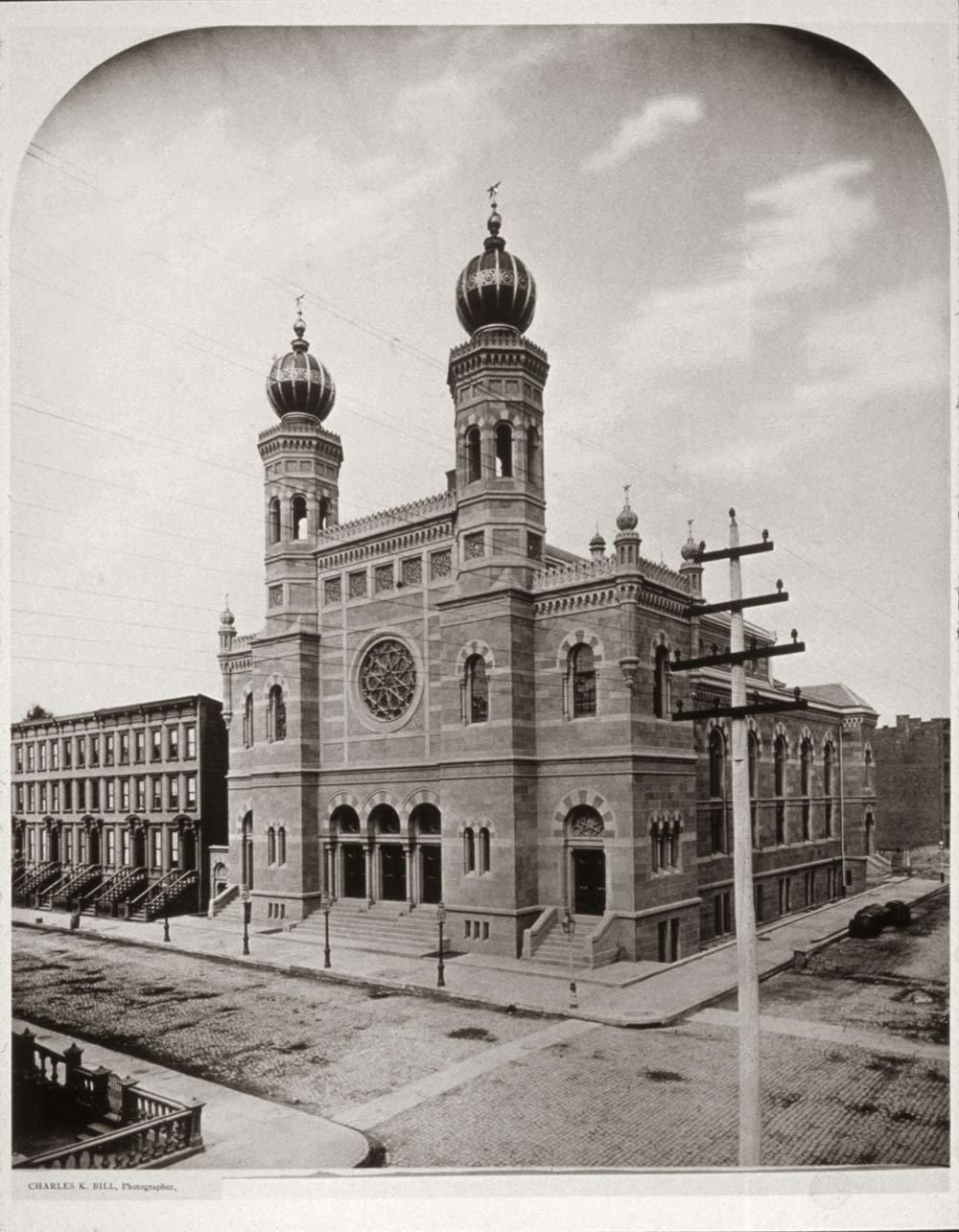

Architectural drawing of Ahawath Chesed, courtesy of Henry Fernbach / Central Synagogue.
The immigrants arriving in the United States in the 1800s brought their religious traditions with them. For example, the German-speaking Jewish immigrants who settled in New York City in the 1830s and 1840s did not feel at home in the American Jewish congregations that had been established in the colonial era. Immigrant communities formed their own congregations so they could preserve their unique religious and cultural traditions and support one another.
Ahawath Chesed was a Jewish congregation formed by German-speaking immigrants in 1846. In its early days, Ahawath Chesed’s religious services were held in rented rooms because the congregation could not afford to build a synagogue.
In 1870, the 140 families of Ahawath Chesed bought a plot of land on the corner of 55th Street and Lexington Ave. They hired a Jewish architect to design a building that symbolized the congregation’s culture, prosperity, and dedication to their faith. The ceremony celebrating the start of the construction of the new building was attended by many city officials, including Christians, signaling the city’s growing acceptance of religious diversity.
The Ahawath Chesed congregation merged with another German-speaking Jewish congregation called Shaar Hashomayim in 1898. In 1918, they renamed their spectacular house of worship Central Synagogue. Today, Central Synagogue is home to a very active congregation of more than 2,600 families.
- congregation
A group of people who come together for religious services.
- Ahawath Chesed
A Jewish congregation formed by German-speaking immigrants in 1846.
- synagogue
A building dedicated to holding Jewish religious services.
- Shaar Hashomayim
A Jewish congregation formed by German-speaking immigrants in 1846.
Why did immigrant communities form their own religious congregations instead of joining established ones?
How does the design of Central Synagogue symbolize its congregation’s culture, prosperity, and dedication to faith?
How is this synagogue an expression of the religious liberty Douglass championed in his "Composite Nation" (Composite Nation on Tour) speech?
Compare and contrast this story with Religious Liberty Tested. Taken together, what do these resources reveal about the possibilities and limits of religious liberty in the 19th century?
Teach this resource together with the life story of David Pharoah, and then ask students to write a short reflection on religion’s role in forming and asserting community and culture.
Frederick Douglass believed that religious liberty would lend strength to the United States. After examining this resource, ask students to read the corresponding passages from “Composite Nation” (Composite Nation on Tour) and then debate whether this resource supports or detracts from his argument.
For resources on the history of Jewish women in the United States, see Women & the American Story.
Resource: Religious Liberty Tested
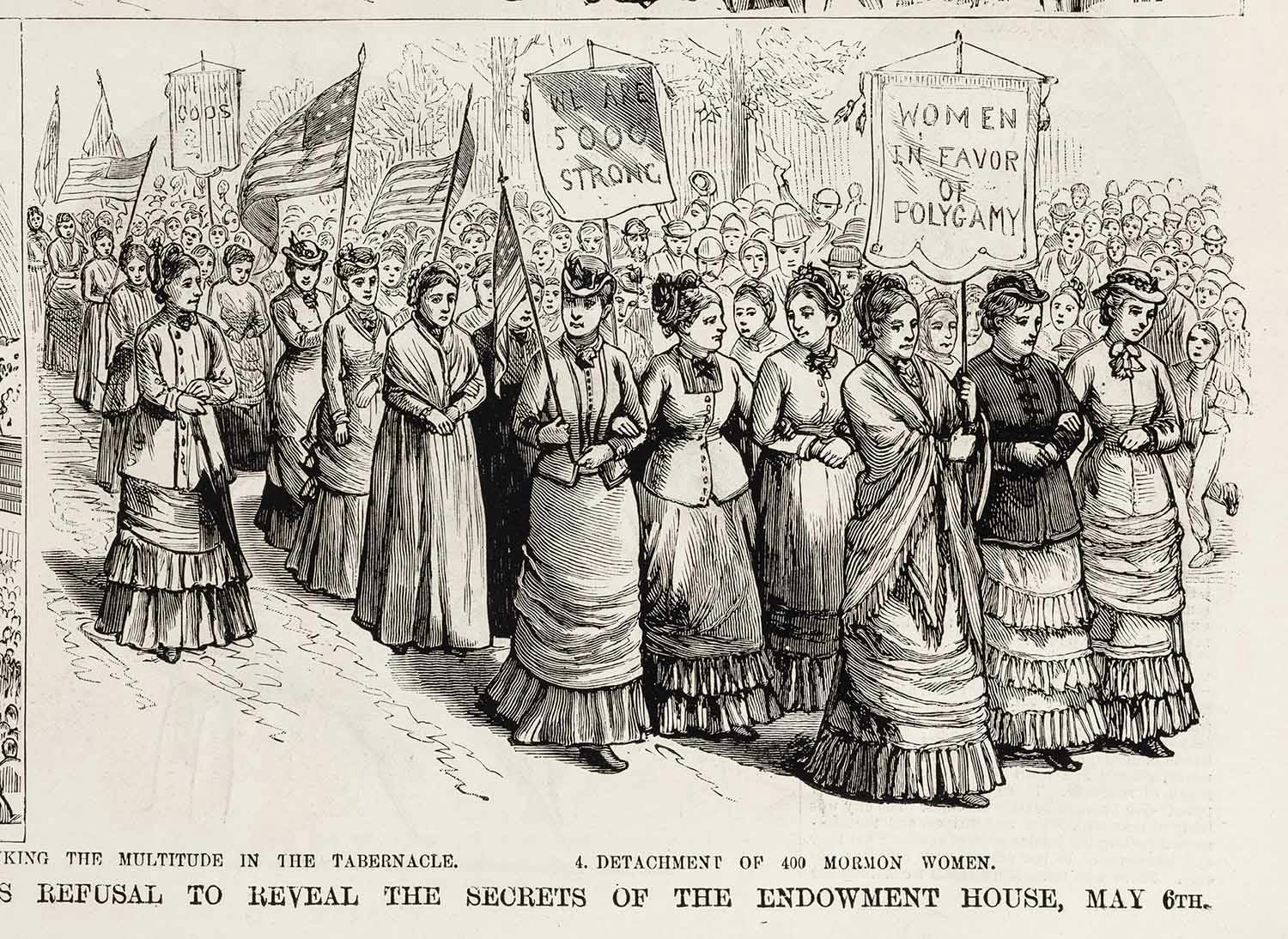
“Detachment of 400 Mormon Women,” Frank Leslie’s Illustrated Newspaper, 1879. New-York Historical Society Library.
In 1830, Joseph Smith published a religious text called the Book of Mormon. Over the next 14 years, he moved around the western states and territories gathering followers and establishing the beliefs and traditions of his new religion. Today, Smith’s religious community is known as the Church of Jesus Christ of Latter-day Saints. People who practice this faith are commonly known as Mormons.
Because Smith’s followers practiced a branch of Christianity that was new and different, they frequently faced hostility and violence. They were forced to move all over Ohio, Missouri, and Illinois before Smith died in 1844. In 1847, a new Mormon leader named Brigham Young led most of the Mormons further west, where they could settle outside the United States and far away from their opponents. The land they settled on was part of Mexico. It became the U.S. territory of Utah in 1850, after the Mexican-American War.
The Mormon community settled in Utah so they could freely practice their religion. But when Utah was annexed to the United States, the territory became subject to the nation's laws. The Mormon practice of polygamy became a particular source of tension with the U.S. government.
Polygamy is when a person has more than one husband or wife at the same time. Mormons believed the practice of polygamy strengthened their community, although only men were allowed to take multiple wives. People who were not Mormon were enraged by this practice. When the Mormon leadership officially announced that polygamy was part of their faith in 1852, other Americans mounted an opposition campaign. Eventually, government officials passed laws banning the practice.
Mormon leaders challenged the new laws in court, and Mormon women marched to show their support. In 1879, the Supreme Court ruled that Mormon beliefs were protected by the First Amendment, but the practice of polygamy was not.
- Book of Mormon
The religious text that serves as the foundation for the Church of Jesus Christ of Latter-day Saints.
- Church of Jesus Christ of Latter-day Saints
The name of the main branch of the church founded by Joseph Smith.
- First Amendment
The amendment to the U.S. Constitution that grants citizens the freedom of speech, religion, and peaceful assembly, as well as the freedom to petition the government.
- Joseph Smith
The man who wrote the Book of Mormon and the founder of the Church of Jesus Christ of Latter-day Saints.
- Mormon
Name commonly used to refer to the people who base their religious beliefs on the Book of Mormon, although the official name is The Church of Jesus Christ of Latter-day Saints.
- polygamy
The practice of having more than one spouse at the same time.
Why did Mormons face strong opposition from non-Mormon people and the U.S. government?
What does this image reveal about Mormon women’s feelings about the practice of polygamy?
How does the debate over polygamy complicate Frederick Douglass’ idea of religious liberty ("Composite Nation" Speech) in the United States?
For more information about the history of polygamy in Mormon communities, see Polygamy and the Church: A History.
Compare and contrast this story with Building Religious Communities. Read together, what do these resources reveal about the possibilities and limits of religious liberty in the 19th century?
Frederick Douglass believed that religious liberty would strengthen the country. After examining this resource, ask students to read the corresponding passages from “Composite Nation” (Composite Nation on Tour) and then discuss whether this resource supports or detracts from his argument.
For more resources on women and religious movements in U.S. history, see Women & the American Story.


