Hope
“It is thought by many, and said by some, that this Republic has already seen its best days. The American people have a right to be indignant at those who make themselves the ministers of despair when they should be those of hope. We never had better reason to be hopeful than now. We are yet to have our day. We are at the beginning of our ascent.
When the architect intends a grand structure, he makes the foundation broad and strong. We should imitate this prudence in laying the foundation of the future Republic. If our action shall be in accordance with the principles of justice, liberty, and perfect human equality, no eloquence can adequately portray the greatness and grandeur of the future of the Republic.
In “Composite Nation,” Frederick Douglass shared his vision for an American rebirth, based on equality, acceptance, and liberty. He traveled thousands of miles to share his hopeful dream with Americans. He warned against those who said the United States was already doomed. Douglass also wanted to convince his audiences that this new America was within reach and inspire them to take action. In his grandchildren, Douglass saw a living embodiment of all that was possible. And, hope, he believed, was essential to action.
However, the 20 years that followed would challenge Douglass’ faith in America. The overthrow of Reconstruction and the rise of Jim Crow legislation signaled that many white Americans did not want to extend equality to all people living in the United States. But Douglass never lost hope. His last speech criticized the nation for all the ways it had failed, but also reminded his listeners that embracing the principles of equality, acceptance, and liberty could once again put the country on a more righteous path.
Frederick Douglass saw the many faults in the United States, yet still believed the country was capable of doing better.
In the 1880s and 1890s, new federal, state, and local laws made life more restrictive and challenging for minority communities.
Minority communities actively resisted the resurgence of white supremacy in meaningful ways.
How do you think Frederick Douglass maintained hope for the future of the country while witnessing the resurgence of white supremacy?
What steps did white politicians take to ensure that white Americans occupied a higher social position than people of color?
How did people of color resist the resurgence of white supremacy in the later 19th century?
- Life Story: Joseph Douglass
The story of the first world-renowned Black violinist.
Topics: Black history, music history, Frederick Douglass, Reconstruction, Jim Crow, Plessy v. Ferguson, segregation
- Resource: Plessy v. Ferguson
An image that illustrates the racial tension that led to the “separate but equal” ruling by the Supreme Court.
Topics: Black history, legal history, Jim Crow, segregation, legal history, activism
- Resource: “Lessons of the Hour”
Excerpts from Frederick Douglass’ last lecture about how the nation can combat the resurgence of white supremacy.
Topics: Black History, Frederick Douglass, Jim Crow, anti-lynching, activism
Life Story: Joseph Douglass

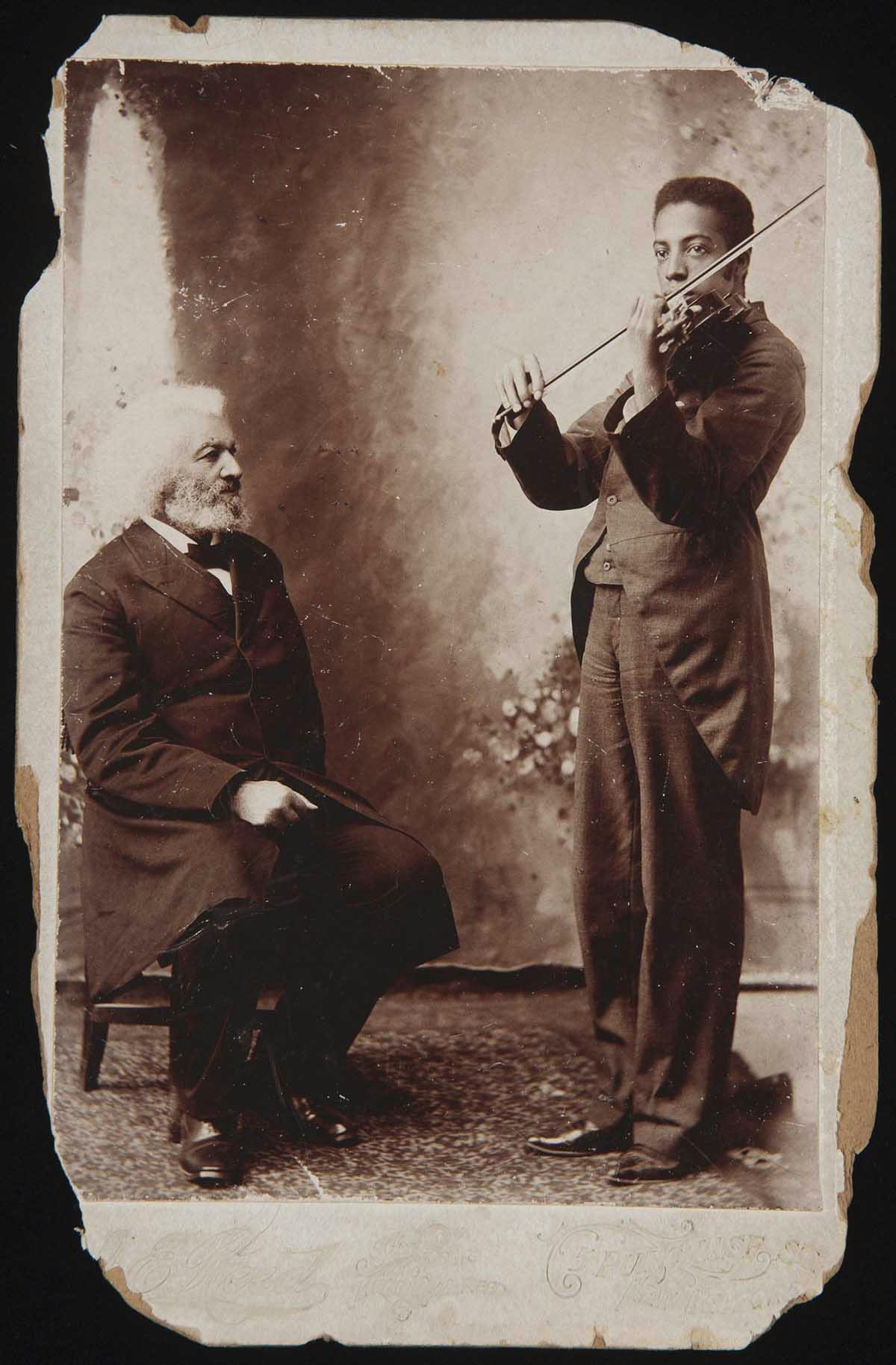
Double Portrait of Frederick Douglass, Seated, with Joseph Douglass, Grandson Standing with Violin. Cabinet card., undated. Randolph Linsly Simpson African-American Collection. James Weldon Johnson Memorial Collection in the Yale Collection of American Literature, Beinecke Rare Book and Manuscript Library
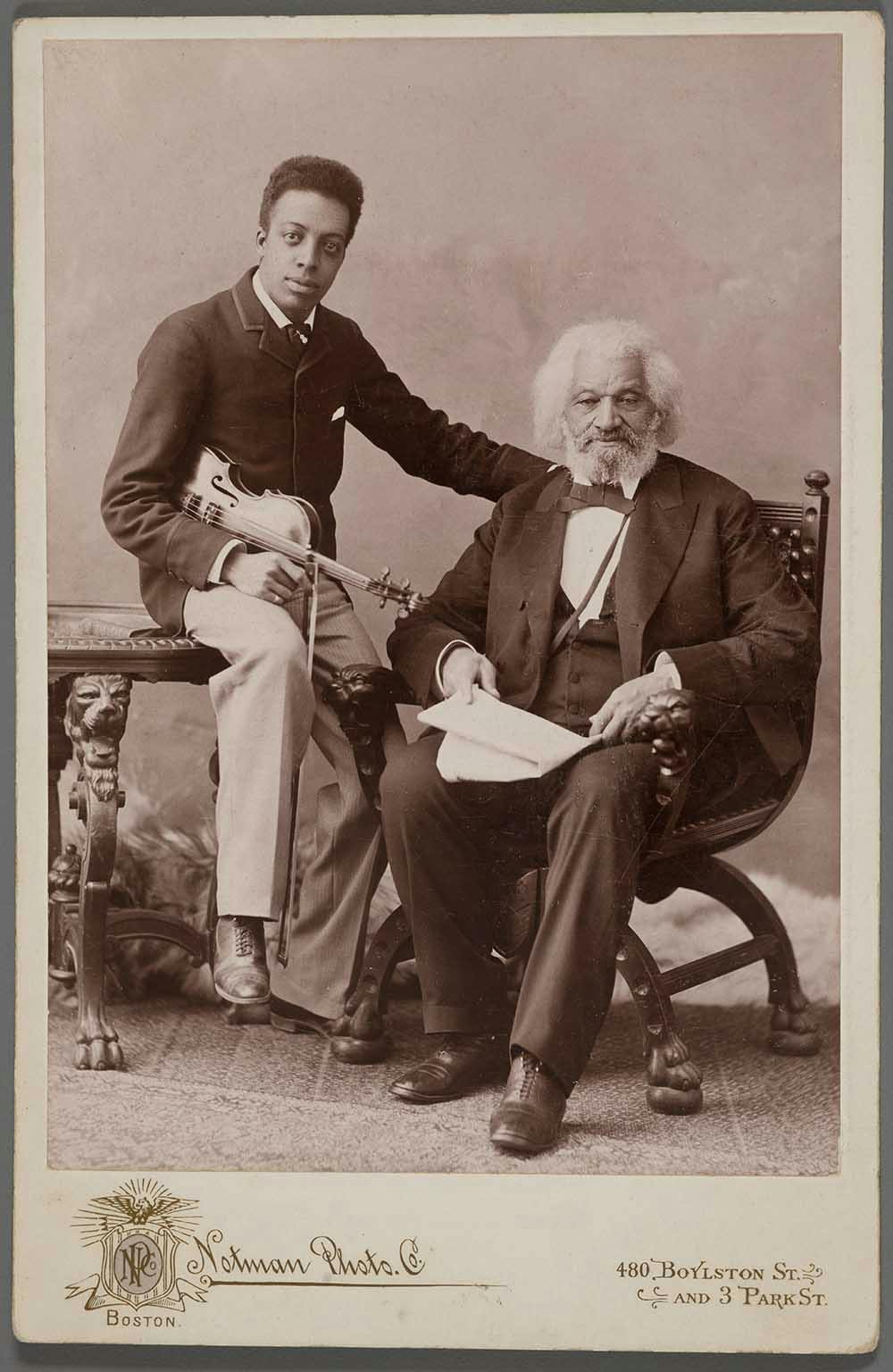
Joseph Douglass (1869–1935)
Concert Violinist
Joseph Henry Douglass was born on July 3, 1871, in Washington, D.C. His parents were Charles Remond Douglass and Mary Elizabeth Murphey. He was the grandson of famous abolitionist and activist Frederick Douglass (Composite Nation on Tour).
Douglass’ early life was marked by tragedy. All five of his siblings died in childhood, and his mother passed away in 1879. His father remarried in 1880, and Douglass’ stepmother gave birth to a son, but Charles struggled to support his family. Charles moved frequently to find work.
Douglass spent a lot of his childhood with his grandparents. His grandfather, Frederick Douglass, was a self-taught amateur violinist, who gave lessons to his children and grandchildren. Frederick Douglass quickly realized that his grandson was musically gifted, and he encouraged Douglass to develop his talent. He even helped pay for Douglass’ education when Charles could not afford to. Douglass studied violin performance and composition at the New England Conservatory for five years. He continued his studies at the Boston Conservatory. By the time he graduated, he was a very talented violin player and performer.
Frederick Douglass also gave Douglass his first big break. In 1893, Frederick Douglass helped plan and organize “Colored American Day,” a showcase of Black artists, writers, and entrepreneurs at the Chicago World’s Fair. Frederick Douglass gave Douglass a slot as a featured performer. On August 25, 1893, Douglass performed for a large audience of people from all over the country and world. The performance established his reputation as one of the world’s most talented violinists.
For the next 40 years, Douglass enjoyed a successful career as a concert violinist and composer. He toured the country. He particularly loved performing for Black audiences in the South. He was the first Black American musician to tour as a featured performer in Europe. Douglass was also the first violinist ever recorded by the Victor Talking Machine Company. Before his grandfather passed away in 1895, Douglass sometimes performed at his lectures. In Frederick Douglass’ eyes, Douglass embodied all that was possible if the U.S. embraced its diversity. He was a shining example of what Black Americans might achieve if given the same opportunities as white Americans.
Douglass’ personal life reflected his professional success. He married a Black concert pianist named Fanny May Howard. She frequently played piano at his performances. They made a home together on U Street in Washington, D.C., where they raised two children. Douglass and Fanny’s success meant they could provide a stable life and good education for their children. Their son, Frederick Douglass III, grew up to be a doctor.
But Douglass rose to success at a time when most Black Americans were facing increasing racism and oppression. State and local governments passed laws that prevented Black Americans from exercising their right to vote (Absolute Equality). The Supreme Court decision in the case Plessy v. Ferguson made racial segregation legal, drastically limiting the economic, social, and educational opportunities for Black Americans. And there was a devastating surge in white violence against Black people and communities, which made even the smallest acts of defiance life-threatening for Black Americans.
Douglass was personally affected by these developments, which probably made him feel like he lived in two different worlds. On the one hand, he was invited to perform at the White House many times. On the other hand, he was forced to travel in segregated train cars and was not welcome in the best hotels and restaurants in the American cities he visited. He and his family lived in a predominantly Black Washington, D.C., neighborhood called “Black Broadway” because it was home to many famous Black performers. They probably enjoyed living in a thriving Black community, but they also did not have a choice. Racist real estate practices meant the couple could not buy a home in any predominantly white neighborhoods.
Douglass was not deterred by the racism he faced. Like his grandfather before him, he continued to tour the United States even when it would have been easier not to do so. He understood that his performances served two very important functions. They reminded white audiences that Black Americans could achieve great things. And they encouraged Black audiences to stand up for their rights and pursue their dreams.
Douglass wanted to nurture young Black musicians and give them the same opportunities his grandfather created for him. So, he founded and led community music schools for Black and immigrant children in New York City and Washington, D.C. Also, he worked as a professor at Howard University and the Colored Music Settlement School. Additionally, Douglass mentored many promising young musicians, helping them launch their careers.
Douglass passed away on December 8, 1935. His life paved the way for countless other Black performers who would follow in his footsteps.
Click here for a video of this life story.
- composer
A person who writes music.
- concert pianist
A piano player who specializes in classical music.
- conservatory
A college for studying music and performance.
- violinist
A person who plays the violin.
What made Joseph Douglass a standout figure in his lifetime? What opportunities in his life helped him achieve success?
How did Joseph Douglass create opportunities for other Black Americans?
Why did Joseph Douglass give his grandfather hope for the future of America?
Teach this life story together with the life story of Frederick Douglass (Composite Nation on Tour), and then ask the students to reflect on how the political and social changes of the Civil War and Reconstruction shaped the different generations of the Douglass family.
After reading this life story, ask your students to read “Composite Nation” (Composite Nation on Tour)and then write a short essay about how Joseph Douglass embodied the hopes that his grandfather held for the future of the United States.
To help the students better understand the historical context for Joseph Douglass’ life, use any of the following: Life Story: Frederick Douglass and The Reconstruction Amendments (Composite Nation on Tour); Philadelphia Streetcar Desegregation and White Resistance (Absolute Equality); and Plessy v. Fergusson, and “The Lessons of the Hour”.
To learn more about the ways Black Americans resisted the rise of oppressive laws after the end of Reconstruction, see Black Citizenship in the Age of Jim Crow.
For more resources about the history of Black women in 19th century America, see Women & the American Story: A Nation Divided and Industry and Empire.
Resource: Plessy v. Ferguson
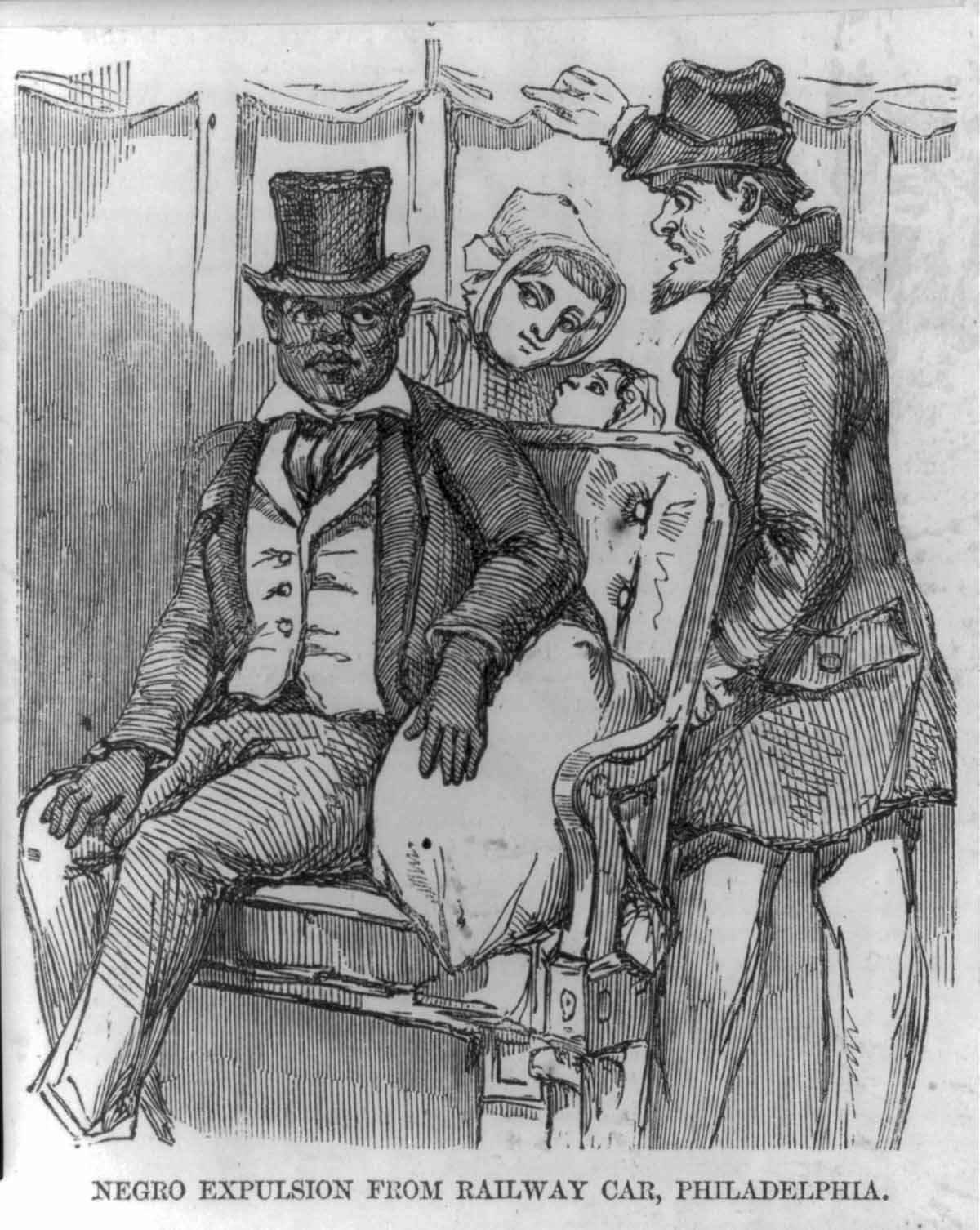
“Negro expulsion from railway car, Philadelphia,” 1856. Library of Congress, Prints & Photographs Division, Washington, D.C.
In 1890, the state of Louisiana passed the Separate Car Act. This law required all passenger trains to separate Black and white passengers. Louisiana’s law was one of many passed by state and local governments (Absolute Equality) that made life more challenging for Black Americans after the end of Reconstruction.
A group of Black activists from New Orleans called the Comité des Citoyens (Citizens’ Committee) challenged the legality of the Separate Car Act. They asked a Black man named Homer Plessy to get arrested for sitting in the white section of a train car so they could challenge the law in court. The resulting court case, called Plessy v. Ferguson, made it all the way to the Supreme Court.
The Supreme Court was asked to decide whether the Separate Car Act violated the Fourteenth Amendment (Composite Nation on Tour), which guaranteed Black Americans equality under the law. In 1896, the court ruled that the Separate Car Act did not violate the Fourteenth Amendment because it required spaces for Black people to be equal to those of white people. They claimed that this meant that Black equality was still upheld by the law. But the separate facilities provided for Black people were never equal to those for whites. This “separate but equal” ruling was used to uphold segregationist laws and racist policies until the Supreme Court’s Brown v. Board of Education decision in 1954.
This illustration from the mid-1800s shows how Black Americans were treated when they tried to use the same facilities as white people. Black people faced racial oppression and opposition throughout the United States, even in places that did not have official segregation laws (Absolute Equality).
- Reconstruction
The years between 1865 and 1877 when the U.S. government actively sought to reincorporate the former Confederacy back into the United States and passed legislation to guarantee the economic, political, and social rights of Black Americans.
- segregate
To separate by race.
What is happening in this picture? How has the artist conveyed this event?
What does this image reveal about the way segregation affected the lives of Black Americans?
How did the Plessy v. Ferguson decision undermine the ideal of absolute equality?
The Plessy v. Ferguson decision was issued one year after Frederick Douglass passed away. Ask students to read his “Composite Nation” (Composite Nation on Tour) and ”Lessons of the Hour” speeches. Then compose a short response to the Supreme Court’s decision from Frederick Douglass’ point of view.
For an example of the ways Plessy v. Ferguson disrupted the daily lives of Black Americans, read the life story of Susie Baker King Taylor.
Ask students to study these images together with the Enduring Exclusion (Composite Nationality) resource and then write a short essay about how the U.S. government rejected the idea of composite nationality (Composite Nation on Tour) in the final years of the 19th century.
To learn more about the possibilities and challenges in achieving absolute equality after the Civil War, use any of the following: Life Story: Frances Ellen Watkins Harper, Philadelphia Streetcar Desegregation and White Resistance (Absolute Equality); Life Story: Wong Kim Ark and Enduring Exclusion (Composite Nationality); Life Story: David Pharoah and Religious Liberty Tested (Religious Liberty); Life Story: Joseph Douglass, Fighting Jim Crow, and Suffrage and the Fifteenth Amendment.
To learn more about the ways Black Americans resisted the rise of oppressive laws after the end of Reconstruction, see Black Citizenship in the Age of Jim Crow.
For more information about Reconstruction, see Women & the American Story: A Nation Divided.
For more resources about Black women’s experiences of the Jim Crow era, see Women & the American Story: Industry and Empire.
Resource: "Lessons of the Hour"
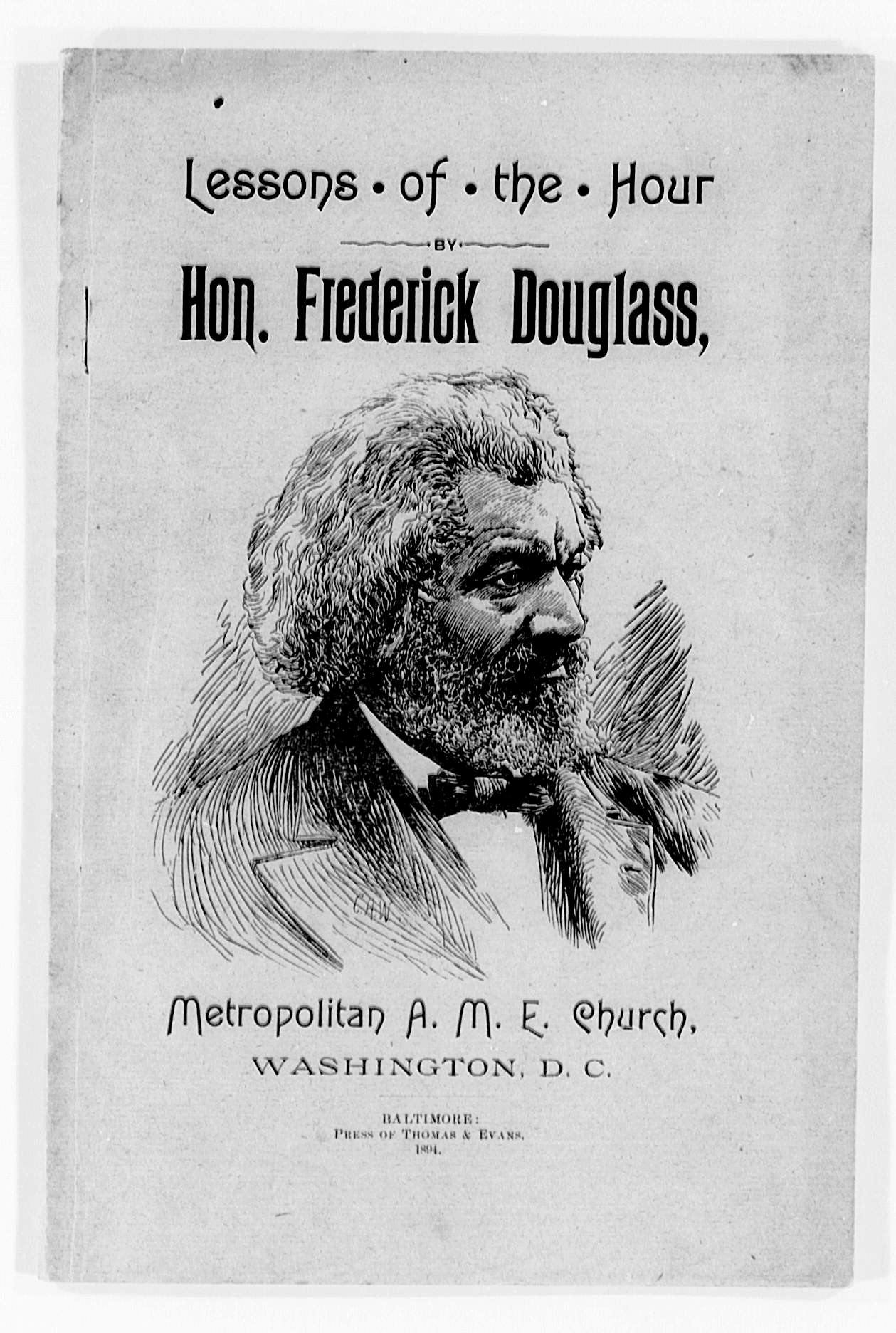
Frederick Douglass, “Address ... January 9th, 1894, on the Lessons of the Hour,” 1894. Frederick Douglass Papers at the Library of Congress, Manuscript Division
“But how can this problem be solved? I will tell you how it cannot be solved. It cannot be solved by keeping the negro poor, degraded, ignorant, and half-starved, as I have shown is now being done in the Southern States.
How can we solve the problem of racial inequality? I’ll tell you what won’t work. The problem cannot be solved by keeping Black people poor, degraded, ignorant, and starving like they do in the South.
It cannot be solved by keeping the wages of the laborer back by fraud, as is now being done by the landlords of the South.
It cannot be solved by stealing the wages of Black people, as the landlords of sharecroppers do in the South.
It cannot be done by ballot-box stuffing, by falsifying election returns, or by confusing the negro voter by cunning devices.
It cannot be solved by stealing elections and preventing Black people from voting.
It cannot be done by repealing all federal laws enacted to secure honest elections.
It cannot be solved by canceling the laws that were passed to make sure elections are fair.
It can, however, be done, and very easily done, for where there’s a will, there’s a way!
But the problem of racial inequality can be easily solved if people want to solve it!
Let the white people of the North and South conquer their prejudices.
White people need to overcome their racism.
Let the great Northern press and pulpit proclaim the gospel of truth and justice against war now being made upon the negro.
Northern newspapers and religious leaders need to raise awareness about the injustices faced by Black Americans.
Let the American people cultivate kindness and humanity.
Americans need to develop their kindness and humanity.
Let the South abandon the system of “mortgage” labor, and cease to make the negro a pauper, by paying him scrip for his labor.
Southern landowners need to end sharecropping. They also need to stop paying Black workers with worthless currency.
Let them give up the idea that they can be free, while making the negro a slave. Let them give up the idea that to degrade the colored man, is to elevate the white man.
White people need to accept that they will never be free if they continue to oppress Black people. They need to give up the idea that they have to degrade Black people to elevate themselves.
Let them cease putting new wine into old bottles, and mending old garments with new cloth.
White people need to stop using the same old systems and expecting a better outcome.
They are not required to do much. They are only required to undo the evil that they have done, in order to solve this problem.
White people don’t have to do much. They just have to undo their evil actions, and the problem will be solved.
In old times when it was asked, “How can we abolish slavery?” the answer was “Quit stealing.”
In old times, when people asked “How can we end slavery?” The answer was, “Stop stealing from Black people.”
The same is the solution of the Race problem to-day. The whole thing can be done by simply no longer violating the amendments of the Constitution of the United States, and no longer evading the claims of justice. If this were done, there would be no negro problem to vex the South, or to vex the nation.
The same solution applies to the racial injustice crisis we are facing today. Everything can be fixed if white people stop breaking the law and stop ignoring calls for justice. If white people did this, then there would be no race problem.
Let the organic law of the land be honestly sustained and obeyed.
Let our laws be honestly preserved and obeyed.
Let the political parties cease to palter in a double sense and live up to the noble declarations we find in their platforms.
Let politicians stop lying and start living up to the promises they make while campaigning.
Let the statesmen of the country live up to their convictions.
Let our leaders live up to their beliefs.
In the language of Senator Ingalls: “Let the nation try justice and the problem will be solved.”
As Senator Ingalls said: “Uphold justice and the problem will be solved."
Transcription of Frederick Douglass, “Address ... January 9th, 1894, on the Lessons of the Hour,” 1894. Frederick Douglass Papers at the Library of Congress, Manuscript Division.
“But how can this problem be solved? I will tell you how it cannot be solved. It cannot be solved by keeping the negro poor, degraded, ignorant, and half-starved, as I have shown is now being done in the Southern States.
It cannot be solved by keeping the wages of the laborer back by fraud, as is now being done by the landlords of the South.
It cannot be done by ballot-box stuffing, by falsifying election returns, or by confusing the negro voter by cunning devices.
It cannot be done by repealing all federal laws enacted to secure honest elections.
It can, however, be done, and very easily done, for where there’s a will, there’s a way!
Let the white people of the North and South conquer their prejudices.
Let the great Northern press and pulpit proclaim the gospel of truth and justice against war now being made upon the negro.
Let the American people cultivate kindness and humanity.
Let the South abandon the system of “mortgage” labor, and cease to make the negro a pauper, by paying him scrip for his labor.
Let them give up the idea that they can be free, while making the negro a slave. Let them give up the idea that to degrade the colored man, is to elevate the white man.
Let them cease putting new wine into old bottles, and mending old garments with new cloth.
They are not required to do much. They are only required to undo the evil that they have done, in order to solve this problem.
In old times when it was asked, “How can we abolish slavery?” the answer was “Quit stealing.”
The same is the solution of the Race problem to-day. The whole thing can be done by simply no longer violating the amendments of the Constitution of the United States, and no longer evading the claims of justice. If this were done, there would be no negro problem to vex the South, or to vex the nation.
Let the organic law of the land be honestly sustained and obeyed.
Let the political parties cease to palter in a double sense and live up to the noble declarations we find in their platforms.
Let the statesmen of the country live up to their convictions.
In the language of Senator Ingalls: “Let the nation try justice and the problem will be solved.”
Transcription of Frederick Douglass, “Address ... January 9th, 1894, on the Lessons of the Hour,” 1894. Frederick Douglass Papers at the Library of Congress, Manuscript Division.
Frederick Douglass lived long enough to see the United States fail to live up to the potential he saw (Composite Nation on Tour) during the Reconstruction era. In the 1880s and 1890s, state and local governments passed restrictive laws that prevented Black Americans from achieving equality. Most Chinese immigrants were barred from entering the United States and forced to live under strict regulations that set them apart (Composite Nationality). In both cases, the U.S. Supreme Court struck down efforts to challenge these unfair practices. But Douglass never gave up hope. Until the end of his life, he toured and gave lectures that advocated for a more just version of America.
In 1894, Douglass debuted a new lecture called “Lessons of the Hour.” In the speech, he acknowledged that the nation had failed to live up to its potential in ways that were especially devastating for Black Americans. He pointed out that the recent rise in lynchings, the enduring popularity of the idea of moving Black Americans out of the country, and the exploitive economic practices of white landowners as evidence of how far the country had fallen. But Douglass insisted that the country could still become a shining leader of democracy. To achieve this, white Americans had to finally embrace the country’s founding principles of liberty, equality, and justice for all.
In this excerpt from the “The Lessons of the Hour” speech, Frederick Douglass summarizes what steps the country must take to solve the problem of racial inequity. He is directly addressing the idea of the “negro problem,” a term invented by white writers and lecturers to make it seem like Black Americans were at fault for their failure to thrive. This list of solutions makes it abundantly clear that the United States did not have a “negro problem,” it had a white supremacy problem.
Click here for a PDF of the full speech.
- lynching
The illegal execution of a person without a proper trial.
- Reconstruction
The years between 1865 and 1877 when the U.S. government actively sought to reincorporate the former Confederacy back into the United States and passed legislation to guarantee the economic, political, and social rights of Black Americans.
What problems did Black Americans face according to Frederick Douglass?
What changes does Frederick Douglass call for in this speech?
Why does Frederick Douglass still believe that the United States can become an equitable and just country?
Ask students to compare the points in this speech with those from “Composite Nation” (Composite Nation on Tour) and answer the following questions: How did Frederick Douglass’ outlook evolve between these two speeches? What do you think accounts for these changes? Are there any themes that are present in both speeches? What do these reveal about Frederick Douglass’ feelings about his country?
To learn more about the lynching crisis and Black Americans response, see the life story of Ida B. Wells and the resource Fighting Jim Crow.
To help students understand the historical context of this speech, use the following: Life Story: Frances Ellen Watkins Harper and White Resistance (Absolute Equality); Life Story: Wong Kim Ark and Enduring Exclusion (Composite Nationality); Religious Liberty Tested (Religious Liberty); Life Story: Joseph Douglass, Plessy v. Ferguson, and Servitude.
For more resources about the history of Chinese people in the United States, see Chinese American: Exclusion/Inclusion.
To learn more about the ways Black Americans resisted the rise of oppressive laws after the end of Reconstruction, see Black Citizenship in the Age of Jim Crow.
For more information about Reconstruction, see Women & the American Story: A Nation Divided.
For more resources about Black women’s experiences of the Jim Crow era, see Women & the American Story: Industry and Empire.


