Composite Nation on Tour
“I am especially to speak to you of the character and mission of the United States, with special reference to the question whether we are the better or the worse for being composed of different races of men. I propose to consider first, what we are, second, what we are likely to be, and, thirdly, what we ought to be.”
In 1869, Frederick Douglass felt more hopeful about the United States than ever before. The nation was in the middle of a period of rebuilding called Reconstruction, and Congress was adding three revolutionary amendments to the U.S. Constitution. Black Americans were free citizens and all Black men would soon have the right to vote. In the middle of this progress, Douglass developed a passionate vision for a reborn America, where these new rights and freedoms would be granted to any person who wanted to call the United States home. He wrote a speech called "Composite Nation" to promote his ideas. Beginning in 1869, Douglass traveled around the Northeast and Midwest to deliver it in person.
Frederick Douglass’ outlook was shaped by the unique circumstances of his life.
In “Composite Nation,” Frederick Douglass delivered a radical message in support of diversity and equality in U.S. society.
Frederick Douglass toured tirelessly to share his vision of the future with the general population.
What events in Frederick Douglass’ lifetime led to the development of the vision he shared in “Composite Nation”?
What made Frederick Douglass’ conclusions in “Composite Nation” so radical for their time?
In what ways is the “Composite Nation” speech still relevant today?
- Life Story: Frederick Douglass
The story of one of the nation’s most important Black leaders and activists.
Topics: Abolition, slavery, Civil War, Reconstruction, Civil Rights, Black history, Abraham Lincoln, Ida B. Wells, activism, anti-lynching
- Resource: The Reconstruction Amendments
How the ratification of the Thirteenth, Fourteenth, and Fifteenth amendments fundamentally changed the concept of citizenship in the United States.
Topics: Reconstruction, Civil War, slavery, Constitutional History, citizenship
- Resource: "Composite Nation"
Excerpts from Frederick Douglass’ speech illustrate his vision for a new United States built upon the pillars of diversity and equality.
Topics: Reconstruction, immigration, Black history, Civil Rights, social history, Frederick Douglass, Chinese Exclusion, religious liberty
- Resource: Speaking Tour Map and Advertisement
Two resources that illustrate how Frederick Douglass took his vision for a reborn United States to the people.
Topics: Black history, Reconstruction, activism
Life Story: Frederick Douglass
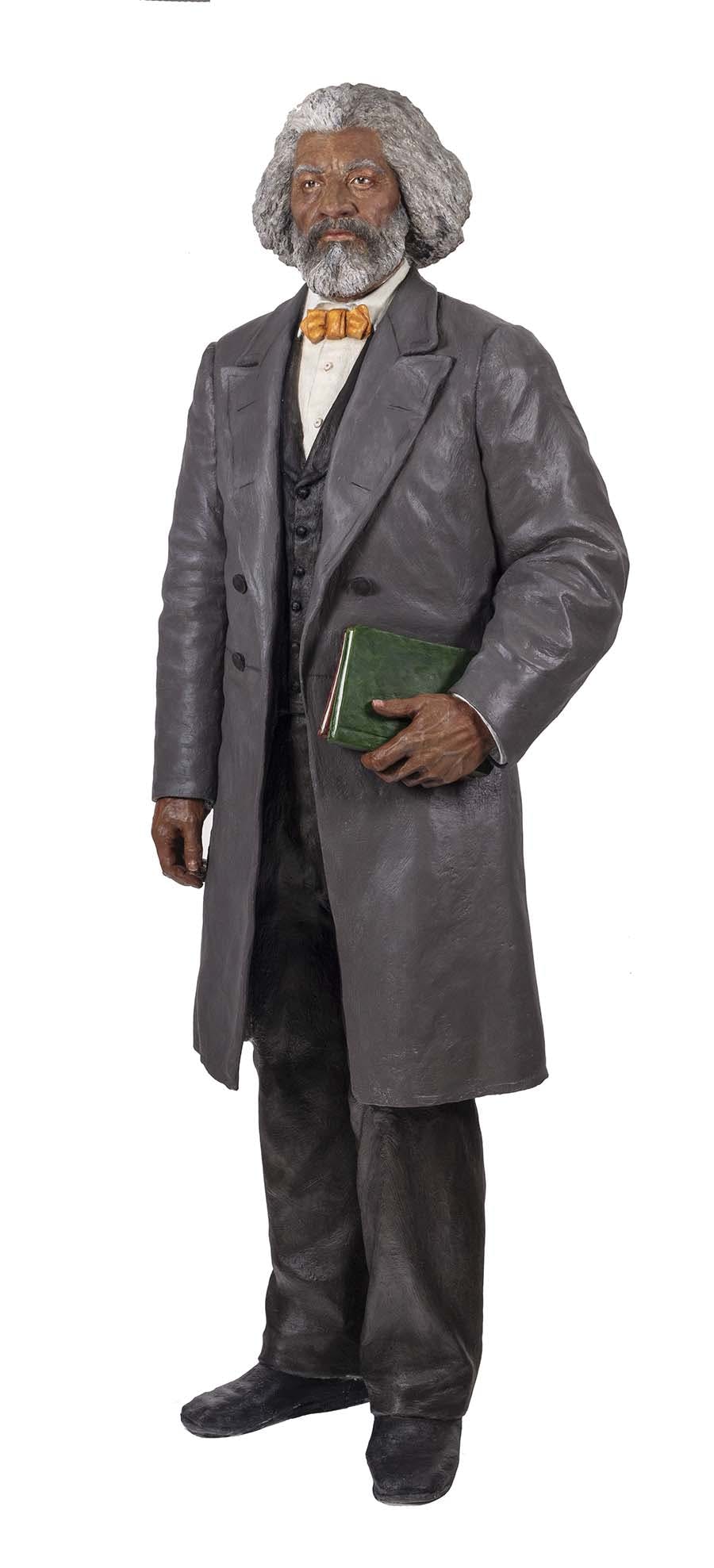
Statue of Frederick Douglass. New-York Historical Society.
Frederick Douglass (1818–1895)
American Activist and Abolitionist
Frederick Augustus Washington Bailey was born on a plantation on the Tuckahoe River in eastern Maryland in February 1818. His mother, Harriet Bailey, was an enslaved woman, so Douglass was born into slavery under the law. Douglass never learned the identity of his father, but later in life he came to believe that he was conceived when his mother was raped by her enslaver.
Douglass’ mother was forced to work on plantations all over eastern Maryland, so he lived with his grandmother until he was six years old. In 1824, his enslaver forced him to move to the main house. This forced separation taught Douglass an important lesson about the cruelty of slavery in the United States: enslaved people could construct families and communities, but they had no ability to keep them together.
Growing up, Douglass was frequently forced to move. He was also beaten and starved. He watched other enslaved people endure excruciating abuse. But Douglass always resisted his enslavement. When he was nine years old, a member of his enslaver’s household in Baltimore taught him to read. When Douglass’ enslaver found out, he ended the lessons. Douglass overheard him say that if enslaved people learned to read and write they would never be controlled again. This inspired Douglass to do everything he could to continue his studies. He gave neighborhood white boys food in exchange for reading lessons and practiced whenever he could. He also taught other enslaved people what he was learning.
When he was about 20 years old, Douglass began to speak at local debates held by members of the free Black community in Baltimore. At one of these gatherings, he met a free Black woman named Anna Murray. The two fell in love and got engaged, but they both knew that their marriage would not be secure while he was enslaved. Anna helped Douglass make a plan to escape. She sold some of her possessions to buy him a train ticket and sewed a disguise for Douglass to wear on his journey. On September 3, 1838, Douglass took the train to New York City, claiming his own freedom. He carried a document borrowed from a Black sailor that identified him as a free man. Anna joined him in New York City, where the two were soon married.
Douglass and Anna moved to New Bedford, Massachusetts, and changed their last name to Douglass. They did this to protect Douglass from being discovered by slave catchers and returned to Maryland. Unfortunately, racism prevented Douglass from finding steady work. This taught Douglass another valuable lesson: ending slavery was not enough. Black Americans needed equal rights and an end to racist practices to thrive.
Douglass continued to read, write, and give speeches in New Bedford. He joined a local church and was soon invited to speak regularly to the congregation. He often spoke about his personal experiences of being enslaved and why slavery should be abolished. Local abolitionists were impressed by his story. Beginning in 1841, they invited him to speak all over New England.
Douglass faced angry, and sometimes violent, opposition from pro-slavery advocates, but his powerful style of speaking and personal stories captivated audiences wherever he lectured. Soon he was traveling all over the country to tell his story. At only 23 years old, Douglass had escaped slavery and established himself as a rising star in the abolition movement.
Douglass published his first autobiography in 1845. The book was a huge success. It drew a lot of attention to the plight of enslaved people in the United States. But Southern readers were furious that Douglass had revealed the secrets of his enslavers. Douglass set out on a tour of England, Scotland, and Ireland. The trip gave him a chance to raise money for the abolitionist cause while also escaping the outrage over his book and the danger from slave catchers. He traveled for nearly two years, leaving Anna alone to tend to their home and family. While he was away, Douglass’ American supporters raised the money needed to purchase his freedom from his former enslaver. Douglass resented that the payment seemed to acknowledge that his enslaver had a claim to his life or person. But he was also relieved that he no longer had to live under the constant threat of re-enslavement.
During his travels, Douglass was well received in England and Ireland. He learned that not every society treated Black people like second-class citizens. He returned to the United States in 1847 as an angrier and more determined man. He used harsher language to describe the ways the United States was failing Black Americans. He began printing his own abolitionist newspaper so he could say what he believed without others trying to soften his language. This led to a painful split with some members of the abolition movement, but Douglass carried on. In a fiery speech called “What to the Slave is the Fourth of July,” he pointed out that the practice of slavery undermined the principles of liberty, justice, and equality that the United States claimed to uphold.
The Fugitive Slave Act of 1850, the Kansas-Nebraska Act of 1854, and the Dred Scott Decision of 1857 made Douglass even more radical. He started to believe that only violence would end slavery in the United States. During this time, he became a friend and supporter of the militant abolitionist John Brown. After Brown’s failed attempt to start a slave rebellion in 1859, people accused Douglass of supporting the rebellion. The government issued a warrant for Douglass’ arrest and he was forced to flee the country.
The tragic death of Douglass’ 11-year-old daughter Annie brought him back to the United States in the spring of 1860. Soon after, the presidential election demanded his full attention. Douglass reluctantly gave his support to Abraham Lincoln, the candidate of the new Republican Party that wanted to halt slavery’s expansion westward. But throughout the campaign, Douglass worried that Lincoln did not fully support ending slavery or equal rights for Black Americans. The secession of the slave states after Lincoln’s election gave Douglass renewed hope that the end of slavery was near.
Douglass was disappointed when Lincoln did not immediately abolish slavery. He also publicly opposed the president’s plan to encourage Black Americans to leave the United States and settle in other countries. But when Lincoln issued the Emancipation Proclamation at the height of the Civil War in 1863, Douglass threw his full support behind the government. He published articles telling Black men that they should join the Union army and fight to both secure their freedom and prove their value to the nation. When Lincoln was facing mounting pressure to end the war while leaving slavery intact, Douglass personally met with him to encourage the president to stay the course.
When the war ended, Douglass was proud that the nation finally abolished slavery by ratifying the Thirteenth Amendment. But he also understood that this was not enough to secure the full equality of Black Americans. White supremacy was still widely accepted and upheld throughout the country. True freedom for everyone would not be achieved until white supremacy was defeated everywhere.
Beginning in 1869, Douglass began to tour the country to give a lecture called “Composite Nation.” He told his listeners that if the United States embraced the diversity of its population, the country would grow in strength for generations to come. His hopefulness is remarkable given his personal experiences with slavery and racism. But Douglass had seen slavery abolished in his lifetime and the Constitution rewritten to guarantee equal citizenship regardless of race. He had come to believe that anything was possible if people committed to change.
The end of Reconstruction and the rise of Jim Crow (Black Citizenship in the Age of Jim Crow) soured Douglass’ optimism. But he never abandoned his role as an activist. After his home in Rochester, New York, burned down, he moved his family to Washington, D.C., where he took several government jobs, continued his speaking tours, and wrote prolifically. He sometimes found himself at odds with a new generation of Black activists and leaders who had different visions for the future of Black Americans. But he continued to work passionately for what he believed was right.
Douglass’ wife Anna passed away in 1882. Their 44-year marriage had often been tested by Douglass’ all-consuming career, family trials and traumas, and his relationships with other women. But still, Anna was the rock of Douglass’ life. She raised their children and kept their household afloat while Douglass devoted his life to his causes. He deeply mourned her passing, but soon found another companion.
In 1884, Douglass married Helen Pitts, a white woman who worked for him. Helen was the daughter of an abolitionist family who had dedicated her life to the cause. But her marriage to a Black man sent shock waves through her family and U.S. society. Helen’s father disowned her, and the couple was ridiculed in the press. The most damaging blow was a lawsuit brought by a member of Douglass’ own family. But Douglass and Helen weathered the storm.
Douglass continued to write and speak about the injustices facing Black Americans until the end of his life. Reconstruction formally ended in 1877, as a new wave of white-supremacist laws and customs known collectively as Jim Crow denied Black Americans many of the rights they had been guaranteed by the Reconstruction amendments. In his final years, Douglass worked closely with activist Ida B. Wells to bring attention to the troubling rise in lynchings, primarily in the South. In 1894, he gave a speech called “Lessons of the Hour” (Hope). In the speech he once again asked Americans to do better. It was his final message to a country he had spent his whole life trying to improve. He passed away on February 20, 1895.
Click here for a video of this life story.
- abolitionist
A person who supported the movement to end slavery in the United States.
- debate
A public discussion of an issue.
- Dred Scott decision
The 1857 Supreme Court decision that prohibited Congress from barring slavery for any of the nation’s western territories and denied American citizenship to all Black Americans.
- Fugitive Slave Act of 1850
A law that required any person who had escaped from slavery to be returned to their enslavers, even if they were living in a “free” state.
- Jim Crow
The name for the group of laws and social practices that enforced segregation between Black and white Americans and denied Black men the right to vote. Jim Crow laws began to appear in the 1880s and were enforced throughout the 1960s.
- John Brown
A radical white abolitionist who believed armed rebellion was the only way to end slavery in the United States. After his failed attempt to start a revolution, John Brown was executed as a traitor but celebrated as a martyr by some abolitionists.
- Kansas-Nebraska Act
The 1854 law that allowed territories to vote on whether they would allow the practice of slavery. This led to a violent clash between antislavery and pro-slavery fighters known as Bleeding Kansas.
- lynching
The illegal execution of a person without a proper trial.
- Reconstruction
The years between 1865 and 1877 when the U.S. government actively sought to reincorporate the former Confederacy back into the United States and passed legislation to guarantee economic, political, and social rights of Black Americans.
- slave catcher
A person who was paid to track down escaped slaves, kidnap them, and return them to their enslaver.
- Union
The name used for the United States of America during the Civil War.
- white supremacy
The belief that white people are naturally superior to all other people and should have control over them. Also the word for the practices and policies that support this belief.
What experiences in Frederick Douglass’ early life inspired his activism and political beliefs?
Why do you think Frederick Douglass wanted the nation to embrace its growing diversity?
What does Frederick Douglass’ life teach us about the experiences of Black Americans in the 19th century?
Use the following resources to provide students with a historical context for Frederick Douglass’ life and career: Salem Female Anti-Slavery Society, Life Story: Harriet Robinson Scott, The Reconstruction Amendments, Backlash Against Black Workers, Philadelphia Streetcar Desegregation (Absolute Equality), White Resistance (Absolute Equality), Claiming Political Power, and Plessy v. Ferguson (Hope).
After reading this life story, invite students to read Frederick Douglass’ speeches “Composite Nation” and “Lessons of the Hour” (Hope). Ask students to write a short reflection piece on how Frederick Douglass’ life experiences informed the content of his lectures.
Compare and contrast the life stories of Frederick Douglass and Frances Ellen Watkins Harper. What similarities do they have? What are their differences? How did their differences impact their lives and activism?
For more resources on the history of slavery, the Civil War, and Reconstruction, see Women & the American Story: A Nation Divided and Industry and Empire.
For more resources about the rise of Jim Crow in the United States, see Black Citizenship in the Age of Jim Crow.
Resource: The Reconstruction Amendments
Thirteenth Amendment: Neither slavery nor involuntary servitude, except as a punishment for crime whereof the party shall have been duly convicted, shall exist within the United States, or any place subject to their jurisdiction.
Slavery and forced labor are illegal in the United States unless a person is being punished for a crime.
U.S. Constitution. Amendment XIII. Section 1.
Thirteenth Amendment: Neither slavery nor involuntary servitude, except as a punishment for crime whereof the party shall have been duly convicted, shall exist within the United States, or any place subject to their jurisdiction.
U.S. Constitution. Amendment XIII. Section 1.
Fourteenth Amendment: All persons born or naturalized in the United States, and subject to the jurisdiction thereof, are citizens of the United States and of the state wherein they reside. No state shall make or enforce any law which shall abridge the privileges or immunities of citizens of the United States; nor shall any state deprive any person of life, liberty, or property, without due process of law; nor deny to any person within its jurisdiction the equal protection of the laws.
Any person who is born in the United States or who follows the legal process of becoming a citizen is a U.S. citizen. States cannot make any laws that try to limit the rights of any citizen of the United States. States cannot take away a citizen’s life, liberty, or property without an official court case. States must provide equal protection under the law for all citizens.
U.S. Constitution. Amendment XIV. Section 1.
Fourteenth Amendment: All persons born or naturalized in the United States, and subject to the jurisdiction thereof, are citizens of the United States and of the state wherein they reside. No state shall make or enforce any law which shall abridge the privileges or immunities of citizens of the United States; nor shall any state deprive any person of life, liberty, or property, without due process of law; nor deny to any person within its jurisdiction the equal protection of the laws.
U.S. Constitution. Amendment XIV. Section 1.
Fifteenth Amendment: The right of citizens of the United States to vote shall not be denied or abridged by the United States or by any State on account of race, color, or previous condition of servitude.
The federal and state governments cannot deny a person the right to vote based on race, skin color, or whether they were once an enslaved person.
U.S. Constitution. Amendment XXV. Section 1.
Fifteenth Amendment: The right of citizens of the United States to vote shall not be denied or abridged by the United States or by any State on account of race, color, or previous condition of servitude.
U.S. Constitution. Amendment XXV. Section 1.
The U.S. government was confident that it would win the Civil War by the fall of 1864. But Republican members of Congress understood that the U.S. Constitution had to be amended if the war was going to lead to lasting change for Black Americans. Over the next five years, Republican members of Congress oversaw the passage and ratification of the Thirteenth, Fourteenth, and Fifteenth Amendments. These amendments are now called the Reconstruction amendments because they were created when the U.S. government was trying to reunify and transform the country. Their ratification represented an era of hope and opportunity for Black Americans across the country.
The Reconstruction amendments revolutionized the U.S. government’s definition of citizenship and its relationship with its citizens. Historians see the passage of these amendments as the beginning of a new era of governance and political thinking in American history. Unfortunately, a backlash against the amendments began in the 1870s. In the South, biracial state and local governments were ousted from power, often with violence. New state governments found ways to undermine the amendments. This resurgence of white supremacist laws was allowed by the U.S. courts (Composite Nationality). Black activists worked for decades to counteract these new laws. Unfortunately, the potential of the Reconstruction amendments would not begin to be realized until the Civil Rights movement of the 1950s and 1960s.
The Thirteenth Amendment was passed by the House of Representatives on January 31, 1865 and ratified by the states on December 6, 1865. It abolished the practice of slavery and involuntary servitude, unless it was punishment for a convicted crime. This amendment did not explain what status newly emancipated people would occupy in American society.
The Fourteenth Amendment was passed on June 8, 1866, and ratified on July 9, 1868. It legalized the concept of “birthright citizenship.” Birthright citizenship means that any person born in the United States is automatically a citizen regardless of their race, ethnicity, religion, or national origin. This amendment established that all Black Americans were U.S. citizens and paved the way for the children of immigrants to claim U.S. citizenship. It also offered equal protection under the law for any person in the country, regardless of their citizenship status. This caused some backlash in states where immigrant populations were high.
The Fifteenth Amendment was passed on February 26, 1869, and ratified on February 3, 1870. It forbade the federal and state governments from denying any U.S. citizen the right to vote based on their race. As a result, all the free Black men in the country were constitutionally guaranteed the right to vote. This amendment caused the most controversy. Many states, including some in the North, resented the fact that the amendment overrode a state government’s constitutional right to determine voting qualifications. Some white women suffrage leaders also protested the amendment because it would grant suffrage to Black men but not to white or Black women.
- abolished
Formally ended.
- amended
Made changes to.
- amendment
A section added to the U.S. Constitution.
- Civil Rights movement
The name for the period in the 1950s and 1960s when Black Americans and white allies publicly protested to achieve equal treatment under the law.
- Civil War
War that began when most of the slave states in the U.S. tried to form a new country to preserve the institution of slavery. The war lasted from 1861-1865.
- Congress
The part of the U.S. government responsible for making federal laws.
- involuntary servitude
When someone is forced to work.
- ratification
The action of states to formally agree to accept an amendment to the U.S. Constitution. Three-fourths of states must ratify an amendment before it is formally adopted.
- Reconstruction
The years between 1865 and 1877 when the U.S. government actively sought to reincorporate the former Confederacy back into the United States and passed legislation to guarantee the economic, political, and social rights of Black Americans.
- Republican
Name for the political party that supported the abolition of slavery during the Civil War. When the war ended, the Republican party led the efforts to establish full equality for Black Americans under the law.
- suffrage
Voting rights.
- U.S. Constitution
The document that lays out how the U.S. government works and the rights of American citizens.
- white supremacy
The belief that white people are naturally superior to all other people and should have control over them. Also the word for the practices and policies that support this belief.
Why do you think the U.S. government hurried to pass the Thirteenth amendment before the end of the Civil War?
Who can claim citizenship according to the Fourteenth amendment? Why was this a radical step for the U.S. government?
Why did Congress think the Fifteenth amendment was necessary when it had already established citizenship for all Black Americans? What does this reveal about the state of race relations in the Reconstruction era?
Has the full potential of these amendments been realized? Why or why not?
Frederick Douglass did not specifically mention the Reconstruction amendments in his “Composite Nation” speech, but their passage and ratification were a part of the context in which he developed and delivered the lecture. After reviewing these amendments, ask students to read excerpts from “Composite Nation” and write a reflection about how the Reconstruction amendments might have influenced the tone and content of his speech.
Ask students to read the life story of Frances Ellen Watkins Harper (Absolute Equality) and watch the reenactment of her address at the National Women’s Rights Convention in 1866. Then pose the following questions: Were Watkins Harper’s concerns fully addressed by these amendments? What further work would she anticipate after their passage?
Combine this resource with Dual Identities (Composite Nationality) and United States v. Wong Kim Ark (in Chinese American: Exclusion/Inclusion) for a lesson about how the Fourteenth and Fifteenth Amendments were used by Chinese Americans in their own quest for equal rights in the United States.
For a larger lesson about the Reconstruction amendments and the questions of women’s suffrage, see The Other Thirteenth Amendment and Suffrage and the Fifteenth Amendment.
To demonstrate how these amendments were circumvented by the U.S. courts in the 1880s and 1890s, see Plessy v. Ferguson (Hope).
For more resources on the history of slavery, the Civil War, and Reconstruction, see Women & the American Story: A Nation Divided.
For more resources about the rise of Jim Crow in the United States, see Black Citizenship in the Age of Jim Crow.
Resource: "Composite Nation"
I am especially to speak to you of the character and mission of the United States, with special reference to the question whether we are the better or the worse for being composed of different races of men. I propose to consider first, what we are, second, what we are likely to be, and, thirdly, what we ought to be. . .
I am here to talk to you about the qualities and purpose of the United States. In particular, I will consider whether the diversity of our population is a good or bad thing. First, I will talk about what we are. Second, I will talk about what we will probably be. Third, I will talk about what we should be. . .
The real trouble with us was never our system or form of Government, or the principles underlying it; but the peculiar composition of our people, the relations existing between them and the compromising spirit which controlled the ruling power of the country.
The problem in the United States is not our government. The problem is our unique and diverse population, how people of different races interact, and how white people exploit other races.
We have for a long time hesitated to adopt, and may yet refuse to adopt, and carry out, the only principle which can solve that difficulty and give peace, strength, and security to the Republic, and that is the principle of absolute equality.
For a long time, we have avoided embracing absolute equality for all U.S. citizens. We might still fail to embrace it. But it is the only path that will solve our racial difficulties and bring peace, strength, and security to the country.
We are a country of all extremes—, ends and opposites; the most conspicuous example of composite nationality in the world.
We have many different kinds of people living in our country. We are the most prominent example of diversity in the world.
Our people defy all the ethnological and logical classifications. In races we range all the way from black to white, with intermediate shades which, as in the apocalyptic vision, no man can name a number.
Our population cannot be easily categorized. Our people have skin colors of every shade.
In regard to creeds and faiths, the condition is no better, and no worse. Differences both as to race and to religion are evidently more likely to increase than to diminish. . . .
When it comes to religion, the same thing is true. And these differences in race and religion are not going to go away. Our population will likely become even more diverse. . . .
We stand between the populous shores of two great oceans. Our land is capable of supporting one fifth of all the globe. Here, labor is abundant and here labor is better remunerated than any where else. All moral, social and geographical causes conspire to bring to us the peoples of all other over populated countries. . . .
Our country stands between two big oceans. We have enough land to support one-fifth of all the people on Earth. We have lots of jobs and our wages are better than any other place in the world. For all of these reasons, we attract immigrants from all the overcrowded countries in the world. . . .
And here I hold that a liberal and brotherly welcome to all who are likely to come to the United States, is the only wise policy which this nation can adopt. . . .
The wisest thing this country can do is give a warm and friendly welcome to any person who comes to the United States. . . .
If we would reach a degree of civilization higher and grander than any yet attained, we should welcome to our ample continent all nations, kindreds and tongues and peoples; and as fast as they learn our language and comprehend the duties of citizenship, we should incorporate them into the American body politic. . . .
If we want to be the greatest country in history, we should welcome immigrants from every part of the world. And as soon as they learn our language and how our government works, we should make them citizens of the United States.
To the minds of superficial men, the fusion of different races has already brought disaster and ruin upon the country. The poor negro has been charged with all our woes. In the haste of these men they forgot that our trouble was not ethnographical, but moral; that it was not a difference of complexion, but a difference of conviction. It was not the Ethiopian as a man, but the Ethiopian as a slave and a coveted article of merchandise, that gave us trouble.
Some small-minded people think our diversity is ruining the country. They blame Black people for all our troubles. But they forget that Black people did not cause our problems. It was the way this country treated Black people that caused our problems. By enslaving Black people, we created an unjust society, and this is what caused our problems.
I close these remarks as I began. If our action shall be in accordance with the principles of justice, liberty, and perfect human equality, no eloquence can adequately portray the greatness and grandeur of the future of the Republic.
I end this speech the same way I started. If we follow our founding principles of justice, liberty, and equality for all citizens, we will be the greatest country in human history.
We shall spread the network of our science and civilization over all who seek their shelter, whether from Asia, Africa, or the Isles of the sea. We shall mold them all, each after his kind, into Americans; Indian and Celt; negro and Saxon; Latin and Teuton; Mongolian and Caucasian; Jew and Gentile; all shall here bow to the same law, speak the same language, support the same Government, enjoy the same liberty, vibrate with the same national enthusiasm, and seek the same national ends.”
We will accomplish great things, and we will share our accomplishments with any person who wants to live here. We will turn immigrants of any nation, faith, or race into Americans. And these new Americans will help us grow even greater and stronger.
Frederick Douglass, “Composite Nation,” 1867. Frederick Douglass Papers at the Library of Congress, Manuscript Division.
I am especially to speak to you of the character and mission of the United States, with special reference to the question whether we are the better or the worse for being composed of different races of men. I propose to consider first, what we are, second, what we are likely to be, and, thirdly, what we ought to be. . .
The real trouble with us was never our system or form of Government, or the principles underlying it; but the peculiar composition of our people, the relations existing between them and the compromising spirit which controlled the ruling power of the country.
We have for a long time hesitated to adopt, and may yet refuse to adopt, and carry out, the only principle which can solve that difficulty and give peace, strength, and security to the Republic, and that is the principle of absolute equality.
We are a country of all extremes—, ends and opposites; the most conspicuous example of composite nationality in the world.
Our people defy all the ethnological and logical classifications. In races we range all the way from black to white, with intermediate shades which, as in the apocalyptic vision, no man can name a number.
In regard to creeds and faiths, the condition is no better, and no worse. Differences both as to race and to religion are evidently more likely to increase than to diminish. . . .
We stand between the populous shores of two great oceans. Our land is capable of supporting one fifth of all the globe. Here, labor is abundant and here labor is better remunerated than any where else. All moral, social and geographical causes conspire to bring to us the peoples of all other over populated countries. . . .
And here I hold that a liberal and brotherly welcome to all who are likely to come to the United States, is the only wise policy which this nation can adopt. . . .
If we would reach a degree of civilization higher and grander than any yet attained, we should welcome to our ample continent all nations, kindreds and tongues and peoples; and as fast as they learn our language and comprehend the duties of citizenship, we should incorporate them into the American body politic. . . .
To the minds of superficial men, the fusion of different races has already brought disaster and ruin upon the country. The poor negro has been charged with all our woes. In the haste of these men they forgot that our trouble was not ethnographical, but moral; that it was not a difference of complexion, but a difference of conviction. It was not the Ethiopian as a man, but the Ethiopian as a slave and a coveted article of merchandise, that gave us trouble.
I close these remarks as I began. If our action shall be in accordance with the principles of justice, liberty, and perfect human equality, no eloquence can adequately portray the greatness and grandeur of the future of the Republic.
We shall spread the network of our science and civilization over all who seek their shelter, whether from Asia, Africa, or the Isles of the sea. We shall mold them all, each after his kind, into Americans; Indian and Celt; negro and Saxon; Latin and Teuton; Mongolian and Caucasian; Jew and Gentile; all shall here bow to the same law, speak the same language, support the same Government, enjoy the same liberty, vibrate with the same national enthusiasm, and seek the same national ends.”
Frederick Douglass, “Composite Nation,” 1867. Frederick Douglass Papers at the Library of Congress, Manuscript Division.
Frederick Douglass traveled throughout the United States giving speeches for over fifty years. Before the Civil War, he focused on the injustice of slavery and the oppression of Black Americans. The end of the Civil War and the ratification of the Reconstruction Amendments gave him hope that Black Americans might finally become equal citizens.
But Douglass wanted even more for his country. He envisioned a future where all people, regardless of their race or religion, had equal opportunity to thrive. He believed that the only way for the United States to achieve its full potential was for the country to enthusiastically embrace its diversity, which he called “composite nationality.” Between 1869 and 1875, he introduced this vision in a new speech named “Composite Nation.”
These excerpts from the “Composite Nation” speech capture Frederick Douglass’ vision for a post-Civil War America. He explains that the diversity of the U.S. population makes the country unique. He asks his audience to embrace diversity as a strength of the United States. It is a startlingly progressive message for its time. Many Americans were uncomfortable with the large numbers of immigrants arriving from all over the world. They also did not believe Black Americans and Native Americans deserved equal citizenship.
Click here for a PDF of the full speech.
- Civil War
War that began when most of the slave states in the U.S. tried to form a new country to preserve the institution of slavery. The war lasted from 1861–1865.
- composite
Made up of many parts.
- nationality
The people who belong to a particular country.
- ratification
The process of states formally agreeing to accept an amendment to the U.S. Constitution. Three-fourths of states must ratify an amendment before it is adopted.
- progressive
New or modern.
- Reconstruction amendments
The name used for the Thirteenth, Fourteenth, and Fifteenth Amendments, which abolished slavery, established birthright citizenship and equal protection under the law, and banned the practice of denying someone the right to vote based on their race.
What advice does Frederick Douglass have for the country as it recovers from the Civil War?
How does this speech make you feel? Do you agree with Frederick Douglass? Why or why not?
Does any part of this speech feel relevant to the United States today?
So much of the “Composite Nation” speech resonates with our modern world, but very few Americans are interested in reading long speeches. Ask your students to identify a part of this speech that most resonates with them and “translate” it into a modern-day format, such as a poster, song, poem, video, TikTok, tweet, etc. You can access the full text of the speech here.
To help students better understand the political context for “Composite Nation,” use The Reconstruction Amendments.
After analyzing this speech, ask students to read Frederick Douglass’ life story and write a short essay about what events of his own life might have inspired him while writing “Composite Nation.”
For more resources on the history of slavery, the Civil War, and Reconstruction, see Women & the American Story: A Nation Divided.
Resource: Speaking Tour Map and Ad
Speaking Tour Map
Rutland, VT
December 1, 1869, and December 8, 1869
Burlington, VT
December 3, 1869
St. Johnsbury, VT
December 4, 1869
Boston, MA
December 7, 1869
Lowell, MA
December 16, 1869
Skowhegan, ME
December 17, 1869
Thompsonville, CT
December 21, 1869
Waltham, MA
December 22, 1869
Salem, MA
December 24, 1869
Augusta, ME
December 25, 1869, and January 1, 1870
Wabash, IN
Winter 1869–1870
Winsted, CT
January 4, 1870
Ware, MA
January 5, 1870
Whitestown, NY
January 13, 1870
Schenectady, NY
January 17, 1870
Paterson, NJ
January 20, 1870
Whitehall, NY
January 20, 1870
Wilmington, DE
January 21, 1870
Washington, DC
January 24, 1870, and Early February 1870
Lewisburg, PA
January 28, 1870
Ottumwa, IA
February 5, 1870
Peoria, IL
February 7, 1870
Chicago, IL
February 9, 1870; February 15, 1870; December 20, 1875
Decorah, IA
February 12, 1870, and an unknown date
Indianapolis, IN
Date unknown
Coldwater, MI
February 25, 1870
Detroit, MI
February 26, 1870
Delaware, OH
March 12, 1870
Evansville, IN
March 17, 1870
Lancaster, PA
March 25, 1870
Troy, NY
April 11, 1870
Brandon, VT
May 12, 1870
St. Paul, MN
February 7, 1873
Trenton, NJ
March 11, 1873
Click here to view a PDF of the Speaking Tour Map.
Speaking Tour Advertisement
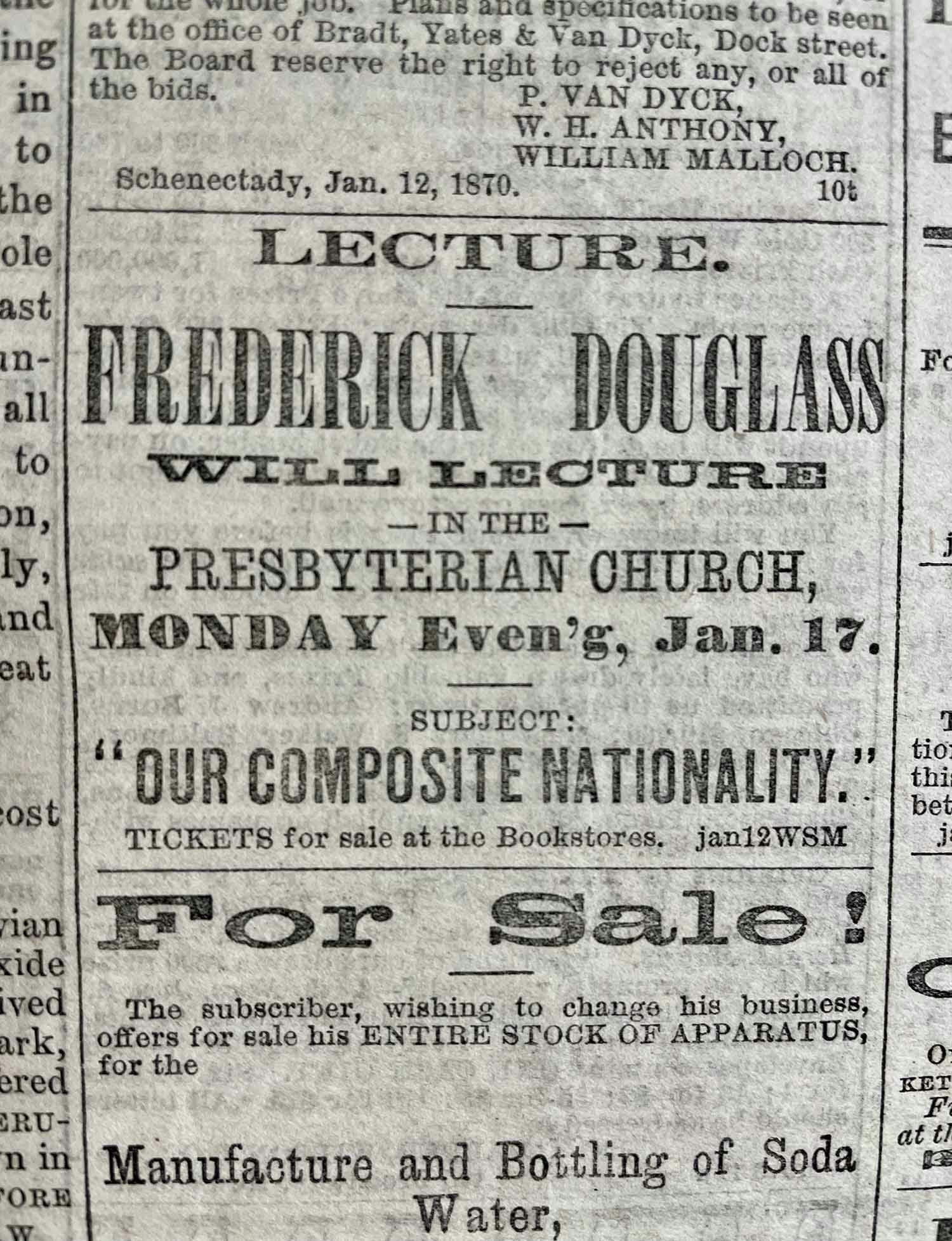
Classified ad for “Our Composite Nationality,” Schenectady Evening Star, January 12, 1870, pg. 3. Courtesy of the American Antiquarian Society.
Lectures were a popular form of entertainment and education in the 1800s. Cities and towns hosted lecture series and invited guest speakers. Frederick Douglass was one of the stars of the lecture circuit. His career lasted more than 50 years. He visited almost every part of the United States during his lifetime.
Touring was a hectic and exhausting way to make a living. Douglass traveled from one event to the next by train. Sometimes, his lectures were one night after the other in locations 200 miles apart. A journey that far could take more than ten hours since the average train speed was only 20 to 25 miles an hour and trains made frequent stops along the way.
This advertisement is for Frederick Douglass’ “Composite Nation” lecture in Schenectady, New York, on January 17, 1870. It shows how people learned about Douglass’ lectures, what kind of spaces he spoke in, and how people bought tickets.
This map shows all the known places Frederick Douglass gave his “Composite Nation” speech. Douglass delivered speeches on other topics during the same period, so this map shows only a small fraction of his lectures between 1869 and 1875. It is worth noting that “Composite Nation” was only booked in places that sided with the Union during the Civil War. It may be that audiences in the former Confederacy were not ready for Douglass’ vision of a more diverse country.
- Civil War
War that began when most of the slave states in the U.S. tried to form a new country to preserve the institution of slavery. The war lasted from 1861-1865.
- Confederacy
The name for the country formed by the eleven states that started their own country to preserve slavery.
- lecture circuit
The planned schedule of venues or events for touring public speakers.
- Union
The name used for the United States of America during the Civil War.
What do these sources reveal about the “Composite Nation” speaking tour?
What parts of the country did Frederick Douglass visit during this lecture tour? What parts did he skip? What do you think drove these decisions?
What does the popularity of speakers like Frederick Douglass reveal about life in the 19th century?
To learn more about Frederick’s Douglass’ 50-year career as a lecturer, read his life story.
Ask students to use images from any of the following to create a modern-day version of the advertisement from 1870: Life Story: Frederick Douglass, Life Story: Frances Ellen Watkins Harper (Absolute Equality), Life Story: Emilia Casanova de Villaverde, Dual Identities (Composite Nationality), Uncle Sam’s Thanksgiving Dinner (Composite Nationality), Life Story: David Pharoah (Religious Liberty), Building Religious Communities (Religious Liberty), Religious Liberty Tested (Religious Liberty), and Life Story: Joseph Douglass (Hope).
After analyzing this speech, ask students to read Frederick Douglass’ life story and write a short essay about what parts of his life might have inspired him to write “Composite Nation.”
Ask students to calculate how many miles Frederick Douglass traveled over the course of his “Composite Nation” tour.
For more resources about how Black activists asserted their equality in the face of racist laws and customs, see Black Citizenship in the Age of Jim Crow.


