The First First Ladies
The First First Ladies
Unit Introduction
- The nation’s first three First Ladies shaped the role in lasting ways.
- The lives of the early First Ladies were bound by the social rules that guided women’s lives at the time, which they put to use and sometimes purposely broke.
- Each in her own way, Martha Washington, Abigail Adams, and Dolley Madison helped define the United States as a country with new values, customs, and style.
The US Constitution created the office of the president. It defined presidential responsibilities and those of Congress and the courts. It did not address every situation the young nation would face, but it provided a blueprint for how the government should work.
No such blueprint existed for the president’s wife. Those who came to the role first had no model to follow. But they created a significant, though informal, role based on accepted ideas about elite women’s behavior and on their own personal histories, strengths, and values. Even before the term was created, they defined what it meant to be First Lady, in ways still recognizable today. Their ideas and actions provide another way to examine the use of political power.
This unit explores the lives of the first three women whose husbands became president. Martha Washington was married to the most revered man in the country, and she was socially skilled and well liked. But every decision she made was judged, and critics thought she behaved too much like a European queen. Abigail Adams’s husband, John Adams, was the nation’s second president. She understood and loved politics and was her husband’s trusted sounding-board and cheerleader. Dolley Madison had a chance to rehearse the role when Thomas Jefferson, a widower, asked her to act as hostess for White House events during his two terms in office. When her own husband, James Madison, became the next president, she raised the role of political hostess to high art. She was the first presidential spouse to be called the First Lady, though not until after her husband had left office.
Note: In this unit, the First Ladies are sometimes referred to by their first names. This avoids confusion over their changing surnames as the women married, and it distinguishes them from their husbands in passages where both appear.
These political terms appear frequently throughout the unit. They are explained here so students can refer to them as needed.
During the American Revolution, as delegates to the Continental Congress thought about designing a new government, they wanted to avoid the abuses of the British monarchy, in which a king or queen inherited supreme power and ruled for life. They saw centralized power as a threat. When Benjamin Franklin and other delegates drafted the Articles of Confederation, they created a confederal system, in which most power was held by the states and the national government was weak. But the Articles of Confederation proved unworkable, especially after the Revolution ended and the United States tried to establish itself on the world stage. States often disagreed with one another, so it was hard to take collective action.
Some leaders—notably, Alexander Hamilton, James Madison, and John Jay, authors of the Federalist Papers—argued for a new constitution that would create a more effective government. They promoted a federal system, in which authority was shared by national and state governments, so neither had too much power. They became known as Federalists. Hamilton emerged as their leader. The US Constitution was passed and ratified largely because of their efforts. But the distrust of Federalism did not vanish. Those who saw the strong central government as too similar to monarchy were known as Anti-Federalists, or Democratic Republicans, or simply Republicans. Their leader was Thomas Jefferson. These two early factions were not thought of or called political parties. (The formal party system began later, in the 1820s.) But they served a similar function by providing a structure for opposing positions and philosophies.
When George Washington became president, he avoided linking himself to either faction, but his actions indicated his support for Federalism. John Adams was a committed Federalist. But with the end of John Adams’s single term as president, Federalists’ political power declined. Federalists were also seen as elites who were out of touch with ordinary Americans. The Republican Thomas Jefferson became the nation’s third president. His successor, James Madison, was also a Republican.
The conflict between Federalists and Republicans affected US foreign policy. Federalists supported the British in their ongoing quarrels and wars with France. Republicans still saw the British as the enemy, and they celebrated the French for aiding the colonial side during the American Revolution.
This nation’s first three First Ladies understood that political realities, and political rivalries, could make or break their husbands’ chances of success. The letters the women wrote, the actions they took, and the criticism they faced were often grounded in the continuing and bitter dispute over where power should lie in the US government.
What role did the nation’s first First Ladies play in shaping their husbands’ political realities?
At a time when women’s lives were circumscribed by laws and customs, how did the first First Ladies understand and use the unofficial power they held as the wife of the president?
What should Americans today expect of the president’s spouse? What should the spouse expect in return?
Compare the lives of Martha Washington, Abigail Adams, and Dolley Madison. What did each woman bring to the role? How do you think each would have described the role of First Lady?
Research the life and activities of a recent First Lady. Then compare her experience to that of one of the First Ladies in this unit. How has the role of First Lady changed over time? How has it remained the same? Biographies of all First Ladies are available via the link below. https://www.whitehousehistory.org/collections/first-lady-biographies.
Click on the materials below to begin exploring this unit.
- Video: The Role of First Ladies
This video addresses the political role of the presidential spouse and considers how the role has evolved over time.
Curriculum Connections: Executive Branch, formal and informal politics, social rules
- Resource: Coverture
This legal principle dating back to the Middle Ages had a lasting impact on women’s lives.
Curriculum Connections: common law, legal identity, social rules
- Resource: Martha Washington Arrives in the Capital City
These documents communicate information about Martha Washington’s journey from Virginia to join George Washington in New York City after his inauguration.
Curriculum Connections: Federal period
- Resource: What are the rules?
In this exchange of letters between Abigail Adams and Martha Washington, Adams seeks advice from Washington on her guidelines for formal social visits as first lady.
Curriculum Connections: Federal period, formal and informal politics, social rules
- Resource: Am I a good politician?
This letter from Abigail Adams to her husband, President John Adams, illuminates Abigail Adams' deep understanding of political affairs and her ability to serve as a support and counsel to her husband.
Curriculum Connections: Federal period, formal politics, XYZ Affair
- Resource: Fashion and Politics
This resource demonstrates how Dolley Madison used fashion to make a political statement in the Federal period.
Curriculum Connections: Federal period, fashion history, formal and informal politics
- Life Story: Martha Washington
The story of the woman who was the first presidential spouse.
Curriculum Connections: American Revolution, Federal period, formal and informal politics
- Life Story: Abigail Adams
The story of the second woman to be the wife of a US president.
Curriculum Connections: American Revolution, Federal period, formal and informal politics
- Life Story: Dolley Madison
The story of the woman who reshaped the political landscape of Washington before and during her time as first lady.
Curriculum Connections: Federal period, formal and informal politics
Video: The Role of First Ladies
This video was created by the New-York Historical Society in collaboration with Makematic.
Three experts discuss the political role of the presidential spouse and how the role has both changed and remained the same since the nation’s founding. The video focuses especially on Martha Washington, Abigail Adams, Dolley Madison, and several First Ladies of the 20th and 21st centuries. The role of Sally Hemings, the enslaved woman who bore President Thomas Jefferson’s six children, is also explored.
David M. Rubenstein is Co-Founder and Co-Chairman of The Carlyle Group, one of the world’s largest and most successful private investment firms. Established in 1987, Carlyle now manages $301 billion from 26 offices around the world.
Mr. Rubenstein is Chairman of the Boards of the John F. Kennedy Center for the Performing Arts, the Council on Foreign Relations, the National Gallery of Art, and the Economic Club of Washington; a Fellow of the Harvard Corporation; a Trustee of the University of Chicago, Memorial Sloan-Kettering Cancer Center, Johns Hopkins Medicine, the Institute for Advanced Study, the National Constitution Center, the Brookings Institution, and the World Economic Forum; and a Director of Lincoln Center for the Performing Arts and the American Academy of Arts and Sciences, among other board seats.
Mr. Rubenstein is a leader in the area of Patriotic Philanthropy, having made transformative gifts for the restoration or repair of the Washington Monument, Lincoln Memorial, Jefferson Memorial, Monticello, Montpelier, Mount Vernon, Arlington House, Iwo Jima Memorial, the Kennedy Center, the Smithsonian, the National Archives, the National Zoo, the Library of Congress, and the National Museum of African American History and Culture. Mr. Rubenstein has also provided to the US government long-term loans of his rare copies of the Magna Carta, the Declaration of Independence, the US Constitution, the Bill of Rights, the Emancipation Proclamation, the 13th Amendment, the first map of the US (Abel Buell map), and the first book printed in the US (Bay Psalm Book).
Mr. Rubenstein is an original signer of The Giving Pledge; the host of The David Rubenstein Show and Bloomberg Wealth with David Rubenstein; and the author of The American Story, How to Lead,and The American Experiment.
Jonathan Alter is an author, documentary filmmaker, and political analyst for NBC News and MSNBC. He has written books about Franklin Delano Roosevelt, Jimmy Carter, and Barack Obama and has interviewed most of our recent presidents before, during, or after their administrations.
Annette Gordon-Reed is the Carl M. Loeb University Professor at Harvard. Her 2008 book, The Hemingses of Monticello: An American Family, won the Pulitzer Prize in History and the National Book Award. It explores the lives of Thomas Jefferson and Sally Hemings.
Cokie Roberts was a political commentator for ABC News and National Public Radio. She was the author of Founding Mothers, which focuses on the sisters, wives, mothers, and other women who influenced the nation’s founders. Her book Capital Dames examines the women of Washington, DC, before and during the Civil War. Roberts died in 2019.
- Research the news coverage of a recent First Lady. What kinds of activities are treated as news? How do these news reports support, or not support, the president’s agenda?
- All of our presidents, so far, have been men. It is likely that one day a woman will be elected president of the United States. What role do you think her spouse will play? (As a point of comparison, research the role played by Doug Emhoff, the husband of Kamala Harris, the nation’s first female vice president. Mr. Emhoff is America’s first Second Gentleman.)
Resource: Coverture
By marriage, the husband and wife are one person in law: that is, the
very being or legal existence of the woman is suspended during the
marriage, or at least is incorporated and consolidated into that of the
husband; under whose wing, protection, and cover, she performs every
thing; and is . . . under the protection and influence of her husband,
her baron, or lord; and her condition during her marriage is called her
coverture. Upon this principle, of an union of person in husband and
wife, depend almost all the legal rights, duties, and disabilities, that either
of them acquire by the marriage. . . .
Husbands and wives are one legal entity. A married woman does not legally exist. She is “covered” by her husband. This is known as her coverture. Before marriage, she is “covered” by her father.
[E]ven the disabilities which the
wife lies under, are for the most part intended for her protection and
benefit. So great a favourite is the female sex of the laws of England.
Coverture is meant to protect women, even if it causes difficulties for them.
Sir William Blackstone, Commentaries on the Laws of England, Book the First: Chapter the Fifteenth: Of Husband and Wife. 4 vols (Oxford: Printed at the Clarendon Press, 1765–1769).
By marriage, the husband and wife are one person in law: that is, the
very being or legal existence of the woman is suspended during the
marriage, or at least is incorporated and consolidated into that of the
husband; under whose wing, protection, and cover, she performs every
thing; and is . . . under the protection and influence of her husband,
her baron, or lord; and her condition during her marriage is called her
coverture. Upon this principle, of an union of person in husband and
wife, depend almost all the legal rights, duties, and disabilities, that either
of them acquire by the marriage. . . .
[E]ven the disabilities which the
wife lies under, are for the most part intended for her protection and
benefit. So great a favourite is the female sex of the laws of England.
Sir William Blackstone, Commentaries on the Laws of England, Book the First: Chapter the Fifteenth: Of Husband and Wife. 4 vols (Oxford: Printed at the Clarendon Press, 1765–1769).
English common law is the group of laws followed in England since the Middle Ages. These laws were based on court decisions and unwritten customs and rules. When English colonists arrived in the Americas, they continued to follow these laws. Though the colonists later rejected British rule, they retained the common laws. They are referred to in the US Constitution, and they were specifically adopted in state constitutions unless they were “repugnant” to those constitutions. This is how coverture, an ancient English law, entered the American legal system.
The word coverture comes from an old French term, feme covert, meaning “married woman” or, literally, “covered woman.” Under coverture law, a married woman did not exist as an individual. Legally, she was “covered” by her husband’s identity. As a result, she could not make a will or own property. Any money she earned or inherited belonged to her husband. Coverture also meant that husbands had control over their wives’ bodies and their childrens’.
Coverture also affected unmarried women. Single women and widows had more legal rights than their married counterparts, but they had few opportunities to exercise those rights. Most young women married, and most widows remarried.
Beyond its impact on women’s legal rights, coverture created and strengthened attitudes about men and women. For example, it reinforced the idea of “separate spheres.” According to this stereotype, women belonged in the home, and men belonged out in the world. This kind of division between private and public spheres was possible only in well-off families, whose daughters’ education was limited to the domestic and social skills they would need. Poor women received little education of any kind. They always had to earn money, often by producing goods the family could sell or working for wealthy families, while caring for their own homes and children.
Laws are not always followed to the letter. Women (and fathers and husbands) sometimes found ways around coverture. Few did so more boldly than Abigail Adams, wife of John Adams, the nation’s second president. When she famously asked him in 1776 to “remember the ladies,” she was asking for some relief from coverture. Though coverture later remained fully in place in the US and state constitutions, she frequently ignored it, often with her husband’s knowledge and consent. She earned money she considered her own, which she spent, gave away, or invested. She even wrote a will, which her husband honored.
Another common law that shaped women’s lives was called dower rights. It granted a woman the use of some of her husband’s assets during her lifetime if he died without a will. This law was applied to Martha Washington when her first husband, Daniel Park Custis, died in Virginia in 1757.
Dower rights affected only women in families with significant property. Coverture affected more women, including working-class white and free Black women. The lives of very poor or enslaved women were not affected by dower rights or coverture. Neither were the lives of Indigenous women living within their own communities, which had their own legal rules and customs.
Click here for an animated video about coverture. For more about the legal and social customs regulating women’s behavior, see “Could and Should: Laws and Rules Affecting Women, 1765–1860.”
William Blackstone was a professor of law at Oxford University. In the 1760s, while he also served as a member of Parliament, he published a massive, four-volume work titled Commentaries on the Laws of England. In it, he set down previously unwritten but widely accepted, or common, English laws. Blackstone did not create these laws, but when he committed them to paper, he made them concrete and official in a way they had not been before.
Click here for the full text of Blackstone’s Commentaries. For coverture, see Book I, The Rights of Persons, Chapter 15. For dower rights, see Book II, The Rights of Things, Chapter 8.
- baron.
In England, a powerful nobleman.
- consolidated.
Joined together as a single whole.
- disabilities.
Limitations or restrictions.
- incorporated.
Combined.
- lord.
A master who has control over others.
Under coverture, what was the legal status of a married woman? Why do you think coverture was accepted for centuries?
Sir William Blackstone wrote that the “disabilities” that women suffer under coverture are in fact meant to help them. What are these “disabilities”? What do you think of his explanation?
How might coverture affect a woman’s thinking about whether and whom to marry? What traits might she look for in a potential husband? What traits might her father look for?
Explore the will written by Abigail Adams in 1816. In what ways did she defy the law of coverture?
The three First Ladies profiled in this unit were among the most prominent women of their time. Select one of the three to look at more closely. What evidence do you see of how coverture affected her life, her ambitions, and her choices?
Resource: Martha Washington Arrives in the Capital City
Wednesday arrived in this city from Mount Vernon, Mrs. Washington, the amiable consort of the President of the United States. Mrs. Washington from Philadelphia was accompanied by the Lady of Mr. Robert Morris. At Elizabethtown point she was met by The President, Mr. Morris, and several other gentlemen of distinction, who had gone here for that purpose. – She was conducted over the bay in the President’s Barge, rowed by 13 eminent pilots, in a handsome white dress; on passing the Battery a salute was fired; and on her landing she was welcomed by crowds of citizens, who had assembled to testify their joy on this happy occasion.
Mrs. Washington and her party arrived in New York City on Wednesday. The president and others met her in New Jersey, and they rode across the Bay in the decorated barge that had welcomed the president when he arrived. She was welcomed by a canon salute and big crowds.
The principal ladies of the city have, with the earliest attention and respect, paid their devoirs to the amiable consort of our beloved President, viz. The Lady of His Excellency the Governor – Lady Sterling—Lady Mary Watts—Lady Kitty Due—La Marchioness de Brehan—the Ladies of the Most Hon. Mr. Langdon, and the Most Hon. Mr. Dalton—the Mayoress—Mrs. Livingston, of Clermont—Mrs. Chancellor Livingston—the Miss Livingstons—Lady Temple—Madam de la Forest—Mrs. Montgomery—Mrs. Knox—Mrs. Thompson—Mrs. Gerry—Mrs. Edgar—Mrs. M’Comb—Mrs. Lynch—Mrs. Houston—Mrs. Griffin—Mrs. Provost—the Miss Bayards, and a great number of other respectable characters.
Mrs. Washington has been visited by the most important women in the city.
Although The President makes no formal invitations, yet the day after the arrival of Mrs. Washington, the following distinguished personages dined at his house, en famille. —Their Excellencies the Vice-President—the Governor of this State—the Ministers of France and Spain—and the Governor of the Western Territory—The Hon. Secretary of the United States for Foreign Affairs—the Most. Hon. Mr. Langdon, Mr. Wingate, Mr. Izard, Mr. Few, and Mr. Muhlenburg, Speaker of the Hon. House of Representatives of the United States.
The day after Martha Washington arrived, the president hosted an informal dinner at his house for a number of distinguished men.
Gazette of the United States (New-York, NY) May 30, 1789. Chronicling America: Historic American Newspapers, Library of Congress.
Wednesday arrived in this city from Mount Vernon, Mrs. Washington, the amiable consort of the President of the United States. Mrs. Washington from Philadelphia was accompanied by the Lady of Mr. Robert Morris. At Elizabethtown point she was met by The President, Mr. Morris, and several other gentlemen of distinction, who had gone here for that purpose. – She was conducted over the bay in the President’s Barge, rowed by 13 eminent pilots, in a handsome white dress; on passing the Battery a salute was fired; and on her landing she was welcomed by crowds of citizens, who had assembled to testify their joy on this happy occasion.
The principal ladies of the city have, with the earliest attention and respect, paid their devoirs to the amiable consort of our beloved President, viz. The Lady of His Excellency the Governor – Lady Sterling—Lady Mary Watts—Lady Kitty Due—La Marchioness de Brehan—the Ladies of the Most Hon. Mr. Langdon, and the Most Hon. Mr. Dalton—the Mayoress—Mrs. Livingston, of Clermont—Mrs. Chancellor Livingston—the Miss Livingstons—Lady Temple—Madam de la Forest—Mrs. Montgomery—Mrs. Knox—Mrs. Thompson—Mrs. Gerry—Mrs. Edgar—Mrs. M’Comb—Mrs. Lynch—Mrs. Houston—Mrs. Griffin—Mrs. Provost—the Miss Bayards, and a great number of other respectable characters.
Although The President makes no formal invitations, yet the day after the arrival of Mrs. Washington, the following distinguished personages dined at his house, en famille. —Their Excellencies the Vice-President—the Governor of this State—the Ministers of France and Spain—and the Governor of the Western Territory—The Hon. Secretary of the United States for Foreign Affairs—the Most. Hon. Mr. Langdon, Mr. Wingate, Mr. Izard, Mr. Few, and Mr. Muhlenburg, Speaker of the Hon. House of Representatives of the United States.
Gazette of the United States (New-York, NY) May 30, 1789. Chronicling America: Historic American Newspapers, Library of Congress.
New York June the 8th 1789
My dear Fanny
Dear Fanny,
I have the pleasure to tell you, that we had a very agreable journey, —I arrived in philadelphia on fryday after I left you without the least accident to dinner we were met by the president of the state, (Gnl. Mifflin) with the city troop of Horse and conducted safe to grays ferry, where a number of Ladies and Gentlemen came to meet me, —and after a cold colation we proceed to Town, — I went to Mrs Morrises — the children was very well and chearfull all the way, Nelly complained very little of being sick . . . .
Our trip to Philadelphia was easy. General Mifflin, president of Pennsylvania, met us with a mounted military escort. They led us to Gray’s Ferry, where several Ladies and Gentlemen had come to welcome me. We had a light meal and then I went to Mrs. Morris’s. The children were healthy and happy on the trip.
I set out on munday with Mrs Morris and her two Daughters, —and was met on Wednesday morning by the President Mr Morris and Col. H at Elizabeth town point with the fine Barge you have seen so much said off in the papers with the same oars men that carred the P. to New York dear little Washington seemed to be lost in a mase at the great parad that was made for us all the way we come the Governor of the state meet me as soon as we landed, and led me up to the House, the papers will tell you how I was complimented on my landing, —I thank god the Prdt is very well, and the Gentle men with him—are all very well, —the House he is in is a very good one and is handsomly furnished all new for the General— I have been so much engaged since I came hear that I have never opened your Box or derections but shall soon have time as most of the visits are at an end— I have not had one half hour to my self since the day of my arrival, —my first care was to get the children to a good school, —which they are boath very much pleased at. . . .
I left Philadelphia on Monday with Mrs. Morris and her two daughters. On Wednesday, President Washington met us at Elizabethtown Point in New Jersey, along with Mr. Morris and Col. H. We crossed the Bay in the same decorated barge, with the same oarsmen, that greeted the president. My grandson Washington was dazed by the crowd that welcomed us. The governor of New York took us to the president’s house, which is very handsome.
Fortunately, the president and the men with him are healthy.
I have been so busy that I have not opened the box you sent. But I will soon. All the formal visits are ending and I will have more time. I found a good school for the grandchildren, which they like.
I am pleased to hear that the domestick concerns goe on well—sickness is to be expected and Charlot will lay her self up for as little as any one will—it was right to give them more Bread if I did not put enough in each bundle. . . .
I am glad things are going well at Mount Vernon. It is too bad some people are ill, but that does happen, and Charlotte will take a sick day for the slightest complaint. You were right to give them more bread if I did not provide enough.
my Hair is set and dressed every day – and I have put on white muslin Habits for the summer – you would I fear think me a good deal in the fashion if you could but see me. . .
M Washington
My hair is set and styled every day. And I have started to wear white muslin clothes now that the weather is warm. If you saw me, you would think I look very fashionable.
Martha Washington to Fanny Bassett Washington, June 8, 1789. Gilder Lehrman Collection.
New York June the 8th 1789
My dear Fanny
I have the pleasure to tell you, that we had a very agreable journey, —I arrived in philadelphia on fryday after I left you without the least accident to dinner we were met by the president of the state, (Gnl. Mifflin) with the city troop of Horse and conducted safe to grays ferry, where a number of Ladies and Gentlemen came to meet me, —and after a cold colation we proceed to Town, — I went to Mrs Morrises — the children was very well and chearfull all the way, Nelly complained very little of being sick . . . .
I set out on munday with Mrs Morris and her two Daughters, —and was met on Wednesday morning by the President Mr Morris and Col. H at Elizabeth town point with the fine Barge you have seen so much said off in the papers with the same oars men that carred the P. to New York dear little Washington seemed to be lost in a mase at the great parad that was made for us all the way we come the Governor of the state meet me as soon as we landed, and led me up to the House, the papers will tell you how I was complimented on my landing, —I thank god the Prdt is very well, and the Gentle men with him—are all very well, —the House he is in is a very good one and is handsomly furnished all new for the General— I have been so much engaged since I came hear that I have never opened your Box or derections but shall soon have time as most of the visits are at an end— I have not had one half hour to my self since the day of my arrival, —my first care was to get the children to a good school, —which they are boath very much pleased at. . . .
I am pleased to hear that the domestick concerns goe on well—sickness is to be expected and Charlot will lay her self up for as little as any one will—it was right to give them more Bread if I did not put enough in each bundle. . . .
my Hair is set and dressed every day – and I have put on white muslin Habits for the summer – you would I fear think me a good deal in the fashion if you could but see me. . .
M Washington
Martha Washington to Fanny Bassett Washington, June 8, 1789. Gilder Lehrman Collection.
Click here to access this document as a PDF in three different formats intended to support students.
Original Document TextDocument Text Using Modern LanguageOriginal Document Text with Accompanying SummaryNew York City was occupied by the British through most of the American Revolution. When the war ended, the British soldiers were evacuated, and George Washington led American troops into the city in triumph. From 1785 until 1790, the city was the temporary capital of the United States. When George Washington was elected president, he arrived in the city to extravagant fanfare. (Click here for more about his welcome ceremony.) He was inaugurated April 30, 1789, at Federal Hall.
Two weeks later, Martha Washington left Mount Vernon, the Washingtons’ Virginia home, to join him. She traveled with her grandchildren, ten-year-old Nelly Custis and eight-year-old Washington Custis (nicknamed Wash), and George Washington’s nephew, Robert Lewis. She also brought six enslaved people from Mount Vernon: Ona (or Oney) Judge, Christopher Sheels, Molly, Giles, Austin, and Paris. They served as the maids, valets, and cooks in the president’s house.
After stops in Baltimore and Philadelphia, Martha Washington and her group arrived in Elizabethtown Point in New Jersey, where they were met by President Washington and other dignitaries. From there they were escorted to Manhattan, with welcoming crowds cheering her arrival. The following day, the president invited several officials for dinner at the Washingtons’ new home on Cherry Street. It is not known if Martha Washington attended, but she was often present for these gatherings of men, the only woman in the room.
Martha Washington arrived in New York City on May 27, 1789. The Gazette of the United States reported this event three days later, on Saturday, May 30. The Gazette was then only a few weeks old and was a staunch supporter of the Federalists. Click here for more about this newspaper.
Martha Washington wrote her letter to “Dear Fanny” after less than two weeks in the nation’s capital city. Fanny was Frances Bassett Washington, the 22-year-old daughter of Martha’s sister. Her husband, George Augustine Washington, was the president’s nephew. When George Washington became president, Fanny and Augustine, as they were known, were asked to take charge of Mount Vernon.
Martha often wrote to Fanny about the enslaved people at Mount Vernon. In this case, she addressed both their health and their diet. Charlotte, whom she mentioned specifically, was her enslaved seamstress.
- amiable.
Friendly.
- Battery.
An area at the tip of Manhattan, part of the fort that defended the city during colonial times.
- city troop of horse.
A mounted military unit founded in Pennsylvania during the American Revolution.
- colation.
A light meal.
- Col. H.
Col. David Humphreys, a close friend of the Washingtons, and George Washington’s biographer.
- complimented.
Praised or flattered.
- consort.
The spouse of a ruler.
- dear little Washington.
A reference to Martha Washington’s grandson, George Washington Custis, known as “Wash.”
- devoirs.
Duties or responsibilities.
- en famille.
A French term meaning together, as a family.
- General.
George Washington was called the General for years after he led the army in the American Revolution. In this letter, Martha Washington referred to him both as “the President” and “the General.” Even writing to her niece, she did not use her husband’s first name.
- Genl. Mifflin.
Thomas Mifflin, a general during the American Revolution, was the president of Pennsylvania in 1789. Later, he was the first governor of the state.
- habits.
Clothes.
- Hon.
Abbreviation for Honorable, often applied to judges or other officials.
- personages.
Important people.
- President’s barge.
A specially -prepared boat to celebrate the arrival of President Washington and later Mrs. Washington. It had a mast and decorated sails and 13 oars on both sides.
- the Lady.
The wife of.
- viz.
Namely.
- Western Territory.
An area held by the British until the end of the Revolutionary War, which later became the states of Ohio, Indiana, Illinois, Michigan, and part of Minnesota.
What does the newspaper account indicate about the people who welcomed Mrs. Washington? What do their titles suggest?
Historians have determined that several people traveled to New York City with Martha Washington. They are named in the Background. Who was left out of the newspaper account? Who was left out of Martha Washington’s letter? What do you think explains these omissions?
How would you describe Martha Washington’s personality? How do you think she would handle the pressures of her new role as First Lady?
Read “President Washington’s Inauguration in New York City.” What aspects of the arrival of Martha Washington in New York City were similar to the celebration of her husband’s arrival? What does the fanfare suggest about Americans’ hopes and expectations for the nation’s first president and his wife?
Using Martha Washington’s letter and her life story as resources, write short profiles of Martha Washington’s grandchildren, Nelly and “dear little Washington.” What do you think their lives were like?
Resource: What are the Rules?
Abigail Adams to Martha Washington, February 9, 1797
my Dear Madam,
I will endeavour to follow Your steps and by that means hope I Shall not essentially fall Short in the discharge of My Duties with this view I Shall be obliged to you Madam to communicate to Me those Rules which you prescribed & practised upon as it respected receiving & returning visits, both to strangers and citizens as it respected invitations of a publick or private nature
I will try to follow your example and not fail in my new duties as First Lady. Please tell me, how did you handle visits from friends and family, strangers, and citizens? I would like to know how you received and returned visits.
Your experience and knowledge. . . must render your advise particularly acceptable to me who inquires not from motives of an Idle curiosity but from a desire to do right, and to give occasion of offence to no one. if you have any Domesticks whose fidelity and attachment to you have merrited your particular confidence, I will thank you to Name them to me.
Your advice is so important. I want to do the right thing and not offend anyone. And can you recommend any domestic servants who have been trusted and loyal?
Abigail Adams to Martha Washington, 9 February 1797. Adams Papers Digital Edition, Massachusetts Historical Society.
Abigail Adams to Martha Washington, February 9, 1797
my Dear Madam,
I will endeavour to follow Your steps and by that means hope I Shall not essentially fall Short in the discharge of My Duties with this view I Shall be obliged to you Madam to communicate to Me those Rules which you prescribed & practised upon as it respected receiving & returning visits, both to strangers and citizens as it respected invitations of a publick or private nature
Your experience and knowledge. . . must render your advise particularly acceptable to me who inquires not from motives of an Idle curiosity but from a desire to do right, and to give occasion of offence to no one. if you have any Domesticks whose fidelity and attachment to you have merrited your particular confidence, I will thank you to Name them to me.
Abigail Adams to Martha Washington, 9 February 1797. Adams Papers Digital Edition, Massachusetts Historical Society.
Click here to access this document as a PDF in three different formats intended to support students.
Original Document TextDocument Text Using Modern LanguageOriginal Document Text & SummaryMy Dear Madam
It is very flattering for me, my dear Madam, to be asked for rules. . . . With in your self, you possess a guide more certain than any I can give, to direct you:— I mean the good sence and judgment for which you are distinguished;—but more from a willingness to comply with your request, than from any conviction—of the necessity, I will concisely add—
I am flattered that you ask for the rules I followed as the president’s wife. You have your own good sense to guide you, but since you asked, I will answer.
That the practice with me, has been always to receive the first visits, and then to return them. . . .
I do not make the first visit. People come to me first, and then I visit them in return.
It has been a custom for the ladies of the diplomatic corps, to be introduced in their first visits by the secretary of state;—and for strangers by those who are known to them and to me; after which the visits have been returned.— This has been the general etequette;—but familiar morning visits have been received and made without cerimoney.—
When the wives of diplomats made their first visit, they were introduced to me by the secretary of state. Strangers are introduced by someone we both know. Then I visited these people in their homes. There was no special etiquette for informal visits from friends and family.
The President having resolved to accept no invitations, it followed of course that I never dined or supped out, except once with the vice President, once with each of the Governers of the state whare we have resided—and (very rarely) at the dancing assemblies.— In a few instances only—I have drank tea with some of the public characters—and with a particular friend or acquantance.—
The president decided we should not accept invitations. So I ate out only a few times, with important politicians or (rarely) at dances. Now and then I had tea with prominent people or friends.
Of domestics, we have none I would venture to recommend, except the steward; who is capable, sober, active and obliging; and for any thing I know, or believe to the contrary, is honest.
Martha Washington
I can’t recommend any servants except the steward. He has good traits and I think he is honest.
Martha Washington to Abigail Adams, February 20, 1797. Founders Online. National Historical Publications and Records Commission, National Archives and Records Administration.
My Dear Madam
It is very flattering for me, my dear Madam, to be asked for rules. . . . With in your self, you possess a guide more certain than any I can give, to direct you:— I mean the good sence and judgment for which you are distinguished;—but more from a willingness to comply with your request, than from any conviction—of the necessity, I will concisely add—
That the practice with me, has been always to receive the first visits, and then to return them. . . .
It has been a custom for the ladies of the diplomatic corps, to be introduced in their first visits by the secretary of state;—and for strangers by those who are known to them and to me; after which the visits have been returned.— This has been the general etequette;—but familiar morning visits have been received and made without cerimoney.—
The President having resolved to accept no invitations, it followed of course that I never dined or supped out, except once with the vice President, once with each of the Governers of the state whare we have resided—and (very rarely) at the dancing assemblies.— In a few instances only—I have drank tea with some of the public characters—and with a particular friend or acquantance.—
Of domestics, we have none I would venture to recommend, except the steward; who is capable, sober, active and obliging; and for any thing I know, or believe to the contrary, is honest.
Martha Washington
Martha Washington to Abigail Adams, February 20, 1797. Founders Online. National Historical Publications and Records Commission, National Archives and Records Administration.
Click here to access this document as a PDF in three different formats intended to support students.
Original Document TextDocument Text Using Modern LanguageOriginal Document Text & SummaryAbigail Adams was nervous about her role as the president’s wife. Martha Washington was friendly and outgoing, with well-developed social skills that she brought to her role as the nation’s first First Lady. For Abigail Adams, she was a hard act to follow. Abigail Adams was intelligent, well informed, and politically savvy, but she also said what was on her mind. This irritated some people. She told her husband she would do her best, but she worried about measuring up to Martha Washington. “Whether I have the patience, prudence, discretion sufficient to fill a Station so unexceptionably as the Worthy Lady who now holds it, I fear I have not.”
John Adams’s inauguration was less than a month away when Abigail wrote this letter in 1797. He was in Philadelphia, which was by now the nation’s capital, because he was still vice president. Abigail was at home in Massachusetts.
Looking ahead to her new role, Abigail Adams wrote directly to Martha Washington, asking for advice. Martha Washington not only had eight years of on-the-job experience, she had lived in a more socially sophisticated world than Abigail Adams. The two women had become friends when their husbands were president and vice president. They liked and admired each other.
Both women understood the importance of visits. More than simple get-togethers, visits were an important part of political as well as social life. The guests of the president and his wife included high-ranking diplomats and government officials. In the capital cities of European monarchies, the etiquette for these meetings was spelled out. But the United States was a new nation, so new rules needed to be established.
Despite the time they spent together, Abigail Adams may not have witnessed the planning and decisions behind Martha Washington’s public behavior. In this letter she specifically asked how to handle visits. For the president’s wife, this familiar social custom had become a high-stakes political performance. Knowing that she would be responsible for the running of the president’s house, Abigail also asked for the names of trusted servants. She meant non-enslaved people, as the Adamses were never slaveholders.
A few days after receiving the letter, Martha Washington answered and described the rules she had adopted. She volunteered that she and the president did not accept invitations to dine out, so she had no advice about how the president’s wife should behave as a dinner guest in someone’s home. Responding to Abigail Adams’s question about trusted servants, Martha Washington had little to offer. Most of the Washingtons’ servants were enslaved and would return to Mount Vernon with the family.
- domestics.
Household servants, such as cooks and maids.
- ladies of the diplomatic core.
The wives of foreign officials representing their countries in the United States.
- monarchy.
A form of government in which a king, queen, or emperor inherits supreme power and rules for life.
- prescribed and practiced.
Created and followed.
- publick or private.
Political or personal.
- republic.
A form of government in which political power is held by the citizens, not a monarch. (In a republic, citizenship may be limited to an elite few. A democracy is a republic in which citizenship is defined broadly to include all or most of the population.)
- steward.
The person responsible for managing a large household, hiring servants, etc.
Judging from her letter to Martha Washington, what was Abigail Adams worried about? How did she think about herself in this new role?
What do you think Martha Washington was trying to communicate as she described the rules she followed? Personal warmth? Republican values? Power and status? Something else?
George Washington was beloved by many Americans. John Adams was less popular, as he and his wife both knew. How might this affect how Martha Washington and Abigail Adams approached their roles?
Make a list of some formal and informal rules they follow in their social lives today. Who establishes such rules? What happens to people who break the rules? Compare your rules with Martha Washington’s response to Abigail Adams. How would you feel if your social behaviors affected the power and prestige of an entire nation?
Conduct an online search for the rules that presidents’ spouses today are expected to follow. Some are formal and a part of strict presidential protocol. Others are unwritten, rooted in custom, taste, and judgment. Based on the rules you discover, what do we expect of a president’s spouse today? How much have expectations changed since the period when Martha Washington, Abigail Adams, and Dolley Madison were in this role?
Resource: Am I a Good Politician
my dearest Friend
Febry 27th 1799
yesterday afternoon mr Greenleaf returnd from Boston, and as he, as well as my others Neighbours, are particuliarly attentive and kind, in bringing Letters and papers to me as well; as of communicating all New’s, he came full fraught, with the appointment of Mr Murrey Minister Plenipo to France, a measure which had astonishd all the Federilist; and was a subject of great speculation, in Boston. Soon after Thomas returnd from Boston, thinking to bring me great New’s but found himself forestall’d. he however got a Good story in Boston. some of the Feds who did not like being taken so by surprize, said they wisht the old woman had been there; they did not believe it would have taken place; this was pretty sausy, but the old woman can tell them they are mistaken, for she considers the measure as a master stroke of policy; knowing as she did that the pulse had been feeling through that minister for a long time. beside’s the appointment, shows that the disposition of the Government is still pacific, and puts to the test the sincerity of the Directory, who if they are really inclined to accommodate, have the door held open to them; and upon them rests in the Eyes of all the World, the responsibility. it is a measure which, strikes in the Head Jacobinism. it come as unexpected to them, as to the Federilists— it will also prevent the directory sending a French minister here which was not desirable, knowing the Nature of the animal. it cannot be considerd as a degradation restricted as I learn the appointment is, that no negotiation shall commence—but with a minister of equal Rank specially appointed to treat; I have not heard an opinion upon it, but revoleving the subject upon my pillow, I call it a master stroke of polocy, even tho it should terminate in a buble it brings the Nation directory, to the touch stone—
Yesterday, Mr. Greenleaf arrived from Boston. He was excited to tell me that you appointed Mr. Murray as minister plenipotentiary to France. He said the Federalists are so surprised. Everybody in Boston is talking about this.
Then our son Thomas arrived from Boston with the news I had just heard. But he told me a good story. He said the Federalists did not like being surprised, and they wished “the old woman”—that’s what they call me—had been there when you made this decision. They think I would have talked you out of it, but they’re wrong! I think it was a great decision, a master stroke!
Mr. Murray’s appointment proves our government wants peace. If the Directory, the ruling group in France, wants peace too, the door is open. This appointment surprised the Republicans as much as the Federalists. The Republicans are pro-French but did not think you would try diplomacy again. Your decision wasn’t weak because you insisted that Mr. Murray would only negotiate with a French diplomat of equal rank. I don’t know what other people are saying, but I think this is a masterful move. Even if it fails, it will test the Directory.
I was vext however to see our House of Rep’s stop in the midst of a wise measure, and take for granted, what they had no buisness to consider; not a cord should be relaxed in concequence of the appointment—to ensure any kind of success to the negotiation, they should be prepared at all points for War, if it fails—
But I’m angry that the House of Representatives considered this question – they had no right to do that! The US should not go easier on the French. We have to show we’re ready for war if Mr. Murray can’t work out a peace agreement.
Pray am I a good politician?
Don’t you think I’m smart about politics?
we have had for the last ten days winter as severe as any before. it has frozen the Rivers & bay more than any time before, and it is now snowing with voilence as to my own Health, it has its up’s & down’s. as soon as I feel any thing tolerable, I get out, and will not lose the air then. I get housed a day or two; but I endeavour to keep up my spirits, and take what comfort I can; as I go along comforting myself, that it will be better by & by—
The winter weather has been fierce. As for my health, I get out on my good days. On bad days I keep my spirits up because I know I will be better soon.
In my last I mentiond to you leaving clinker for Thomas but I did not calculate that he was the only saddle Horse you had, untill afterwards—when I recollected the loss of one, and that I had two here;
In my last letter I asked about leaving Clinker for Thomas, but I did not realize that Clinker is the only saddle horse you have. I wasn’t thinking about the horse that died, or that two of our horses are here.
you mention that dr Tufts might draw upon you for any sum within Reason. the sum which he will draw for will be 500 dollors—unless you should give orders that any further sum should be laid out in public Securities; I know not the reason, but the funds are allways a shilling in a pound higher here than at Philadelphia. they are now 6 pr cents, at 16. & 4 pencee, fallen a shilling in a pound since the new loan— as to defered stock, there is not any to be had the 6 pr cents are the most advantages, only that two pr cent is annully paid off—
Dr. Tufts will ask you for $500, which I want to invest in bonds for a new Federal loan at 6% interest. It’s better if I do this in Boston, where the rate of return is higher than in Philadelphia.
I wrote you that French would give with Belchers place—, 52 pound ten shilling—
It looks so like the depdth of winter, that spring appears far off. I hope you will be at home before much is wanted to be done.
Our tenant, Moses French, wants to lease Belcher’s place from us. He will pay 52 pounds, 10 shillings for the lease.
Spring seems so far away. I hope you are home before it arrives and we have work to do around the farm.
I am my dear Friend / affectionatly / Your
A Adams
Abigail Adams to John Adams, February 27–28, 1799.Adams Papers Digital Edition, Massachusetts Historical Society.
my dearest Friend
Febry 27th 1799
yesterday afternoon mr Greenleaf returnd from Boston, and as he, as well as my others Neighbours, are particuliarly attentive and kind, in bringing Letters and papers to me as well; as of communicating all New’s, he came full fraught, with the appointment of Mr Murrey Minister Plenipo to France, a measure which had astonishd all the Federilist; and was a subject of great speculation, in Boston. Soon after Thomas returnd from Boston, thinking to bring me great New’s but found himself forestall’d. he however got a Good story in Boston. some of the Feds who did not like being taken so by surprize, said they wisht the old woman had been there; they did not believe it would have taken place; this was pretty sausy, but the old woman can tell them they are mistaken, for she considers the measure as a master stroke of policy; knowing as she did that the pulse had been feeling through that minister for a long time. beside’s the appointment, shows that the disposition of the Government is still pacific, and puts to the test the sincerity of the Directory, who if they are really inclined to accommodate, have the door held open to them; and upon them rests in the Eyes of all the World, the responsibility. it is a measure which, strikes in the Head Jacobinism. it come as unexpected to them, as to the Federilists— it will also prevent the directory sending a French minister here which was not desirable, knowing the Nature of the animal. it cannot be considerd as a degradation restricted as I learn the appointment is, that no negotiation shall commence—but with a minister of equal Rank specially appointed to treat; I have not heard an opinion upon it, but revoleving the subject upon my pillow, I call it a master stroke of polocy, even tho it should terminate in a buble it brings the Nation directory, to the touch stone—
I was vext however to see our House of Rep’s stop in the midst of a wise measure, and take for granted, what they had no buisness to consider; not a cord should be relaxed in concequence of the appointment—to ensure any kind of success to the negotiation, they should be prepared at all points for War, if it fails—
Pray am I a good politician?
we have had for the last ten days winter as severe as any before. it has frozen the Rivers & bay more than any time before, and it is now snowing with voilence as to my own Health, it has its up’s & down’s. as soon as I feel any thing tolerable, I get out, and will not lose the air then. I get housed a day or two; but I endeavour to keep up my spirits, and take what comfort I can; as I go along comforting myself, that it will be better by & by—
In my last I mentiond to you leaving clinker for Thomas but I did not calculate that he was the only saddle Horse you had, untill afterwards—when I recollected the loss of one, and that I had two here;
you mention that dr Tufts might draw upon you for any sum within Reason. the sum which he will draw for will be 500 dollors—unless you should give orders that any further sum should be laid out in public Securities; I know not the reason, but the funds are allways a shilling in a pound higher here than at Philadelphia. they are now 6 pr cents, at 16. & 4 pencee, fallen a shilling in a pound since the new loan— as to defered stock, there is not any to be had the 6 pr cents are the most advantages, only that two pr cent is annully paid off—
I wrote you that French would give with Belchers place—, 52 pound ten shilling—
It looks so like the depdth of winter, that spring appears far off. I hope you will be at home before much is wanted to be done.
I am my dear Friend / affectionatly / Your
A Adams
Abigail Adams to John Adams, February 27–28, 1799.Adams Papers Digital Edition, Massachusetts Historical Society.
Click here to access this document as a PDF in three different formats intended to support students.
Original Document TextDocument Text Using Modern LanguageOriginal Document Text with Accompanying SummaryThe French had provided crucial help to the colonists during the American Revolution. In the 1790s, however, relations between the two countries turned sour. The French were angry because the United States had not supported the French Revolution after it descended into violence and had acted in ways that favored Great Britain, France's long-time rival. In 1796, France began to seize American ships at sea. In March 1797, John Adams sent an American team to Paris to negotiate an end to such actions. Representatives of the Directory, the five-member committee that then governed France, tried to bribe the US envoys. The shocked Americans refused and returned home. The scandal is known as the XYZ Affair.
Tensions increased. John Adams established the US Navy to defend American ships. In the summer of 1798, France and the United States began a series of naval battles, a conflict known as the Quasi-War because it was limited and never declared. But all-out war seemed possible. Without consulting with fellow Federalists, John Adams decided to make one last attempt to establish peace. In February 1799, he named William Vans Murray to lead a team to meet with French representatives in Paris. Adams was a Federalist, but many other Federalists believed the French could not be trusted. They thought the peace initiative made the United States look weak, too unwilling to risk war. Abigail Adams, however, had her own thoughts on this subject.
Abigail Adams wrote this letter ten days after John Adams announced Murray’s nomination. Abigail wrote to her husband immediately after hearing the news. As she often did, she included details about the farm, the weather, real estate and stock prices, and her health. She suffered with rheumatism and, historians suspect, malaria, which both flared up periodically.
But Abigail began her letter with politics and devoted more than half of it to this topic. She was seen, at least by some, as smart and persuasive and also as more ready for war with France than her husband. Abigail was also interested in actions in the House of Representatives. The House was debating a bill that would encourage American privateers to attack French ships. She thought those who opposed this bill made the United States look weak. She believed that the US should prepare for war even while it sought a diplomatic solution.
Abigail Adams knew she was a very good politician. In the privacy of her letters to her husband, she showed skill and fortitude that many Americans believed women could and should not have.
Postscript:
Over the next weeks, the Senate debated and ultimately approved the mission to France. Oliver Ellsworth and William R. Davie were named to the negotiating team. They left the United States for France on November 3, 1799. Shortly before they arrived in Paris and joined Murray, Napoleon Bonaparte overthrew the French Directory and took power. Napoleon had no interest in conflict with the US, and he soon reached an agreement called the Convention of 1800 with the American team. It was a significant victory for John Adams. But by the time news of the treaty arrived in Washington, Americans had voted him out of office. Thomas Jefferson would become the nation’s third president.
- Belcher’s place.
A property that John and Abigail Adams had previously bought from Moses Belcher.
- Clinker.
One of the family’s horses.
- Directory.
The name of the five-member committee that governed France from 1795 to 1799.
- Dr. Tufts.
Dr. Cotton Tufts, a physician and Abigail’s uncle. He served for many years as her trustee, making many financial transactions she could not carry out herself as a married woman.
- Feds.
Federalists.
- French.
Moses French, a tenant of the Adamses.
- forestalled.
Hindered or blocked.
- full fraught.
Bursting with news.
- Jacobinism.
A radical, violent ideology that contributed to the Reign of Terror following the French Revolution. The Adamses used this term to describe members of the pro-French Republican political faction in the United States.
- malaria.
A severe flu-like disease carried by mosquitos.
- minister plenipotentiary.
A diplomat appointed by the president and confirmed by the Senate to represent the United States in negotiations with a foreign country.
- Mr. Greenleaf.
Daniel Greenleaf, a Quincy resident.
- Mrs. Vesey.
Mary Miller Veasey, a Quincy resident with a small piece of land for sale next to the Adamses’ farm.
- pacific.
Peaceful.
- pounds and shillings.
Units of measurement for British money. It had been used in the American colonies and was still in use as the US dollar was becoming the standard.
- Quasi-War.
The limited, undeclared maritime war between the United States and France, 1798–1799. The term means almost-war or partial-war.
- rheumatism.
A disease that causes pain and stiffness in joints and muscles.
- saucy.
Impertinent, often in a humorous way.
- Thomas.
Thomas Boylston Adams, Abigail and John’s youngest child.
What can you learn about Abigail Adams’s political skills from this letter?
What did Abigail Adams think of her husband’s recent political actions and why?
Compare this February 27, 1799, letter from Abigail Adams to the passage from Dolley Madison’s March 27, 1812, letter to her sister. Madison’s passage begins “Electioneering for his office goes on beyond all description” and is included in the life story of Dolley Madison. Based on these letters, what similarities do you see between Abigail Adams’s and Dolley Madison’s political skills and approaches to their roles? How were they different?
In Abigail Adams’s letter to John dated March 9, 1799, she complained about those who fought Murray’s nomination. Analyze and summarize the following passage, which has been edited here for spelling, capitalization, and punctuation. What was she saying about her own reputation and influence?
The measure [to appoint Murray] no doubt disappoints the views of many persons. Nor does [it] in the least flatter my vanity to have the public imagine that I am not equally pacific with my husband. Or that the same reasons and motives which led him to take upon his own shoulders the weight of a measure, which he knew must excite a clamor, would not have equally operated upon my mind if I had been admitted a partner in the counsel. I never pretended to the weight they ascribe to me.
Resource: Fashion and Politics
2 Looking Glasses, long, and large as can be bought for $100.00
100 yds the best carpeting that can be had for $1 pr yd—100.00
1 piece Black Levantine, 1 piece cheap white satin
1 piece queens grey florence silk, 20 yds Blond Lace 3 inches wide—
1 small Box assorted Feathers, do. Flowers, do. Ribbons—
2 pieces of fine cambric a 2 or three Dolls pr. yd.
2 pieces pocket Kerchiefs Cambric, at 75 Cents or one Doll pr. kerchief
10 yds fine Lace at 4 or 5 Dolls pr. yd—1 dito at 2 dols, narrow/
2 doz. pr. white & one doz pr. black silk stockings large size—
2 doz pr. white Kid gloves long, & large—4 doz short do assorted colours
1 Doz pr. shoes with heels—one doz pr. without—
—1 piece white crape— —a print, of the bust, of N. Bonaparte, large as life, taken by an elève of David; it may be found in the shops of the Marchands des graveures <…> the price some months since was, 20 francs. —4 Orange, or bright yellow Marino Shawls not exceeding 12 or 15 Dollars—one large white shawl $20 or 25 with a rich border—Two Spring bonnets—Two dito for Winter—Two of them for a large Head—one of each for a smaller head, all for the morning
one douzn fanciful but very cheap snuff boxes
Dolley Payne Todd Madison’s Memorandum to Mr. Zantzinger for Purchases, [1801-1807], inThe Dolley Madison Digital Edition, ed. Holly C. Shulman (Charlottesville: University of Virginia Press, Rotunda, 2004).
Click here to access this document as a PDF in two different formats intended to support students.
Original Document TextDocument Text Using Modern LanguageDolley Madison's Silk Satin Open Robe
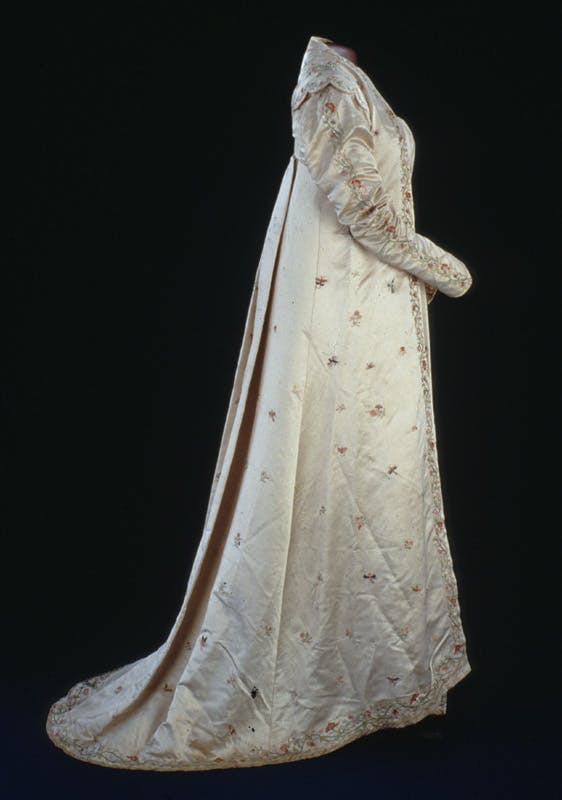
Dolley Madison’s Silk Satin Open Robe, late 1810s. The National Museum of American History, Smithsonian Institution.
Political allegiance was serious business in the Early Republic. Men of all social classes chose sides over how best to run the new nation. Although they could not vote, many women followed politics very closely and formed their own opinions.
Women were discouraged from speaking publicly about politics, but they could signal their political opinions in other ways, including through their clothing choices. For example, wearing imported fashions and fabrics was a way to show support for different foreign policies.
Dolley Madison understood that her appearance could reinforce Republican values and shape the image of the government and the country. She was a fashion icon who made her choices with care. Historians have not determined the identity of Mr. Zantzinger. But when Dolley Madison knew someone who was going to Paris, she often provided a shopping list of items she wanted—sewing materials, fashion magazines, and other luxuries. She spent lavishly on French goods. She understood it was her responsibility to look prosperous and elegant to signal the solidity and refinement of the United States. She felt this responsibility even before James Madison became president. This shopping list was written when her husband was secretary of state, and Dolley Madison served as the widowed President Thomas Jefferson’s hostess for many events at the White House.
The open silk robe dates to a slightly later period, when (or possibly soon after) Dolley Madison was First Lady. Like many of her surviving clothes, it was elegant and distinctly French, but the style also evoked women’s fashion in ancient Greece. It reinforced Republicans’ pro-French politics, and it also subtly linked the United States to the Greek culture that many Americans saw as the first republic in Western history.
Dolley Madison’s clothing choices were consciously political. But they may also have reflected the freedom she felt within her role. The United States was no longer brand-new. Her husband became the nation’s fourth president in 1809. The two previous First Ladies, Martha Washington and Abigail Adams, had defined the role of the president’s wife. Dolley Madison, given her personality and political instincts, was able to put her own stamp on it.
- cambric.
Lightweight linen or cotton cloth.
- cockade.
A knot of ribbons worn as a pin to symbolize a cause or allegiance.
- crape.
A dressy fabric, now usually spelled crepe.
- David.
French artist Jacques-Louis David.
- do., dito.
Ditto, the same as the previous item.
- dols and doll.
Dollars.
- doz, douzn.
Dozen.
- elève.
Student (in French).
- Federal period.
The early years of the United States, usually defined as 1790–1830.
- Florence silk.
Silk made in the city of Florence, Italy.
- francs.
Units of measurement in French money.
- kerchief.
A small piece of cloth worn on the head or neck.
- kid.
Soft, thin leather made from goat skin.
- levantine.
A silk fabric, woven for extra texture.
- looking glasses.
Mirrors.
- merino.
A high-quality wool.
- marchands des graveurs.
Shopkeepers who sell prints made from engravings (in French).
- pr.
Pair, or per.
- pr. yd.
Per yard.
- republic.
A form of government in which political power is held by the citizens, not a monarch. (In a republic, citizenship may be limited to an elite few. A democracy is a republic in which citizenship is defined broadly to include all or most of the population.)
- silk satin.
A silk fabric woven to have the smooth, shiny texture of satin.
- snuff box.
A container for powdered tobacco, which is inhaled through the nose.
- yds.
Yards.
- < . . . >
Missing or unreadable text.
What do you notice about Dolley Madison’s dress? What impression does it give?
Why and how did women use clothing to express their political opinions? Do women and men do this today?
What does a person’s clothing tell us? If people analyzed the clothes you or your friends wear, what do you think they might conclude?
After studying Dolley Madison’s dress, research the fashion choices of another First Lady in American history. What is considered her signature look? What did this look symbolize? What did it say about the country and/or the presidency? How did the public respond to her choices?
Research some images of prominent women and men today. What clothing rules are people following? Based on the way they dress, what do they want others to think of them? What clothing rules do people your age follow?
Life Story: Martha Washington
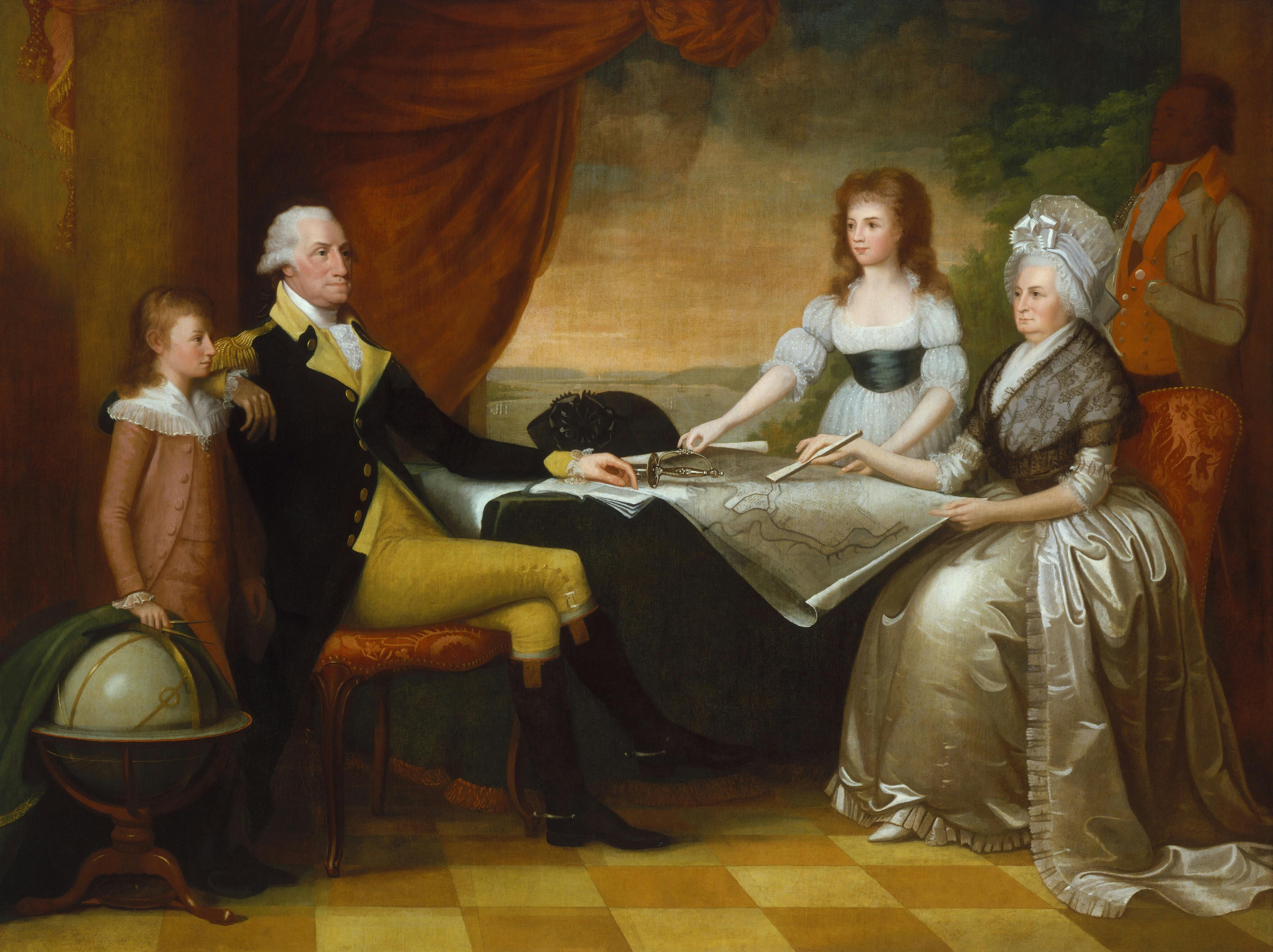
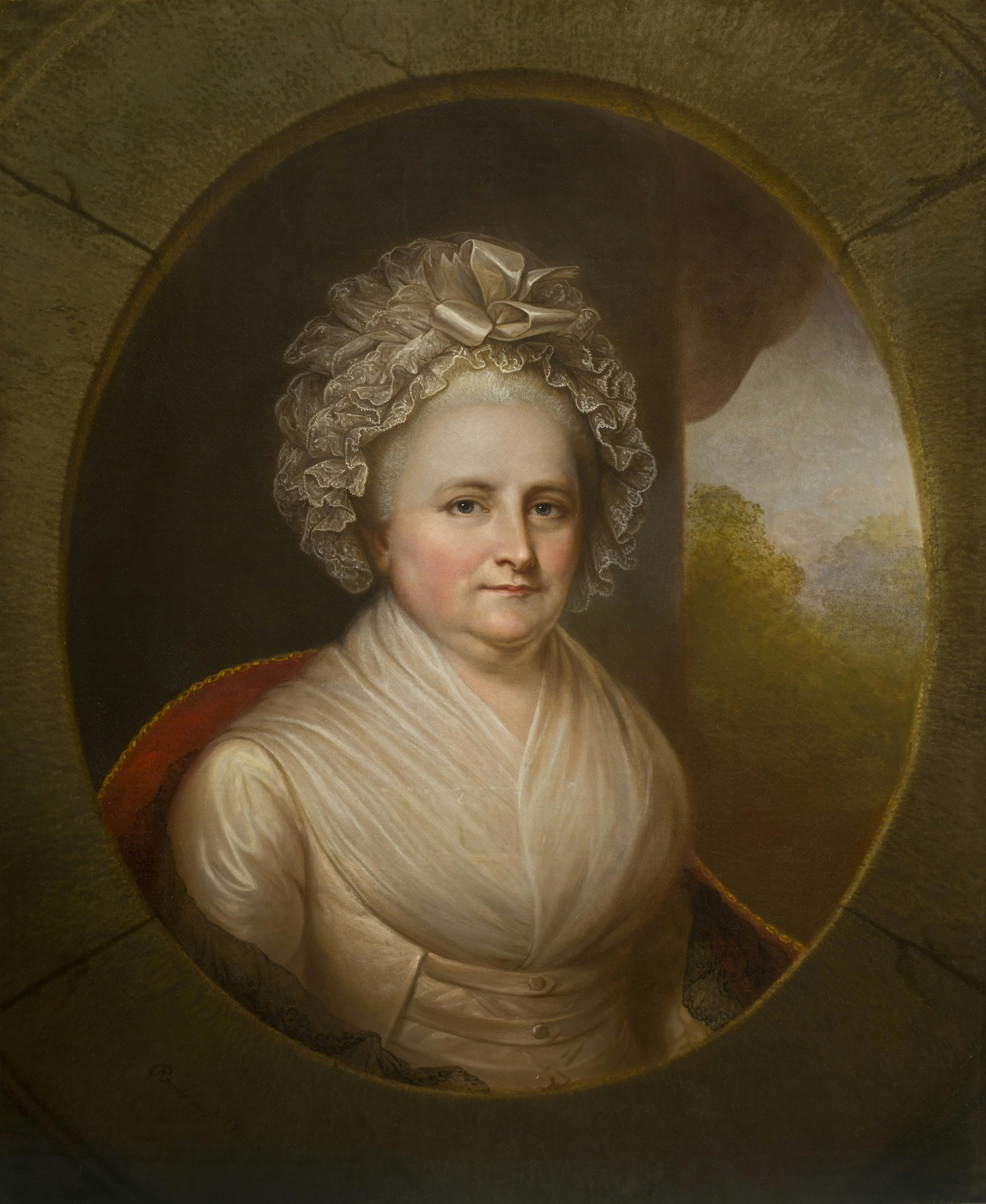
Rembrandt Peale (1778–1860). Mrs. George Washington (Martha Dandridge Custis, 1731–1802), 1853. New-York Historical Society, Bequest of Caroline Phelps Stokes.
Martha Washington (1731–1802) began her life as Martha Dandridge, the daughter of a slaveholding tobacco planter in Virginia. In 1750, at the age of 19, she married one of Virginia’s wealthiest men, Daniel Parke Custis. They had four children. The oldest child died in 1754, and the second in 1757, the same year her husband died suddenly. Because her husband left no will, Martha was entitled to what were known as dower rights, which were meant to protect widows. According to this law, Martha was allowed the use during her lifetime of one-third of Daniel Custis’s vast estate, including 84 enslaved workers. The remainder of the estate was inherited by Martha and Daniel’s two young children, who would also inherit Martha’s share when she died.
Martha Custis did not own her share of the Custis estate, but she controlled it, and she could make financial decisions that benefited her children until they were adults. Because of coverture, if she remarried, her new husband would manage her wealth. He could use it as collateral to secure loans and make purchases that would increase the couple’s worth. This made Martha Custis one of the most eligible widows in Virginia, and she was eagerly courted by several men.
In January 1759, Martha Custis married George Washington, an ambitious military officer whose wealth did not match her own. She was then 27 and he was a few months younger. They moved to Mount Vernon, the Washington family plantation. She brought some of the Custis enslaved people with her, and they joined the Washington family’s enslaved workers. George and Martha Washington began their married life in wealth and comfort, and together they raised Martha’s children. John Custis, called Jacky, was four at the time of their marriage. Martha, known as Patsy, was two.
Martha and George Washington had been married for over 15 years when the American Revolution began. Because he had distinguished himself during the French and Indian Wars, George was appointed commander-in-chief of the Continental Army. Martha joined her husband in military camps during the winters, when armies did not fight. She spent the warmer months at home, so she was not at the battle of Yorktown in the fall of 1781. But her son, Jacky, an adult by then, had volunteered to serve as his stepfather’s aide. A few days after arriving, Jacky died of camp fever. Patsy had died a few years earlier. Martha Washington outlived all of her children.
After the Revolution, Martha and George Washington returned to Mount Vernon, believing that his years of service were over. George and Martha Washington had no children of their own, but they were in the role of parents for many years. They adopted Jacky’s two youngest children, Eleanor Custis (called Nelly) and George Washington Custis (called Wash). Jacky’s two oldest children remained with their mother.
In 1788, George Washington was elected president of the United States. He and Martha had enjoyed their private life at Mount Vernon, and now they were worried. He wondered if he was up to the challenge and confessed that he felt like a criminal going to his execution. Martha Washington feared that the presidency would be too much for her 57-year-old husband. But both accepted what they saw as a duty to their country. George Washington was inaugurated in New York City, then the nation’s capital, on April 30, 1789. A month later, Martha joined him. Both stepped into roles no one had ever held—not in the United States, not anywhere.
How should the United States show its citizens, and the world, that it was a republic when people had no experience with this form of government? What Americans knew (and despised) was monarchy, specifically the reign of King George III. One issue involved the president’s title. It was hard to find a title that did not sound like royalty. George Washington rejected suggestions including “His Excellency” and “His Majesty” in favor of the much simpler “Mr. President.” People also wondered how to refer to Martha Washington. Some tried “Mrs. Presidentress,” but usually she was called Mrs. Washington or Lady Washington, even though the term “Lady” was associated with British nobility. So was “consort,” a word applied to Martha Washington and to the wife of Britain’s King George. The term “First Lady” was eventually adopted in America, but not until well after Martha Washington’s death.
Martha Washington knew how to behave as an elite woman in Virginia—what to wear, how to entertain, how to maintain the family’s status and avoid offending anyone. She and George had long lived by the accepted rules for elite couples at the time. Husbands were responsible for the family’s affairs out in the world—work, politics, commerce. Women were responsible for the couple’s home, family, and social life. But for Martha Washington, now the wife of the president, “social life” was no longer private and personal. She had to adapt the old rules to reflect well on her husband and the country he now led.
As her familiar social customs changed to become political rituals, her private life suffered. The president and his advisers, especially in the beginning of Washington’s first term, believed that the president and his wife should be entirely public figures. As a result, most of the Washingtons’ entertaining reflected their official role. Martha Washington’s choices and activities were watched and written about in newspapers. In her clothing and behavior, she could contribute to her husband’s success and help define what it meant to be American. It was a powerful public position for a woman, but mistakes could be costly. Her husband and other officials could base their political decisions on the Constitution. For her, there was no instruction manual to follow.
Martha Washington invented the role of the president’s wife, but she found the rules, and the public spotlight, difficult. Six months after arriving in New York City, she wrote to her niece Fanny Bassett Washington: “I live a very dull life here and know nothing that passes in the town. I never go to the public place. Indeed I think I am more like a state prisoner than anything else. There is certain bounds set for me which I must not depart from, and as I cannot do as I like, I am obstinate and stay home a great deal.”
Fanny Bassett Washington and her husband, Augustine Washington, were in charge of Mount Vernon during George Washington’s presidency. But Martha remained the estate’s mistress, and she managed it from a distance. Her letters to Fanny often gave instructions for the enslaved people who served as Mount Vernon’s cooks, seamstresses, and maids. The Washingtons also brought enslaved people to serve in the president’s official house. When Martha Washington was elaborately welcomed to New York City after the inauguration, her party included six enslaved people: Ona Judge, Christopher Sheels, Molly, Giles, Austin, and Paris. Ona Judge, sometimes called Oney, was Martha’s personal maid. Later, Hercules Posey, the Washingtons’ favorite cook, joined the presidential household. Late in George Washington’s second term, Ona Judge escaped, and Hercules Posey ran away a few months later. Neither was ever re-enslaved, despite George Washington’s efforts to capture them.
Martha Washington’s letters to Fanny are an important source of information. Letters once existed between Martha and George Washington, but late in her life, after he died, she burned their correspondence to keep their private lives private. As a result, we know little about her most personal thoughts. More is known about the public’s opinion of her. She was well liked and widely admired, but she was also closely scrutinized. Her critics, who were often opposed to George Washington’s federalist politics, thought she behaved too much like a European queen. One newspaper editor denounced her horse-drawn carriage, which he described as a “very large cream-colored chariot of globular form, surrounded by cupids.” Others complained that her clothing was too fancy, although George wrote that “her wishes coincide with my own as to simplicity of dress and everything which can tend to support propriety of character without partaking of the follies of luxury and ostentation.” Martha Washington learned what all First Ladies learn: her every move would be judged.
In March 1797, George Washington’s two terms as president ended after he declined to serve a third term. He and Martha had spent most of his presidency in Philadelphia, the temporary capital. Once out of office, they returned to Mount Vernon and again hoped for a quiet life. But George died suddenly two years later, leaving behind a will that would emancipate his enslaved people after Martha’s death. He had reconsidered his earlier support for slavery after the escapes of Ona Judge and Hercules Posey, but he wanted Martha’s last years to be easy ones. She freed the Washington enslaved people three years later, in part because she feared they would try to kill her to hasten their freedom.
Martha deeply mourned her husband’s death. She oversaw arrangements for his burial in the family vault at Mount Vernon, but she did not attend. She moved out of the bedroom they had shared, in which he had died. She died at Mount Vernon at the age of 70. Her dower share of Custis enslaved people, plus one more enslaved person she claimed to own, passed to her grandchildren.
- Continental Army.
The army of the American colonies during the Revolutionary War.
- electors.
People appointed by state legislatures to vote for president and vice president.
- follies.
Foolish behaviors.
- genteel.
Refined, high-class.
- monarchy.
A form of government in which a king, queen, or emperor inherits supreme power and rules for life.
- ostentation.
Overdone or tasteless display of wealth.
- republic.
A form of government in which political power is held by the citizens, not a monarch. (In a republic, citizenship may be limited to an elite few. A democracy is a republic in which citizenship is defined broadly to include all or most of the population.)
What challenges did Martha Washington face when she became the wife of the first president? How did her previous life prepare her to address them?
Compare Martha Washington’s tenure as the first president’s wife to the lives of First Ladies today. What do you think has caused any differences you can identify?
Given the opportunity, how do you think Martha Washington would have changed the role of the First Lady?
At least twelve presidents were slaveholders at some point in their lives, eight of them while they were in office. Research the history of slavery among the men and women who helped create the roles of President and First Lady. How does this research inform our understanding of these individuals and their leadership? How does this information affect your opinion of George and Martha Washington?
Currier and Ives published popular lithographs during the 19th century, which allowed people to put pictures on their walls even if they could not afford original paintings. One of the Currier and Ives lithographs was a copy of “The Washington Family,” a painting by Edward Savage. Why do you think people would have wanted to own a portrait of the Washington family and display it in their homes? How would you describe the portrayal of the Washingtons in this image? What do we learn about them from this image?
Life Story: Abigail Adams
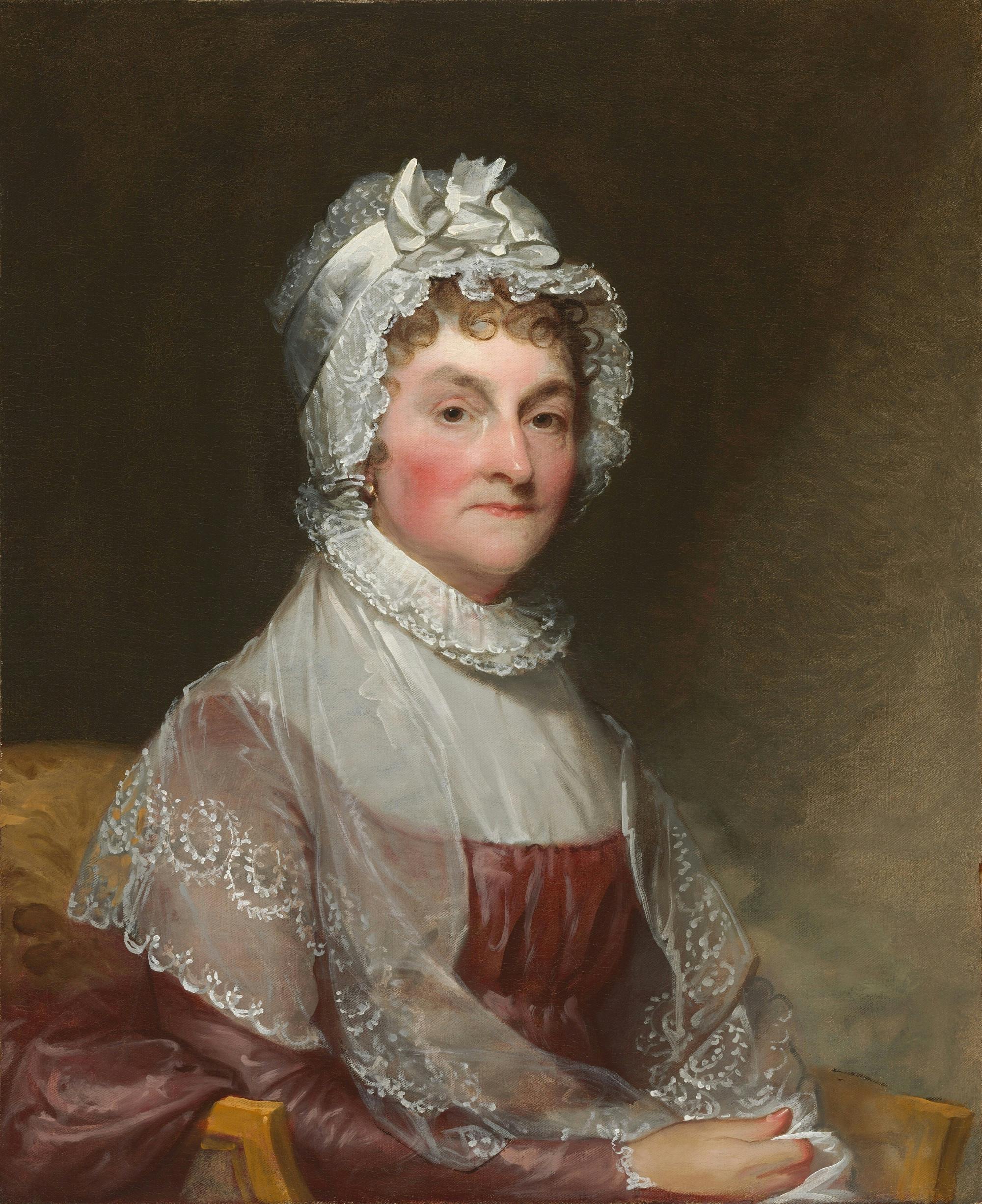
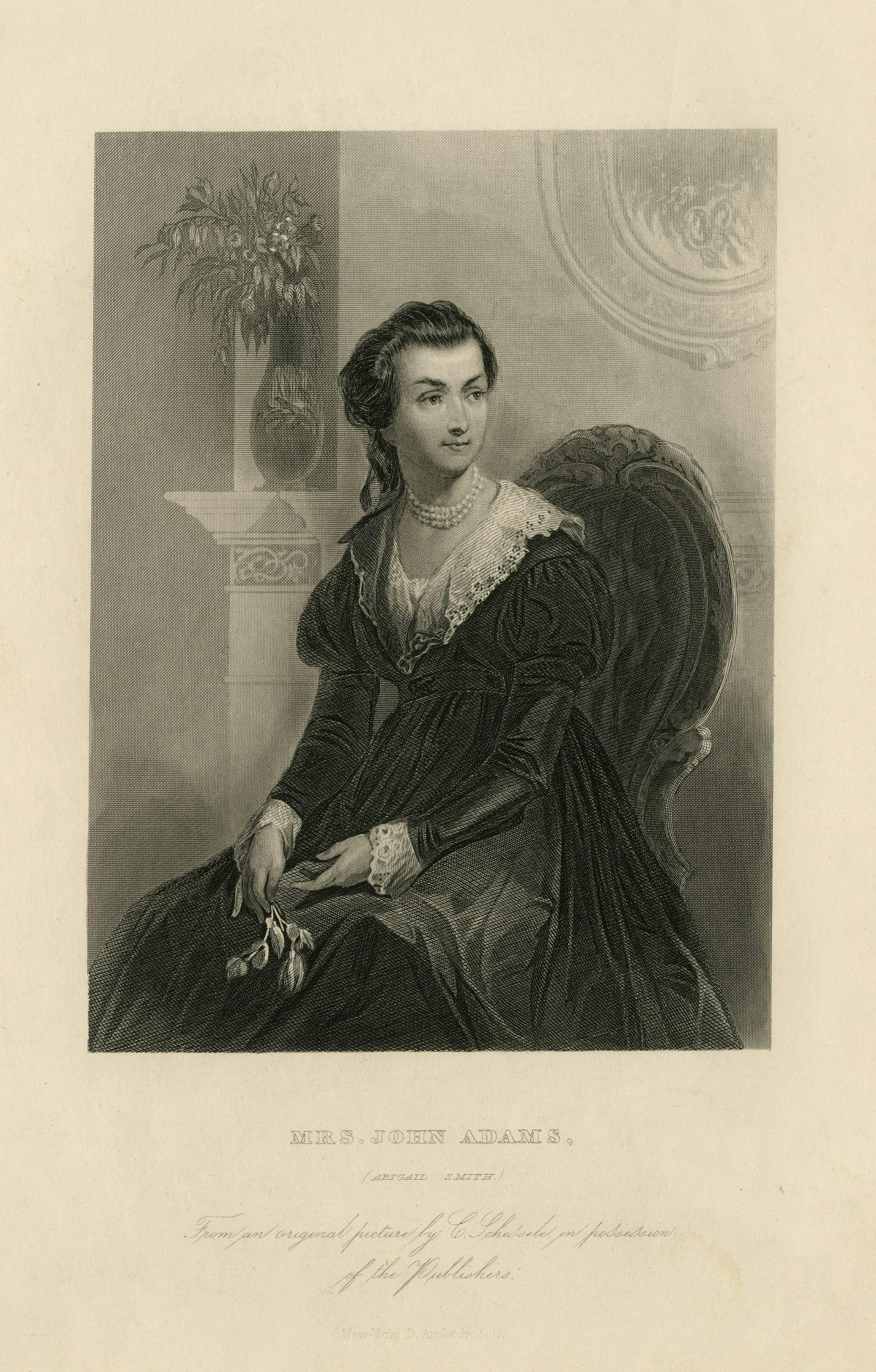
C. Schessele, Mrs. John Adams (Abigail Smith), ca. 1775. Engraving. New-York Historical Society Library

Abigail Smith Adams (1744–1818) was born to a political family. Her grandfather, John Quincy, was speaker of the Massachusetts House of Representatives during the colonial period. She loved politics, which she observed with a sharp eye and keen intelligence. When the American Revolution began, she was 30 years old and had been married for 10 years to John Adams, a lawyer and elected official. They lived in Braintree, Massachusetts, and had four children: Abigail, called Nabby, John Quincy, Charles, and Thomas.
John Adams traveled a great deal, and he and Abigail wrote to each other constantly during their separations. Over 1,100 of their letters survive. The letters are personal, affectionate, witty, and full of family details and private feelings. They are also a window into the extraordinary period when America fought for independence and then established the government of the new United States.
During the American Revolution, John Adams was a delegate to the Continental Congress, which met in Philadelphia. In her letters from home, Abigail reported what she saw and knew. More British troops had arrived. The colonists needed gunpowder. Prices had soared. In 1776, Abigail wrote one of the most famous letters in American history. Assuming the delegates would declare independence and would therefore need to create a new form of government, she asked them to “remember the ladies.” She was not asking for the right to vote but for relief from coverture, which deprived women of financial and legal control over their own lives. Normally supportive, John dismissed her note with a laugh. The following year, the Articles of Confederation, the charter for the new government, was adopted by the delegates. This document did not eliminate or weaken coverture.
In November 1779, John Adams left for Paris as an official diplomat for the United States. He took with him the couple’s two oldest sons. John Quincy Adams was 12, and Charles was 9. Abigail wrote even before their ship had left Boston. “My habitation, how disconsolate it looks! My table I set down to it but cannot swallow my food. . . . My dear sons . . . my tenderest love to them.” It would be five more years before she saw her husband or John Quincy again, though Charles became homesick and returned home, alone, after two years.
Throughout this time, and for much of her married life, Abigail Adams was in charge of the family finances. During the Revolution and when John was in Europe, every penny mattered. Many items were in short supply, and prices were rising. Abigail set up a small business, asking John to send European goods, which she then sold for a profit. She also managed the Adams farm. She hired workers and worried about weather and crops and prices. She made many decisions on her own, conferring with John when she could. But the mail traveled slowly by ship. It sometimes took almost four months for a letter to make its way from Europe to Massachusetts.
The American Revolution ended in 1783. By then, John Adams had spent most of the previous five years in Europe, negotiating treaties on behalf of the United States even while the Revolution was still being fought. In 1784, the two youngest Adams children, Charles and Thomas, went to live with Abigail’s sister Elizabeth. Abigail and 19-year-old Nabby sailed for France to join John. The three lived outside Paris for several months. They moved to London in 1785, after John was named the first US minister to Great Britain. When the family returned to Braintree in 1788, Abigail had been away from home for four years, and John for most of a decade. Thomas Adams, then a student at Harvard, had not seen his father since he was seven.
On April 21, 1789, John Adams took the oath of office as the nation’s first vice president. John and Abigail Adams moved to New York City, then the nation’s capital, and faced even tighter finances. They had all the expenses of their home and farm in Braintree, but they were also expected to pay for their home and personal expenses in New York, in addition to the entertaining that was part of his job. His $5,000 yearly salary was not nearly enough.
The Washingtons, by contrast, were wealthy. President Washington declined his $25,000 presidential salary, just as he had refused his wages during the Revolution. The Adamses were in no position to do the same. One of their expenses was household staff. John and Abigail hosted politically important social events. They needed people to clean the house, cook, and take care of their horses and carriage. The Washingtons had brought enslaved workers from Mount Vernon, but Abigail believed slavery was evil. She loved and took care of Phoebe, the formerly enslaved woman who had been her childhood nursemaid and whom she once described as “the only surviving parent that I have.” John and Abigail Adams never owned enslaved people, which set them apart from many of their peers in political society.
After eight years as vice president, John Adams was elected president in December 1796. He wrote to Abigail with urgent appeals to join him. He was then in Philadelphia, which served as the nation’s capital while the city of Washington was being built. On New Year’s Day 1797, he asked her to come in February, to be on hand for his inauguration on March 4. “I had rather not,” she wrote, “if I may be excused.” She gave several reasons. She was in good health and did not want to risk it. She had no interest in finding or furnishing a house for them in Philadelphia, which she thought should be handled by the government. And there were problems at home with the farm—rising costs that cut into their finances.
Abigail Adams bore the lion’s share of responsibility for their farm, so it was difficult for her to leave. She was also nervous about what lay ahead for her. Although she had been the wife of the Vice President, she recognized that the wife of the President was a much higher profile role. In February, she wrote to her friend Martha Washington, asking for advice. The information she received was probably helpful, but the life Martha Washington described may have seemed quite lonely and narrow to Abigail Adams. In the end, she put off her reunion with John until May. She missed his inauguration.
John Adams’ yearly salary jumped to $25,000 when he became president. This eased the family’s financial concerns, but their expenses increased too. John continued to worry about money. He also faced political hurdles. He was not the heroic, revered figure George Washington had been. He was engaged in a maritime war with France, known as the Quasi-War. His rival Alexander Hamilton undercut his policies, and Thomas Jefferson disagreed with him on issue after issue. Newspapers took sides, some criticizing the president in the sharpest language.
The atmosphere was so charged that Abigail began to worry that John’s life might be in danger. She and John were both desperate to stop the criticism.
In May 1797, with John Adams’s support, Congress began to pass the four Alien and Sedition Acts. The first three focused on foreigners living in the United States. The fourth act outlawed “false, scandalous and malicious” speech or writing against the US government. Abigail was relieved. “Let the vipers cease to hiss,” she wrote, as journalists who criticized the president were put in prison. The Alien and Sedition Acts were condemned by Republicans (and by historians to this day) as clear violations of the First Amendment. They became a costly black mark on the administration of John Adams.
In the fall of 1800, Washington City, as the new capital was known, was still a construction site. But the White House was considered ready, or ready enough. John Adams moved into the new presidential home on November 1, just as Americans were beginning to vote in the presidential election, a process that lasted several months because states had different voting days.
Abigail Adams arrived in Washington on November 16. The city, she wrote to her sister, was all but barren except for this “castle of a House.” The “castle” was cold and damp, and the Adamses were miserable. But they were not there for long—John Adams lost his bid for reelection. Thomas Jefferson moved into the White House when he became the nation’s third president in March 1801. Abigail and John Adams returned to Massachusetts.
In January 1816, Abigail Adams was 71 years old, and so ill she thought she was dying. She did something unusual: she wrote her will. Under coverture, married women’s wills had no legal standing, but Abigail had her husband’s consent. She had spent much of her life advocating for greater legal rights and education for women, especially married women.
Despite the rules of coverture, Abigail Adams had money she considered her own. She used it in part to support family members facing hard times. She had saved some of her money by being frugal, but she had also made investments that earned interest and helped ensure the family’s financial well-being. John did not always approve of her investments. Abigail preferred stocks and bonds, and he preferred land. But he trusted her to take care of their finances when he was away. By the time of her death, she had about $5,000, worth about $100,000 today. She had made earlier gifts to her two surviving sons, but otherwise she left almost everything to women: nieces, granddaughters, and servants. Her bequests included money, stocks, furniture, clothing, and other items. After she died on October 28, 1818, John Adams could legally have ignored the terms of her will, but he carried them out to the letter.
Abigail Adams did not live to see her son, John Quincy Adams, become the sixth president of the United States in 1825, but her husband did. John Adams died in 1826 at the age of 91.
- Continental Congress.
The governing body of the thirteen colonies. The First Continental Congress met in 1774 and adopted the Articles of Confederation. The Second Continental Congress met during the American Revolution, from 1775 until the Articles of Confederation took effect in 1781.
- disconsolate.
Too sad to be comforted.
- habitation.
House or home.
- malicious.
With the intent or purpose of doing harm.
- revered.
Loved and respected.
- scandalous.
Offensive to the accepted sense of morality.
- sedition.
Encouraging rebellion against the government.
- vipers.
Poisonous snakes.
Abigail Adams spent much of her life as the wife of a political figure. How did Abigail approach her role? How did she engage with John’s political life and work?
Abigail Adams was the second woman to be the wife of a US president. How did coming after Martha Washington help her? How did that create challenges for her?
Abigail Adams lived at a time when women were restricted in many ways. How did she conform to these restrictions? How did she challenge them?
The Massachusetts Historical Society organizes the letters of John and Abigail Adams by time period. Those dated between November 2, 1800, and February 21, 1801, cover the move to the White House, the election that John Adams lost, and their return home to Massachusetts. Working in small groups, read and summarize these letters. What were the Adamses’ concerns for themselves, each other, and the country?
Shortly after his inauguration as president, John Adams wrote in a letter to Abigail, “I never wanted your Advice or assistance more.” What did John Adams see as Abigail’s strengths? What did he need from her, as a husband and a president?
Life Story: Dolley Madison
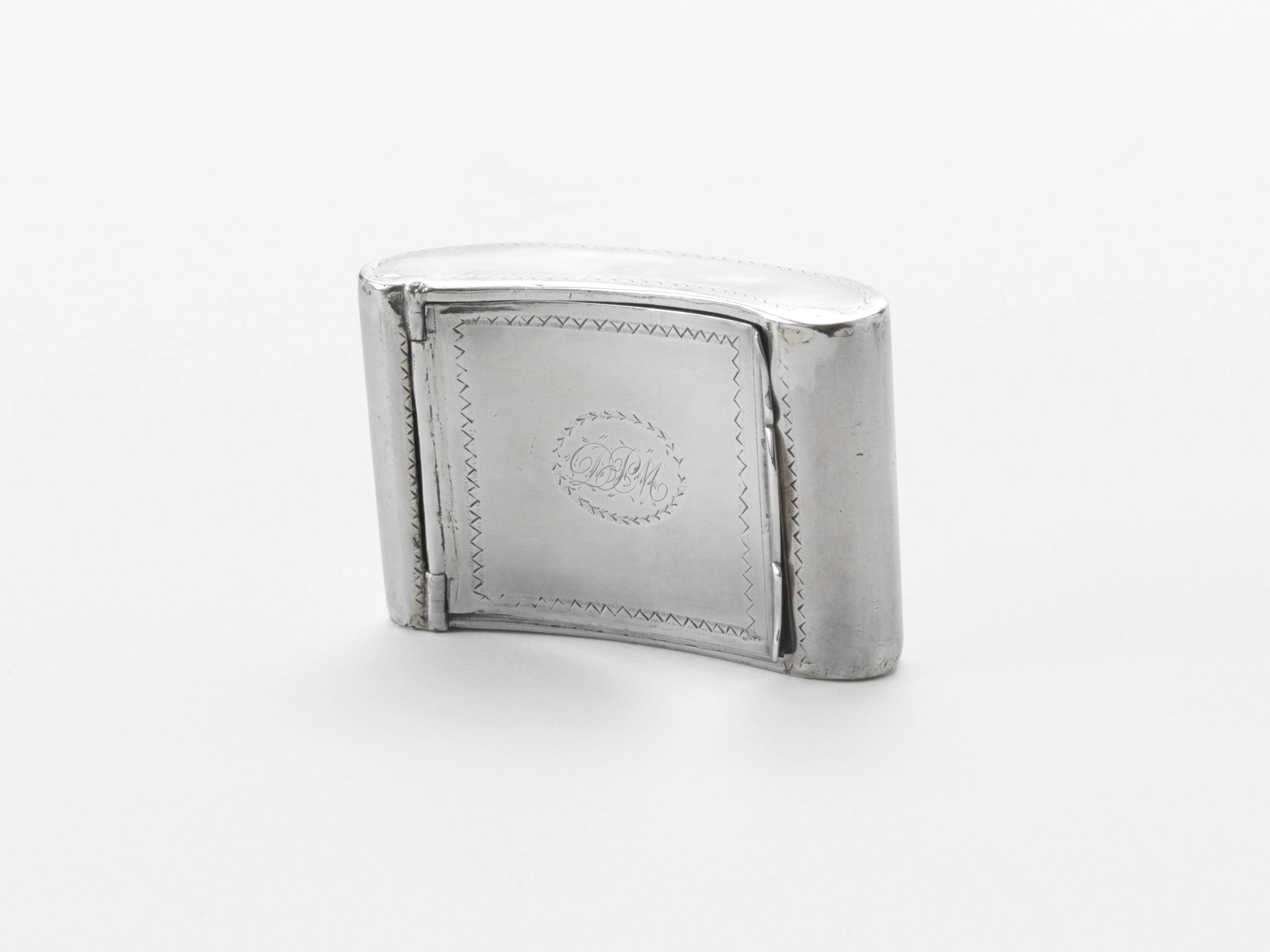
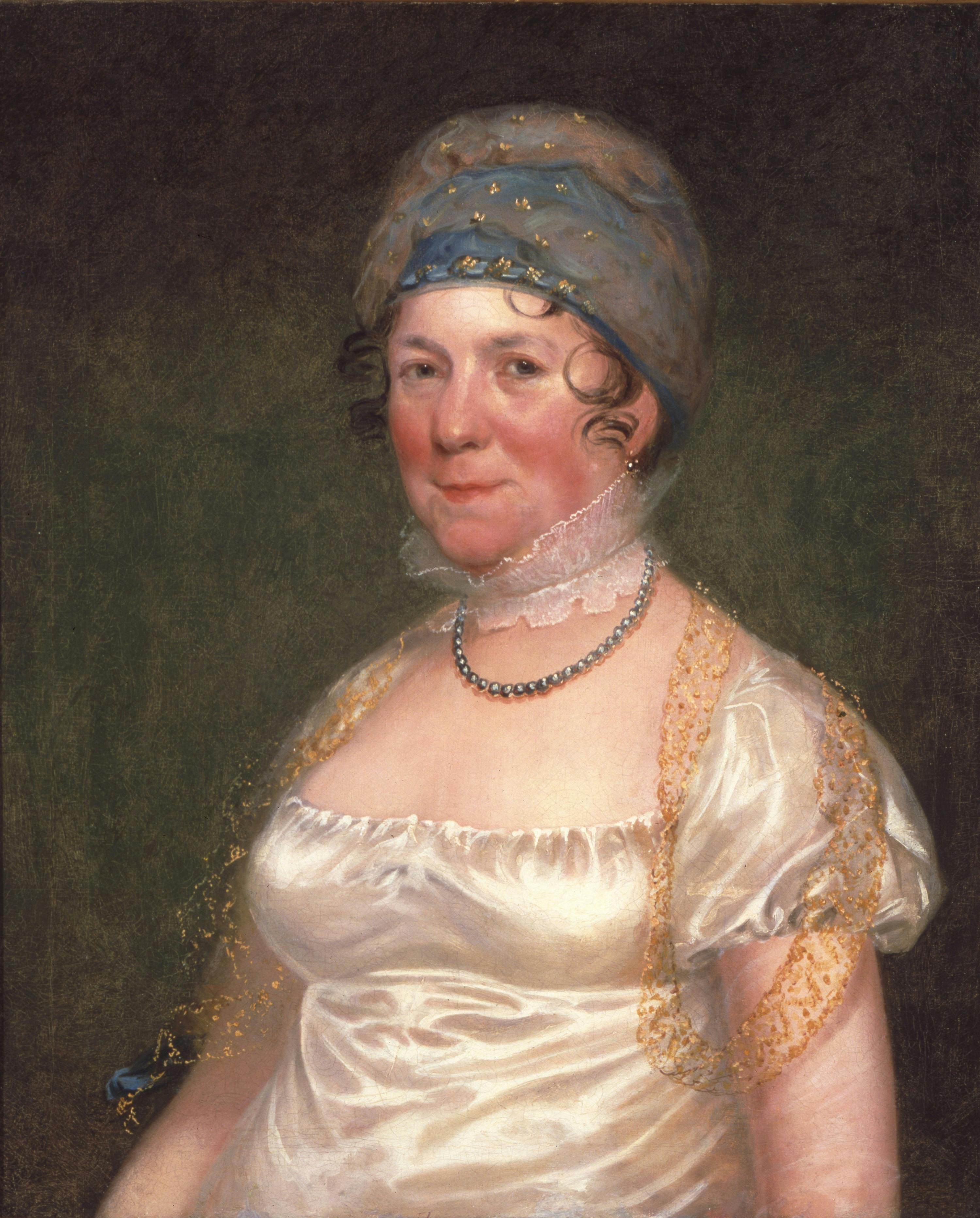
Bass Otis (artist), Mrs. James Madison, ca. 1817. New-York Historical Society, Gift of Thomas Jefferson Bryan.
Dolley Madison (1768–1849) began her life as Dolley Payne, the daughter of John and Mary Payne, devout Quakers who owned a farm in Virginia. When she was 15, her father decided to follow Quaker teachings and free his enslaved people. He sold the farm and moved his family to Philadelphia. Unfortunately, his new merchant business failed. This was taken as a sign of weakness by the Quaker community, and John Payne was expelled from Quaker Meeting. Mary took in boarders to make ends meet. It was a difficult time for the Payne family.
In 1790, when Dolley Payne was 21, she married a Quaker lawyer named John Todd. Some think that her father pressured her into the marriage. When her father died nearly three years later, she invited her 11-year-old sister, Anna, to stay with her and help care for her two young sons. In 1793, a yellow fever outbreak swept Philadelphia. Dolley lost four members of her family: her father-in-law, mother-in-law, husband, and baby son. Her sadness was overwhelming, but so was living as a young widow with a child and sister under her care.
During this time, men were considered responsible for their female relatives because of the practice of coverture. But all the men who might have taken care of Dolley had died. Her husband had left her some money in his will, but his brother withheld it until she sued him. At one point early in her grief, when her many debts included the bill for her baby’s funeral, she had only $19. She needed to remarry to keep her family together. Supporting herself, Anna, and her surviving son, named Payne, would have seemed impossible for a single woman.
Philadelphia was then the temporary capital of the United States, and it had a very active and exciting social life. Dolley was a beautiful woman who soon caught the eye of many men, including Virginia Congressman James Madison. He was famous for drafting the US Constitution and the Bill of Rights. He was also a wealthy slaveholder, but Dolley seemed untroubled by this. They married in September 1794, less than a year after her first husband’s death. This second marriage caused a scandal in the Philadelphia Quaker community. James Madison was not a Quaker, and many did not think Dolley had waited long enough before remarrying. Like her father, she was expelled from Quaker Meeting. From then on, she attended Episcopal services with James and often complained about her rigid Quaker upbringing.
In 1801, newly elected president Thomas Jefferson named James Madison as secretary of state. Dolley and James moved to the nation’s unfinished new capital, Washington City. They brought with them some of the enslaved household staff from Montpelier, the Madisons’ tobacco plantation. One was Sukey, Dolley Madison’s personal maid.
Because Thomas Jefferson was a widower, he asked Dolley Madison to help host events at the White House when women were present. This gave her a close-up view of the political conflicts that divided the nation’s leaders. The new Constitution and Bill of Rights had established a government, but Federalists and Republicans had different ideas about how to run the country. Political debates occasionally erupted into physical fights. Given this hostile environment, President Jefferson preferred to host only one political party at a time at the White House. Sometimes he invited members of his own party, the Republicans. Sometimes he invited his opponents, the Federalists. This kept fights out of his home. It also increased his power because he was the only person who met with all sides of a debate.
James and Dolley Madison were Republicans like Jefferson, but they took an entirely different approach to entertaining. They invited everyone to mix—foreign visitors, members of Congress, Federalists, Republicans. Their home on F Street became the center of Washington City’s social scene. When James Madison was elected president in 1808, Dolley continued to host her social events. They were fun, noisy, relaxed, and so crowded that they were called “squeezes.” Dolley, elegantly dressed, circulated among her guests. Her friend Margaret Bayard Smith wrote that “Every visitor left her with the pleasing impression of being an especial favorite, of having been the object of particular attention. She never forgot a name she had once heard, nor a face she had once seen, nor the personal circumstances connected with every individual of her acquaintance.” And frequently, Dolley shared the tobacco from her snuffbox, which Mrs. Smith said was a “perfect security from hostility.”
Dolley Madison’s social behavior and success were based on her personality, but also on her keen understanding of politics. On March 27, 1812, she described one of her squeezes in a letter to her sister, Anna Payne Cutts. At the time, Vice President George Clinton was ill and near death. “Electioneering for his office goes on beyond all description. The world seems running mad, what with one thing and another. The Federalists, as I told you, were all affronted with Madison, refused to dine or come, but they have changed their tack. Last night and the night before, our rooms were crowded with Republicans, and such a rallying of our party has alarmed them [the Federalists] into a return. They came in a large party last night also, and are continually calling. Even D.R. Will . . . who is a fine fellow, came last night. The old and young mustered. The war business goes on slowly, but I fear it will be sure.”
Dolley Madison was right: war did come. The War of 1812 started in June, just weeks after her letter to her sister. It pitted the United States against the British, again. In 1814 the British invaded Washington City. One day in late August, James Madison was several miles away, conferring with military leaders as they faced the British in Bladensburg, Maryland. Knowing the British were close, Dolley Madison began to pack up important government papers, as James had asked. She then directed the few people who remained in the White House, including Sukey and Paul Jennings, to take down the portrait of George Washington. (Paul Jennings, also enslaved, had his own version of the painting’s rescue.) They took the portrait and other items with them when they escaped the White House, which the British soon seized and set on fire. The Madisons spent the rest of his presidency in a rented house in Washington while the White House was repaired.
In 1817, at the end of James’s second term, the Madisons returned to their plantation. They hoped for an easy retirement, but Dolley’s son, Payne, created ongoing problems. He had serious gambling debts that the couple had to pay off to protect his reputation. When James died in 1836, Dolley was once again a widow forced to take care of herself in a society that offered her few choices. To make matters worse, Payne kept creating new debts that left her with very little money. She sold James’s papers to Congress but made less than she had hoped. Next, she sold some of her enslaved people, including Sukey’s daughter, in violation of James’s will. The enslaved people were given no choice in this decision. Finally, in 1844, she sold Montpelier and returned to Washington. She was still an American icon, perhaps the country’s most beloved woman. President Zachary Taylor referred to her with a new term of honor: First Lady. Some called her America’s Queen, and they said it with admiration. But her financial struggles continued to the end of her life in 1849.
Dolley Madison was celebrated in her time for her beauty, style, and charisma, and for her bravery and quick-wittedness during the War of 1812. But her most significant contribution was more subtle and more consciously political. When she arrived on the scene, politics was a rough game, with physical fights, shouting matches, stony silences, even duels. The idea of bipartisan cooperation did not exist; there was not even a term for it. But Dolley Madison understood that warring factions needed a safe place to come together, and that social life, especially with women present, could require good behavior from all. In this setting, even enemies could have an informal conversation and quietly look for common ground.
Dolley Madison did not fundamentally change Washington politics, which remained a rough game. But her social events, which she planned so carefully and understood so well, provided a model that stressed civility and cooperation over fighting and coercion. It allowed adversaries to see each other as human beings.
- Bill of Rights.
The first ten amendments to the Constitution. The Bill of Rights protects the liberties of individual US citizens.
- boarder.
A person who pays to live in another person’s home.
- Constitution.
The governing document of the United States.
- D. R. Will.
David Rogerson Williams of South Carolina, a Republican member of the House of Representatives.
- Episcopal.
Refers to a Protestant Christian faith based on the Church of England.
- muster’d.
Mustered, assembled for battle.
- Quakers.
The Society of Friends, a Protestant community that believes in pacifism and the equality of the sexes.
- Quaker Meeting.
The official name for a community of Quakers.
- secretary of state.
The US government official in charge of relationships with foreign countries.
- Vice P.
Vice President George Clinton, who died April 20, 1812.
- War of 1812.
A war between the US and Britain, 1812–1815.
- yellow fever.
A deadly virus that affects the liver and kidneys.
Dolley Madison invited friends and rivals into her home, greeted them warmly, fed them, and sometimes shared her snuff with them. Why is hospitality important? Why would it matter especially for a First Lady in the heated political climate of Dolley Madison’s time?
How do you think Dolley Madison would have described the role of the president’s wife? If her successor, Elizabeth Monroe, had asked her for advice about the role of First Lady, what do you think she would have said? (As an example, consider Martha Washington’s response to Abigail Adams in Resource 4.)
What do you think Dolley Madison added to Americans’ expectations of First Ladies? What similarities do you see between the example she set and the public lives of recent First Ladies?
Read about Republican Motherhood and discuss whether Dolley Madison embodied or subverted the ideals put forward for women in the Federal period. (“Republican” here refers to the US form of government in which political power is held by the citizens, not specifically to the principles of the Republican political faction.)
Teach this life story together with the life story of Sukey and Resource 6, Fashion and Politics. How do these pieces inform one another? Why is it important to study a story from multiple perspectives?
Source Notes
The text of the Coverture and Fashion and Politics resources, and the life story of Dolley Madison, are adapted from the New-York Historical Society's Women & the American Story curriculum. Other selected sources are listed below.
“Adams Papers Digital Edition.” Massachusetts Historical Society. https://www.masshist.org/publications/adams-papers.
Allgor, Catherine. A Perfect Union: Dolley Madison and the Creation of the American Nation. New York: Henry Holt, 2006.
“Founders Online.” National Archives. Founders.archives.gov.
Gelles, Edith B. Abigail & John: Portrait of a Marriage. New York: William Morrow, 2009.
“George Washington’s Mount Vernon.” https://www.mountvernon.org/.
Holton, Woody. Abigail Adams. New York: Free Press, 2009.
Holton, Woody. Liberty is Sweet: The Hidden History of the American Revolution. New York: Simon and Schuster, 2021.
“The Households of President John Adams.” The White House Historical Association. https://www.whitehousehistory.org/the-households-of-john-adams.
Schwartz, Marie Jenkins. Ties that Bound: Founding First Ladies and Slaves. Chicago: University of Chicago Press, 2017.
Seale, William. The President’s House: A History. Washington, DC: White House Historical Association, 1986.
Credits
Writer:
Marjorie Waters
Project Director:
Leslie Hayes
Project Managers:
Lee Boomer
Kelly Aliano
Project Historian:
Meena Bose
Scholar Advisors:
Kathleen DuVal, Professor of History, University of North Carolina
Marie Jenkins Schwartz, Professor Emerita, University of Rhode Island
Sara Martin, Editor in Chief, The Adams Papers, Massachusetts Historical Society
Special Thanks:
Carol Barkin, Copy Editor
Use All 5, Website Developer
Dayna Bealy, Rights Clearance Specialist