Presidential Leadership
During Crisis
Presidential Leadership
During Crisis
Unit Introduction
Explore how presidents lead in times of crisis through case studies of Harry S. Truman and Ronald Reagan.
Presidential leadership is a window into how the American democracy balances the power of the people and the power of the government.
Presidents can motivate the nation toward new goals and can calm the people during times of trauma. Leaders matter.
Communicating effectively with the White House staff and the executive bureaucracy, Congress, the people, and sometimes the international community, is essential for a president, especially during an emergency.
In facing a crisis, presidents rely on their skills, beliefs, and experience, as well as on their constitutional and political authority.
The United States is a nation of, by, and for the people. But leadership is necessary, so we are also a nation with a government and a chief executive. The president’s power is set forth in the Constitution. It has grown over time, but it is still constrained by Article II of the Constitution and by political realities. As powerful as American presidents are, they are not monarchs.
Presidential leadership is different from presidential power. Leadership is the ability to influence the public and Congress in order to get things done. It requires a clear vision and a range of political and personal skills. Leaders must persuade, inspire, empathize, negotiate, and bargain. Leadership skills are most important during times of crisis, whether the crisis is foreign or domestic, long-simmering or out of the blue.
This unit opens with “Presidential Leadership,” an animated video in which presidential historian Douglas Brinkley and journalist Jia Lynn Yang cite notable examples of presidents leading through crisis. The unit then offers two examples of skilled presidential leadership. The first follows President Harry Truman as he faces the spread of Soviet communism in 1947. Over the course of a few months, he learned of the seriousness of the threat and presented the Truman Doctrine, a bold new foreign policy that would remain in place throughout the cold war. Early reactions to the new policy are shown in a collection of cartoon and comic-book images.
In the unit’s second example, President Ronald Reagan addresses the American people after the explosion of the space shuttle Challenger in 1986. Like most Americans, the president and his team learned of the disaster from TV coverage. Just hours later, the president spoke to a nation stunned by the loss of life and the shocking failure of a National Aeronautics and Space Administration (NASA) mission after a long history of successes. Before the week ended, the president and Mrs. Reagan traveled to Houston for a memorial service, standing and grieving with family members and the NASA community.
The unit contains a life story of each president, as well as primary resources. These materials, along with the discussion questions and suggested activities, are designed to help students explore how presidents respond, lead, and are evaluated during times of crisis. The materials can be used individually or collectively, and in any order that works for your classroom. Some teachers may choose to introduce the life stories first, to put key players at the forefront before students explore the rest of the story. Others may want to dive into specific primary resources to encourage students to glean as much information as possible before viewing the wider narrative. The unit has been designed so that either approach works.
In a democracy “of, by, and for the people,” how should the president work with Congress and the people during a crisis?
What should we expect presidents to do as they address different emergencies, and how much should they communicate with the people during that time?
If one role of the president is to lead during a crisis, what is the role of the people? What about people your age?
What are the essential characteristics of presidential leadership during crisis? How do they connect to the president’s roles, responsibilities, and duties as laid out in the Constitution? How do they illuminate the people’s expectations of presidents at different times in US history?
These items in this unit can be used individually or collectively and in any order that works for your classroom. Some teachers may choose to introduce the life stories first, to put key players at the forefront before students explore the rest of the story. Others may want students to dive into specific primary resources to glean as much information as possible before viewing the wider narrative. The unit has been designed so that either approach works.
The video that begins this unit examines a number of times that presidents have responded to crises. The remaining materials focus on two specific examples of presidential leadership: President Harry Truman’s cold war response to expansion by the Soviet Union, and President Ronald Reagan’s handling of the national trauma after the explosion of the space shuttle Challenger. One way to make the most of these materials is to watch and discuss the video as a class. Then assign the remaining materials to small groups. Ask each group to analyze the crisis faced by President Truman or President Reagan. What was the nature of the crisis, and how did the president respond? Then, as a class, discuss what presidential leadership means and what Americans, and the students themselves, expect of their chief executive.
- Video: Presidential Leadership
This video examines how presidents lead the nation and respond to various events that happen on their watch.
Curriculum Connections: leadership, transfer of power, civil rights, empathy
- Life Story: Harry S. Truman
The story of the president who established the United States’ approach to Cold War relations with the Soviet Union.
Curriculum Connections: World War II, Truman Doctrine, Cold War
- Resource: Understanding the Soviet Threat
This document excerpt comes from President Truman’s Special Counsel, Clark Clifford, who was asked to analyze the Soviet Union’s broken agreements with the West in 1946.
Curriculum Connections: Cold War, foreign policy
- Resource: The Truman Doctrine
A newsreel focused on the speech Truman gave to Congress in 1947 laying out his strategy for stopping the spread of communism.
Curriculum Connections: Cold War, foreign policy, foreign aid
- Resource: After the Speech
A collection of political cartoons and comic book pages that illustrate early reactions to the Truman Doctrine speech.
Curriculum Connections: Cold War, foreign policy, political cartoons
- Life Story: Ronald Reagan
The story of the president who consoled the nation after the shocking loss of the space shuttle Challenger.
Curriculum Connections: Cold War, conservative movement, space race
- Resource: The Challenger Explodes and The President Responds
President Reagan’s diary entry from the day of the Challenger disaster reveals how he responded to the space shuttle’s explosion.
Curriculum Connections: space race
- Resource: The Challenger Speech
The speech delivered by Reagan to the American public on the day of the Challenger disaster.
Curriculum Connections: space race, Cold War
- Resource: Grieving Together
This collection of images paired with Reagan’s diary entries from the days following the Challenger disaster depict the grieving that followed the shuttle’s explosion.
Curriculum Connections: space race
Video: Presidential Leadership
This video examines how presidents lead the nation and respond to various events that happen on their watch.
This video was created by the New-York Historical Society in collaboration with Makematic.
In the video, historian Douglas Brinkley and journalist Jia Lynn Yang offer examples of presidential leadership over time: George Washington leaving office after two terms; Abraham Lincoln leading through the Civil War and emancipating the enslaved people in the Confederate states; Theodore Roosevelt starting the national park system; Lyndon B. Johnson guiding civil rights legislation and immigration reform; Ronald Reagan signing a nuclear treaty with the Soviet Union and responding to the Challenger disaster; Franklin D. Roosevelt modeling courage in the Great Depression and World War II; John F. Kennedy’s commitment to the moon landing; George W. Bush standing with first responders after 9/11; Barack Obama grieving with parishioners after a mass shooting at a Charleston, SC, church. These examples illustrate how presidents respond to various events that happen on their watch and try to move the country forward.
David M. Rubenstein is Co-Founder and Co-Chairman of The Carlyle Group, one of the world’s largest and most successful private investment firms. Established in 1987, Carlyle now manages $301 billion from 26 offices around the world.
Mr. Rubenstein is Chairman of the Boards of the John F. Kennedy Center for the Performing Arts, the Council on Foreign Relations, the National Gallery of Art, and the Economic Club of Washington; a Fellow of the Harvard Corporation; a Trustee of the University of Chicago, Memorial Sloan-Kettering Cancer Center, Johns Hopkins Medicine, the Institute for Advanced Study, the National Constitution Center, the Brookings Institution, and the World Economic Forum; and a Director of the Lincoln Center for the Performing Arts and the American Academy of Arts and Sciences, among other board seats.
Mr. Rubenstein is a leader in the area of Patriotic Philanthropy, having made transformative gifts for the restoration or repair of the Washington Monument, Lincoln Memorial, Jefferson Memorial, Monticello, Montpelier, Mount Vernon, Arlington House, Iwo Jima Memorial, the Kennedy Center, the Smithsonian, the National Archives, the National Zoo, the Library of Congress, and the National Museum of African American History and Culture. Mr. Rubenstein has also provided to the U.S. government long-term loans of his rare copies of the Magna Carta, the Declaration of Independence, the U.S. Constitution, the Bill of Rights, the Emancipation Proclamation, the 13th Amendment, the first map of the U.S. (Abel Buell map), and the first book printed in the U.S. (Bay Psalm Book).
Mr. Rubenstein is an original signer of The Giving Pledge; the host of The David Rubenstein Show and Bloomberg Wealth with David Rubenstein; and the author of The American Story, How to Lead, and The American Experiment.
Douglas Brinkley is the Katherine Tsanoff Brown Chair in Humanities and Professor of History at Rice University, CNN Presidential Historian, and a contributing editor at Vanity Fair. He has written studies of several presidents, including Gerald Ford, Theodore Roosevelt, and John F. Kennedy. He served as editor of The Reagan Diaries.
Jia Lynn Yang, the national editor at the New York Times, was previously deputy national security editor at the Washington Post, where she was part of a team that won a Pulitzer Prize for coverage of President Trump and Russia. She is the author of One Mighty and Irresistible Tide: The Epic Struggle over American Immigration, 1924−1965.
The video presents several examples of presidential leadership over time. As a class, discuss the examples. How do they show the different ways that presidents lead? Based on this conversation, generate a list of leadership skills and traits shown in the examples. The list might include showing empathy, having a vision of the future, inspiring confidence, taking risks. Add the terms in the generated list to the leadership traits mentioned in the video. Which ones seem most important? As you continue with the materials in this unit, return to the list and modify it.
Students have many experiences with people in leadership roles—parents, teachers, coaches, clergy. Ask them to write about a leader in their lives, someone they admire. What makes this person a good leader? How is presidential leadership the same as, or different from, the leadership they experience in their own lives? Why are good leaders so important?
Life Story: Harry S. Truman
The story of the president who served from 1945-1953 and who established the United States’ approach to Cold War relations with the Soviet Union.
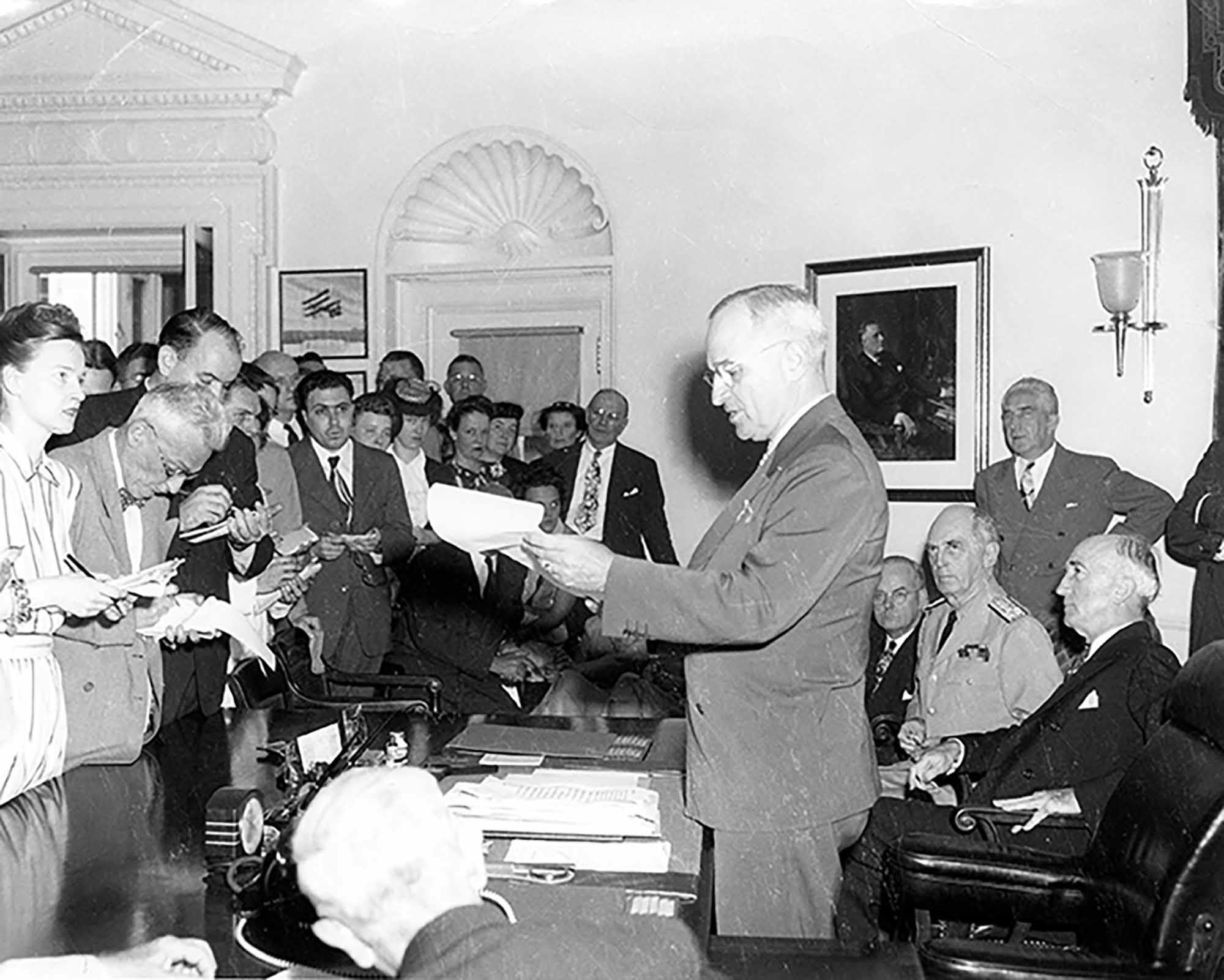
Photo, Abbie Rowe, President Harry S. Truman announcing the surrender of Japan, ending World War II, to assembled reporters in the Oval Office. August 14, 1945.National Park Service. Harry S. Truman Library.
When President Franklin D. Roosevelt ran for his fourth term, he chose a new candidate for vice president: Harry S. Truman, the Democratic senator from Missouri. They won and were inaugurated in January 1945. Three months later, Roosevelt died, and Truman became America’s 33rd president. He said later that he had never expected or wanted to be in this weighty role. But there he was, with World War II still going on. “I felt like the moon, the stars, and all the planets had fallen on me.”
Harry Truman was born and raised in Missouri. He graduated from high school in 1901 at a time when most boys did not complete high school and many did not start it. (Among white children, girls were more likely to attend high school than boys. Most African American children at the time received little or no formal education.) Truman later took some college courses, but he is the last American president who did not have a college degree. His political career began when he was elected a county judge in 1922. In 1934 he ran for and won his first term in the US Senate. He remained a senator until Roosevelt chose him to run as his vice president in 1944.
Roosevelt had led the United States throughout most of the war, but Harry Truman oversaw its end. He was president when Germany formally surrendered on May 8, 1945. He authorized the US military to drop atomic bombs on the Japanese cities of Hiroshima and Nagasaki in August. Japan announced its surrender days later. Victory celebrations erupted in towns and cities across America.
After the war, Americans were relieved and exhausted. They wanted soldiers to be back home and for life to get back to normal. They wanted especially to stay out of any the future wars. In the midterm elections in 1946, Republicans won overwhelmingly because they vowed to keep the country focused at home and removed from international problems.
But there was a serious international problem. The Soviet Union, under its leader Josef Stalin, was breaking promises it had made at the close of the war. The United States, Great Britain, France, and the Soviet Union had been allies. When they won, each of them agreed to take responsibility for part of the territory seized by Germany and Japan. They would keep the peace in the zones they occupied and would help these areas recover and establish democratic governments. But the Soviet Union installed repressive communist governments in the countries within its zone: Poland, Hungary, Bulgaria, eastern Germany, and Romania. The governments of Yugoslavia and Albania were not part of the Soviet zone, but they were communist and loyal to the Soviet Union. Stalin now had a solid foothold in eastern Europe, and he planned to spread further, into Greece and Turkey.
The State Department is the branch of the US government that deals with America’s role in world affairs. It monitored the spread of communism in Europe with increasing alarm. At the State Department’s urging, President Truman scheduled a speech to both houses of Congress on March 12, 1947. He would talk about Soviet aggression and offer a plan for dealing with it.
In the weeks before the speech, White House aides and State Department personnel met with members of Congress and the press. They described what the Soviets were doing and how dangerous these actions were to the United States and the whole world. They sent a consistent message: communism was spreading, the situation was critical, and the United States needed to act. Newspapers began to cover events in Greece and Turkey from the perspective of the White House. Meanwhile, State Department staff worked with the White House to help write and revise the president’s speech.
Harry Truman was a savvy politician, thoughtful and decisive. Some said he had the common touch and could really connect with ordinary Americans. But as a speaker, many people found him bland, especially after the fiery, charismatic Roosevelt. Truman said that oratory wasn’t good for politicians. His rule was: keep it simple, use short sentences, and don’t be boring. That was the best way to convince people. Truman said the president needed to be the greatest PR (public relations) man in the world. “He’s got to make the country believe that what he wants to do is the proper thing.” With communism spreading, Truman needed to be a truly great PR man. He had to sell a bold new foreign policy to Congress and the public when neither wanted it.
Truman spent weeks preparing, but in the days before the speech, he became ill. He was tired, suffered fits of coughing, and had trouble breathing. His doctor diagnosed a serious heart problem that was affecting his lungs. Truman wrote in his diary, “makes no diff, will go on as before.” So on the morning of March 12, 1947, President Truman was driven from the White House to the Capitol to address Congress. Immediately after the speech, he traveled to Florida to recuperate in the sun’s warmth. He wrote to his wife, Bess, “I had no idea I was so tired. I have been asleep most of the time.” Despite the doctor’s diagnosis, Harry Truman recovered and lived another 25 years.
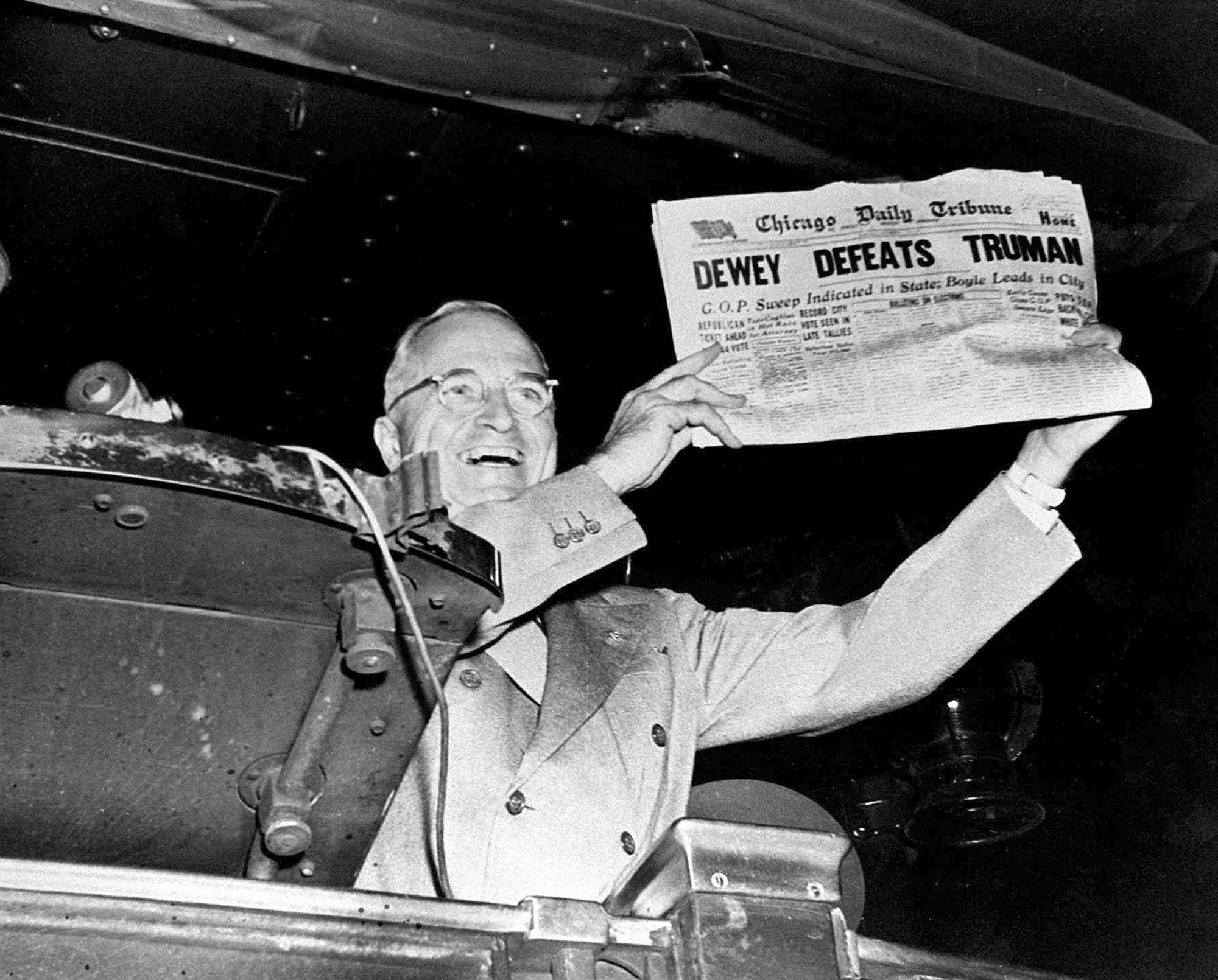
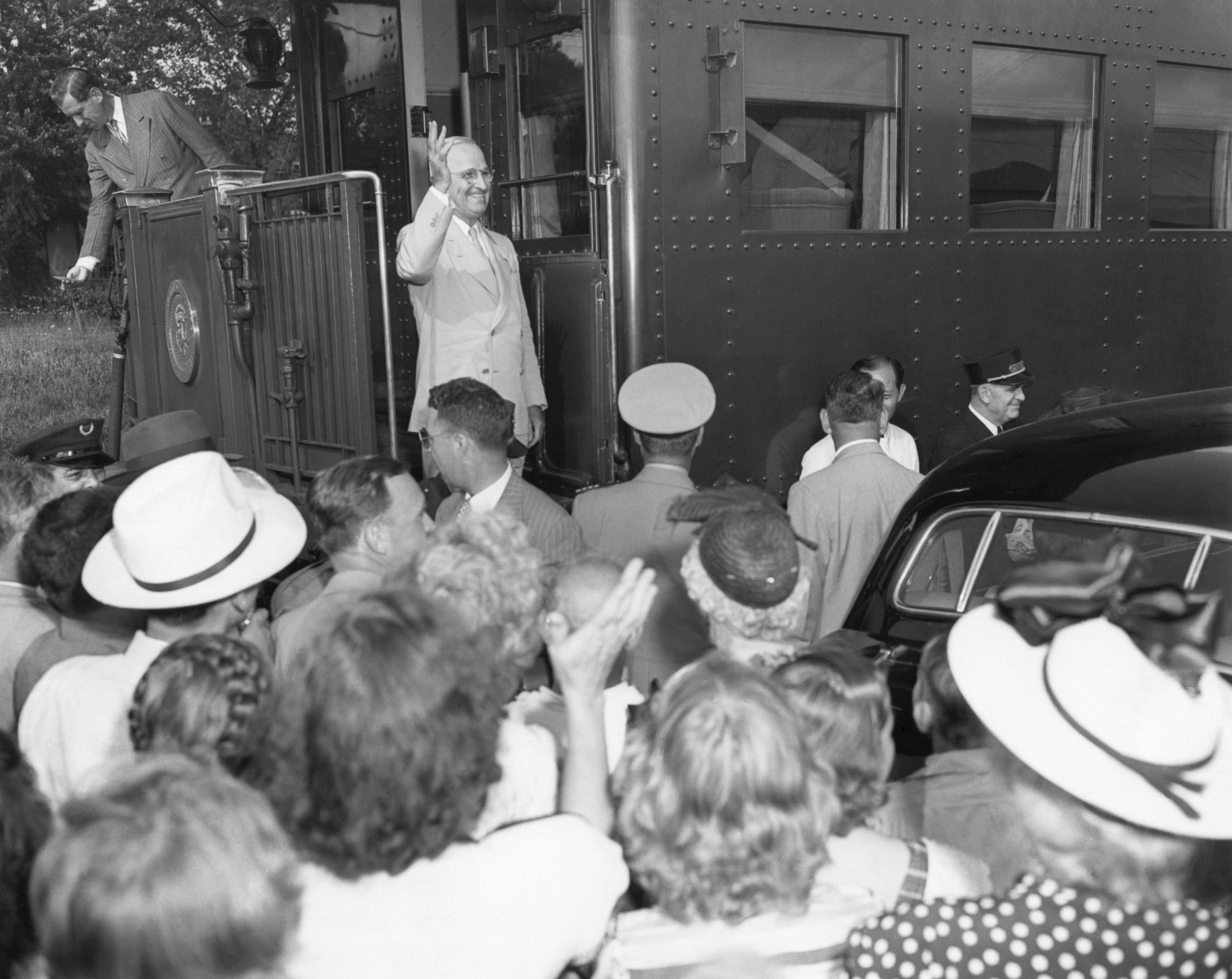
Most Americans supported Truman’s plan for dealing with the spread of communism, but they blamed him for labor strikes and a bad economy. When he ran for reelection in 1948, almost no one thought he would win. His opponent, Thomas E. Dewey, was so sure of being elected that he barely campaigned. Truman, by contrast, traveled tirelessly by rail, waving to crowds and greeting voters. People still expected a Dewey victory, and one newspaper even declared it, inaccurately, in a huge headline. But Truman won, and Democrats regained both houses of Congress.
President Truman began his second term with an ambitious domestic agenda, and he succeeded in expanding some programs from Franklin D. Roosevelt’s New Deal. But he was presiding over different times, and many of his domestic efforts failed. Americans were focused on the threat of communism. President Truman had not used the phrase “Truman Doctrine” in his 1947 speech, but his foreign policy became known by this name. He followed it throughout his presidency. In 1948, he began supporting the French in their efforts to hold Indochina (now known as Vietnam, Laos, and Cambodia), against communist insurgents. In 1950, after mainland China fell to a communist takeover, Truman sent troops to South Korea after an invasion by the communist North.
The Truman Doctrine remained the established US foreign policy until the cold war ended in 1990. The United States and the Soviet Union never engaged in a “hot war” in their own countries. But they challenged each other in what were called proxy wars, fought on other nations’ soil. Presidents after Truman were following this doctrine when they engaged the US in the long, unsuccessful war to keep South Vietnam a noncommunist state.
- aggression
Hostile action.
- authorized
Approved.
- charismatic
Charming, inspiring.
- Cold War
The struggle between the United States and the Soviet Union, as well as each country’s allies, lasting from the 1940s to 1990.
- diff
Difference.
- midterm elections
Congressional elections held in the middle of a president’s four-year term.
- oratory
Powerful, often emotional, public speeches.
- PR
Public relations, the use of communication skills to persuade or to create a good impression.
- proxy war
A conflict directed or funded by a country but fought elsewhere.
- savvy
Smart, clever.
What were Harry Truman’s important personal traits? How did they serve him in his role as president?
What is foreign policy? Why were Americans more interested in life at home immediately after the war? What accounted for the interest in foreign policy in the late 1940s?
How did the Truman administration try to persuade Americans to take a bold new direction in dealing with world events?
The Truman Doctrine speech is considered one of the best examples of presidential opinion leadership. What do you think that means? Why is public opinion important?
Compare Harry Truman’s life story to Ronald Reagan’s. How did each president show leadership in a time of crisis? What personal beliefs and experiences were important?
Watch a current or historical presidential speech. How does this president communicate? What kind of language is used? What makes it persuasive, or not? How do you think people reacted to it?
Watch a television nightly news report. Ignoring the ads, analyze how the time is spent on foreign affairs. How much time is devoted to events happening in the United States versus events around the world?
Resource: Understanding the Soviet Threat
This document excerpt comes from President Truman’s Special Counsel, Clark Clifford, who was asked to analyze the Soviet Union’s broken agreements with the West in 1946.
The fundamental tenet of the communist philosophy embraced by Soviet leaders is that the peaceful coexistence of communist and capitalist nations is impossible. The defenders of the communist faith, as the present Soviet rulers regard themselves, assume that conflict between the Soviet Union and the leading capitalist powers of the western world is inevitable. . . .
The leaders of the communist Soviet Union believe that they can never live in peace with the capitalist countries. They think war is inevitable.
Generalissimo Stalin and his associates are preparing for the clash by many means, all of them designed to increase the power of the Soviet Union. . . . Beyond the borders now under her control, the Soviet Union is striving to penetrate strategic areas, and everywhere agents of the Soviet Government work to weaken the governments of other nations and to achieve their ultimate isolation and destruction. . . .
Stalin and his government are doing all they can to prepare for war. They are seizing territory and trying to weaken other countries.
The Near East is an area of great strategic interest to the Soviet Union because of the shift of Soviet industry to southeastern Russia, within range of air attack from much of the Near East, and because of the resources of the area. The Soviet Union is interested in obtaining the withdrawal of British troops from Greece and the establishment of a “friendly” government there. It hopes to make Turkey a puppet state which could serve as a springboard for the domination of the eastern Mediterranean.
The Soviet Union wants to control Greece and Turkey and then all of the eastern Mediterranean.
Clark Clifford, “American Relations with the Soviet Union,” September 24, 1946. Harry S. Truman Presidential Library and Museum, National Archives and Records Administration.
The fundamental tenet of the communist philosophy embraced by Soviet leaders is that the peaceful coexistence of communist and capitalist nations is impossible. The defenders of the communist faith, as the present Soviet rulers regard themselves, assume that conflict between the Soviet Union and the leading capitalist powers of the western world is inevitable. . . .
Generalissimo Stalin and his associates are preparing for the clash by many means, all of them designed to increase the power of the Soviet Union. . . . Beyond the borders now under her control, the Soviet Union is striving to penetrate strategic areas, and everywhere agents of the Soviet Government work to weaken the governments of other nations and to achieve their ultimate isolation and destruction. . . .
The Near East is an area of great strategic interest to the Soviet Union because of the shift of Soviet industry to southeastern Russia, within range of air attack from much of the Near East, and because of the resources of the area. The Soviet Union is interested in obtaining the withdrawal of British troops from Greece and the establishment of a “friendly” government there. It hopes to make Turkey a puppet state which could serve as a springboard for the domination of the eastern Mediterranean.
Clark Clifford, “American Relations with the Soviet Union,” September 24, 1946. Harry S. Truman Presidential Library and Museum, National Archives and Records Administration.
The Soviet Union fought alongside the Allies during most of World War II. But the United States, Great Britain, and France were western countries with much in common. They did not trust their Soviet partner, an eastern country, or the ambitions of its leader, Josef Stalin. When the war ended, the mistrust grew. The Allies agreed to divide the former Nazi territory in Europe into four zones, each occupied by one of the four Allies. The Soviet Union’s zone included the countries closest to its border: Hungary, Poland, Romania, Bulgaria, and eastern Germany. It promised to hold free elections in these countries, but instead it installed communist dictatorships under Soviet control. Yugoslavia and Albania also had communist governments that identified with the Soviet Union.
Winston Churchill, former prime minister of Great Britain, warned in March 1946 that an “iron curtain had descended across the Continent.” The phrase “iron curtain” captured western countries’ view of the Soviet Union’s repressive techniques and its powerful ruler. In the United States, President Harry Truman monitored Soviet actions with increasing alarm.
In July 1946, President Truman asked Clark Clifford to analyze the Soviet Union’s broken agreements with the West. Clifford was Special Counsel to the President. After two months, he submitted an 81-page report. Truman insisted on keeping it secret because if it leaked, he said, “the lid would blow off the White House.” He meant that the shocking findings would so inflame the public that it would be impossible for him to work behind the scenes to control Soviet aggression. The report remained secret for two decades. These passages are from Chapter 1.
- capitalist
Refers to a system in which industry is owned and controlled privately, rather than by the government.
- coexistence
Living or existing together.
- communist faith
Refers to the belief that a country’s industry should be owned and controlled by the state, not by private parties who make a profit. Communism is a political system and a form of government, not a religion.
- eastern
Refers to nations in eastern Europe, Asia, and the Middle East; also referred to collectively as “the East.”
- Generalissimo
The highest military rank in the Soviet Union.
- Near East
An outdated term for the area that stretched from Turkey and Egypt to Iran. The term was based on the perspective of Europe and America, known as “the West.” The Near East is now known as the Middle East.
- philosophy
A system of belief, or a way of understanding the world.
- puppet state
A country controlled by a more powerful nation.
- Soviet Union
A shortened name for the Union of Soviet Socialist Republics. From 1945 to 1991, this vast area stretched from Germany to Japan. Russia was the controlling country, and the capital was Moscow.
- Special Counsel to the President
In Truman’s time, a senior adviser who provided policy guidance to the president; today, the White House Counsel has comparable responsibilities.
- strategic
Having military importance.
- tenet
A belief or conviction.
- western
A reference to the United States, Canada, New Zealand, Australia, and western Europe; also referred to as “the West.”
In your own words, summarize what Clifford was telling the president. What was his main message?
As you read the passage now, what strikes you as the most concerning information? How do you think Americans would have reacted if the report had been made public?
Communism is not a religion. Why would Clifford refer to the “communist faith”? What was he saying about how people from the Soviet Union thought and felt?
On a map, such as this one, identify Russia and the countries the Soviet Union controlled after World War II. Find Turkey and Greece. Based on geography, why would the Soviet Union want to control these two countries? What would it gain by dominating eastern Mediterranean countries? Why would western countries be worried?
Combine this map activity with the newsreel footage in The Truman Doctrine. Based on these materials, what was the role of the United States in global events after World War II? What was the president’s role in world affairs? How would you define those roles today?
Resource: The Truman Doctrine
A newsreel focused on the speech Truman gave to Congress in 1947 laying out his strategy for stopping the spread of communism.
Truman’s Speech to Congress! March, 1947. Courtesy of the Sherman Grinberg Film Library, Issue #58.
After World War II, Greece and Turkey both faced increasing pressure from the Soviet Union to become communist states. Great Britain and the United States provided both countries with economic and military assistance to meet this pressure. When Britain could no longer afford to continue this aid, President Truman saw the US as the world’s only hope for stopping Soviet aggression. He had a strategy for doing this, ultimately called the Truman Doctrine. It called for the US to send money and military assistance to any country facing Soviet threats.
But World War II had ended only recently, and war-weary Americans wanted no part of other countries’ problems. Congress was controlled by Republicans, and President Truman was a Democrat. So in the weeks before the speech, the White House and the new Public Affairs office in the State Department laid the groundwork with a coordinated campaign. They met with members of Congress, visited influential people who could lead public opinion, spoke with reporters at major newspapers, all with a consistent message: the situation in Greece and Turkey was dire, and the United States had to act.
When President Truman addressed a joint session of Congress on March 12, 1947, his job was to leave no doubt about the rightness of his plan.
Americans could listen to Truman’s speech on the radio and read about it in the papers, but they could not see him standing before Congress. Television news did not yet exist, and almost no one owned a TV. But people did go to the movies regularly. And at the movies, they saw newsreels, short black-and-white films shown before the feature. Newsreels typically included a “hard news” story as well as one or two lighter items, but this particular newsreel focused entirely on Truman’s speech to Congress. It was produced by Paramount News, which distributed two new newsreels weekly, to all the Paramount movie theaters in the United States.
This newsreel used selected passages from the president’s speech. The complete transcript is available here.
- Balkans
The countries on the Balkan Peninsula. They included Greece and Turkey as well as Albania, Yugoslavia, Bulgaria, and Romania, which were aligned with the Soviet Union.
- coercion
Force or oppression.
- collaborator
A traitor, or someone who cooperates with an enemy.
- Dardanelles
One of the two straits that provide the only way for ships to travel from the Black Sea to the Mediterranean. The other is the Bosphorus. Both straits are within Turkish borders.
- Mussolini
The leader of Italy during World War II, when Italy was allied with Germany.
- outflanked
Threatened, at risk of attack.
- right and left
Refers to people with opposing political views. In general, people on the left are more liberal, and those on the right are more conservative. In the time of the Truman Doctrine, communists and those allied with the Soviet Union were considered to be on the left. Those on the right were the governments of Greece and Turkey and their supporters.
- profiteer
A person who makes profits by selling scarce goods at high prices.
- provocateur
An agitator, or someone who makes trouble.
- totalitarian
A form of government that exercises complete control over its citizens.
- tubercular
Suffering from tuberculosis, a bacterial infection of the lungs.
- Wehrmacht
Nazi Germany’s armed forces before and during World War II.
What is the point of view of the newsreel? Is it for or against the Truman Doctrine? How can you tell?
The newsreel spends roughly the same amount of time on the Greece and Turkey footage as it does on Truman’s speech to Congress. Why do you think the editors made that choice?
After watching this newsreel, what emotions do you think moviegoers felt?
How does the newsreel present the story of ordinary people in Greece? Why was it important to include them? What would their story have communicated to moviegoers?
The full text of the Truman Doctrine speech can be read here. Ask students to compare the complete speech to the newsreel. What parts did the newsreel omit? Why did the newsreel producers include the parts they did? In the full speech, how did Truman position the United States as a world leader?
Great Britain produced its own newsreel about Truman’s speech, from the British perspective. Watch it here. How was the message for British audiences different from the message for those in the United States? What do those messages suggest about America’s role in the world after the Truman Doctrine?
How do people get their news today? Pick a news source—TV nightly news, newspapers, online platforms, etc. Analyze six or seven lead stories from one day’s news. Keep a list of each story’s subject, the time allotted to it, the video or images used, and the role of the journalist. Were these stories about local, domestic or international news? What differences do you notice between this coverage and the Truman Doctrine newsreel? How should the public learn about events that affect them?
Resource: Responding to Truman's Speech
A collection of political cartoons and comic book pages that illustrate early reactions to the Truman Doctrine speech.
Where To? 1947. Granger Historical Picture Archive, 0034161.
Reactions to the Truman Doctrine speech were mostly positive. Congress approved the money Truman requested to help Greece and Turkey. Newspaper editorials acknowledged there were risks to the president’s plan but said the danger was great and the risk must be taken. Polls showed that most Americans supported the president, although they wished the United Nations would take a greater role.
Despite the support for Truman’s plan, nearly everyone recognized that it took the country in a new, costly, and dangerous direction. And it was not guaranteed to stop Stalin.
Political cartoons, like the two in this unit, can exaggerate, ridicule, and convey what cannot be said as easily in a different format. They are sometimes, but not always, funny, and they are meant mostly for people who follow the news closely. During the Cold War, political cartoons expressed the terrible anxiety Americans lived with, as well as their expectations of and dissatisfactions with world leaders.
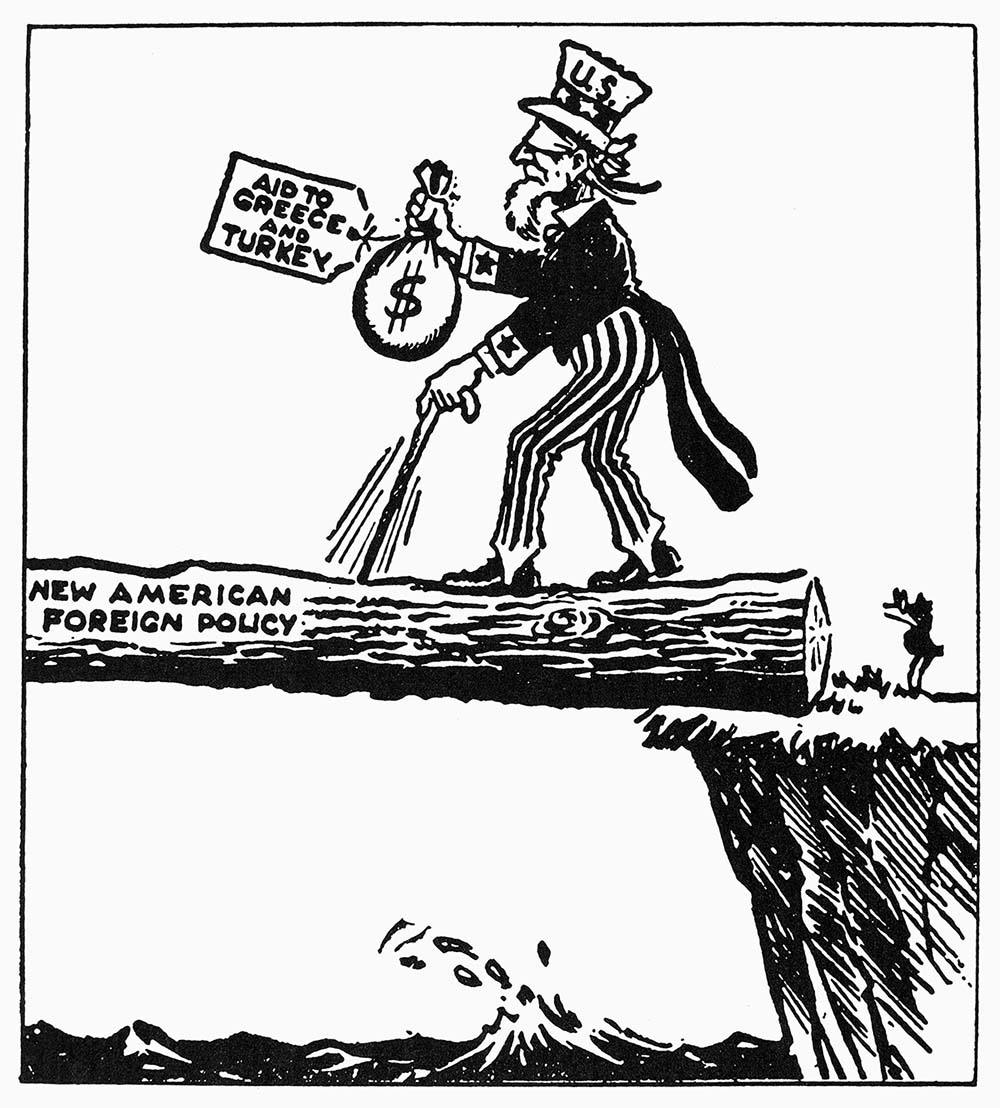
Item 1 is a political cartoon that appeared in the United States in 1947. Uncle Sam is handing over a big bag of money to Greece and Turkey while walking blindly into the unknown. It vividly captures, and magnifies, the peril many saw in President Truman’s plan.
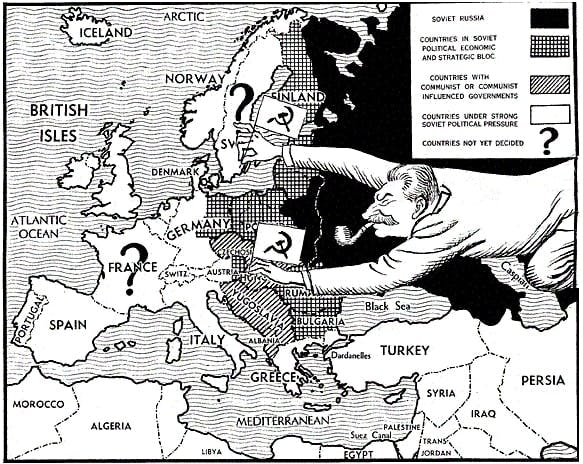
Item 2 appeared in a British newspaper three months after Truman’s speech to Congress. It shows Stalin greedily reaching for control of Europe. It supports the need for the Truman Doctrine, and it also illustrates the enemy’s power and Europeans’ fear.
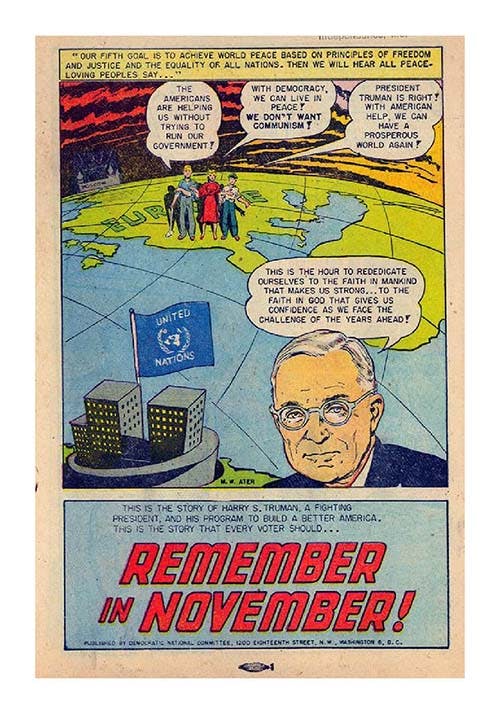
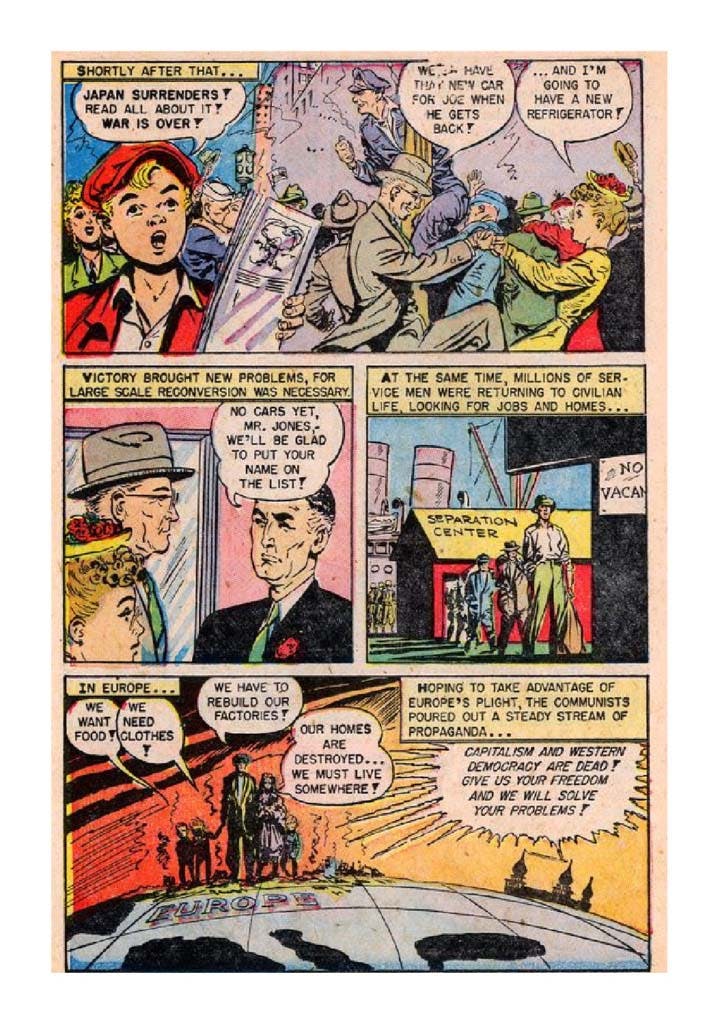
Item 3 is page 12 of The Story of Harry S. Truman, a 16-page comic book biography. Comic books were a popular form for children and teens. But this one was produced for voters during Truman’s 1948 election campaign. This page captures some of the realities faced by the United States and Europe after the end of World War II.
Item 4 is the final page of the same comic book. The previous page presented the first four of the president’s goals for his next term. Voters usually care most about what happens at home, so these focused on human rights, education, housing, and the economy. Only the fifth goal had a page to itself, and it was entirely about the promise of the Truman Doctrine. The president, and many in America and abroad, already viewed this new direction in foreign policy as his great achievement. Truman was widely expected to lose his bid for another term in 1947, but he won.
- bloc
A group of countries united by shared purpose or politics. The term “eastern bloc” was used in the West to identify the eastern European countries that were under Soviet control.
- Soviet Russia
Russia was by far the largest country in the Soviet Union. So people sometimes referred to Russia, or Soviet Russia, to represent the entire Union of Soviet Socialist Republics.
Examine and compare items 1 and 2. Based on these images, how were Americans feeling about the Truman Doctrine in the months after the speech? How were people in Europe feeling?
How does Item 3 portray the Truman Doctrine as a success? What words and images carry this message?
Examine Item 4 specifically. How was the postwar period presented on this page? What was happening in America? What was happening in Europe?
Political images make their point by being one-sided. Item 1, for example, is about fear and doubt. Item 2 is about present and future danger. Item 3 is about confidence and hope for the future. Item 4 stresses the very different problems faced by Americans and Europeans. Ask students to draw an image or make a collage that tells a more complete story of the Truman Doctrine.
Consider all the materials in the Truman section together: the life story, and Resources 2, 3, and 4. How would you define President Truman’s leadership qualities? What effect did they have on the United States and the world? How did they affect the American people and people around the world?
Life Story: Ronald Reagan
The story of the president who served from 1981–1989 and who consoled the nation after the shocking loss of the space shuttle Challenger.

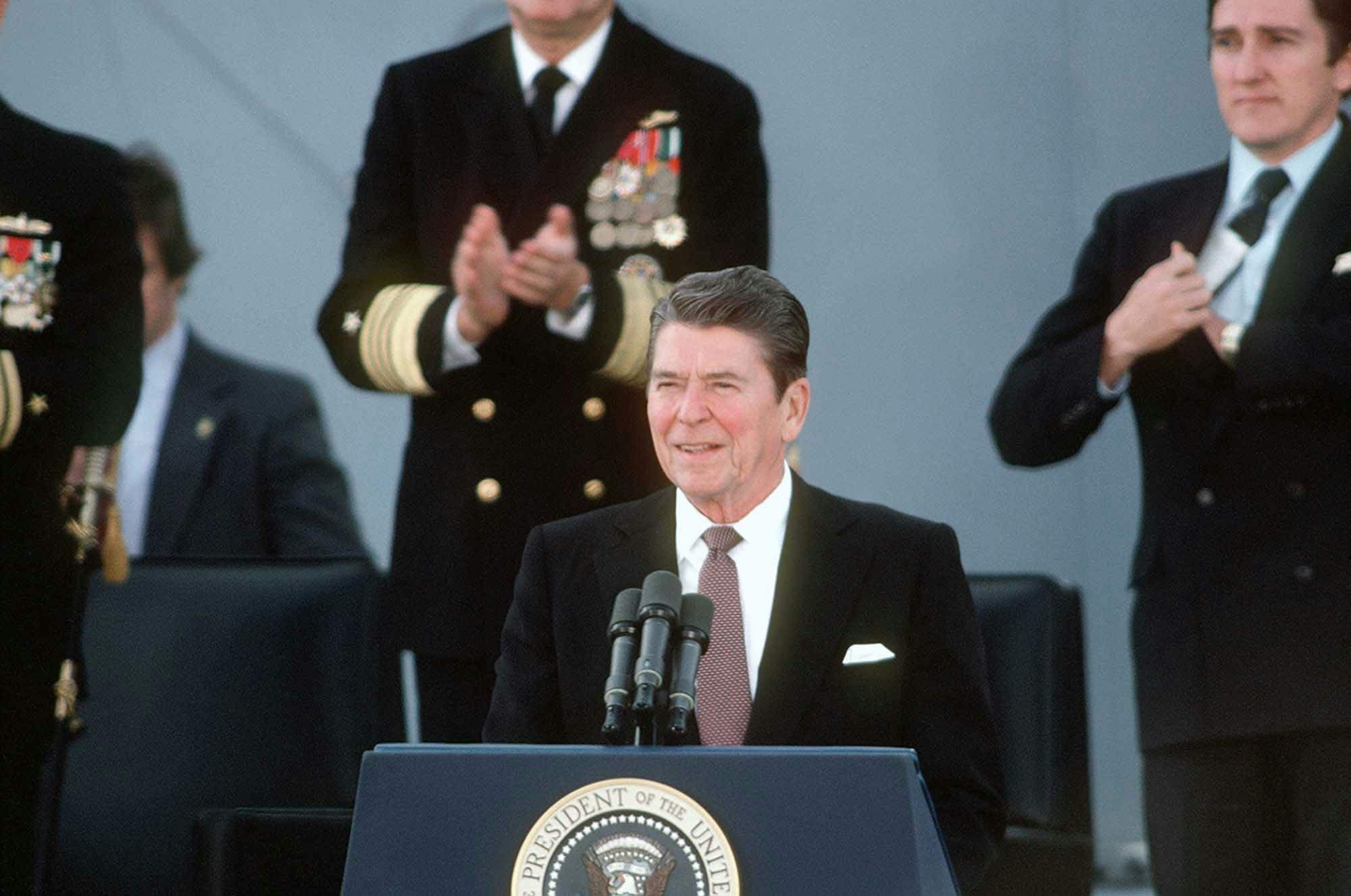
President Ronald Reagan, principal speaker, addresses the guests attending the recommissioning ceremony for the battleship USS NEW JERSEY, December 28, 1982. World Politics Archive /Alamy Photo.
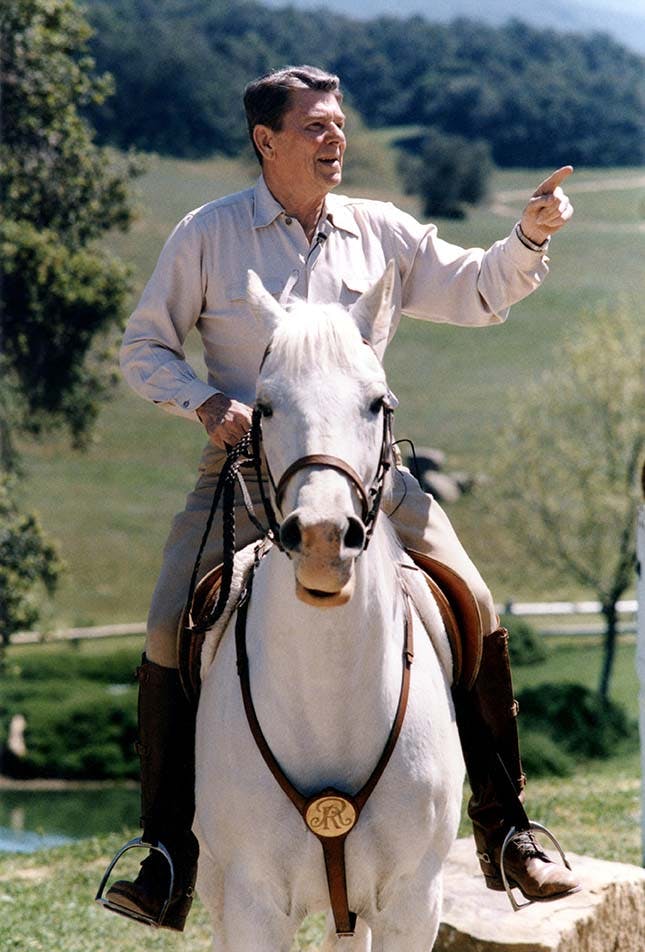
Ronald Reagan had a bumpy childhood. His father was a heavy drinker, money was scarce, and the family moved often. But he always had an optimistic outlook on life. In high school and college in his home state of Illinois, he loved drama and sports. He acted in school plays and worked as a lifeguard. Combining both interests after college, he became a popular sports announcer for an Iowa radio station. Listeners thought he sounded warm and genuine.
Reagan was covering a sports story in California in 1937 when he took a screen test for Warner Brothers, one of the major movie studios at the time. He was tall, good-looking, and skilled at using his voice. He won a Warner Brothers contract and spent the next three decades as a movie actor. He played cowboys, war heroes, athletes, goofy comic roles, and romantic leads. He was never a major star, but he made dozens of movies and was familiar to most Americans. His best-known role was in the 1940 movie biography Knute Rockne, All American. Reagan played George Gipp, a college football player coached by Rockne. The real Gipp died young, and in the deathbed scene, Reagan delivered a line meant to spur on his teammates: “Win one for the Gipper.” Later, as a politician, he used the phrase often.
After World War II, Reagan’s film career tapered off. But he hosted and sometimes acted in a television program called General Electric Theater. In this role, he introduced himself and the program viewers were about to see. This show kept him in front of the public for the eight years of its run. And it gave him experience projecting an appealing, friendly face to a TV audience. He was working from a script, but it wasn’t obvious. He seemed to be speaking as himself.
During the Depression, Reagan’s father had found work through the New Deal program of President Franklin D. Roosevelt. A grateful young Reagan spent several years as a liberal Democrat and was a lifelong fan of FDR. But over time he turned away from liberalism, which he blamed for the country’s social problems. By the time he retired from acting in the 1960s, he was a committed conservative Republican. He was firmly anticommunist and thought big government programs were destroying traditional American values. He believed that people should stand tall and take care of themselves.
Reagan worked on the 1964 presidential campaign of conservative Arizona senator Barry Goldwater. Goldwater lost the election, but influential conservatives saw Reagan’s promise. He was well-known and comfortable in front of a camera. His disposition was sunny, he smiled easily. He was witty and quick with wisecracks and jokes, often at his own expense. People liked him, even if they didn’t agree with him. At the urging of conservative Republicans, he ran for governor of California. He won in 1966 and served two terms. He remained a public figure after he left office, writing columns and doing radio programs.
Americans became deeply disappointed with their presidents in the 1970s. The Watergate scandal forced Richard Nixon to resign. Gerald Ford’s pardon of Nixon outraged many voters. And Jimmy Carter was seen as ineffective in addressing the many challenges that the United States faced during his presidency. When Ronald Reagan ran for president in 1980, he seemed to offer the big change voters wanted. Many welcomed his conservative philosophy and saw him as the hero he had often played. He easily defeated Jimmy Carter’s run for reelection.
President Reagan was one year into his second term when the space shuttle Challenger blew apart after takeoff and burst into flame. In the White House, a stunned Reagan shifted gears from the State of the Union speech he was preparing to deliver to Congress that night. He huddled with aides and spoke with staff at NASA, the National Aeronautics and Space Administration. He met, as planned, with the anchors of TV news shows. But they spoke of the Challenger, not the State of the Union. One of the president’s aides took notes of what he said during this meeting and delivered those notes to speechwriter Peggy Noonan. The president’s thoughts formed the spine of the speech she was writing for him. Noonan spent the next hours crafting the speech around the spine, and President Reagan delivered it that afternoon. When he finished, he was disappointed, not in the words but in his delivery. But, though he thought he had failed to meet the moment, it is now considered one of the great presidential speeches.
Reagan’s presidency changed the mood of America and energized the conservative movement. It also survived a serious scandal. In his first term, President Reagan authorized a complicated and illegal scheme to sell military equipment to Iran, which Congress had declared a State Sponsor of Terrorism. The money from the secret sale went to support anticommunist insurgents, called contras, in Nicaragua. When news of the Iran-contra deal leaked late in 1986, the administration lied to cover it up, and the scandal grew worse. Eventually the president fired people on his staff and apologized to the public, though he never acknowledged his role.
President Reagan’s reputation was bolstered when he took a hard stance against the Soviet Union in his first term and then held four summit meetings with Soviet leader Mikhail Gorbachev from 1985 to 1988. Gorbachev knew his country was in decline. In December 1987, the two leaders signed an agreement to reduce the number of intermediate-range missiles held by the two countries. Mr. Reagan left office in 1989. Within two years, the Soviet Union had dissolved and the cold war was over.
President Reagan suffered from Alzheimer’s disease for the last decade of his life. He died at the age of 93 in 2004.
- Alzheimer’s disease
An illness that kills brain cells and causes memory loss.
- anchor
The on-air host of a news program on television.
- Jimmy Carter
A Democrat, president from 1977 to 1981.
- Cold War
The struggle between the West and the Soviet Union from the 1940s to 1990.
- Gerald Ford
A Republican vice president who became president when Richard Nixon resigned; he served 1974–1977.
- intermediate-range missiles
Weapons with a range of 300 to 3,400 miles.
- Iran
A country in the Middle East, declared a State Sponsor of Terrorism by Congress in 1984.
- NASA
National Aeronautics and Space Administration, the federal agency that oversees the US space program.
- New Deal
President Franklin D. Roosevelt’s program to bring economic relief to Americans during the Depression.
- Nicaragua
A country in Central America.
- Richard Nixon
A Republican, president from 1969 to 1974; he resigned under threat of impeachment over the Watergate scandal.
- optimistic
Hopeful, confident, cheerful.
- Franklin D. Roosevelt
A Democrat, president from 1933 to 1945; he served through the Depression and World War II.
- screen test
A short film made to test an actor’s skills.
- Soviet Union
A shortened name for the Union of Soviet Socialist Republics. From 1945 to 1991, this vast area stretched from Germany to Japan. Russia was the controlling country, and the capital was Moscow.
- space shuttle
A spaceship that can carry people or satellites into space.
- Watergate scandal
The wrongdoing discovered after the June 1972 break-in at the Democratic National Committee headquarters in the Watergate building in Washington, DC. Investigators uncovered abuses of power by the Nixon administration, which ultimately led President Nixon to resign from the presidency.
How did Ronald Reagan’s personal and professional past prepare him for the presidency?
President Reagan and President Truman each faced a crisis that demanded presidential leadership. How were those crises different? How did each president respond?
How do you think Reagan would have defined presidential leadership? What did he think his duty was after the spectacular failure of the Challenger mission?
If the explosion had not been so widely seen by the American public, what do you think the president’s response might have been?
Watch the Challenger speech in light of the president’s career as an actor and host of a television program. How would you describe his delivery? Why do you think it’s seen as a great speech?
Compare Harry Truman’s life story to Ronald Reagan’s. How did each man’s background prepare him to lead during a crisis?
Even during times of crisis, presidents face a wide array of other issues. Research the diaries kept by President Reagan from January 27, 1986, the day before the Challenger disaster, to February 3, 1986. What other topics was the president thinking about during the course of the week? What evidence do you see of the president’s normal daily life?
Every presidential speech is a kind of performance. Compare President Truman’s speech before Congress to President Reagan’s televised Challenger speech. What did each president try to accomplish? How did he describe the crisis the country faced and his suggestions for dealing with it? Analyze the setting, language, voice, facial expression, and gestures.
Resource: A Space Shuttle Explodes and the President Responds
A photograph of President Reagan watching television coverage of the Challenger disaster and his diary entry from later that evening, which reveals how he responded to the space shuttle’s explosion.
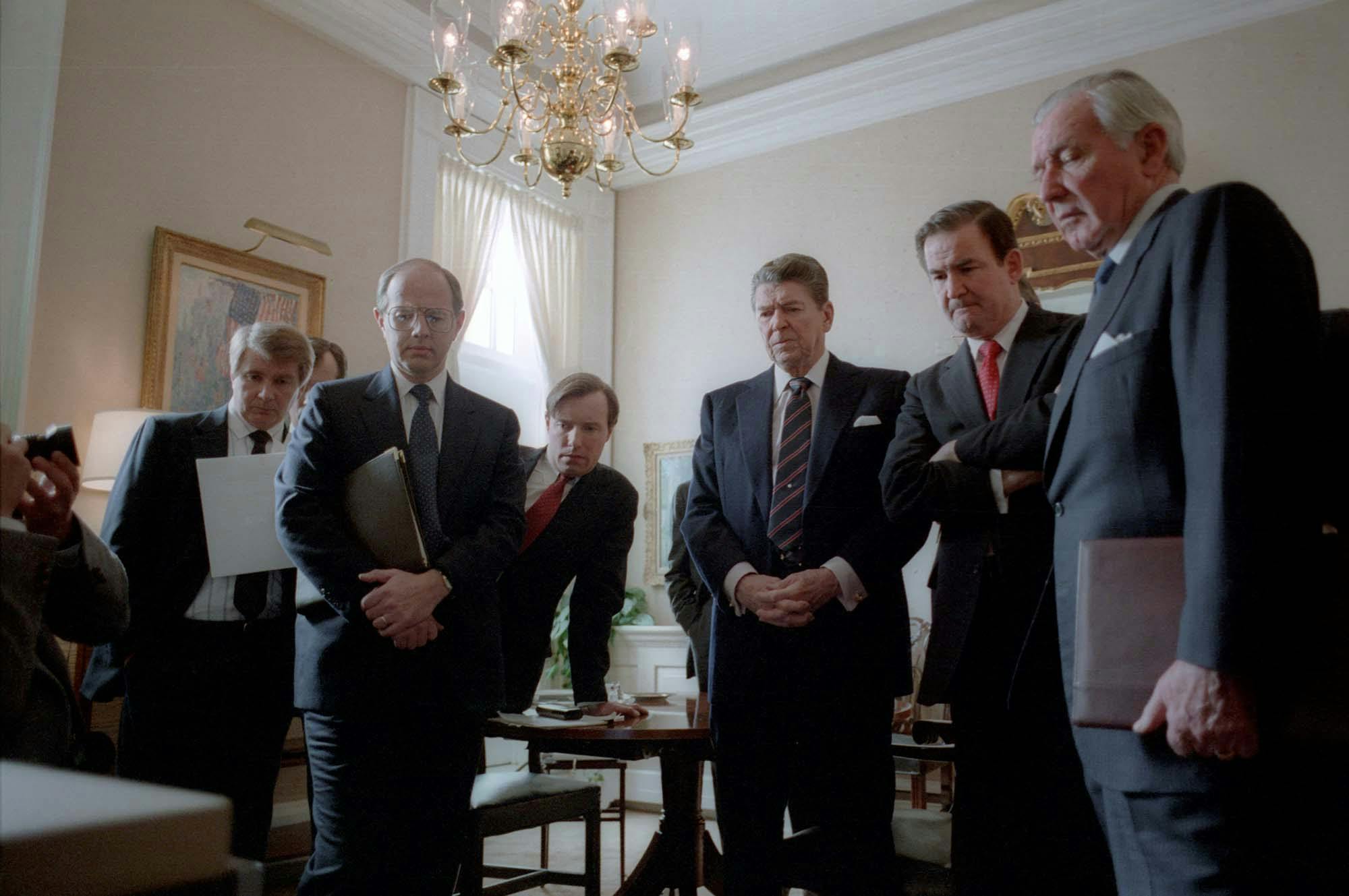
Photo, Pete Souza. President Reagan and aides watch television coverage of the Challenger disaster. January 28, 1986. Courtesy Ronald Reagan Presidential Library/National Archives and Records Administration; White House Photographic Collection and the Ronald Reagan Presidential Foundation and Institute.
A day we’ll remember for the rest of our lives. Started off with a staff meeting & then a session with the Cong. Leadership of both parties. Had a go around with Tip—think I came out pretty good. Then Sen. Murkowski brought in a family of 4 just recently united here in Am. An American husband, his Vietnamese wife & their 2 children who had been held in Vietnam.
We’ll never forget this day. I had several meetings in the morning.
Then I was getting a briefing for a meeting I was to have with network anchors—an advance on the St. of the Union address scheduled for tonight. In came Poindexter & the V.P. with the news the shuttle Challenger had blown up on takeoff.
I was getting information for a later meeting when we learned that the space shuttle Challenger had blown up.
We all then headed for a T.V. & saw the explosion re-played. From then on there was only one subject—the death of the 6 crew & 1 passenger—Mrs. McAuliffe the teacher who had won the right to make the flight. There is no way to describe our shock & horror.
We watched TV coverage in shock. All we could think of was the seven people who died, including Christa McAuliffe. She was the teacher on board.
We cancelled—I should say postponed the St. of the Union address til next week. Cong. closed down for the day.
I postponed the State of the Union speech to next week. Congress closed for the day.
Nancy’s brother Dick, Patty & son Geoff were already on their way here for the speech—also Maureen was here. Well they’ll all be back next week.
Family members were in Washington, or on their way, to hear the State of the Union speech. They will come back for that speech next week.
White House Diaries, January 28, 1986. Courtesy Ronald Reagan Presidential Library/National Archives and Records Administration.
A day we’ll remember for the rest of our lives. Started off with a staff meeting & then a session with the Cong. Leadership of both parties. Had a go around with Tip—think I came out pretty good. Then Sen. Murkowski brought in a family of 4 just recently united here in Am. An American husband, his Vietnamese wife & their 2 children who had been held in Vietnam.
Then I was getting a briefing for a meeting I was to have with network anchors—an advance on the St. of the Union address scheduled for tonight. In came Poindexter & the V.P. with the news the shuttle Challenger had blown up on takeoff.
We all then headed for a T.V. & saw the explosion re-played. From then on there was only one subject—the death of the 6 crew & 1 passenger—Mrs. McAuliffe the teacher who had won the right to make the flight. There is no way to describe our shock & horror.
We cancelled—I should say postponed the St. of the Union address til next week. Cong. closed down for the day.
Nancy’s brother Dick, Patty & son Geoff were already on their way here for the speech—also Maureen was here. Well they’ll all be back next week.
White House Diaries, January 28, 1986. Courtesy Ronald Reagan Presidential Library/National Archives and Records Administration.
On January 28, 1986, at 11:38 a.m., the space shuttle Challenger lifted off as expected from Cape Canaveral—later renamed the Kennedy Space Center—in Florida. Seven astronauts were on board. One was teacher Christa McAuliffe, and her presence made the flight special. During their six-day mission, she was to teach lessons from space. So in classrooms around the country, children and teachers watched the TV coverage of the launch. So did huge crowds at Cape Canaveral. About a minute after takeoff, a fireball could be seen in the sky, and then a twisting, curling plume of white smoke. The shuttle had broken apart and burst into flame. All seven astronauts died. President Reagan was in a meeting when he heard the news.
Ronald Reagan kept a daily diary throughout his presidency. He is one of the few US presidents to do so. He barely missed a day. He wrote in longhand, and the entries were short. He kept track of what he had done during the day and who he met with, but he also mentioned his golf games and his love for his wife, Nancy. He began the diaries with his inauguration in 1981, which he called “an emotional experience.” The last entry is dated January 20, 1989, the day he left office. All the diaries can be read here. They are collected in book form in The Reagan Diaries, edited by Douglas Brinkley, 2007.
As the president and aides watched the TV coverage of the Challenger disaster, photographer Pete Souza captured their expressions and body language. Souza was the official White House photographer in the administrations of Ronald Reagan and Barack Obama. In 2004, he wrote this remembrance of his years with President Reagan:
The president was comfortable with my presence and understood the historic value of documenting behind-the-scenes moments of his life on film. As a result of his trust, I had virtually unfettered access to the Oval Office. The only time he asked me not to photograph him was when I once saw him putting in his hearing aid.
Many of the moments I witnessed were extraordinary for their historical impact: consoling families whose loved ones were killed in the U.S.
Marines' Beirut barracks bombing attack in 1983. Agonizing over the Iran-contra debacle in late 1986 and early 1987. Grimacing while watching a rerun of the space shuttle Challenger explosion in January 1986. Storming out of a summit meeting with Soviet leader Mikhail Gorbachev in October of that same year.
Pete Souza. “President Reagan’s Shadow.” Digital Journalist, July 2004.
- briefing
A presentation of background information.
- Cong.
Congress.
- network anchors
The on-air hosts of nightly news programs on national television.
- Poindexter
John Poindexter, President Reagan’s national security adviser.
- space shuttle
A spaceship that can carry people or satellites into space.
- St. of the Union
State of the Union, the yearly speech that every president is required to make to Congress.
- Tip
Speaker of the House Tip O’Neill, a Democrat. O’Neill and President Reagan disagreed about politics, but they were friends and golf partners.
- V.P.
Vice president George H.W. Bush.
Describe what is happening in the photo. What are people doing? How are they feeling? How can you tell?
From the photo and the president’s diary entry, what can you learn about President Reagan as a man and as a leader?
President Reagan wrote, “From then on there was only one subject.” What do you think he meant? What was the rest of the day like at the White House?
In the photo, President Reagan and his aides are engrossed in the television coverage of the Challenger disaster. The following day, the Orlando [Florida] Sentinel printed an article about the intense efforts of local and national television news organizations to follow the shocking turn of events. Study the photo and the article, and discuss as a class what the public wants and expects from television during a disaster. Why do people watch for hours? Have you ever spent long periods watching coverage of a tragedy? If so, how did it make you feel? Why do you think some people avoid news coverage of upsetting events?
Compare the Challenger disaster Reagan faced to the crisis in Greece and Turkey during President Truman’s term. What leadership skills did each crisis require of the president? How did both Truman and Reagan use a public speech to provide leadership at a momentous time?
Resource: The Speech to the Nation
The speech delivered by Reagan to the American public on the day of the Challenger disaster.
President Reagan’s Challenger Disaster Speech, January 28, 1986. Courtesy Ronald Reagan Presidential Library.
The Challenger disaster occurred on a Tuesday, shortly before noon. According to the Washington Post, “For most of the day the president, like most of the country, was reported to be stunned into silence at what he had witnessed in slow motion, stop-action, on split screen again and again and again over television.” Speechwriter Peggy Noonan recalled the president’s afternoon differently. She said he was “meeting with aides, making decisions, talking to NASA, handling the crisis.” Perhaps both were true: the president was both stunned and busy. At 1:00, he gave a press conference where he voiced his and the nation’s grief and offered his own commitment to continuing with the space program.
One thing the president was not doing was writing the speech he would deliver about the disaster. That task was in the hands of Peggy Noonan. An aide to the president took notes as Reagan talked about the tragedy at the press conference, and those notes became what Noonan called the spine of the speech. During the afternoon, she wrote the body of the president’s address and ended it with a line of poetry. She knew that President Reagan would read the line only if he knew the poem, so she made sure the speech would end well if he chose to leave it out. A draft was sent to the president and his aides for their edits. President Reagan faced the television cameras at 5:00.
President Reagan delivered the speech from his desk in the Oval Office. Behind him were photographs of his family and an American and a presidential flag. The draperies were open, and a late-afternoon gray sky was visible through the window. The president read the speech from a teleprompter, but in case the device broke, a printed copy was on his desk in front of him. The speech lasted about five minutes. A transcript is available here.
- civilians
People who are not members of the military.
- mission
A specific task or assignment.
- NASA
National Aeronautics and Space Administration, the federal agency that oversees the US space program.
- quest
A journey or search.
- State of the Union
The yearly speech that every president is required to make to Congress.
- surly
Unfriendly, or bad-tempered.
- teleprompter
A device that allows a speaker to read a speech while appearing to speak without a script.
What were the most important parts of the speech? How would you summarize it?
Why does the public need to hear from the president after a disaster?
Why was a formal televised speech, delivered from the Oval Office, important?
How do you react to the president’s speech? Describe how it makes you feel.
Ask students to read the transcript of President Reagan’s Challenger speech. What stands out? Then have someone in the class read it out loud while the class listens. Now what stands out? How is hearing the speech different from reading it? Finally, watch President Reagan deliver the speech to a television audience. Listen to what he emphasizes and where he pauses. Watch his expressions and gestures. What did the president bring to this speech? How was he providing leadership to a grieving nation?
Every president must be ready to lead the nation after a sudden disaster. Compare President Reagan’s speech to George W. Bush’s address after 9/11 or Barack Obama’s after the mass shooting at a Charleston, SC, church. Describe each president’s words, gestures, and expressions. How do presidents lead when Americans face a sudden, devastating loss?
Resource: Grieving Together
This collection of images paired with Reagan’s diary entries from the days following the Challenger disaster depict the grieving that followed the shuttle’s explosion.
Wednesday, January 29, 1986: A memorial service has been set up for Fri. in Houston for the 7 heros who lost their lives yesterday.
A service to remember the Challenger astronauts will be held in Houston on Friday.
White House Diaries, January 29, 1986. Courtesy Ronald Reagan Presidential Library/National Archives and Records Administration.
Wednesday, January 29, 1986: A memorial service has been set up for Fri. in Houston for the 7 heros who lost their lives yesterday.
White House Diaries, January 29, 1986. Courtesy Ronald Reagan Presidential Library/National Archives and Records Administration.
Friday, January 31, 1986: At 8:45 on way to Andrews. A.F.1 taking us to Houston for memorial service to Astronauts. Met with families at N.A.S.A. Center—an emotional time. Then out to join some 14,000 people which included all the employees, familys etc. of the entire space center. Nancy & I sat between Mrs. Scobee—wife of leader of the Challenger crew & Mrs. Smith widow of one of the crew. It was a hard time for all the families & all we could do was hug them & try to hold back our tears. When it was over we flew to Andrews & then helicoptered to Camp D. It was really winter there—in the 20°s & covered with snow.
This morning we flew to Houston for the memorial service. We met with the Challenger astronauts’ families. A big crowd attended the service. Nancy and I sat with the families. We grieved with them and tried to console them. Then we flew to Camp David, where it was cold and snowy.
White House Diaries, January 31, 1986. Courtesy Ronald Reagan Presidential Library/National Archives and Records Administration.
Friday, January 31, 1986: At 8:45 on way to Andrews. A.F.1 taking us to Houston for memorial service to Astronauts. Met with families at N.A.S.A. Center—an emotional time. Then out to join some 14,000 people which included all the employees, familys etc. of the entire space center. Nancy & I sat between Mrs. Scobee—wife of leader of the Challenger crew & Mrs. Smith widow of one of the crew. It was a hard time for all the families & all we could do was hug them & try to hold back our tears. When it was over we flew to Andrews & then helicoptered to Camp D. It was really winter there—in the 20°s & covered with snow.
White House Diaries, January 31, 1986. Courtesy Ronald Reagan Presidential Library/National Archives and Records Administration.
Saturday, February 1, 1986: Still cold & wintry—we took a brisk walk & then spent the day with books & papers by the fire.
The president and Mrs. Reagan spent the day at Camp David. They took a walk, read, and relaxed.
White House Diaries, February 1, 1986. Courtesy Ronald Reagan Presidential Library/National Archives and Records Administration.
Saturday, February 1, 1986: Still cold & wintry—we took a brisk walk & then spent the day with books & papers by the fire.
White House Diaries, February 1, 1986. Courtesy Ronald Reagan Presidential Library/National Archives and Records Administration.
Images of Grief and Collective Mourning
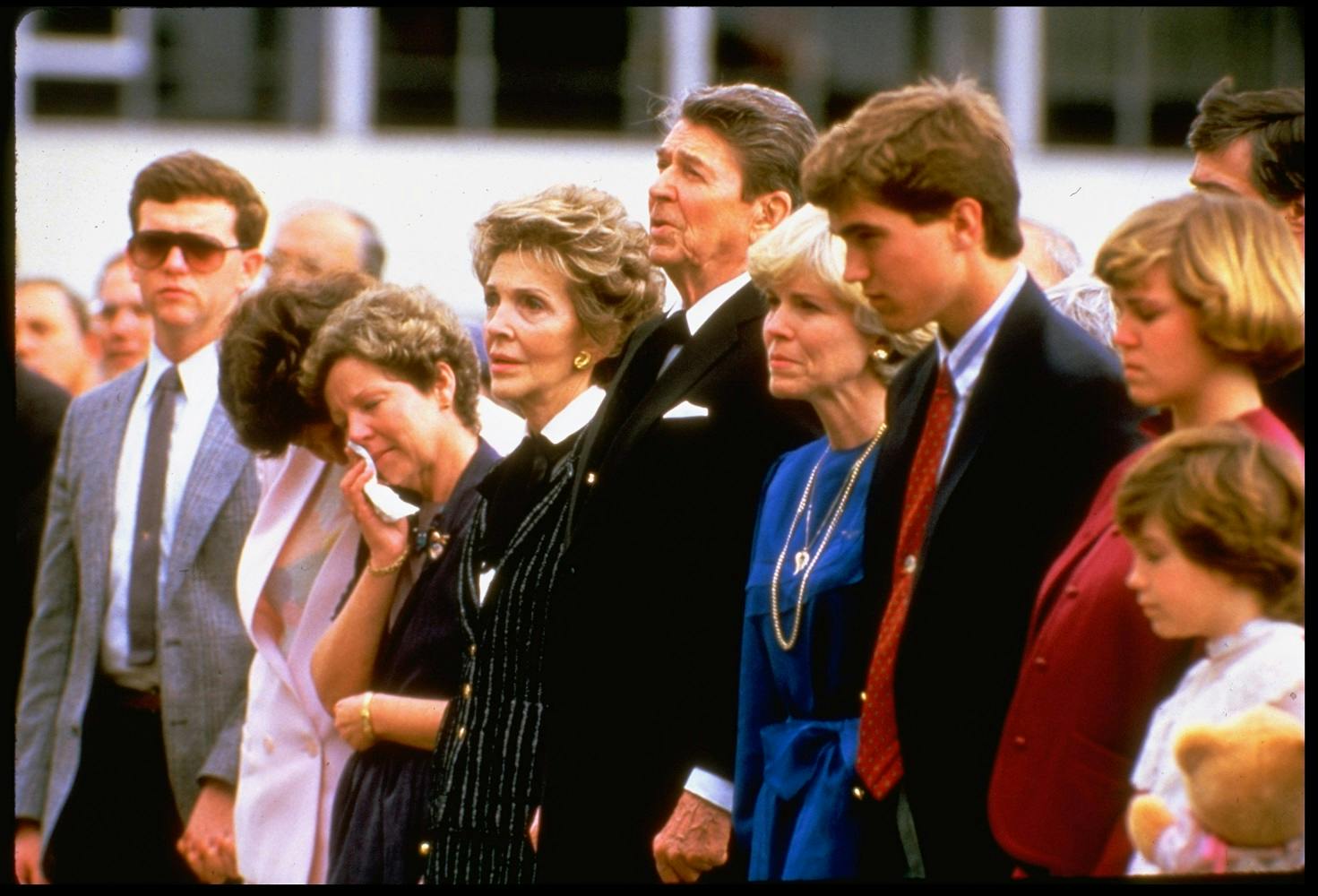
Diana Walker. President Reagan and Nancy Reagan at the Challenger memorial service at the Johnson Space Center in Houston, June Scobee on Mrs. Reagan’s right, and Jane Smith on the president’s left. January 31, 1986. Diana Walker/Getty Images.
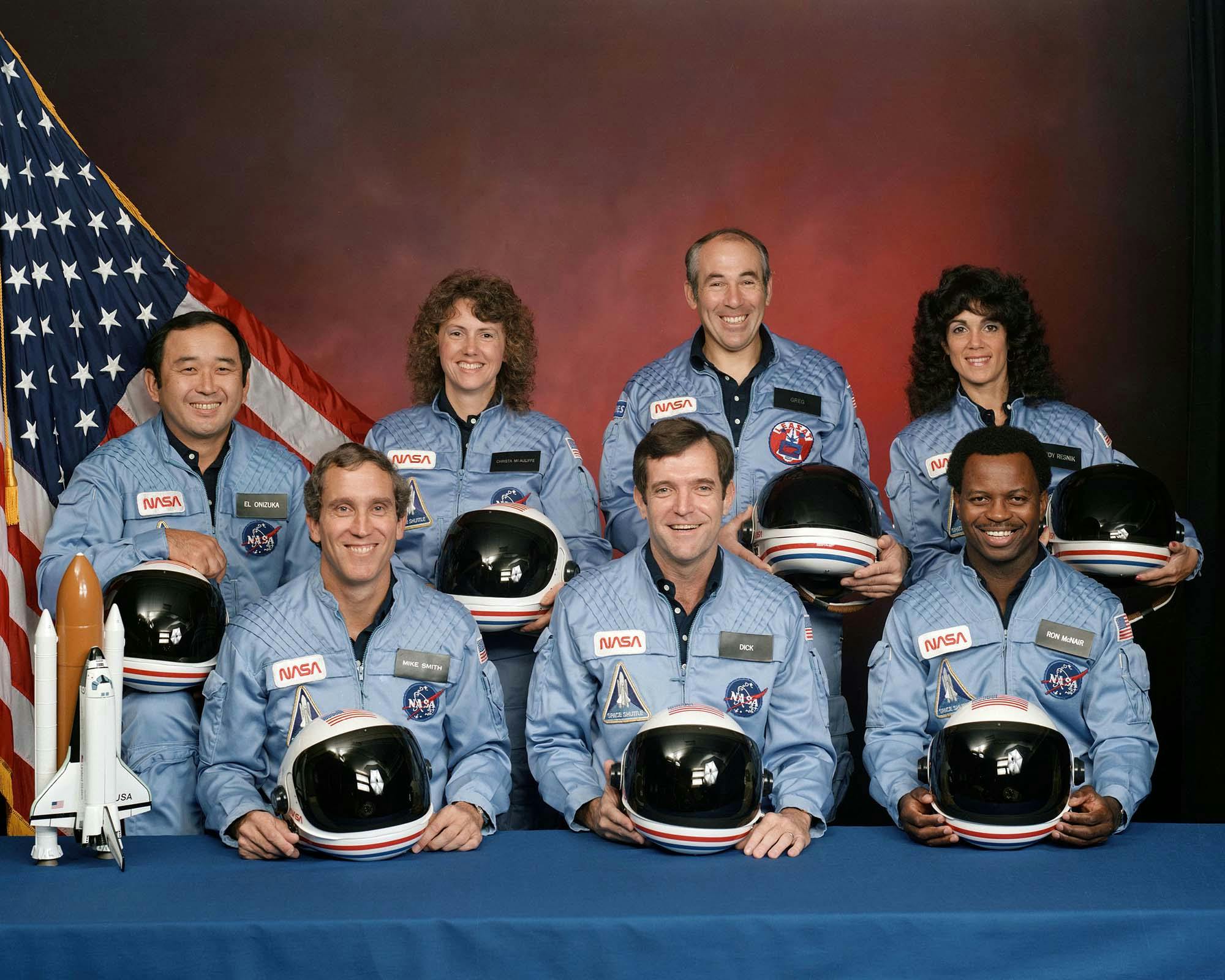
The space shuttle Challenger launched from Cape Canaveral, now called the Kennedy Space Center, in Florida. Because of its predictably good weather conditions, it is the main launch site for most of the NASA (National Aeronautics and Space Administration) space program. But the Manned Spacecraft Center, later renamed the Lyndon B. Johnson Spacecraft Center, is located more than a thousand miles to the west, outside Houston, Texas. This is where the Challenger astronauts trained for their flight and where Mission Control was located. At the time of the Challenger, thousands of NASA employees and contractors worked there, and many of the astronauts and their families lived nearby.
On the morning of the launch, many relatives of the astronauts were on the ground at Cape Canaveral to watch the flight take off. They witnessed the explosion. That night, they were flown to Houston on NASA training jets. They were then driven to their homes with police escorts, to grieve in private.
The president remained in Washington until Friday morning, when he flew to the memorial service in Houston. He and Mrs. Reagan stood with families, sang “America the Beautiful” with the thousands gathered, and greeted each of the relatives personally, but the president did not speak. The service was widely covered in the press.
President Reagan’s daily diaries cover the events of the days between the Challenger explosion and the memorial service. On Wednesday, the day after the Challenger disaster, he noted positive responses to his speech and his very difficult phone calls with the families. On Thursday, he mentioned several meetings and a formal dinner but said nothing about the Challenger. On Friday, he described flying to Houston with Mrs. Reagan and the wrenching emotions he felt and witnessed there.
The photo of President and Mrs. Reagan with the families of the Challenger crew was taken during the memorial service. It was held outside, in Houston, with thousands of the NASA community in attendance. Standing next to the president is Jane J. Smith, wife of Pilot Michael J. Smith, with their children, Scott and Alison. Standing next to Mrs. Reagan is June Scobee, wife of Commander Francis R. “Dick” Scobee.
The portrait of the smiling Challenger crew is one of many taken during the lead-up to the launch. It captures the optimism that they and most Americans felt before the takeoff ended in disaster. It later became emblematic both of the lives lost and of the commitment to continuing American space exploration. For a selection that also includes training photographs, ground crew, the launch pad, and reactions to the disaster, click here.
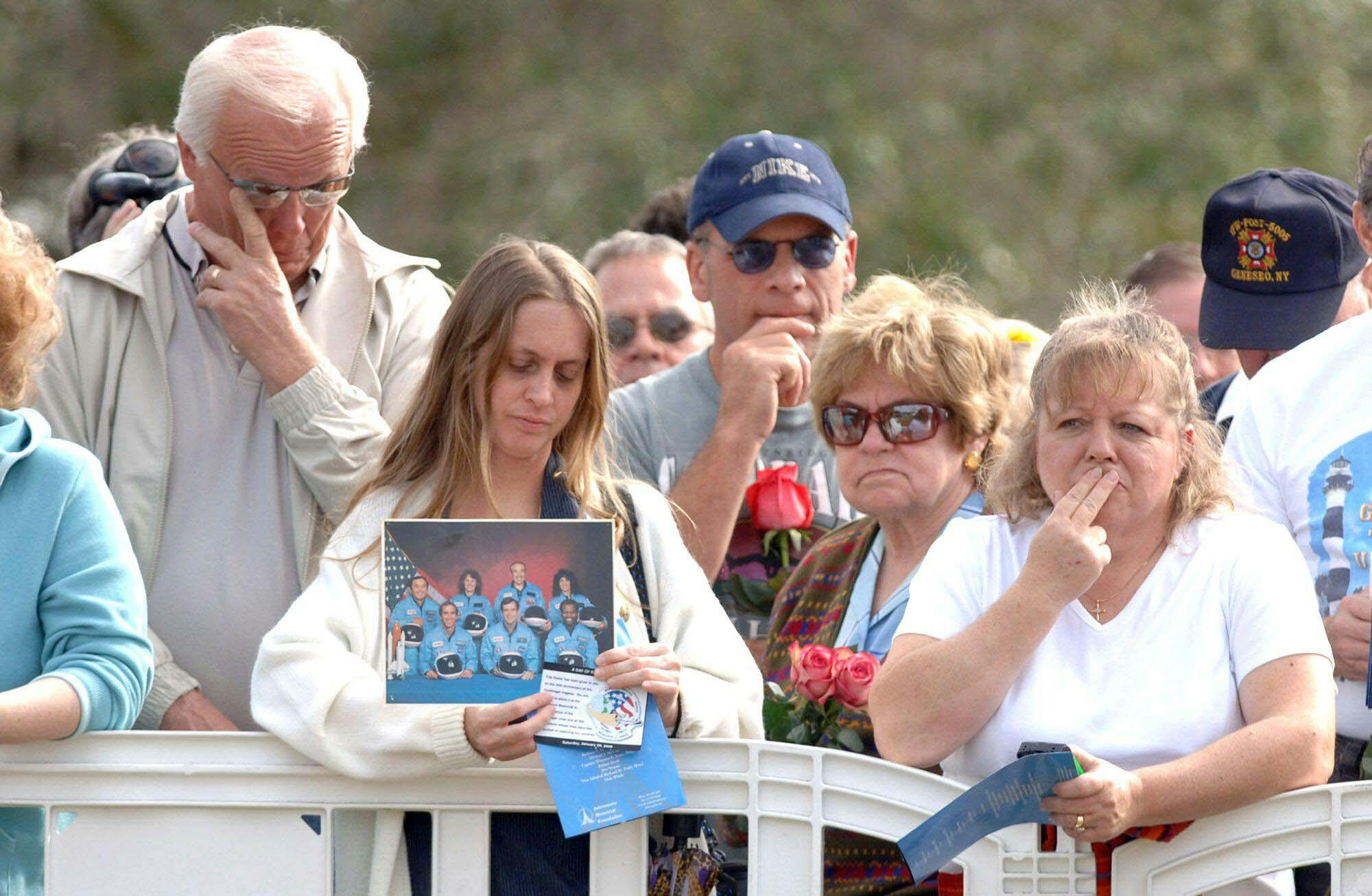
The same portrait of the Challenger crew appears in the 2006 photo of a public memorial at the Kennedy Space Center Visitors Complex on the 20th anniversary of the Challenger accident. The event was held to honor the crew and all astronauts who have sacrificed their lives.
- A.F.1.
Air Force One, any of the several planes specially equipped to transport the president.
- Andrews
Andrews Air Force Base in Maryland, about 15 miles from Washington.
- Camp D.
Camp David, a retreat in rural Maryland where presidents can work or relax.
- heros
A misspelling of heroes.
- wires
Telegrams.
In his diary, how did the president describe the emotions of the day in Houston? How does his description compare to what you see in the photo?
Why was it important for the president to be in Houston? What did his presence communicate to the family, NASA employees, and the American public?
What do Americans need from the president in sudden moments of crisis? What kinds of personal and leadership skills are important?
President Reagan went to Camp David after the memorial service in Houston. President Harry Truman traveled to Florida to rest after his Truman Doctrine speech. Why do you think they did this?
President Reagan faced an earlier disaster when the Marine barracks in Beirut Lebanon was attacked and 16 US Marines were killed in 1983. He went to the ceremony when the remains were returned to the US. He spoke with the family members and wrote about the day in his diary. Compare and contrast the president’s diary entries for this event and the Challenger disaster.
A 2018 survey found that 83 percent of respondents said the president should act as consoler-in-chief in times of tragedy. This is remarkable agreement in a politically polarized time. As a class, discuss what this survey indicates about the power of the presidency and the expectations of the public. As an optional part of this discussion, introduce the ABC News footage of the memorial service in Houston. Section 4:33 to 8:28 shows President and Mrs. Reagan personally greeting each family member, including young children. ABC anchor Peter Jennings comments that more is involved here than the power of the presidency. He cites “the president’s mere presence . . . the gift of warmth.” This footage vividly shows the president in the role of consoler-in-chief, but it is heartbreaking and may be too much for some students. It’s important for you to review it before showing it to your class.
The National Archives has collected documents related to the Challenger here. The collection is 40 pages long, without page numbers. It contains, in the following order, versions and edits of the speech the president delivered on the afternoon of the disaster, a transcript of the president’s press conference, a NASA brochure about the Teacher in Space Project, a press kit, and three letters to President Reagan from people who watched the speech. The final document is a telegram to the president dated January 28, 1986, from a teacher and mother who supports the continuation of the space program. The collection can be used in numerous ways. You could ask students to select one or more documents and describe how it adds to their understanding of the Challenger event. Or you could print out the letters and telegram and ask students to analyze the language for a sense of the reactions to the president’s speech.
Source Notes
Sources consulted for this unit were:
- Atkinson, Nathan S. “Newsreels as Domestic Propaganda: Visual Rhetoric at the Dawn of the Cold War.” Rhetoric and Public Affairs 14, no. 1 (2011): 69–100, http://www.jstor.org/stable/41940524.
- Bostdorff, Denise M. Proclaiming the Truman Doctrine: The Cold War Call to Arms. College Station: Texas A&M University Press, 2008.
- Brands, H.W. The General vs. the President: MacArthur and Truman at the Brink of Nuclear War. New York: Doubleday, 2016.
- Brands, H.W. Reagan: The Life. New York: Doubleday, 2015.
- Brinkley, Douglas, ed. The Reagan Diaries. New York: Harper Collins, 2007.
- Cannon, Lou. Ronald Reagan: The Presidential Portfolio. New York: Public Affairs, 2001.
- Dallek, Robert. Harry S. Truman. New York: Times Books, Henry Holt, 2008.
- Fielding, Raymond. The American Newsreel, 1911-1967. Norman: University of Oklahoma Press, 1972.
- Kernell, Samuel. “The Truman Doctrine Speech: A Case Study of the Dynamics of Presidential Opinion Leadership.” Social Science History, Vol. 1, No. 1, Fall 1976, 2-45, https://www.jstor.org/stable/1170931?read-now=1&seq=1#page_scan_tab_contents.
- McCullough, David. Truman. New York: Simon and Schuster, 1992.
- Noonan, Peggy. The Time of Our Lives. New York: Twelve, an imprint of the Hachette Book Group, 2015.
- “The President and the National Security State During the Cold War,” https://millercenter.org/the-presidency/teacher-resources/recasting-presidential-history/president-and-national-security-state-during-cold-war.
- The Reagan Library, https://www.reaganlibrary.gov.
- “35 Years Ago: Remembering Challenger and Her Crew,” https://www.nasa.gov/feature/35-years-ago-remembering-challenger-and-her-crew.
- The Truman Library, https://www.trumanlibrary.gov/.
- Truman, Margaret, ed. Where the Buck Stops: The Personal and Private Writings of Harry S. Truman. New York: Warner Books, 1989.
Credits
Writer:
Marjorie Waters
Project Director:
Mia Nagawiecki
Leslie Hayes
Project Manager:
Lee Boomer
Project Historian:
Meena Bose
Special Thanks:
Carol Barkin, Copy Editor
Use All 5, Website Developer
Dayna Bealy, Rights Clearance Specialist